CSEIT1831125 | Received : 01 Feb 2018 | Accepted : 11 Feb 2018 | January-February-2018 [(3) 1 : 918-920 ]
International Journal of Scientific Research in Computer Science, Engineering and Information Technology © 2018 IJSRCSEIT | Volume 3 | Issue 1 | ISSN : 2456-3307
918
An Enhanced Optimization Technique for Scheduling In Cloud
Based Applications
S. Saranya Devi 1, G. Muthulakshmi 2
PG Scholar, Department of CSE, Anna University Regional Campus Coimbatore, Tamilnadu, India
ABSTRACT
Cloud offers more services which is a good choice for high resource demanding. In the complex and oversized network, the utilization of the available computation resources like processor, storage, data and services and so on around the world in commercialized manner is possible with the help of cloud computing. But the scarcity of resources requires the effective scheduling algorithm to schedule the task in effective manner by reducing cost of execution and achieve resource utilization effectively. Many scheduling mechanisms have been developed by researchers such as Cost and Energy Aware Scheduling, Cloud Based Workflow Scheduling, Multi Objective Scheduling Method Based on Ant Colony Optimization, etc. Fuzzy based optimization has proposed which makes the scheduling decision by evaluating entire group of task in job queue manner. The simulation result shows cost of execution and resource utilization are independent of each other which are executed separately by different algorithm.
Keywords: Cloud Computing, Scheduling Algorithms, Resource Utilization, Cost of Execution, jfuzzy.
I.
INTRODUCTION
In Cloud Computing, applications are provided and managed by cloud server and data is also stored remotely in the cloud configuration. Users do not install or download the application on their own device or computer. All processing and storage is maintain by cloud server. Cloud computing is composed of five essential characteristics, three service models and deployment models. The service models are Software as a service (SaaS), Platform as a Service (PaaS) and Infrastructure as a Service (IaaS). Scheduling is the determination of when something is to be done the task and activities required to do it. Main objective of scheduling in cloud computing environment is to utilize resource properly while managing load between resource so that execution time reduced and increase the efficiency of the workload of cloud computing.
Fuzzy logic: The proposed fuzzy controller uses fuzzy logic introduced by Zadeh in 1965. Fuzzy Logic has no strict assignment of elements to sets like binary logic. Instead, every elements has a degree of membership to a set. This degree is represented by a value between 0 and 1. To be able to apply Fuzzy Logic to a specific problem such as the scheduling between cloudlets or virtual machines, a fuzzy system must be constructed. The construction consists of three steps:
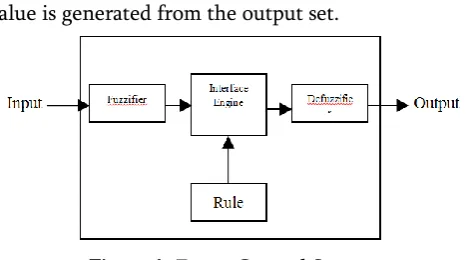
Fuzzyfication: In this step, the degree of membership of the input values is assigned to Fuzzy sets. The degree of membership is given by μ:X→ [0, 1], where X is the set of input values. So every input value is mapped to a value between zero and one.
De-Fuzzyfication: In this step, a numerical output value is generated from the output set.
Figure 1. Fuzzy Control System
The difference between these logics is that Fuzzy set theory provides a form to represent uncertainties; that is, it accepts conditions partially true or partially false. Fuzzy Logic is a good logic to treat random uncertainty, i.e., when the prediction of a sequence of events is not possible. A Fuzzy Control System is a rule-based system, which a set of so-called Fuzzy rules represents a control decision mechanism to adjust the effects of certain causes coming from the system. The aim of the Fuzzy Control System is normally to substitute for or replace a skilled human operator with a Fuzzy rule based system. Specifically, based on the current state of a network an inference engine equipped with a Fuzzy rule base determines an online decision to adjust the system behavior in order to guarantee that it is optimal in some certain senses. The first step in Fuzzy Control is to define the input variables and the control variables. Each variable must be quantified. Then each quantification of the variable is assigned a membership function. Then a Fuzzy rule base must be design, this rule base determines what control action take place under what input conditions. The rules are written in an if-then format. An implication formula is used to evaluate the individual if-then rules in the rule base. A composition rule is used to aggregate the rule results to yield a Fuzzy output set.
Fuzzy Inference System: Fuzzy set theory is a suitable system for modeling uncertainty arising from mental phenomena, which are neither random nor stochastic. In this paper, we use Fuzzy Inference System (FIS) to evaluate the cloud computing user’s
satisfaction. A Fuzzy Inference System is a rule based system with concepts and operations associated with Fuzzy set theory and Fuzzy Logic. This system is a rule based system which is mapping input spaces to output spaces. Therefore, they allow constructing structures to be used to generate responses (outputs) by certain simulations (inputs) based on the stored knowledge of how the responses and simulations are related. The knowledge is stored in the form of a rule base, that is, a set of rules that express the relation between inputs of a system and expected outputs. A “membership function” is a curve that defines how the value of Fuzzy variable is mapped in a degree of membership between 0-1. To evaluate Cloud Computing user’s satisfaction three steps have been done. In step one, membership functions are used to calculate the degree of Fuzzy user’s satisfaction in different values expressed by linguistic term such as low, low to medium, medium, medium to high and high . If-Then expression is the most common way for representing human knowledge. This form generally is referred to as deductive form. It means that if we accept on a fact (premise, hypothesis, antecedent), then we can infer another fact called conclusion (consequent). The Fuzzy Inference System is a popular way for wide range of science and engineering. In step two, for making rules the verbal options of experts regarding the effects of different factors such as security, efficiency and performance, adaptability and cost are gathered and processed for generating a rule base and using them as inputs of our Fuzzy Inference System.
are proposed for the huge data store and highly parallel computing needs, such as Google MapReduce. Hadoop Map Reduce running on top of Hadoop Distributed File System (HDFS) is inspired slots to execute map or reduce tasks. These tasks are parallel processed on the nodes of the cluster by the policy which strives to keep the work as close to the data as possible. Task scheduling problems are of paramount importance, which relate to the efficiency of the whole cloud computing facilities. The scheduling algorithms in distributed systems usually have the goals of spreading the load on processors and maximizing their utilization while minimizing the total task execution time. Task scheduling, one of the most famous combinatorial optimization problems, plays a key role to improve flexible and reliable systems. The main Purpose is to schedule tasks to the adaptable resources in accordance with adaptable time, which involves finding out a proper sequence in which tasks can be executed under transaction logic constraints. Based on the system information used by the scheduling approaches, there are two main categories, namely static and dynamic. Both have their own limitations. Usually dynamic load-balancing mechanism has better performance in comparison to static one, but has higher overhead since the schedule need to be determined dynamically and system information should be updated on the fly.
Disadvantages of Existing System
Resources mapping requires high Computing power preference.
Its require updating on System information. Dynamic load balance has higher overhead
compare to static load balance.
Certain optimization problems (they are called variant problems) cannot be solved by means of genetic algorithms.
Problem definition: In any environment, the availability of resources is finite. So effective utilization of resources is very important for the fulfillments of requirements of human beings. Thus effective usage comes into picture. To achieve required the optimal mechanism for effective management of the available resources in a scalable environment. In order to do this, choosing of scheduling algorithm is important. The right way of choosing an algorithm for Application execution is a major task in today’s world requirement of utilizing available computational resources. The scheduling techniques should selected in such a way that the various user demands are satisfied. An optimization algorithm based on Fuzzy has been proposed to optimize scheduling decisions.
II.
MATERIAL AND METHODS
Proposed system: The System is designed based on these components of fuzzifier, de-fuzzier and FSI. According to rules set to arrive a solution which is optimal to the availability of the computational resources in the system.
Advantages of proposed system: In real-time, taking right decision is not a simple task as people consider. Because uncertainties are part of the current world. To avoid such problem , we are going to use jfuzzy logic. This would handle the situation based on the current availability of input parameters. It has the following features which have advantage over the previous existing system:
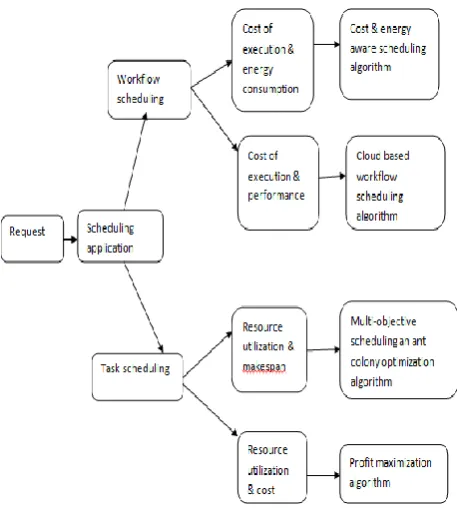
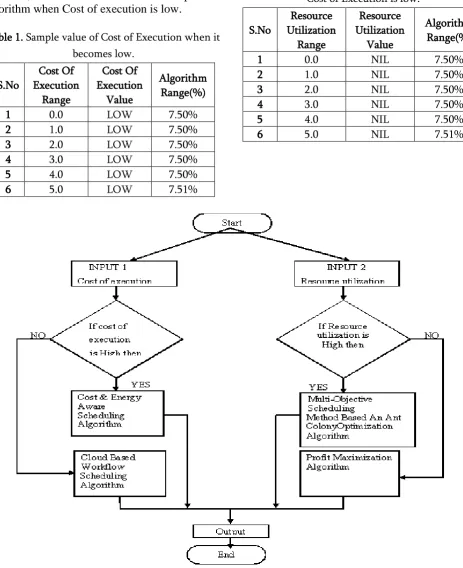
System architecture: The System architecture is shown below shows the entire process of system design(Fig.2). The choosing of algorithm for scheduling has been decided based on the input and output requirements of the jFuzzy Logic system. The system flow diagram clearly explains the entire system of working principle of choosing of right algorithm based on the given input variables like cost of execution and resource utilization(Fig.3). As explained earlier the IF-ELSE framework is being used to decide what kind of algorithm has to be opted from the given four algorithm based on the rule sets .Based on the variables along with the jFuzzy rules set the right decision is taken to choose the algorithm for scheduling.
III.
RESULT AND DISCUSSION
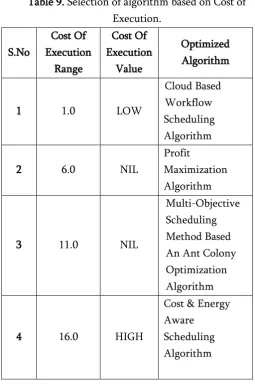
The empirical results show that what kind of outputs are being generated when the input variables are set out by the member function. As a result when the cost of execution and resource utilization is low, the Cloud Based Workflow Scheduling Algorithm and Profit Maximization Algorithm are being chosen respectively. If cost of execution and resource utilization are high then the other two algorithms Multi-Objective Scheduling Method Based an Ant Colony Optimization Algorithm and Cost & Energy Aware Scheduling Algorithm are chosen in a respective ways. The outputs for these algorithms are shown on appendix in Figure 6 and 7 respectively.
Figure 4. Sample output when resource utilization is low
Figure 5. Sample output when cost of execution is high.
Figure 6. Sample output when cost of execution is low
Figure 7. Sample output when resource utilization is high
Table 1 and 2 shows the sample values of Cost of
execution, Resource Utilization and optimized
Algorithm when Cost of execution is low.
Table 1. Sample value of Cost of Execution when it becomes low.
S.No
Cost Of Execution
Range
Cost Of Execution
Value
Algorithm Range(%)
1 0.0 LOW 7.50%
2 1.0 LOW 7.50%
3 2.0 LOW 7.50%
4 3.0 LOW 7.50%
5 4.0 LOW 7.50%
6 5.0 LOW 7.51%
Table 2. Sample value of Resource Utilization when Cost of Execution is low.
S.No
Resource Utilization
Range
Resource Utilization
Value
Algorithm Range(%)
1 0.0 NIL 7.50%
2 1.0 NIL 7.50%
3 2.0 NIL 7.50%
4 3.0 NIL 7.50%
5 4.0 NIL 7.50%
6 5.0 NIL 7.51%
Figure 3. system flow diagram with fuzzy architecture
Table 3. Sample value of Cost of Execution when it becomes High.
Table 4. Sample value of Resource utilization when Cost of Execution is High.
S.No execution, Resource Utilization and optimized Algorithm when Resource Utilization is low.
Table 5 and 6 shows the sample values of Cost of execution, Resource Utilization and optimized Algorithm when Resource Utilization is low.
Table 5. Sample value of Cost of Execution when Resource Utilization is Low.
S.NO
Table 6. Sample value of Resource Utilization when it becomes Low. Cost of execution, Resource Utilization and optimized Algorithm when Resource Utilization is high.
Table 7. Sample value of Cost of Execution when Resource Utilization is High.
Table 8. Sample value of Resource Utilization when it
Table 9. Selection of algorithm based on Cost of Execution.
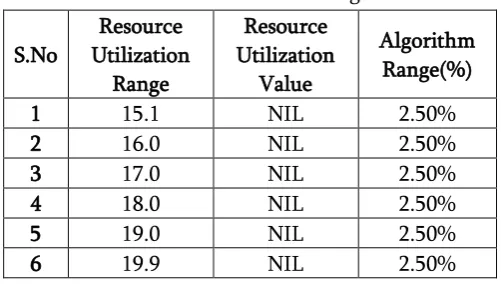
Table 10. Selection of algorithm based on Resource Utilization.
Cost & Energy Aware Scheduling Algorithm
IV.
CONCLUSION AND FUTURE WORK
V.
REFERENCES
[1].Zhongjin Li, Jidong Ge, Haiyang Hu, Wei Song, Hao Hu, and Bin Luo" Cost and Energy Aware Scheduling Algorithm for Scientific Workflow with Deadline Constraint in Clouds" in IEEE Transactions on Services Computing, Vol. 1, no.99 , PP.1-1, Sept. 25, 2015.
[2].LiyunZuo, Lei Shu, ShoubinDongy, Yuanfang Chen, Li Yan Guangdong, "A Multi-objective Hybrid Cloud Resource Scheduling Method Based on Deadline and Cost Constraints" in IEEE Access,Vol.1, no. 99, pp 1-1,Dec. 30, 2016.
[3].Haitao Yuan, Jing Bi, Wei Tan,and Bo Hu Li" Temporal Task Scheduling With Constrained Service Delay for Profit Maximization in Hybrid Clouds" IEEE Transactions on Automation Science and Engineering, vol. 14, no. 1, pp. 337-348, Jan. 2017.
[4]."Types of scheduling", https://www.go4expert.com/articles/types-of- scheduling-t22307/.
[5].Bonissone P.P, "Fuzzy logic controllers: An industrial reality," In Computational Intelligence: Imitating Life, IEEE Press, 316-327 (1994).