A Comparison of MT Errors and ESL Errors
Homa B. Hashemi, Rebecca Hwa
Intelligent Systems Program, Computer Science Department University of Pittsburgh
Pittsburgh, PA 15260 USA [email protected], [email protected]
Abstract
Generating fluent and grammatical sentences is a major goal for both Machine Translation (MT) and second-language Grammar Error Correction (GEC), but there have not been a lot of cross-fertilization between the two research communities. Arguably, an automatic translate-to-English system might be seen as an English as a Second Language (ESL) writer whose native language is the source language. This paper investigates whether research findings from the GEC community may help with characterizing MT error analysis. We describe a method for the automatic classification of MT errors according to English as a Second Language (ESL) error categories and conduct a large comparison experiment that includes both high-performing and low-performing translate-to-English MT systems for several source languages. Comparing the distribution of MT error types for all the systems suggests that MT systems have fairly similar distributions regardless of their source languages, and the high-performing MT systems have error distributions that are more similar to those of the low-performing MT systems than to those of ESL learners with the same L1.
Keywords:Error Analysis, Machine Translation, English as a Second Language
1.
Introduction
Performing error analysis of machine translation output is an important but challenging task. Because there is no unique “gold standard” translation for any text, it is diffi-cult to define in-depth evaluation measures. Existing au-tomatic metrics such as BLEU (Papineni et al., 2002) and Meteor (Denkowski and Lavie, 2011) primarily provide a single-value evaluation of the quality of the translation but the task of improving a translation system needs more de-tailed information about identifying source of errors in a given system. On the other end of the spectrum, manual evaluation provides most reliable error analysis, but it is time-consuming and costly. Even in this case, we still need to come up with standards and guidelines for characterizing the error types.
This paper investigates whether research findings from the Grammar Error Correction (GEC) community may help with characterizing MT error analysis. GEC is concerned with the automatic detection of common grammar mistakes made by students while learning a language that is not their native tongue (e.g., English as a Second Language (ESL)). Arguably, an automatic translate-to-English system might be seen as a non-native English writer whose native lan-guage is the source lanlan-guage. The intuition is that since MT systems and non-native speakers of English both do not have a perfect model of fluent English, they may carry over some linguistic properties of the source language that do not hold in English.
Previous work have shown that learners with the same na-tive language (i.e., the same L1) tend to make similar types of mistakes when they learn English (Wong and Dras, 2009; Leacock et al., 2010; Wong and Dras, 2011; Dahlmeier and Ng, 2011; Rozovskaya and Roth, 2011). One of the goals of this paper is to determine whether MT systems of a source language make mistakes in ways that are similar to ESL learners of the same L1. If this is true, then MT models
might be improved by addressing those regular, predictable error patterns for a given source language. A second goal of this paper is to determine the frequency with which MT errors fall into one of the ESL categories. If certain ESL error types are common for MT errors, then GEC methods might be applied to correct them.
In this paper, we first describe a method for the automatic classification of MT errors according to ESL error cate-gories developed by Rozovskaya and Roth (2010). We val-idate the performance of the automatic method empirically. Next, we conduct a large comparison experiment that in-cludes both high-performing and low-performing translate-to-English MT systems for several source languages. Com-paring the distribution of MT error types for all the systems, we find that, unlike human ESL learners, the MT systems in our experiment do not seem to be very sensitive to the source languages; their error distribution patterns are rela-tively similar to each other and not very similar to the ESL learners. With respect to the second goal, we observe that a non-negligible portion of the MT errors do fall into some ESL error categories, even though translation word choice errors are still the majority.
2.
Automatic MT Error Analysis
In an earlier work, Rozovskaya and Roth (2010) compared common grammar errors made by ESL students with differ-ent L1. In this paper, we follow their categories, described in Table 1. However, while the ESL student writing sample is small enough for manual annotation, we want to perform MT error analysis on a large sample of translation outputs, so manual analysis is not practical. Therefore, we need to develop a method to automatically identify and extract translation mistakes.
Error type Description Example
Article error Errors involving an article “. . . to focus on [the/None] football as a whole.”
Preposition error Errors involving a preposition “. . . [to/for] outpatient treatment.”
Noun number Confusion between plural/singular noun “. . . where [the families/family] and friends . . . ”
Verb form Verb tense or verb inflection errors “. . . the European commission [warns/having warned] against . . . ”
Word form Same stem with wrong suffix “. . . where [the tax/taxation] is particularly favorable.”
Word choice: insertion, deletion or replacement
Other errors that cannot be categorized
into the above categories “He also promised to [resolve/solve] the bohemians case.”
Table 1: ESL error types used in Rozovskaya and Roth (2010) for annotation and in this study for automatic error classi-fication. The examples are the MT output sentences and the parts that are different from reference sentences are located inside brackets. The delimiters separate the MT system and reference sentence choice of words.
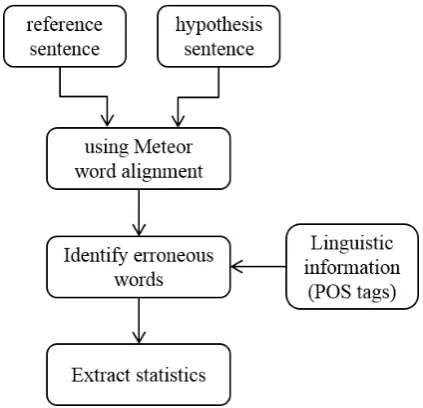
Figure 1: General procedure for automatic error analysis based on the Meteor word alignment and POS tags.
to identify all erroneous words and then use their part-of-speech (POS) taggings to categorize errors.
For establishing the alignments between hypotheses and reference sentences, we use Meteor (Denkowski and Lavie, 2011) word alignment, which has a multistage process based on exact, stem, lexical synonym, and paraphrase matches between words and phrases.
Based on the alignments, we classify different types of translation errors using the following procedure:
• Unaligned reference words are marked as missing. They are further classified into missing article, prepo-sition, punctuation and content word using POS tags.
• Unaligned hypothesis words are marked as inserted words and classified based on their POS tags into extra article, preposition, punctuation and content word.
• Aligned words with different surface form and POS tags are marked as word form, verb form, noun num-ber and word replacement errors.
In order to detect article confusion and preposition replace-ment errors, when two words are exactly aligned, their pre-vious words are compared, if they were two different arti-cles or prepositions, they would be marked as article confu-sion or proposition replacement errors. Also, if they were
marked previously, the old marks would be deleted. An example of a reference sentence and hypothesis sentence along with the corresponding word alignments is shown in Figure 2.
3.
Experiments
We conduct two experiments. In the first experiment, we evaluate the quality of the proposed automatic error extrac-tion method by comparing its outputs against a small set of manually constructed gold standard. In the second exper-iment, we apply the automatic error extractor over a large sample of MT outputs to build distributions of error types for MT systems under different conditions. We compare these error distributions with the error distribution patterns of ESL learners reported by Rozovskaya and Roth (2010). 3.1. Data
Our experiments are conducted using the reference sen-tences and system output submissions to WMT121 shared tasks. The WMT12 reference data consists of 3003 sen-tences which are used in our automatic error analysis approach. To control for the variation of source lan-guages and the quality of the MT systems, our experi-ment compares a total of eight systems: a high-performance and a low-performance system for each of the follow-ing language pairs: German-to-English, Czech-to-English, Spanish-to-English and French-to-English (Callison-Burch et al., 2012).
3.2. Verification of Automatic Error Extraction
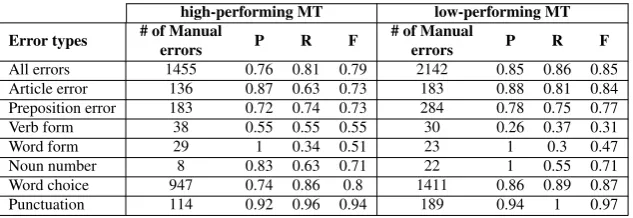
We manually annotated a subset of the translation outputs so that the automatically flagged errors can be verified. In this set of manual annotation, we limit the scope of project and annotate mistakes of the reported highest-performing and lowest-performing MT systems of WMT12 German-English shared task. We randomly picked 100 reference sentences and then select their corresponding translation outputs from high and low-performing systems. So, we manually annotated totally 200 sentences according to the ESL taxonomy (see Table 1) and compare the performance of our method in the form of precision and recall based on the number of correct detected errors.
Table 2 presents the individual precision, recall and F-scores for each error type. It can be seen that in compar-ison to human annotator, the automated method has an ac-ceptable precision and recall rate for most categories. The
1
Figure 2: Meteor’s (v. 1.4) multi-stage alignment using exact match (solid line), synonym match (dashed line), word form match (dotted line) and paraphrase (solid outline). Missing words in reference sentence (strikethrough) and inserted words at hypothesis (underlined).
high-performing MT low-performing MT
Error types # of Manual
errors P R F
# of Manual
errors P R F
All errors 1455 0.76 0.81 0.79 2142 0.85 0.86 0.85
Article error 136 0.87 0.63 0.73 183 0.88 0.81 0.84
Preposition error 183 0.72 0.74 0.73 284 0.78 0.75 0.77
Verb form 38 0.55 0.55 0.55 30 0.26 0.37 0.31
Word form 29 1 0.34 0.51 23 1 0.3 0.47
Noun number 8 0.83 0.63 0.71 22 1 0.55 0.71
Word choice 947 0.74 0.86 0.8 1411 0.86 0.89 0.87
Punctuation 114 0.92 0.96 0.94 189 0.94 1 0.97
Table 2: Evaluation results of our automatic error analysis method: precision(P), recall(R) and F-score(F) of each ESL error type based on the manual annotated errors.
overall F-scores range between 79-85%. Although the au-tomatic extraction method is not perfect, we believe that it is sufficient for performing comparative error analysis. Moreover, the automatic method allows us to collect many more instances than manual error analysis so that trends may be observed on a larger scale.
3.3. Automatically Extracted Errors
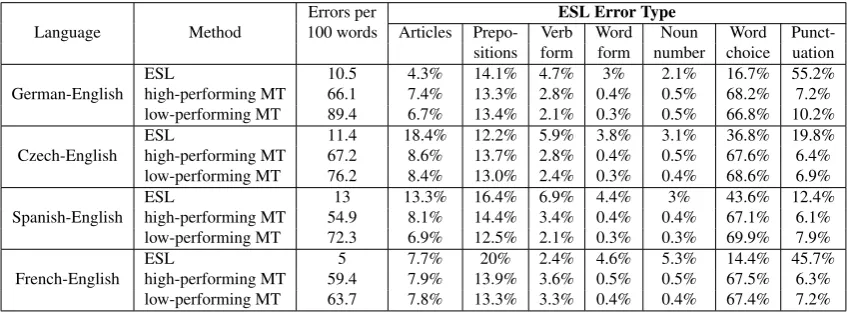
In this experiment, we have applied the automatic error analysis approach described in Section 2. over the outputs of a high-performance and a low-performance MT system for four language pairs. Table 3 summarizes the results. As a point of comparison, we also display the error distribu-tions of ESL learners as reported by Rozovskaya and Roth (2010).2 A limitation of this comparison study is that the corpus of corrected ESL writings is quite different from the MT dataset; It is a short collection of 200-300 sentences of student essays (per L1). The ESL student mistakes are manually corrected, and in some cases, multiple alterna-tives are given; in contrast, the MT errors are automatically detected, so mismatches with the references are typically considered an error. Despite these data differences, by ex-amining the distributions of the error types, we might make some qualitative comparisons. To calibrate the quality of each system’s performance across different corpora, we re-port the the number of errors made per 100 words.
The objectives of this experiment are to determine to what extent is there a relationship between MT systems and ESL learners. Our two hypotheses are:
• The types of errors made by MT systems are depen-dent on the source language, just as ESL learners’ er-rors are impacted by their L1.
• The distribution of error types for high-performing MT systems may be more similar to that of the ESL
2For the ESL errors, we excludedspellingandword order
er-rors and renormalized the distribution with the remaining erer-rors.
students than to low-performing MT systems.
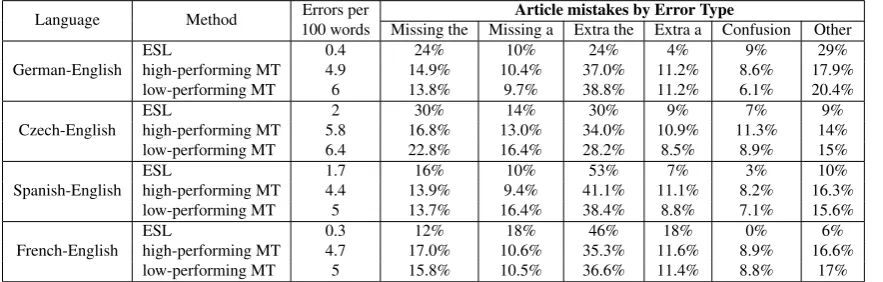
Comparing the error distributions of the eight MT sys-tems, we observe that all eight MT systems have fairly similar distributions regardless of their source languages. Moreover, the four high-performing MT systems have er-ror distribution that are more similar to those of the low-performing MT systems than to those of ESL learners with the same L1. Thus, the results suggest that our two hy-potheses do not hold. However, it is also not the case that the source language has no impact on the performance of the systems. For example, consider the German-English case. Comparing to other ESL students, German students make a significant amount of punctuation mistakes (51%). In a more subdued fashion, the low-performing German-English MT system makes more punctuation errors than the high-performing system. In contrast, for the other lan-guages the low and high-performing machine translation systems make similar proportions of punctuation mistakes. There are two possible explanations for why the error dis-tribution patterns of MT systems behaved differently than what we hypothesized. One is that the MT systems have largely the same underlying model – they are statistical phrase-based systems. They use the same English language model; therefore, they have similar preferences in terms of the fluency of the output sentences. Another possibility is that because MT systems are still struggling with word choice decisions, which is an adequacy problem, their dis-tribution of errors is skewed by the highword choiceerrors, which are mostly due to unaligned words in the reference and MT output sentences. In contrast, the focus of the ESL error categories is on fluency problems only. To factor out the impact ofword choiceerror, we examine article errors in greater detail.
3.3.1. Statistics on Article Errors
Language Method Errors per Article mistakes by Error Type
100 words Missing the Missing a Extra the Extra a Confusion Other
German-English
ESL 0.4 24% 10% 24% 4% 9% 29%
high-performing MT 4.9 14.9% 10.4% 37.0% 11.2% 8.6% 17.9%
low-performing MT 6 13.8% 9.7% 38.8% 11.2% 6.1% 20.4%
Czech-English
ESL 2 30% 14% 30% 9% 7% 9%
high-performing MT 5.8 16.8% 13.0% 34.0% 10.9% 11.3% 14%
low-performing MT 6.4 22.8% 16.4% 28.2% 8.5% 8.9% 15%
Spanish-English
ESL 1.7 16% 10% 53% 7% 3% 10%
high-performing MT 4.4 13.9% 9.4% 41.1% 11.1% 8.2% 16.3%
low-performing MT 5 13.7% 16.4% 38.4% 8.8% 7.1% 15.6%
French-English
ESL 0.3 12% 18% 46% 18% 0% 6%
high-performing MT 4.7 17.0% 10.6% 35.3% 11.6% 8.9% 16.6%
low-performing MT 5 15.8% 10.5% 36.6% 11.4% 8.8% 17%
Table 4: Distribution of article mistakes by error type, source language and MT system. Confusionerror type refers to confusing articlesaandthe.Otherdenotes confusing articles with demonstrative and possessive pronouns.
Alla Rozovskaya and Dan Roth. 2010. Annotating ESL errors: Challenges and rewards. In Proceedings of the NAACL HLT Fifth Workshop on Innovative Use of NLP for Building Educational Applications, pages 28–36. Alla Rozovskaya and Dan Roth. 2011. Algorithm selection
and model adaptation for ESL correction tasks.Urbana, 51:61801.
Joel R Tetreault and Martin Chodorow. 2008. Native judg-ments of non-native usage: Experijudg-ments in preposition error detection. InProceedings of the Workshop on Hu-man Judgements in Computational Linguistics, pages 24–32.
Sze-Meng Jojo Wong and Mark Dras. 2009. Contrastive analysis and native language identification. In Proceed-ings of the Australasian Language Technology Associa-tion Workshop, pages 53–61.