NASTIA: Negotiating Appointment Setting Interface
Layla El Asri
1,2, R´emi Lemonnier
1, Romain Laroche
1, Olivier Pietquin
3, Hatim Khouzaimi
1,41Orange Labs / Issy-les-Moulineaux, France 2UMI 2958 GeorgiaTech-CNRS / Metz, France
3University Lille 1, LIFL (UMR 8022 CNRS/Lille 1) - SequeL team / Lille, France 4Laboratoire d’Informatique d’Avignon-CERI / Avignon, France
{layla.elasri,romain.laroche,hatim.khouzaimi}@orange.com [email protected] [email protected]
Abstract
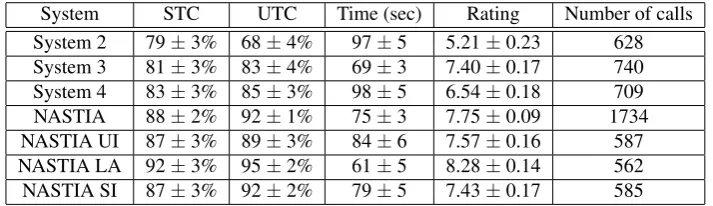
This paper describes a French Spoken Dialogue System (SDS) named NASTIA (Negotiating Appointment SeTting InterfAce). Appointment scheduling is a hybrid task halfway between slot-filling and negotiation. NASTIA implements three different negotiation strategies. These strategies were tested on 1734 dialogues with 385 users who interacted at most 5 times with the SDS and gave a rating on a scale of 1 to 10 for each dialogue. Previous appointment scheduling systems were evaluated with the same experimental protocol. NASTIA is different from these systems in that it can adapt its strategy during the dialogue. The highest system task completion rate with these systems was 81% whereas NASTIA had an 88% average and its best performing strategy even reached 92%. This strategy also significantly outperformed previous systems in terms of overall user rating with an average of 8.28 against 7.40. The experiment also enabled highlighting global recommendations for building spoken dialogue systems.
Keywords:Spoken Dialogue Systems, Reinforcement Learning, Evaluation
1.
Introduction
NASTIA (Negotiating Appointment SeTting InterfAce) is a French Spoken Dialogue System (SDS). Its task is to sched-ule an appointment with a user who needs the intervention of an engineer on site. This SDS pursues the research on the appointment scheduling task, started by Lacson (2004) and continued during the CLASSiC EU FP7 project1 (Laroche et al., 2011). Appointment scheduling is both a slot-filling and a negotiation task. NASTIA’s contribution to it lays in the fact that it is able to adapt its negotiation strategy ac-cording to dialogue progress. This adaptation is made with Reinforcement Learning (RL) (Sutton and Barto, 1998), which was shown to be suited to negotiating SDS (Heeman, 2009; Georgila and Traum, 2011). NASTIA can choose between three negotiation strategies, more or less conserva-tive, depending on the course of the dialogue. Other choices such as confirmation strategies are made with RL.
An RL-based dialogue manager chooses between different actions depending on its current state, which models the manager’s beliefs about the dialogue (Lemon and Pietquin, 2012). These decisions are based on rewards distributed to the system after each action, or at the end of a dialogue. The manager seeks for the most rewarding sequence of deci-sions. Hand-crafting the state space and the reward function of an SDS raises several issues (Paek, 2006). The reward function defines the task of the system. Following (Walker et al., 1997), the reward here is defined so that the system learns to maximise user satisfaction. Hand-crafting a state space that enables learning to distinguish between different levels of user satisfaction is challenging since it requires se-lecting relevant features and finding an appropriate model to discretise the state space (El Asri et al., 2012).
NASTIA’s development follows a novel approach to set up the RL parameters of an SDS. NASTIA’s dialogue
man-1
Computational Learning in Adaptive Systems for Spoken Conversation, http://www.classic-project.org/
ager is based on an automaton, modelling the dialogue as a sequence of phases. A phase might require one or sev-eral decisions be taken. Dialogue logics is ensured by the automaton-based structure. Therefore, each action can be tried by the system without the dialogue be irreversibly harmed. It is proposed here to collect a set of evaluated dialogues with a random, uniform choice of actions. Each dialogue is a path in the automaton. From this set of paths and the corresponding evaluations, it is possible to infer the relevant features for decision making and a reward function.
Such an evaluation campaign has been carried and this pa-per reports its results. 1734 dialogues were collected with 385 users interacting with the system at most five times (El Asri et al., 2014). After each dialogue, the user filled in an evaluation questionnaire about the dialogue. The evalu-ation protocol was the same as the one set up for the eval-uation of the CLASSiC systems. The conclusion of this evaluation is twofold. First, with a uniformly random be-haviour, NASTIA outperformed all the systems designed during CLASSiC in terms of user satisfaction. This means that all the strategies implemented in the system were rel-evant for the appointment scheduling task. Then, the com-ments left by the testers show a need for RL. Indeed, some users expressed a preference for one particular strategy over the other two and the system could learn to switch between strategies according to user behaviour.
Initiative strategy User Initiative (UI); System Initiative (SI); List of Availabilities (LA) ASR rejections; User inactivity Play a help message; Tell the user their utterance was not understood
Confirmation strategy Explicit confirmation; Implicit confirmation; No confirmation System calendar information Give information; Do not give information
Help message Recall dialogue context; Give the possibility to cancel + Recall dialogue context + Recall available commands;
Give the possibility to cancel + Recall dialogue context
Table 1: Actions of the appointment setting system.
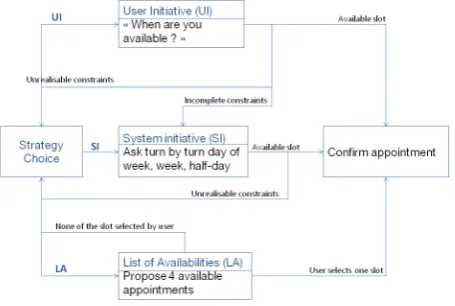
The first point of choice determines the negotiation strat-egy. The User Initiative (UI) strategy consists of asking the user: “When would you like to book an appointment ?”. System Initiative (SI) asks the user which day, which week and which half-day in three different dialogue turns. The order of the questions is decided as for System 4 (see previous section). In addition to these classical strategies, a third option was implemented where the system directly proposes a List of Availabilities (LA) to the user, wait-ing for her/him to interrupt the listwait-ing after an adequate appointment has been proposed. This last option was in-spired by recent work on incremental dialogue management (Schlangen and Skantze, 2011). Incremental dialogue man-agement and barge-in in particular are at the heart of cur-rent research on SDS and more and more complex models can be found in the literature (Selfridge et al., 2013). Inter-ruptions are common in human dialogue (Strombergsson et al., 2013), which makes it much more interactive than turn-taking human/machine conversation. Thus, including in-crementality in a dialogue system is likely to make it more reactive and human-like.
Figure 1 describes the way NASTIA carries a negotiation to set an appointment. The system chooses which strategy to follow at the beginning of each dialogue and after each appointment setting failure. This leaves to NASTIA the op-portunity to adapt its way of realising the task in function of the course of the dialogue as it was proposed for instance by (Chu-Carroll, 2000) and (Litman and Pan, 2002). If the system picks out the LA strategy, four available slots are
Figure 1: NASTIA’s appointment scheduling strategies.
proposed to the user. If the user has not interrupted the sys-tem after the fourth proposition, the syssys-tem asks the user to confirm that none of the slots is suitable and then the ne-gotiation strategy is decided upon again, the system may either keep to this strategy or switch to UI or SI. While the system lists its availabilities, the user can also interrupt the system to propose some constraints. For instance, if the system starts listing slots for a week during which the user is not available, the user has the possibility to interrupt the system and say “next week”. If so, the system switches to SI and asks for the missing slots.
The second point of choice concerns contextual help gener-ation. The user may express a help request at any moment of the dialogue. If so, the system may combine three com-ponents of help messages:
• (a) Tell the user: “You have required the help section” and let them the possibility to answer “no” in case the system misunderstood the user’s request.
• (b) Recall the current context of the dialogue (e.g.
“You were asked when you would like to make an ap-pointment”) and tell the user what they can say (e.g.
“You can answer saying for instancethis Friday after-noon,this week in the morningorMonday the 19th.”)
• (c) Recall the available commands (Repeat and Help)
NASTIA chooses amongst three combinations: (b); (a)+
(b)+(c) or (a)+(b).
pro-System STC UTC Time (sec) Rating Number of calls
System 2 79±3% 68±4% 97±5 5.21±0.23 628
System 3 81±3% 83±4% 69±3 7.40±0.17 740
System 4 83±3% 85±3% 98±5 6.54±0.18 709
NASTIA 88±2% 92±1% 75±3 7.75±0.09 1734
NASTIA UI 87±3% 89±3% 84±6 7.57±0.16 587
NASTIA LA 92±3% 95±2% 61±5 8.28±0.14 562
NASTIA SI 87±3% 92±2% 79±5 7.43±0.17 585
Table 2: Performance comparison between NASTIA and CLASSiC’s systems 2, 3 and 4. STC is System Task Completion and UTC, User Task Completion. Time is measured in seconds. We provide 95% confidence intervals for the mean of the binomial (STC and UTC) and the normal law (Time and Rating).
at first, they were not sure of the date format expected by the system but then they found out the day of week/day of month/half-day format was well understood by the system and enabled to fasten ruling out slots. Thus it seems im-portant to keep the three negotiation strategies as, the more users call this system, the more comfortable they are with UI but the other two strategies are important to keep for less experimented users. The choice of strategy according to current dialogue context should be successfully learnt with reinforcement learning. If a strategy fails, dialogue history and what was observed during previous dialogues should inform NASTIA about what strategy to try next.
This shows that dialogue management requires a finer rep-resentation of the course of the dialogue than the one only relying on points of choice. To make an efficient deci-sion, the system needs to know more then its current point of choice, it must also take into account dialogue history. Therefore, future work will consist of learning a state space representation from user ratings to apply RL and learn an optimal behaviour for the system at each point of choice, according to dialogue history. Another point encouraging the use of reinforcement learning is that, as noticed by Laroche et al. (2011), the overall rating for System 3 is higher than the one for System 4 even though the task com-pletion is higher with System 4. Task comcom-pletion is not the most important parameter to define a successful dialogue according to testers but it might not be the case for real users.
6.
Conclusion
This paper discussed dialogue management for the appoint-ment scheduling task. It described a spoken dialogue sys-tem designed for this task. The Negotiating Appointment Setting Interface (NASTIA) combines three negotiation strategies to perform appointment scheduling. This system was tested on 1734 scenario-based dialogues. This paper reports the results of this study and the general conclusions about dialogue management that were drawn from it. Fu-ture work will consist of applying reinforcement learning to find an optimal way to carry an appointment setting dia-logue, according to user behaviour.
7.
Acknowledgements
The authors would like to thank all the members of the NA-DIA team in Orange for their help during the conception of
the test of the system. The authors would also like to thank
theInnovation primeurteam in Orange for their help with
the experimentation and all the volunteers who interacted with the system. Finally, we also thank the anonymous re-viewers for their valuable comments on the submitted ab-stract.
8.
References
Chu-Carroll, J. (2000). Mimic: An adaptive mixed initiative spo-ken dialogue system for information queries. InProc. of ANLP, pages 97–104.
El Asri, L., Laroche, R., and Pietquin, O. (2012). Reward func-tion learning for dialogue management. InProc. of STAIRS. El Asri, L., Laroche, R., and Pietquin, O. (2014). DINASTI:
Di-alogues with a Negotiating Appointment Setting Interface. In
Proc. of LREC (to be published).
Georgila, K. and Traum, D. (2011). Reinforcement learning of argumentation dialogue policies in negotiation. InProc. of In-terSpeech.
Grice, P., (1989). Studies in the Way of Words, chapter Logic and Conversation. Harvard University Press, Cambridge MA. Heeman, P. (2009). Representing the reinforcement learning state
in a negotiation dialogue. InProc. of ASRU.
Jurˇc´ıˇcek, F., Keizer, S., Mairesse, F., Yu, K., Young, S., Ja-narthanam, S., Hastie, H., Liu, X., and Lemon, O. (2010). D5.4: Proof-of-concept CLASSIC Appointment Scheduling system (”System 2”). Technical report, CLASSIC Project. Lacson, R. (2004). The medical appointment scheduler. InProc.
of MEDINFO.
Laroche, R., Putois, G., Bretier, P., and Bouchon-Meunier, B. (2009). Hybridisation of expertise and reinforcement learning in dialogue systems. InProc. of Interspeech.
Laroche, R., Putois, G., Bretier, P., Aranguren, M., Velkovska, J., Hastie, H., Keizer, S., Yu, K., Jurˇc´ıˇcek, F., Lemon, O., and Young, S. (2011). D6.4: Final evaluation of classic towninfo and appointment scheduling systems. Technical report, CLAS-SIC Project.
Lemon, O. and Pietquin, O., (2012). Data-Driven Methods for Adaptive Spoken Dialogue Systems. Springer.
Litman, D. J. and Pan, S. (2002). Designing and evaluating an adaptive spoken dialogue system. User Modeling and User-Adapted Interaction, 12:111–137.
Meguro, T., Higashinaka, R., Dohsaka, K., Minami, Y., and Isozaki, H. (2009). Analysis of listening-oriented dialogue for building listening agents. InProc. of SIGDIAL.
de-ployment. In Proc. of Interspeech, Dialog-on-Dialog Work-shop.
Schlangen, D. and Skantze, G. (2011). A general, abstract model of incremental dialogue processing. Dialogue and Discourse, 2:83–111.
Selfridge, E., Arizmendi, I., Heeman, P., and Williams, J. D. (2013). Continuously predicting and processing barge-in dur-ing a live spoken dialogue task. InProc. of SIGDIAL. Sondik, E. J. (1971). The optimal control of partially observable
markov processes. Technical report, Stanford Electronics labs. Strombergsson, S., Hjalmarsson, A., Edlund, J., and House, D. (2013). Timing responses to questions in dialogue. InProc. of Interspeech.
Sutton, R. S. and Barto, A. G., (1998). Reinforcement Learning. An introduction. MIT Press.
Walker, M., Hindle, D., Fromer, J., Fabbrizio, G., and Mestel, C. (1997). Evaluating competing agent strategies for a voice e-mail agent. InProc. of EuroSpeech.
Williams, J. D. and Young, S. (2007). Partially observable markov decision processes for spoken dialog systems. Com-puter Speech and Language, 21:231–422.
Appendix A: Evaluation questionnaire
1. Have you booked an appointment?2. Was the appointment booked on one of your available slots?
3. When did you book the appointment?
4. During your dialogue with the system, you knew what to say.
5. You could easily recover from system misunderstand-ings.
6. Understanding the system was easy.
7. The system provided enough information for the dia-logue to be easy to follow.
8. The dialogue with the system was efficient.
9. The dialogue with the system was fluid.
10. The system was concise.
11. Overall evaluation.