Using a sledgehammer to crack a nut?
Lexical diversity and event coreference resolution.
Agata Cybulska, Piek Vossen
VU University Amsterdam De Boelelaan 1105 1081HV Amsterdam
[email protected], [email protected]
Abstract
In this paper we examine the representativeness of the EventCorefBank (ECB) (Bejan and Harabagiu, 2010) with regards to the language population of large-volume streams of news. The ECB corpus is one of the data sets used for evaluation of the task of event coreference resolution. Our analysis shows that the ECB in most cases covers one seminal event per domain, what considerably simplifies event and so language diversity that one comes across in the news. We augmented the corpus with a new corpus component, consisting of 502 texts, describing different instances of event types that were already captured by the 43 topics of the ECB, making it more representative of news articles on the web. The new ”ECB+” corpus is available for further research.
Keywords:events, event coreference, ECB+
1.
Introduction
In the annotation guidelines of the Automatic Content Ex-traction program (ACE), an event is defined as a specific occurrence of something that happens, often a change of state, involving participants (LDC, 2005). In the TimeML specification, events are described as “situations that hap-pen or occur” that can be punctual or durational, as well as stative predicates describing “states or circumstances in which something obtains or holds true” (Pustejovsky et al., 2003).
Expanding the above definitions, in this work we model events from news data as a combination of four compo-nents:
1. an event action component describing what happens or holds true
2. an event time slot anchoring an action in time describ-ing when somethdescrib-ing happens or holds true
3. an event location component specifying where some-thing happens or holds true
4. a participant component that gives the answer to the question: who or what is involved with, undergoes change as a result of or facilitates an event or a state; we divide event participants into human participants and non-human participants.
For example in the sentence:
On Monday Lindsay Lohan checked into rehab in Malibu,
1.action checked into, crash
2.time On Monday
3.location rehab in Malibu, California 4.participant human Linsay Lohan
non-human car
Table 1: Event components.
California after a car crash.
Lindsay Lohan is a human participant involved with the event,caris a non-human participant,On Mondaytells us when the event happened, rehab in Malibu, California is the place where the event happened andchecked intoand crashconstitute actions (viz. TABLE 1).
We make a distinction between mentions (descriptions) of events in text and what they refer to, that is, their denota-tion (e.g. World War II,WWII andSecond World War all refer to a global war between 1939 and 1945). If an event is described more than once in one or in multiple texts, we say that its descriptions arecoreferent. A coreference rela-tion can be established between menrela-tions of acrela-tions, par-ticipants, times and locations. Consider the following sen-tences:
Lindsay Lohan checked into rehab. Ms. Lohan entered a rehab facility.
These two sentences might refer to the same event, al-though as Ms. Lohan has been to rehab multiple times, it may also refer to two different instances. If one can determine based on the context that two event instances refer to the same real world event, they can be considered as coreferent. If not, the actions should not be seen as coreferent. But the human participant descriptions from our example sentences are coreferent either way, as they refer to the same person. The last question is whetherrehab andrehab facilityrefer to the same facility but to answer this one would need some extra context information.
Event coreference resolution is the task of determining whether two event descriptions (event mentions), refer to the same event. It is a difficult task that strongly influences diverse NLP applications. Evaluation of coreference resolution is not straightforward. There is no consensus in the field with regards to evaluation measures used to test approaches to coreference resolution. Some of the commonly used metrics1 are highly dependent on the
1
evaluation data set, with scores rapidly going up or down depending on the number of singleton items in the data (Recasens and Hovy, 2011). Researchers tend to use the same data sets for evaluation of coreference resolution so that results of their work can be compared more easily, in consideration of the limitations of the evaluation metrics.
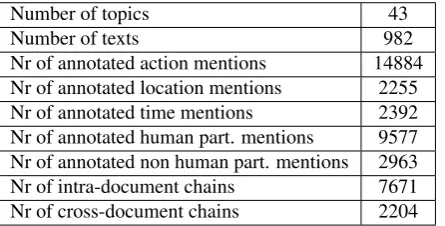
The EventCorefBank (ECB) (Bejan and Harabagiu, 2010) is one of the data sets available for studies of event coreference resolution. The corpus consists of 43 topics (each corresponding to a seminal event), which in total contain 482 texts from GoogleNews archive (http://news.google.com), selectively annotated (amongst other relations) with within- and cross-document event coreference. Events were annotated in accordance with the TimeML specification (Pustejovsky et al., 2003).
The annotation of the ECB, was extended by (Lee et al., 2012), following the OntoNotes annotation guidelines (Pradhan et al., 2007). The re-annotation process resulted in fully annotated sentences and annotation of NP corefer-ence relations (no specific annotation of entity types was performed).
The goal of this paper is to shed light on the notion of representativeness of the ECB corpus as an evaluation data set for event coreference resolution. In follow up to deliberations on ECB’s representativeness, this work contributes to ”ECB+”, a new resource for evaluation of approaches to event coreference resolution, that is more representative of large volume streams of news published over a longer period of time.
After looking at some corpora annotated with coref-erence of events (chapter 2), in chapter 3 we will analyze the lexical diversity of the ECB corpus. Chapter 4 presents the ECB+ corpus: the way in which the new corpus texts were collected and how the whole corpus was annotated. We conclude in chapter 5.
2.
Related Work
Besides the ECB corpus, two preeminent data sets an-notated with coreference of events (event identity) are available for English: the ACE 2005 data set and the OntoNotes corpus.
The ACE 2005 data set (LDC, 2005) was used in the 2005 Automatic Content Extraction technology evaluation. The English part of the data is annotated for entities, rela-tions and events. This data set, containing 535 documents, was marked with within document coreference of events. Only a restricted set of 8 event types was annotated as LIFE, MOVEMENT, CONFLICT, JUSTICE.
The English part of the OntoNotes corpus (Pradhan et al., 2007), consists of 597 texts annotated with intra-document identical (anaphoric) and appositive NP coreference
not limited to MUC (Vilain et al., 1995) , B3 (Bagga and Baldwin, 1998) , CEAF (Luo, 2005), BLANC (Recasens and Hovy, 2011) , and most recently, CoNLL F1 (Pradhan et al., 2011) .
(pronominal, nominal and named entity coreference). Events are annotated with coreference mainly if expressed by a NP. Verbal event coreference is marked only if there is a link present to a NP event.
3.
Lexical Diversity in the ECB
The EventCorefBank is an important resource, that has been used in some recent studies of event coreference res-olution, including those of (Bejan and Harabagiu, 2008), (Bejan et al., 2009), (Lee et al., 2012). Considered ECB’s popularity as a data set in event coreference experiments, it is crucial to analyze and be aware of its limitations and of how these limitations influence the results of experiments performed on the ECB.The validity of corpus based studies depends on the notion of representativeness of a corpus. If a corpus is not representative of the sampled language population, one cannot be sure that the results of experiments obtained on it can be generalized onto the intended language population (Sinclair, 2004). Lets take a closer look at the representativeness of the ECB corpus.
3.1. Experiment 1
To determine the lexical (event mentions) and conceptual (the instances of events) diversity with regards to corefer-ence chains captured by the (latest version of annotation of the) ECB corpus, we performed an experiment. For the purpose of the experiment, we created chains of corefering events based on lemma matches of mentions of event actions. For the experiment we used tools from the Natural Language Toolkit (Bird et al., 2009, NLTK version 2.0.4): the NLTK’s default word tokenizer and POS tagger, (POS tagger for the purpose of proper verb lemmatization) and WordNet lemmatizer2. TABLE 2 shows the results of experiment 1 achieved by means of lemma matches of event actions in terms of recall (R), precision (P) and F-score (F) by employing the commonly used coreference resolution evaluation metrics: MUC (Vilain, 1995), B3 (Bagga and Baldwin, 1998), mention-based CEAF (Luo, 2005), BLANC (Recasens and Hovy, 2011), and CoNLL F1 (Pradhan et al., 2011).
The following results were achieved in related work:
• (Bejan and Harabagiu, 2010): 83.8% B3 F, 76.7% CEAF F on the ACE (2005) data set and on the ECB corpus 90% B3 F, 86.5% CEAF F-score
• (Lee et al., 2012): 62.7% MUC, 67.7% B3 F, 33.9% (entity based) CEAF, 71.7% BLANC F-score on the ECB corpus
• (Chen et al., 2011): 46.91% B3 F on the OntoNotes 2.0 corpus.
Compared to the evaluation results achieved in related work by means of the lemma approach coreference be-tween events was solved with an F-score of 54.04% MUC,
2
Experiment\Metric MUC B3 CEAFm BLANC CoNLL
R P F R P F R/P/F R P F F
Experiment 1 54.29 53.80 54.04 60.04 59.05 59.54 40.00 61.56 54.98 56.91 52.52
Experiment 2 51.83 83.16 62.19 59.40 92.75 71.23 61.03 63.10 84.09 65.53 64.76
Table 2: Event coreference resolution based on lemma match of actions in experiment 1 (cross-topic) and experiment 2 (within topic matches), evaluated on the ECB 0.1 in MUC, B3, CEAFm, BLANC and CoNLL F.
59.54% B3, 40.00% CEAFm, 56.91% BLANC F and 52.52% CoNLL F1. Considering that this approach neither performs anaphora resolution nor employs entities or any syntactic features, these are surprisingly good results.
3.2. Hypothesis
The high scores achieved by the lemma baseline make room for (at least) two crucial assumptions. First, it seems that there is relatively little lexical diversity in descriptions of event actions from ECB coreference chains. Second, other event components, besides the action slot, do not seem to play a crucial role in event coreference resolution, at least not if one evaluates on this data.
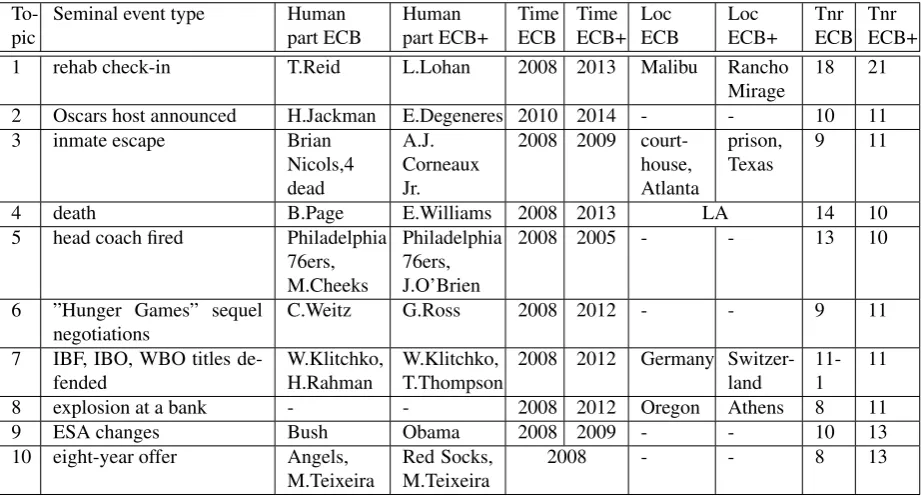
Based on our linguistic intuitions, we hypothesize that the two assumptions cannot be true in realistic situations (compare event descriptions as car bombing in Madrid in 1995 withbombing in Spain in 2009, or massacre in Srebrenica withgenocide in Rwanda). Our hypothesis is that the ECB corpus, while containing multiple documents describing particular real world events, in most cases captures only single instances of each particular event type. For instance texts from ECB topic one, describing Tara Reid’s check-in into rehab in 2008, constitute the only rehab-related event coreference chain in the corpus; and so the only instance of a rehab check-in event captured by the corpus. It is understandable that if testing event coreference resolution on such data set, event entities will not seem to play a big role in resolution of coreference between events. As the number of event instances per topic is limited (in most cases referring to only one event instance of an event type, with exception of few topics like earthquake, acquisition, death and fire), event descriptions from a particular topic tend to share their entities (for a complete overview of seminal events in the ECB see (Cy-bulska and Vossen, 2014)). By that the event coreference task becomes simplified to topic classification.
3.3. Experiment 2
To illustrate this situation, we repeat our experiment, how-ever this time we use lemma matches of event action men-tions to generate event coreference chains within each topic of the ECB corpus. The results expose the diversity of event coreference chains within a topic, resembling the task of solving event coreference after the first step of topic clas-sification, as performed in most recent approaches to event coreference resolution. TABLE 2 shows results of our sec-ond experiment.
Restricting lemma matches to actions from a topic bought
us a 20-30% increase of precision across the evaluation metrics (8-20% improvement of the F-scores). It is remark-able to see that with the simple lemma match heuristic we obtained results comparable to those achieved by means of sophisticated machine learning approaches in related work.
This experiment to some extent exposed the division of work in a multi-step machine learning approach to coreference resolution. Based on the results of the second experiment, we see that much of the work on a data set like ECB is done with the topic classification step. Based on our intuitions, we make the assumption that the situation looks different if one considers large volumes of news articles from a longer period of time, where different topics are represented by multiple event instances of the same type (for instance multiple celebrities going into rehab, or the same celebrity reentering a rehab facility). Our expectations are that when solving event coreference on a corpus with multiple instances representing an event type, topic classification will still make the task easier. The task difficulty however will significantly increase, as on top of matching compatible action mentions (which in the second experiment gave us an CoNLL F score of ca. 65%) a system will also have to make a distinction between mentions of different instances of an event type. With this hypothesis in mind, we augmented the ECB corpus with other instances of the already captured event types, creating a new resource called ”ECB+”.
4.
ECB+
4.1. Extending the ECB
With the objective to make the ECB corpus (482 texts3) more representative of large volume streams of news, we augmented the topics of the ECB with 502 texts reporting different instances of event types provided in the ECB. For example the first ECB topic consists of texts outlining Tara Reid’s check-in into rehab in 2008. We created an exten-sion to topic number one of the ECB, that is constituted by a collection of texts describing another event instance of the same type, namely Lindsay Lohan going into a rehab facility in 2013. ECB+ texts were collected by means of the Google News search. On average we gathered roughly eleven texts per topic. TABLE 3 shows some examples of seminal events, as captured per topic in both components of the corpus, the original ECB and in the new component of ECB+. Next to a seminal event per topic, human par-ticipants involved with the seminal events as well as their
3
To-government (or its representatives). Besides these five subtypes we also distinguish two additional ones: HUMAN PART MET – for any remaining metonymically expressed human participants of events (He has sworn loy-alty to the flagorThe crown gave its approval) as well as HUMAN PART GENERIC for generic mentions referring to a class or a kind of human participants or their typical representative without pointing to any specific individual or individuals of a class (Linguistic Data Consortium, 2008), for instance genericyouoroneas event participants.
Next to locations, times and human participants we recognize a fourth entity type – NON HUMAN PART – for ALL remaining entity mentions – that is, besides human participants of events, event times and locations – that contribute to the meaning of an event action. These are often artifacts expressed as a (direct or prepositional) object of a sentence or as PP phrases not in object position such as instrument phrases. Within the NON HUMAN PART type we distinguish a special sub-tag for generic entities: NON HUMAN PART GENERIC for generic mentions referring to a class or a kind of non human entities or their typical representative without pointing to any specific individual object or objects of a class (Linguistic Data Consortium, 2008) for instance in the sentence: Linda loves cats.
Within the ECB+ annotation task we annotated both, inter- and intra-document coreference relations (whether anaphoric or not) between mentions of a particular instance of an event component. Two or more time expressions, location or participant mentions corefer with each other if they refer respectively to the same time, place or partici-pants. Two action mentions corefer if they refer to the same instance of an action that happens or holds true: (1) in the same time, (2) in the same place and (3) with the same participants involved. In case of copular constructions, if the subject and its complement both refer to the same entity in the world, coreference between the two was annotated. If however, the reference of the sentence subject and of the subject complement is not EXACTLY the same as in: James is just a little boy. coreference would NOT be marked.5
4.3. Event Centric Annotation
The ECB+ annotation specification was designed to be event centric. Mentions of event components were anno-tated in text from the point of view of an event action, mark-ing:
1. participants involved with an action as opposed to any participant mention occurring in a sentence
2. time when an action happened as opposed to any time expression mentioned in text
5In the example sentence James refers to a particular boy
called Jamesbut the phrasea little boyis indefinite and might refer to any little boy, not necessarily toJames.Jamesin this case is just one element of the whole set, hence the reference of the two is not identical.
3. location in which the action was performed in con-trast to a locational expression that does not refer to the place where an action happened.
For exampleher fatherin the sentenceHer father told ABC News he had no idea what exactly was going to happen refers to the only human participant of the reporting action described in the sentence namely the father. The denotation ofherdoes not refer to a participant of the reporting action hence we would leaveherun-annotated. On the other hand herin the sentenceHer stay in rehab is overdoes denote a human participant of action stay. Similarly Mondays in I hate Mondays does not refer to the time when the state holds true but in this sentence it should be anno-tated as a non-human participant. Event centric thinking was applied throughout the whole annotation effort and it guided the decision making process with regards to annotation of linguistic phenomena (such as whether to annotate possessive pronouns as human participants or not).
4.4. Setup of the Annotation Task
The ECB+ corpus was annotated in three annotation rounds:
1. First mentions of event components were annotated in the newly created ECB+ corpus component and intra-document coreference relations were established.
2. Modifications were made to the ECB 0.1 annota-tion (Lee et al., 2012; Recasens, 2011) of the Event-CorefBank (Bejan and Harabagiu, 2010)
3. Finally, cross-document coreference relations were es-tablished for each topic (the new topics include both, the ECB texts and the newly added ECB+ texts).
Two student assistants were hired for a period of four months to perform the annotation. They were paid for their work. Both of them are native speakers of English pursuing a degree at VU University Amsterdam (one of them was an exchange student from the UK, both are British nationals). After the annotators were trained, we moved on to the first stage of the annotation.
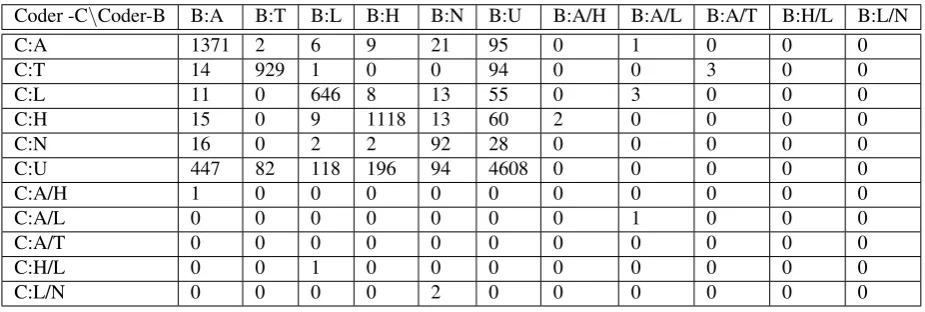
Firstly, a newly created ECB+ corpus component of 502 news articles was annotated. The annotators were given the task to annotate mentions of event actions together with mentions of their participants, times and locations and intra-document coreference between them in the new ECB+ corpus component. The first topic of the new ECB+ component was annotated as burn in by both annotators. The next three topics were also annotated by both anno-tators (in total 55 texts per person annotated by both and used for the calculation of the inter-annotator agreement, see paragraph 4.5) and the remainder of the corpus (447 texts) was divided between the two student assistants and annotated once.
Coder -C\Coder-B B:A B:T B:L B:H B:N B:U B:A/H B:A/L B:A/T B:H/L B:L/N
C:A 1371 2 6 9 21 95 0 1 0 0 0
C:T 14 929 1 0 0 94 0 0 3 0 0
C:L 11 0 646 8 13 55 0 3 0 0 0
C:H 15 0 9 1118 13 60 2 0 0 0 0
C:N 16 0 2 2 92 28 0 0 0 0 0
C:U 447 82 118 196 94 4608 0 0 0 0 0
C:A/H 1 0 0 0 0 0 0 0 0 0 0
C:A/L 0 0 0 0 0 0 0 1 0 0 0
C:A/T 0 0 0 0 0 0 0 0 0 0 0
C:H/L 0 0 1 0 0 0 0 0 0 0 0
C:L/N 0 0 0 0 2 0 0 0 0 0 0
Table 5: Confusion matrix ECB+ topics 1-4; five component annotation by two coders: B and C. A stands for ACTION, T for TIME, L - LOCATION, H stands for HUMAN PART tag, N for NON HUMAN PART, U for UNTAGGED.
ponent. We asked coder A to first work on topics 1, 2 and coder B to annotate topics 3, 4. Then coder B was asked to familiarize herself with instances created for topics 1,2 (no access to annotations of coder A was possible, only the in-stances are shared) and then to establish coreference links re-using the instances created for topics 1 and 2 by coder A. Similar procedure was applied for second coder annota-tion of topics 3 and 4. Because of the CROMER setup it is clear what the intended referent (denotation) of a corefer-ence chain that is of an instance is, hcorefer-ence we simply used Cohen’s Kappa (Cohen, 1960) to calculate agreement on assignment of the coreference relation. As the total num-ber of annotated items we considered all tokens annotated at least by one annotator. On the first four topics (490 cross document coreference IDs) our two coders reached Cohen’s kappa of 0.76 (substantial agreement).
5.
Conclusion
In this paper we analyzed the representativeness of the ECB corpus with regards to large volume news streams. We aug-mented the original ECB corpus with a new corpus compo-nent, creating a new, extended ECB+ corpus that captures descriptions of double event instances per topic, and by that becomes more representative of news available on the web. The corpus was annotated with event classes and with specific types of entities and times as well as with inter-and intra-document coreference between them. The coders reached substantial agreement on both: mention and con-ference annotation. We make this newly created resource available for research. The ECB+ can be used amongst oth-ers to develop and test approaches to event extraction and event coreference resolution.
6.
Acknowledgements
This work has been supported by the EC within the 7th framework programme under grant agreement nr. FP7-IST-316040 and the Network Institute, VU University Am-sterdam under the Semantics of History project. We are grateful for the contribution of the annotators Elisa Wubs and Melissa Dabbs as well as the feedback from the three anonymous reviewers. All mistakes are our own.
7.
References
Bagga, Amit and Baldwin, Breck. (1998). Algorithms for scoring coreference chains. InProceedings of the Inter-national Conference on Language Resources and Evalu-ation (LREC).
Bartalesi Lenzi, Valentina, Moretti, Giovanni, and Sprug-noli, Rachele. (2012). CAT: the CELCT Annotation Tool. InProceedings of LREC 2012.
Bejan, Cosmin Adrian and Harabagiu, Sanda. (2008). A linguistic resource for discovering event structures and resolving event coreference. InIn Proceedings of the 6th International Conference on Language Resources and Evaluation (LREC’08), Marrakech, Morocco.
Bejan, Cosmin Adrian and Harabagiu, Sanda. (2010). Un-supervised event coreference resolution with rich lin-guistic features. InProceedings of the 48th Annual Meet-ing of the Association for Computational LMeet-inguistics, Uppsala, Sweden.
Bejan, Cosmin Adrian, Titsworth, Matthew, Hickl, An-drew, and Harabagiu, Sanda. (2009). Nonparametric bayesian models for unsupervised event coreference res-olution. InAdvances in Neural Information Processing Systems 22, pages 73–81.
Chen, Bin, Su, Jian, Pan, Sinno Jialin, and Tan, Chew Lim. (2011). A unified event coreference resolution by inte-grating multiple resolvers. InProceedings of the 5th In-ternational Joint Conference on Natural Language Pro-cessing, Chiang Mai, Thailand, November.
Cohen, J. (1960). The coefficient of agreement for nom-inal scales. Educational and Psychological Measure-ment, 21(1):37–46.
Cybulska, Agata and Vossen, Piek. (2014). Guidelines for ecb+ annotation of events and their coreference. Techni-cal Report NWR-2014-1, VU University Amsterdam. Landis, J. R. and Koch, G. (1977). The measurement
of observer agreement for categorical data. Biometrics, 33(1):159–174.
LDC. (2005). Ace (automatic content extraction) english annotation guidelines for events ver. 5.4.3 2005.07.01. Technical report, Linguistic Data Consortium.
Mihai, and Jurafsky, Dan. (2012). Joint entity and event coreference resolution across documents. In Proceed-ings of the 2012 Conference on Empirical Methods in Natural Language Processing and Natural Language Learning (EMNLP-CoNLL).
Linguistic Data Consortium. (2008). Ace (automatic content extraction) english annotation guidelines for entities, version 6.6 2008.06.13. Technical report, June. http://projects.ldc.upenn.edu/ace/docs/English-Entities-Guidelines v6.6.pdf.
Luo, Xiaoqiang. (2005). On coreference resolution per-formance metrics. In Proceedings of the Human Lan-guage Technology Conference and Conference on Empir-ical Methods in Natural Language Processing (EMNLP-2005).
Pradhan, Sameer, Ramshaw, Lance, Weischedel, Ralph, MacBride, Jessica, and Micciulla, Linnea. (2007). Un-restricted coreference: Indentifying entities and events in ontonotes. InProceedings of the IEEE International Conference on Semantic Computing (ICSC), September. Pradhan, Sameer, Ramshaw, Lance, Marcus, Mitchell, Palmer, Martha, Weischedel, Ralph, and Xue, Nian-wen. (2011). Conll-2011 shared task: Modeling un-restricted coreference in ontonotes. In Proceedings of CoNLL 2011: Shared Task.
Pustejovsky, James, Castano, Jose, Ingria, Bob, Sauri, Roser, Gaizauskas, Rob, Setzer, Andrea, and Katz, Gra-ham. (2003). Timeml: Robust specification of event and temporal expressions in text. InProceedings of Compu-tational Semantics Workshop (IWCS-5).
Recasens, Marta and Hovy, Eduard. (2011). Blanc: Imple-menting the rand index for coreference evaluation. Nat-ural Language Engineering, 17(4):485–510.
Recasens, Marta. (2011). Annotation guide-lines for entity and event coreference. In http://www.bbn.com/NLP/OntoNotes.
Saur´ı, Roser, Littman, Jessica, Knippen, Robert, Gaizauskas, Robert, Setzer, Andrea, and Pustejovsky, James. (2005). Timeml 1.2.1 annotation guidelines, Oc-tober. http://timeml.org/site/publications/timeMLdocs/ annguide 1.2.1.pdf.
Sinclair, John. (2004). Developing linguis-tic corpora: a guide to good practice. http://ota.ahds.ac.uk/documents/creating/dlc/ chap-ter1.htm#section4.