CSEIT1833637 | Received : 05 April 2018 | Accepted : 20 April 2018 | March-April-2018 [ (3 ) 3 : 1572-1576 ]
© 2018 IJSRCSEIT | Volume 3 | Issue 3 | ISSN : 2456-3307
Review on Congestion Control in MANET
Rashmi JatainResearch Scholar, CSE Department, Maharishi Dayanand University, Rohtak, Haryana, India
ABSTRACT
Wireless ad-hoc network is becoming one of the most animated and dynamic field of communication. Because the moveable devices and wireless networks have increased significantly in recent years. Mobile ad-hoc network (MANET) uses wireless connections to connect various networks. There are number of issues and challenges in MANET. Due to many number of nodes transmitting packets over the network, the chances of losing the packets over the network increases to a great extent. Also, with the increase in size and quantum of data packets, the congestion over the network increases which may also lead to packet loses. The objective of this paper is to study the comparison of various protocols based upon parameters such as Throughput performance, Packet drop ratio, Data error, Packet delivery rate. This study will facilitate the researcher in this field to undertake development of optimized new technique.
Keywords: Destination-Sequenced Distance-Vector Routing (DSDV), Dynamic source routing (DSR), Ad-hoc on Demand Distance Vector (AODV), Ad-hoc on Demand Multipath Distance Vector (AOMDV), Zone Routing Protocol (ZRP), Gate way Discovery Protocol (wGDP), Congestive-Adaptive Routing Protocol (CRP).
I.
INTRODUCTION
MANET is a branch of networking that deals with communication between two or more nodes without use of any external devices. MANET is a continuously self-configuring, infrastructure-less network of mobile devices connected wirelessly. It is one of the types of ad-hoc network. Here ad-hoc means whenever there is need, devices establish the connection. MANET is collection of nodes, which are free to move in the wireless network. The nodes are responsible for forwarding the data or packets from source to destination. Each node performs the role of both host and router. The nodes can consist of laptop, mobile phones and personal digital assistant (PDAS) see “Figure1”
Figure 1. General Representation of MANET [12]
1. MANET Characteristics:-
1.1 Autonomous and infrastructure-less: Each mobile node is an independent node, which could function either as a host or as a router.[1]
1.3 Dynamic Network Topologies: The nodes in MANETs are free to move independently in any direction. The network's wireless topology may change frequently and randomly at unpredictable times and primarily consists of bidirectional links.[2]
1.4 Limited Battery Power: The nodes or hosts operate on small batteries and other exhaustible means of energy. So, energy conservation is the most important design optimization criteria.[2]
1.5 Scalability: Due to the limited memory and processing power on mobile devices, the scalability is a key problem when we consider a large network size. Networks of 10,000 or even 100,000 nodes are envisioned, and scalability is one of the major design concerns.[2]
2. Advantages of MANET:-
2.1 Minimum cost estimation.[2]
2.2 Enhanced flexibility.[2]2.3 These networks can be set up at any place and time.[10]
2.4 MANET gives access to information and facilities regardless to geographic location.[10]
3. Disadvantages of MANET:-
3.1 These networks have lower capacity and shorter transmission range than fixed infrastructure networks.[1]
3.2 Volatile network topology makes it hard to detect the malicious nodes.[1]
3.3 Limited resources and physical security.[10] 3.4 Dynamic network topology makes it difficult to identify malicious attack.[10]
4. Applications of MANET:-
4.1 Military field: Ad-Hoc networking can permit army to exploit benefit of conventional network expertise for preserving any info network among vehicles, armed forces, and headquarters of information.[1]
4.2 Cooperative work: To facilitate the commercial settings, necessity for concerted computing is very significant external to office atmosphere and surroundings as compared to inner environment. People want getting outside meetings for exchanging the information plus cooperating with each other regarding any assigned task.[1]
4.3 Emergency Services: Ad-hoc network could be used for rescuing and emergency processes for adversity assistance struggles, for instance, in flood, fire or earthquake.[2] 4.4 Educational sector: Set up virtual classes & conference rooms.[2]
4.5 Location Aware Services: Automatic Call forwarding, advertise location specific services, Location– dependent travel guide.[2]
Congestion In MANET
Congestion is the most important issue in ad-hoc network. When the number of packets increases beyond the limit that can be handled by network resources which results degradation in network performance is called congestion. It is unwanted situation where network face the problem of more traffic than its rated capacity [5], which result in packet loss, bandwidth degradation, waste time and energy etc. A network that is congested for one user is not necessarily congested for other user. To control the congestion so many routing protocols have been designed so that we send our data without any interruption.
Congestion in MANET result [6] in following:- Long delay:- Most of the congestion control technique takes too much time for identify congestion. Sometimes the operation of new routes is more critical situations. The main problem occur delay existing for route observant in on-demand routing protocol.
multipath routing protocol. More packets loss:-Congestion control is perpetuate by decreasing the sending rate towards the sender or collapsed packets at the intermediate nodes or executing both the procedure. This causes increased packet loss rate or least throughput.
1. Congestion types
There are mainly four types of congestion describe [4] as follows:-
1.1 Instantaneous Congestion: It is caused by mild bursts, created naturally by burstiness of IP traffic. 1.2 Baseline Congestion: It appears to be caused by systematic under-engineering of network or hop capacity (or alternatively due to simple source overflow described earlier).
1.3 Flash Congestion: It suggests frequent but momentary periods of overload in a highly utilized network, where bursts from individual sources add up to create significant packetloss hills.
1.4 Spiky Delay: It a condition where no packets are transferred for a long duration of time - the transit delay of packets shoots up from few milliseconds to tens of seconds during this period.
II.
CONGESTION CONTROL ROUTING
PROTOCOLS
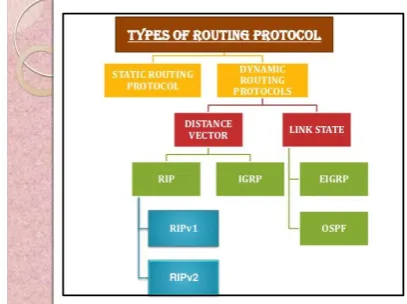
The main function of routing protocol is to find the path between the sender and the receiver. If nodes are in direct range of each other then they can directly connect and can communicate with each other , but if in case nodes are not in direct range then they need some intermediate nodes to transfer their data packet Basically in MANET there are three types of routing protocols i.e. Proactive, Reactive and hybrid see in “Figure2”
Figure 2. Types of Routing Protocol
2.1 Proactive Routing Protocols
They are also called as table driven routing protocols. In this every node maintain routing table which contains the full information of all the nodes present in the network. The routing tables are updated periodically after a small time interval. Proactive protocols are not suitable for large networks as they need to maintain full information of all the nodes present in the network. This causes more overhead in the routing table leading to consumption of more bandwidth. Example: DSDV.[2]
2.2 Reactive Routing Protocol: They are also known as on-demand routing protocols. These protocols do not maintain the routing information of all the nodes present in the network at all the time. If a node wants to send a packet to another node then this protocol searches for the route in an on-demand manner and establishes the connection between sender and receiver so that they can communicate with each other. Reactive routing protocols are more popular because they require less bandwidth and there is no extra wastage of memory. Example: DSR.[2]
2.3 Hybrid Routing Protocol: It is combination of
both reactive and proactive routing
protocol is suitable for large networks. In this, large network is divided into set of zones where routing inside the zone is performed by using reactive approach and outside the zone routing is done using reactive approach. Example: ZRP.[2]
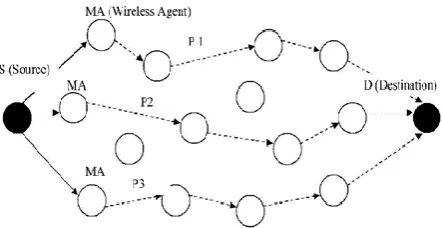
Related Work Rajesh M and Gnanasekar[3] proposed about network congestion is collected and distributed by Wireless Agent (WA). A wireless agent starts from every node and moves to an adjacent node at every time see in “Figure 3”.
A node visited next is selected at the equivalent probability. The WA brings its own history of movement and updates the routing table of the node it visits. In this technique, the node is classified in one of the four categories depending on whether the traffic belongs to background, best effort, video or voice AC, respectively. Then WA estimates the queue length of the various traffic classes and the channel contention of each path. Then this total congestion metric is applied to the routing protocol to select the minimum congested route in the network.
A wireless agent based congestion control AODV routing protocol reduces the end-toend delay and the number of route discovery requests balances the traffic load. With the help of this technique, he attains high delivery ratio
Figure 3. Agent based congestion routing
Gurmeen Kaur, KamaljeetKaint and Rakesh Kumar [4]worked on enhanced IRED with new route discovery mechanism for avoidance of problems in MANET. IRED has been enhanced on the basis of
weight age factor provided in the algorithm with queue length. This scheme is for congestion avoidance in the network. Route discovery management will change routes from source to destination due to random mobility in the nodes. KomalBadhran and Gautam Gupta [5]proposed a new protocol wGDP protocol is designed for combined congestion control and scheduling in MANET. It enabled mobility based routing algorithm calculates multiple disjoint paths. Congestion is reduced by varying number of nodes. Multicast algorithm achieve higher packet delivery fraction with reduced overhead. S. Tamilselvi and O.P.UmaMaheshwari [6]proposed method is integrated with the Dynamic Source Routing Protocol (DSR). This proposed algorithm is implemented using Network Stimulator (NS 2.3). High level of energy is consumed in this method so, developed energy efficient scheme to minimize the congestion. With help of extensive stimulator it improved packet delivery ratio, low delay and high network life time. Anju ,Sugandha Singh [7] worked on modified AODV routing protocol for congestion control in MANET, in which traffic bottleneck is the major issue in congestion control. It assures that system is running even in the worst condition like overload situation. Bandana Bhatia [8]it proposed congestion control protocols based on AODV in MANETs. Improved Ad-hoc on-demand Distance Vector Routing Protocol (AODV-I) and Early Detection Congestion and Control Routing Protocol (EDAODV).
goal of the proposed method is to determine all available node disjoint routes from source to destination with minimum routing control overhead.
Figure 4. Finding alternate path to reduce congestion
III.
CONCLUSION
There has been vast development in the field of wireless communication and MANET. In this review paper various routing protocol techniques to control the congestion in MANETS have been evaluated .The routing protocol “AODV” provides the better results in terms of packet delivery ratio, throughput and low delay as compared to other routing protocols such as DSR, IRED, EOAODV to control the congestion and packet loss.
IV.
REFERENCES
[1]. Muhammad Qasim Akbar "Mobile Ad-Hoc Networks Applications and Its Challenges"
Scientific Research Publishing ,
Communications and Network, July 2016, Volume 8, Pages 131-136.
[2]. Prabhleen Kaur "An Overview on MANET- Advantages, Characteristics and Security Attacks" International Journal of Computer Applications, 4th International Conference on Advancements in Engineering & Technology (ICAET 2016).
[3]. Rajesh M and Gnanasekar " Congestion Control using AODV Protocol scheme for wireless ad-hoc network" Advances in Computer Science
and Engineering, Volume 16, Numbers 1-2, August 2016, Pages 19-37.
[4]. Gurmeen Kaur, KamaljeetKaint and Rakesh Kumar " Congestion Control in MANET Using Various Approaches" International Journal of Advanced Research in Computer and Communication Engineering, Volume 6, Issue 6, June 2016 ,pp846-850.
[5]. KomalBadhran and Gautam Gupta " A Survey of Performance of Congestion Control Techniques in MANET" International Journal of Advanced Research in Electronics and Communication Engineering , Volume 5, Issue 4, April 2016, pp 858-862.
[6]. S. Tamilselvi and O.P.UmaMaheshwari " A novel scheme for Congestion Control in Mobile Ad Hoc Networks" International Journal of Advanced Research in Computer and Communication Engineering , Volume 5, Issue 2, February 2016, pp 357-359.
[7]. Anju ,Sugandha Singh "Modified AODV for Congestion Control in MANET" International Journal of Computer Science and Mobile Computing, Vol. 4, Issue. 6, June 2015, pg.984 – 1001.
[8]. Bandana Bhatia "Performance Analysis of AODV Based Congestion Control Protocols in MANET", 1st International conference on futuristic trend in computational analysis and knowledge management (ABLAZE 2015), 2015, pp 45-53.
[9]. hupinde Kaur "A Survey on Congestion Control Techniques in MANET" International Journal of Advanced Research in Computer Science and Software Engineering, Volume 5, Issue 5, May 2015, pp1441-1446.
[10]. S.Leemaroselin "A Review on Congestion
![Figure 1. General Representation of MANET [12]](https://thumb-us.123doks.com/thumbv2/123dok_us/1034564.1128830/1.595.303.546.381.530/figure-general-representation-of-manet.webp)