International Journal of Scientific Research in Computer Science, Engineering and Information Technology © 2018 IJSRCSEIT | Volume 3 | Issue 4 | ISSN : 2456-3307
College Time Table Management System using Android
Application
G. Dhana Sekar1, N. Hemanth Kumar2, P. Gowtham2
1Assistant Professor, Department of MCA, SVCET, Chittoor, Andhra Pradesh, India 2Department of MCA, SVCET, Chittoor, India
ABSTRACT
This application manages configuration, fabricate and test a Mobile Time Table framework that encourages the client to see the timetable of the school. The issue is to outline and execute to make a semester course timetable by allotting schedule vacancies and rooms to a given arrangement of courses to be run that semester under given limitations. The requirements incorporate evading conflicts of schedule openings and rooms, allotting suitable rooms and fitting no. of spaces and contact hours to the courses and so forth.
Keywords: Component, Constraints, Time Table generation, Optimal Solution.
I.
INTRODUCTION
The principle reason to outline this Mobile Application is to give completely arranged timetable in a portable application since nowadays everybody is utilizing the Android based Smartphone. Along these lines, by the basic versatile application client can have the capacity to see timetable regardless of their subject. The versatile application is making the client association simple. The client can discover their school's chance table in at the tip of his finger and no compelling reason to recollect the timetable or no compelling reason to keep the printed copy of timetable. Each refresh will be specifically gone to the client.
Albeit the majority of the school managerial work has been electronic, the address timetable planning is still for the most part done physically because of its specialized challenges. The manual booking of address timetable requires impressive time and endeavors. The address timetable booking is a requirement fulfillment issue in which we locate an
ideal arrangement that fulfills the given arrangement of imperatives.
The advancement of this new framework contains the accompanying exercises, which endeavor to mechanize the whole procedure keeping in the perspective of database mix approach.
Require less time to create the timetable.
No paperwork requires.
Instant refresh goes to the portable.
Easily access by portable from anyplace.
Administration and client association will be simple for a refreshed timetable.
In the adaptability of the utilization, the interface has been created a designs idea as the main priority, related through a program interface. The GUI'S at the best level have been ordered as
1. Administrative UI
2. The operational or bland UI
the information gathering. The interfaces help the organizations with all the value-based states like Data addition, Data cancellation and Data refreshing alongside the broad information look abilities. The operational or nonexclusive UI helps the clients upon the framework in exchanges through the current information and required administrations. The operational UI likewise helps the conventional clients in dealing with their own particular data helps the common clients in dealing with their own particular data in a tweaked way according to the helped adaptabilities
Modules
The system after careful analysis has been identified to be presented with the following modules:
Registration
Login
Update of Subject/Faculty
Assignment of Subject and Faculty
Generate Time Table
View Time Table
Registration:
Enlistment is the procedure which is enabling the client to wind up the piece of that specific framework. In the enlistment, module client nourishes their total subtle elements to get enrolled in the framework. This enlisted subtle element additionally comes to use during the time spent login their own record.
Login:
In each continuous framework User login is genuinely necessary to give the security to the client. These highlights making the thing to be private and particular to a specific client who isn't be taken by other. Presently with the claim certifications, just that specific individual is advantaged to get to their record.
Update of Subject/Faculty:
In this timetable application, the Admin has all the benefit to refresh and adjust the framework. Here administrator is including the subject and staff concerning the semester, branch and area. Every one of the points of interest refreshed by the administrator will store in the database for sometime later.
Assignment of Subject and Faculty:
Subsequent to choosing the Semester, Branch and segment, now the Admin work is to outline subject for the class with its separate instructor. Administrator likewise takes think about that no classes and schedule opening ought to befall. There creating the time by getting every one of the points of interest from the database. In this timetable age, the whole subject will tumble to the timetable with the related educator and the allocated periods.
View Time Table:
This is the last advance of the timetable application, where the client gets the yield. Here administrator and client both can see the timetable. In the event that the administrator is seeing the timetable, at that point, he will dissect and watch that the real timetable is coming appropriately or not.
Furthermore, if the Student is seeing the timetable, at that point he will get the last and completely sorted out the timetable. Presently he understudies can see the classes and timing with the educator data.
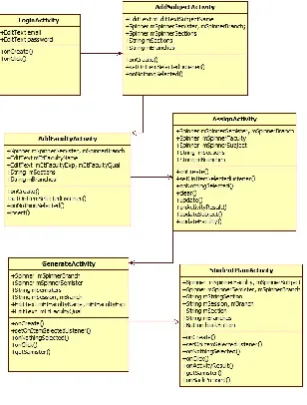
Class Diagram
system by showing the system's classes, their attributes, operations (or methods), and the relationships among the classes. It explains which class contains information.
Figure 1 Use Case Diagram
A use case diagram in the Unified Modeling Language (UML) is a type of behavioral diagram defined by and created from a Use-case analysis. Its purpose is to present a graphical overview of the functionality provided by a system in terms of actors, their goals (represented as use cases), and any dependencies between those use cases. The main purpose of a use case diagram is to show what system functions are performed for which actor. Roles of the actors in the system can be depicted.
Figure 2
SEQUENCE DIAGRAM:
A sequence diagram in Unified Modeling Language (UML) is a kind of interaction diagram that shows how processes operate with one another and in what order. It is a construct of a Message Sequence Chart. Sequence diagrams are sometimes called event diagrams, event scenarios, and timing diagrams. Admin Sequence Diagram
Figure 3 User Sequence Diagram
Collaboration Diagram:
In collaboration diagram the method call sequence is indicated by some numbering technique as shown below. The number indicates how the methods are called one after another. We have taken the same order management system to describe the collaboration diagram. The method calls are similar to that of a sequence diagram. But the difference is that the sequence diagram does not describe the object organization where as the collaboration diagram shows the object organization.
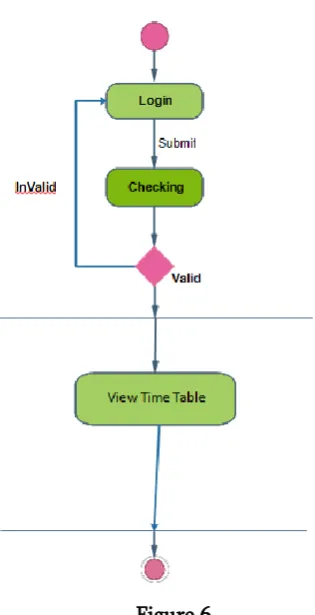
ACTIVITY DIAGRAM:
Activity diagrams are graphical representations of workflows of stepwise activities and actions with support for choice, iteration and concurrency. In the Unified Modeling Language, activity diagrams can be used to describe the business and operational step-by-step workflows of components in a system. An activity diagram shows the overall flow of control.
Figure 5
Figure 6
II.
CONCLUSION
It has been an extraordinary joy for me to deal with this energizing and testing venture. This task demonstrated bravo as it gave commonsense learning programming in Java, as well as about all taking care of method related to "Time Table App". It likewise gives learning about the most recent innovation utilized as a part of creating web-empowered application and customer server innovation that will be awesome request in future. This will give better openings and direction in future in creating ventures freely.
III.
REFERENCES
[2]. E.K.Burke, J.P.Newall, Solving Examination Timetabling Problems through Adaptation of Heuri stic Orderings Masri Ayob, Salwani Abdullah and Ariff Md Ab Malik (September 2007), A Practical Examination Timetabling Problem at the Universiti Kebangsaan Malaysia, IJCSNS International Journal of Computer Science and Network Security, Vol .7 No.
[3]. D. Datta , Kalyanmoy Deb, Carlos M. Fonseca (2005.), Solving Class Timetabling Problem of IIT Kanpur using Multi - Objective Evolutionary Algorithm.
[4]. Nations, Daniel. "Web Applications". About.com. Retrieved 20 January 2014.
[5]. Alex Chaffee (2000-08-17). "What is a web application (or "webapp")?". Retrieved 2008-07 27.
[6]. James Duncan Davidson, Danny Coward (1999-12-17). Java Servlet Specification ("Specification") Version: 2.2 Final Release. Sun Microsystems. pp. 43–46. Retrieved 2008-07-27.
[7]. "Dynamic HTML and XML: The XMLHttpRequest Object". Apple Inc. Retrieved 2008-06-25.
[8]. Jeremy Petersen. "Benefits of using the n-tiered approach for web applications".
[9]. "Top Tips for Secure App Development". Dell.com. Retrieved 2012-06-22.
[10]. Multiple (wiki). "Web application framework". Docforge. Retrieved 2010-03-06.