International Journal of Scientific Research in Computer Science, Engineering and Information Technology © 2017 IJSRCSEIT | Volume 2 | Issue5 | ISSN : 2456-3307
The Unified Resource Utilization Techniques and Analytical
Model in E-Commerce
Dr. Sharad Gangele
1, Deepika Pathak
2and Dr. Dhanraj Verma
31,2Department of Computer Science & Application, RKDF University, Bhopal, MP, India [email protected]
3Department of Computer Science & Engineering, Dr. APJ Abdul Kalam, Indore, MP, India
ABSTRACT
The popularity of electronic commerce is gaining day by day. The points of attractions for adoption of E-commerce are time, high availability, ubiquitous, efficiency and economic cost. With the rapid growing technologies, the recent growth in e-commerce organizations need improvement of internal and external information flow. The high availability of information requirements have served combination of logistics management systems and supply chain management systems in many industries. The utilization of unified resources with e-commerce will shape the business progress for the future. In this paper, we are presenting framework for e-commerce processes based on efficient resource utilization model. This unified framework can be applied as a new e-commerce service delivery model by using a design pattern with solution templates. The e-commerce strategies can be improved with the impact of this framework when making decisions to support the supply chain management systems.
Keywords:E-Commerce, Resource Utilization, Framework,Unified Model.
I.
INTRODUCTION
The E-Commerce market is thriving and poised for robust growth in Asia. There are players who made a good beginning. Their success depends on their understanding of the market and offering various types of features [1]. It makes large changes in the economic, social and cultural aspects. One aspect of this transformation is changes in economic relations between individuals, corporations and governments. Commercial exchange between people who had been based on paper documents to transactions of by us the systems based on electronic information [2]. This research gives an overview of the future of E-Commerce in India and discusses the future growth segments in Indias E-Commerce. Also find out various factors that would essential for future growth of Indian E-commerce and represent the various opportunities for retailers, wholesalers, producers and for people [3]. It is found that the Overall E-Commerce will increase exponentially in coming years in the emerging market of the E-commerce trade in Asian nation has come back an extended approach since its period. The market
discusses relevant design features as they relate to e-commerce and Web 2.0 [7]. We propose a new model and a set of principles for guiding social commerce design.
II.
LITERATURES REVIEW
For developing countries like Asian country, e-commerce offers extended chance. E-e-commerce in Asian country remains in growing stage, however even the most-pessimistic projections indicate a boom. Its believed that low price of non-public computers, a growing put in base for Internet use, associate degreed an progressively competitive net service supplier market can facilitate fuel e-commerce growth in Asias second most inhabited nation. The primary e-commerce website in India was rediff.com. Following are some publication and research in e-commerce and distributed management. Tian et al. presented an optimization in e-commerce market network based on value order parameter, predicts a revolution similar to the industrial revolution, which the world has entered the information age. It makes large changes in the economic, social and cultural aspects. One aspect of this transformation is changes in economic relations between individuals, corporations and governments. Commercial exchange between people who had been based on paper documents to transactions of by us the systems based on electronic information. In this work, they discussed the benefits of e-commerce and its impact on the understanding of the market and offering various types of features. This paper gives an overview of the future of E-Commerce in India and discusses the future growth segments in Indias E-Commerce. Also find out the various factors that would essential for future growth of Indian E-commerce. And represent the various opportunities for retailers, wholesalers, producers and for people. They found that the Overall E-Commerce will increase exponentially in coming years in the emerging market of India [9]. Bagnall discussed the conceptual knowledge of search engine marketing (SEM) or e-commerce, literature review, current and future aspects of e-commerce in Indian context. They discussed about the top motivator factors
of shopping online. The present development would be a valuable addition to researcher and academicians; and useful theory for practitioners, advertisers, and entrepreneurs [10]. J¨ageler presented a study on distribution which plays a key role within the marketing mix, and the key to success is its successful integration within the mix, ensuring that customers get their products at the right place and at the right time. If the product cannot reach its chosen destination at the appropriate time, then it can erode competitive advantage and customer retention. The purpose of this study is to explore the best distribution strategy and other factors that help the organization meet customer expectations in respect of delivery and service promises the organization might make [11]. Liu et al. discussed the rapid rise of e-commerce as a legitimate market has brought a corresponding increase in the number of academic papers on the subject. Stakeholder theory suggests that, as an emerging research discipline, E-Commerce research is likely to focus primarily on specific stakeholders and ignore others. The surveys of seven of the top nine e- Commerce journals to test this proposition. They demonstrate that academic E-Commerce researchers concentrate their attentions on two stakeholder groups, specifically customers and the internal organization (i.e., managers and employees) of the Net-Enhanced Organization (NEO) [12]. Ohidujjaman et al. described the present challenges of e-commerce and its solution in BD. It also discusses the effectiveness of E-commerce in financial sector of BD. Proper E-commerce sites like Brand E-commerce play a vital role in employment generation as well as increasing the Internet utilization. This research mainly described the present status of BDs E-commerce sites as well as study of traditional commerce for developing online business [13].
Geet al. explored the application of e-commerce, now a days e-commerce is doing business online and electronically. They attempted to highlight the different challenges faced by e-commerce in India and to understand the essential growth factors required for e-commerce and described the different services and opportunities offered by E-commerce to business, Producers, Distributers and Customers [15]. Whereas Hsiao et al. discussed an article about support versus confidence in the data mining technique, association rules. In the last four years this article has been downloaded nearly twenty-thousand times from an open access repository. This interest by researchers and practitioners has motivated us to write this technical editorial. The structure of this editorial will be as follows. In this section, we briefly introduce data mining and electronic commerce. In the following section, we describe different data mining techniques. In the final section, we discuss the effect of support versus confidence in association rules technique applied to electronic commerce [16].
III.
EXISTING SYSTEM
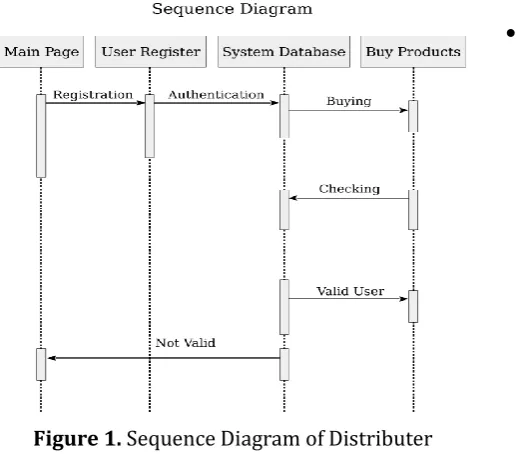
Arrangement chart and joint effort outline used for ecommerce modelling are called “INTERACTION DIAGRAMS” [17]. An association chart demonstrates collaboration, comprising of set of items and their relationship including the messages that might be dispatched among them [18]. The Figure 1 represents the existing sequence diagram of distributer management.
Figure 1. Sequence Diagram of Distributer
Management
A collaboration diagram is an introduction diagram that emphasizes the structural organization of the objects that send and receive messages. Graphically a collaboration diagram is a collection of vertices and arcs [19][20]. The Figure 2 represents the existing collaboration diagram of distributer management.
Figure 2. Collaboration Diagram for Distributor
Management
IV.
PROPOSED METHOD
E-Commerce Average Performance Metrics
Two main performance metrics are considered to specify the real-time database QoS: per-class deadline miss ratio and freshness of data accessed by timely transactions.
Miss Ratio: Let #Tardyi and #Timelyi represent the number of tardy and timely transactions for admitted transactions belonging to Class i. The Class i miss ratio is defined as:\
freshness and perceived freshness. Database freshness, also called QoD (Quality of Data), is the ratio of fresh data to the entire data in a database. In contrast, perceived freshness is defined for the data accessed by timely transactions as follows. Let us call the number of data accessed by timely transactions Naccessed. Let Nfresh represent the
number of fresh data accessed by timely transactions.
In a QoSspecification only the perceived freshness is considered, since tardy transactions add no value to our firm realtime database model. In this way, we can leverage the inherent leeway in the QoD. Under overload, the QoD can be traded off for a certain subset of data to reduce the update workload as long as the perceived freshness requirement is not violated. As a result, the deadline miss ratio of user transactions can be improved without affecting the perceived freshness.
V.
CONCLUSION
In this paper, exploratory survey of different e-commerce framework and techniques has been analysed and it is found that the demand for real-time services is increasing in ecommerce applications. In many e-commerce applications, it is desirable to process user service requests within their deadlines using fresh data. However, it is very challenging to satisfy this fundamental requirement due to possibly time varying workloads and user shopping patterns. Moreover, we present required quality of service (QoS) including the desired data freshness and differentiated miss ratios for improving ecommerce utilization model.
REFERENCES
[1]. R. T. Kreutzer, E-Commerce. Wiesbaden: Springer Fachmedien Wiesbaden, 2016, pp. 137-149.
[2]. Z. Sun and G. R. Finnie, E-Commerce. Berlin, Heidelberg: Springer Berlin Heidelberg, 2004, pp. 43-65.
[3]. S. Tadelis, "The economics of reputation and feedback systems in e-commerce marketplaces," IEEE Internet Computing, vol. 20, no. 1, pp. 12-19, Jan 2016.
[4]. S. Hernndez, P. lvarez, J. Fabra, and J. Ezpeleta, "Analysis of user’s behavior in structured e-commerce websites," IEEE Access, vol. 5, pp. 11 941-11 958, 2017.
[5]. C. Lyu, L. Li, and T. Pan, "A smart b2c e-commerce system based on acp approach," IEEE Intelligent Systems, vol. 29, no. 4, pp. 102-104, July 2014.
[6]. H. Xu, D. Liu, H. Wang, and A. Stavrou, "An empirical investigation of ecommerce-reputation-escalation-as-a-service," ACM Trans. Web, vol. 11, no. 2, pp. 13:1-13:35, May 2017.
[7]. E. ehirli and lhami M. Orak, "E-commerce according to hobby," Procedia - Social and Behavioral Sciences, vol. 143, no. Supplement C, pp. 1144 - 1147, 2014, 3rd Cyprus International Conference on Educational Research, CY-ICER 2014, 30 January - 1 February 2014, Lefkosa, North Cyprus.
[8]. Z. Tian, Z. Zhang, and R. Gao, "Optimization in e-commerce market network based on value order parameter," Information Technology and Management, vol. 17, no. 2, pp. 187-197, Jun 2016.
[9]. A. Saxena and A. R. Dani, "Technologies for e-commerce: India initiatives," in TENCON 2003. Conference on Convergent Technologies for Asia-Pacific Region, vol. 4, 2003.
[10]. J. Bagnall, "New technology briefing: Search engine marketing," Interactive Marketing, vol. 4, no. 4, pp. 388-394, Apr 2003.
[11]. F. J. J'ageler, "Marketing and distribution systems," Intereconomics, vol. 9, no. 2, pp. 54-57, Feb 1974.
[12]. G. J. Liu, K. McKone-Sweet, and R. Shah, "Assessing the performance impact of supply chain planning in net-enhanced organizations," Operations Management Research, vol. 2, no. 1, pp. 33-43, Dec 2009.
[13]. Ohidujjaman, M. Hasan, and M. N. Huda, "Article: E-commerce challenges, solutions and effectiveness perspective bangladesh," 4 International Journal of Computer Applications, vol. 70, no. 9, pp. 9-17, May 2013, full text available.
[15]. J. Ge, Y. Tian, L. Liu, R. Lan, and X. Zhang, "Understanding e-commerce systems under massive flash crowd: Measurement, analysis, and implications," IEEE Transactions on Services Computing, vol. PP, no. 99, pp. 1-1, 2017. [16]. Y.-H. Hsiao, M.-C. Chen, and W.-C. Liao,
"Logistics service design for cross-border e-commerce using kansei engineering with text-mining-based online content analysis," Telematics and Informatics, vol. 34, no. 4, pp. 284 - 302, 2017.
[17]. H. Y. Chen, C. Li, and T. H. Tse, "Transformation of uml interaction diagrams into contract specifications for objectoriented testing," in 2007 IEEE International Conference on Systems, Man and Cybernetics, Oct 2007, pp. 1298-1303.
[18]. A. Ray and R. Cleaveland, "Architectural interaction diagrams: Aids for system modeling," in 25th International Conference on Software Engineering, 2003. Proceedings., May 2003, pp. 396-406.
[19]. H. C. Purchase, L. Colpoys, M. McGill, and D. Carrington, "Uml collaboration diagram syntax: an empirical study of comprehension," in Proceedings First International Workshop on Visualizing Software for Understanding and Analysis, 2002, pp. 13-22.