CSEIT1726117 | Received : 25 Nov 2017 | Accepted : 21 Dec 2017 | November-December-2017 [(2)6: 952-956]
International Journal of Scientific Research in Computer Science, Engineering and Information Technology © 2017 IJSRCSEIT | Volume 2 | Issue 6 | ISSN : 2456-3307
952
Robust Face Recognition System using Non Additive Entropy
with Kernel Entropy Component Analysis
Aruna Bhat
Research Scholar, Department of Electrical Engineering, IIT Delhi, India
ABSTRACT
A technique for illumination invariant face recognition using Gaussian non-additive entropy based Kernel Entropy Component Analysis is proposed. The approach is combined with Gabor Wavelet Transformation and Discrete Cosine Transform to achieve illumination invariance along with expression and pose invariance as well, thereby leading us towards the design of a universal robust face recognition system.
Keywords : Kernel Entropy Component Analysis, Entropy, Discrete Cosine Transform, Gabor Wavelet Transformation, Kernel PCA
I.
INTRODUCTION
Face recognition is the least intrusive and unobtrusively fastest biometric technology. The motivation of using Face as a modality for recognition lies in discreetness and non-intrusiveness. There is no need to ask people to place their fingers on a scanner or to accurately adjust the position of their eyes against a reader. Instead, a face recognition system can unobtrusively recognize people by their face when they enter a particular area. With no delay involved in carrying out this process, the subjects are also completely unaware of being observed. Unlike other biometric methods, there is no issue of people feeling under surveillance or worrying that their privacy has been invaded.
There have been various face recognition methods proposed in the past but nearly all suffer from the practical aspect of changes in the face, which to a certain extent are unavoidable. Most of the existing face recognition systems demand precise alignment and correspondence between the testing and the training data sets. This restriction makes the system unusable in practice. The changes in the face image due to variations in pose, illumination, expressions etc. make such strict face recognition systems futile in real world applications. The results are even more deplorable if the variations are collectively present. However there is no escape to such variations in real world and there is a
need to design strong reliable face recognition methods.
In order to evaluate the usability of the Kernel Entropy Component Analysis (KECA) [1] based on Gaussian non-additive entropy for dealing with various changes in face due to variations in illumination, pose and expressions, the approach is combined with Gabor Wavelet Transformation (GWT) [2] for achieving illumination invariance with some degree of expression and pose invariance, and Discrete Cosine Transform (DCT) [3] for significant robustness towards illumination changes in the face.
The methodology is mainly centered on KECA with the conventionally used Renyi entropy [4] being replaced with the Gaussian non-additive entropy measure [5], useful for the representation of information content in the non-extensive systems containing some degree of regularity or correlation which makes it a better option than Renyi entropy in KECA.
Discrete Cosine Transform is known to aid in increasing the robustness against variations in illumination. The entropy measures are applied on the Discrete Cosine Transform coefficients to extract the maximum entropy preserving pixels in order to yield a feature vector with the most informative features of a face. We apply the Kernel Entropy Component Analysis over the coefficients of Discrete Cosine Transform which have highest contribution towards the Gaussian non-additive entropy estimate. It produces only those real Kernel Entropy Component Analysis Eigen vectors which correspond to the Eigen values with high positive entropy contribution.
Likewise Gabor Wavelet Transformation is applied over the images from which the most crucial discriminative facial features characterized by spatial frequency, spatial locality and orientation selectivity are derived. Here also, we apply Kernel Entropy Component Analysis based on the Gaussian non-additive entropy on the computed feature vectors of face images so as to obtain only those real KECA Eigen vectors which correspond to the Eigen values with high positive entropy contribution. Finally, these real KECA features will be used for image classification.
The proposed methodology produces a reasonable increase in the resilience of the face recognition system against the changes in facial expression, pose and illumination. It is not only efficient and reliable but also computationally fast and simple to implement.
The rest of this paper is organized as follows: Section 2 provides a detailed description of the proposed methodology for robust face recognition based on Kernel Entropy Component Analysis using a non-additive entropy measure. Experimental results have been elaborated in Section 3 followed by Section 4 which provides the conclusion.
II.
METHODOLOGY
A major nonlinear spectral data transformation method for face recognition is Kernel PCA (KPCA) [6]. KPCA performs traditional PCA in a kernel feature space, which is nonlinearly related to the input space. A positive semi definite kernel function computes inner products in the kernel feature space yielding an inner product matrix called a kernel matrix. Performing metric multi-dimensional scaling on the kernel matrix,
based on the best Eigen values of the matrix provides the KPCA data transformation.
Kernel Entropy Component Analysis (KECA) is another spectral data transformation method extending from the concept of KPCA. It is useful as an alternative to KPCA in performing pattern de-noising. KECA is directly related to the Renyi entropy of the input space data set through a kernel based Renyi entropy estimate. The same is expressed through projections onto the principal axes of the feature space. The transformation done by KECA is based on the highest entropy preserving axes and reveals the structure related to the Renyi entropy of the input space data set.
In order to develop KECA, an estimator of the Renyi entropy may be expressed in terms of the spectral properties of a kernel matrix through a Parzen window for density estimation.
Let Φ be a non-linear mapping between the input space and the feature space. Also, let SK be a subspace
spanned by all those "K" Kernel Principal Component Analysis axes which contribute most to the Renyi entropy estimate of the data. Then, K dimensional data transformation is performed by projecting Φ onto SK.
For nonlinear mapping, any one of the existing classes of kernel functions like polynomial kernels, radial basis function kernels, sigmoid kernels or arc cosine kernels may be used.
Features characterized by spatial frequency, spatial locality and orientation are computed using Gabor Wavelet Transformation. Gabor wavelets portray strong characteristics of spatial locality and orientation selectivity. They are optimally localized in the domains of space and frequency. Basically, using the Gabor wavelets, an image can be represented as its convolution with a family of Gabor kernels.
To extract the most discriminative features, the convolution outputs of the image I with all the Gabor kernels are determined. These outputs have the complex values in them. Therefore, every pixel value of the convolution output is replaced by its modulus.
This yields an image that can be represented as AI, for
I=1,2,…,K. Here K denotes the total number of Gabor kernels. Subsequently, a division of every such image AI is done into various blocks. Each block is of size P ×
pixels are considered whose values are greater than the overall mean of the image. They are stored in a column vector representing the most discriminating feature vector. The process is repeated for all the convolution outputs to obtain a set of feature vectors.
To begin with, in each image AI, the overall mean
image AM is calculated. Thereafter, for each block, we
begin with finding its maximum value MB which is to
be compared with AM.
If MB>= AM then feature point is MB, else if MB< AM
then feature point is AM.
Likewise, the feature points so determined are stored in the column vector. Finally all such column vectors are concatenated into a single feature vector which holds the most important discriminating features from all the Gabor convolution outputs.
Illumination Normalization can be achieved in a variety of ways. One of the most reliable methods is to compute the logarithmic transformation of the grey level distribution of an image I(x, y). Further the variance equalization enables us to increase the local contrast of the face in the image. As the illumination variations are expected to be in the low frequency components of a facial image, they can be removed simply by setting the low frequency DCT coefficients to zero.
The image I(x,y) is divided into blocks of size P×P pixels. DCT is performed over each of these P × P blocks of image.
A compression is performed on each of the DCT block using the standard quantization matrix which is followed by computation of the entropy estimate for each pixel of the DCT transformed image. Only that pixel which has the highest entropy estimate for the block is chosen and stored as the entropy based feature points into a column vector. Finally each of these feature vectors is concatenated to form a feature vector which contains the maximum amount of information of the face image. The final high entropy content feature vector is generated by accumulation of the elements column wise to a single vector for every individual face.
Unlike the traditional component analysis techniques where the face images are the directly input for face recognition, we now use the following two features
vectors as the input to Kernel Entropy Component Analysis:
1. A Gaussian non-additive entropy based Discrete Cosine Transform feature vector.
2. A feature vector containing the features extracted from the Gabor transformed images by applying GWT.
The above two feature vectors are used as input in KECA to derive the real KECA features.
The major novelty in this approach lies in the use of the Gaussian non-additive entropy measure instead of the conventional Renyi entropy in KECA as well as in computing the DCT based entropy feature vector.
The new entropy measure is estimated on similar lines by using Parzen window estimator.
The projection of Φ onto the ith
principle axes Si is determined such that only that axis Si for which the Eigen value is greater than zero and Eigen vector is non-zero, contribute towards the entropy estimate. Evidently the principle axes contributing towards the Gaussian non-additive entropy estimate are the most crucial informative sources of the details about the shape of the probability density function generating the input space data set.
Suppose K be the extracted most informative feature vector with its image in the feature space represented as Φ(K), the KECA feature E of K can be expressed as:
E = PSiΦ(K) (1)
where, PSi signify the principle axes.
In order to derive real KECA features only those KECA Eigen vectors are considered that are associated with nonzero positive Eigen values and sum of the components of the corresponding Eigen vectors is not equal to zero.
The optimal features obtained from (1) are the robust representative of the images.
Each feature in the test feature vector FTest is compared
with the features in every training feature vector FTrain.
The maximum number of matches between the test and the training feature vectors leads to the possible result, which is however, first checked for being a false positive.
The minimum distance between the optimal feature vectors of the images are used for image classification. The classifier then applies, the nearest neighbour (to the mean) rule for classification using the similarity (distance) measure.
Feature matching is done using NNS (Nearest Neighbour Search). For a given set S of points in a d-dimensional metric space D and a query point q ∈ D, we find the nearest point in S to q by measuring the Euclidean distance in between them.
d(u, v) = ( ∑i (ui - vi)²)0.5
(2)
1. Create a match vector MTrain for every training
image to hold the number of matches between the training and test image features.
2. For every feature in the test feature vector FTest of
the test image, its Euclidean distance to all the features in every training feature vector FTrain of the
training image is computed.
3. The feature in each training feature vector FTrain
with the least Euclidean distance to the current test feature in FTest is marked as the best match for it
from FTrain.
4. The Euclidean distances of the best matches from all the training feature vectors are compared and the one with the least Euclidean distance is decided as the final match to the current test feature in FTest.
Update the corresponding training match vector
MTrain.
5. Find the NNDR (Nearest Neighbour Distance Ratio) by comparing the distance to the best (d1) and the second best (d2) matching feature. If the ratio between the both is above a threshold, then reject it as a false match.
NNDR = d1/d2 (3)
6. If NNDR > 0.8, reject as false positive
7. Steps 2-5 are repeated for all the features in FTest.
8. The training image with the matching vector MTrain
having the maximum number of matches is identified as the resultant best match to the test image.
To find a match for a test subject in the database therefore needs identifying the maximum number of nearest neighbours in the vicinity of the test sample. The subject yielding maximum such values is decided as the best match for the test image.
III.
EXPERIMENTAL RESULTS
The accuracy of the proposed technique has been ascertained for PIE (Pose, Illumination, and Expression) using standard databases [7] – [11].
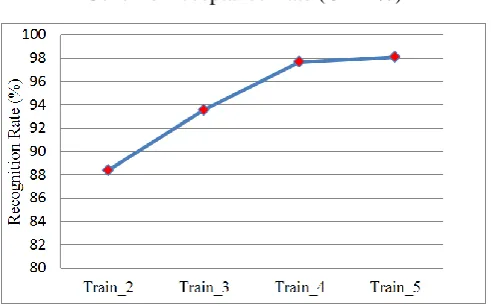
Figure 1 : ROC for Recognition Rate in terms of Genuine Acceptance Rate (GAR %)
As we can see, even the degree of training effort required by the proposed methodology is significantly lower.
IV.
CONCLUSIONS
An attempt is made to design a universal robust face recognition methodology which is invariant to changes in pose, illumination and expressions as well. To address it, we have proposed a design using Kernel Entropy Component Analysis based on Gaussian non-additive entropy measure. We have used Gabor Wavelet Transformation for achieving illumination invariance with some degree of expression and pose invariance, and Discrete Cosine Transform for significant robustness towards illumination changes in the face. The methodology not only yields high success rate due to discriminatory power of the used entropy measure and the Inner Product Classifier, but is also computationally efficient as a common solution to pose, illumination and expression variations. Using NNS, each fiducial point in the test feature vector is compared with the fiducial points in every training feature vector. The maximum number of matches between the test and the training feature vectors leads to a possible match.
V.
REFERENCES
[1]. R. Jenssen, "Kernel entropy component analysis", IEEE Transactions on Pattern Analysis and Machine Intelligence, Volume. 32, No. 5, pp. 847-860, May, 2010.
[2]. T. S. Lee, "Image representation using 2D Gabor wavelets", IEEE Transactions on Pattern Analysis and Machine Intelligence, Volume. 18, pp. 959-971, October, 1996.
[3]. Z. M. Hafed and M. D. Levine, "Face Recognition using the Discrete Cosine Transform", International Journal of Computer Vision, Volume. 43, No. 3, pp. 167-188, 2001. [4]. A. Renyi, "On measures of entropy and
information", Fourth Berkeley Symposium, Volume. 1, pp. 547-561,1961.
[5]. Seba Susan and Madasu Hanmandlu, "A non-extensive entropy feature and its application to texture classification", Neurocomputing, Volume. 120, pp. 214-225, 2013.
[6]. B. Schölkopf, A.J. Smola and K.R. Müller, "Nonlinear Component Analysis as a Kernel Eigenvalue Problem", Neural Computation, Volume. 10, pp. 1299-1319, 1998.
[7]. P. J. Phillips, H. Moon, S. Rizvi and P. Rauss, "The FERET evaluation methodology for face recognition algorithms", IEEE Transactions on Pattern Analysis and Machine Intelligence, Volume. 22, No. 10, pp. 1090-1104, 2000. [8]. P.J. Phillips, H. Wechsler, J. Huang and P.
Rauss, "The FERET database and evaluation procedure for face recognition algorithms", Image Vision Computing, Volume. 16, No. 5, pp. 295-306, 1998.
[9]. Yale Face Database B,
http://cvc.yale.edu/projects/yalefacesB/yalefaces B.html, 2001.
[10]. Michael J. Lyons, Shigeru Akamatsu, Miyuki Kamachi and Jiro Gyoba, "JAFFE database, Coding Facial Expressions with Gabor Wavelets", Proceedings. Third IEEE International Conference on Automatic Face and Gesture Recognition, Nara Japan, IEEE Computer Society, pp. 200-205, April 14 - 16, 1998.