A Concise Query Language with Search and Transform Operations for
Corpora with Multiple Levels of Annotation
Anil Kumar Singh
School of Computer Engg. KIIT University, Bhubaneswar, India
Abstract
The usefulness of annotated corpora is greatly increased if there is an associated tool that can allow various kinds of operations to be performed in a simple way. Different kinds of annotation frameworks and many query languages for them have been proposed, including some to deal with multiple layers of annotation. We present here an easy to learn query language for a particular kind of annotation framework based on ‘threaded trees’, which are somewhere between the complete order of a tree and the anarchy of a graph. Through ‘typed’ threads, they can allow multiple levels of annotation in the same document. Our language has a simple, intuitive and concise syntax and high expressive power. It allows not only to search for complicated patterns with short queries but also allows data manipulation and specification of arbitrary return values. Many of the commonly used tasks that otherwise require writing programs, can be performed with one or more queries. We compare the language with some others and try to evaluate it.
Keywords:Corpus query language, Annotated corpus, Search and transform operations
1.
Introduction
Representation of annotated corpora and mechanisms to ac-cess and manipulate data have been a major area of research in Natural Language Processing (NLP) during the last many years. These are difficult problems (even when considering only text), primarily because linguistic annotation can be of various kinds and at multiple levels, e.g. morphological, Part Of Speech (POS) tagging, chunking, phrase structure, dependency relations, semantic relations, discourse and di-alog information etc. Merging all such annotation (Suder-man and Ide, 2006) for some corpus in one file per docu-ment is perhaps not possible or it may not be feasible. How-ever, many of these annotation levels can indeed be merged in one file per document. One of the ways to do this is through a formalism based on threaded trees (Larchevłque, 1995; Ait-Mokhtar et al., 2002), by having different kinds of threads for different kinds of annotation and putting con-straints on the threads. The concon-straints ensure that the prob-lem of ‘chasing pointers’ (Bird and Liberman, 2000) does not become a serious problem. In the absence of typed threads with well defined constraints, there can be arbitrary pointers that can make the representation as complex as any unconstrained graph.
One specific annotation scheme that uses threaded trees (Begum et al., 2008) encodes dependency trees and some other relations (such as co-reference) over chunked data by the use of constrained threads. It might be possible to translate many other annotation schemes into a threaded tree based scheme, but we leave that for future work, as here we will focus on the query language, not the annota-tion framework.
Though a lot of query languages have been proposed (Bird et al., 2000; Lai and Bird, 2004), we are not aware of any language for threaded tree based annotated data. Languages for linguistic trees have, however, been well studied and we will try to relate our language with a few of those.
We will first present a short review of the related work (Section-2). Then we briefly discuss how threaded trees can be used for encoding multiple layers of annotation (Section-3). After discussing the requirements of a query language for searching and transforming annotated data in Section-4, we present a brief overview of the syntax of the language in Section-5, followed by some examples (Section-6) and a description of the syntactic elements in Section-7. We then suggest some applications of the language (Section-8), be-fore presenting a comparative assessment of the language and its limitations (Section-9). We also derive some direc-tions for future work based on this.
2.
Related Work
In this section we present a short review of related work reported in the literature under two headings: 1) annotation frameworks, and 2) query languages.
2.1. Annotation Frameworks
matched the search conditions. The operations could (optionally) simply specify return values. (Optional)
4. Destinations (dst): The documents or data streams to which the results have to be stored or transferred. (Op-tional)
The source and the destination fields are optional because if the query language is being used from inside a tool (such as an annotation interface), then an annotated file might al-ready be open and this file can become the implicit source, while the screen can become the implicit destination for the query results.
The the top level description of the syntax of a query would be:
[src =:]cnd[−> act] [:= dst] (1)
6.
Example Queries
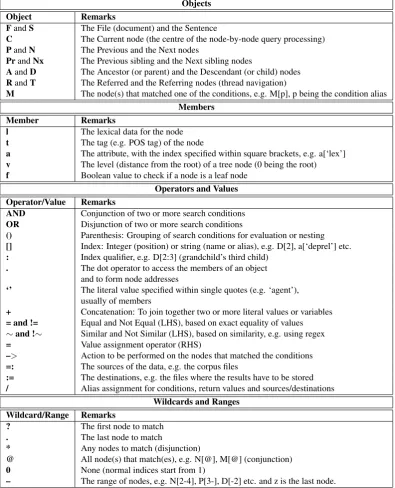
Table 1 (next page) presents a summary of the syntactic elements of the language (Section-7.). A simple example of a query is:
C.t=’NN’ -> C.t=’Noun’ and A
The above query has only two parts: the conditions vided on the Left Hand Side or LHS) and the actions (pro-vided on the Right Hand Side or RHS). This query will replace all the ‘NN’ tags of the tree nodes in the document with the ‘Noun’ tag and return the parent node (the first an-cestor, A[1] or just A).Chere represents the current node, trepresents the tag,. is the dot operator,=is the value as-signment operator and–>is the action operator. If we want the action to be applied only on the leaf nodes (which will usually hold the actual tokens with some lexical data), we can write:
C.t=’NN’ and C.f=’t’ -> C.t=’Noun’
The previous two queries use one of the logical operators (and/or) and the literal value ’t’, which means ’true’. If we add the source and destination to the query (leaving out the terminal node condition to save space), it will be:
xml:src.txt:UTF-8 =: C.t=’NN’ \ -> C.t=’Noun’ := xml:tgt.txt:UTF-8
Two more operators are introduced in the above query: the source (=:) and the destination (:= operators). If, instead of an action, we want the query to return the current, the previous and the next node, then the query would be:
xml:src.txt:UTF-8 =: C.t=’NN’ \
-> C and P and N := raw:tgt.txt:UTF-8
How the result is displayed or stored will depend on the format specified (raw, i.e., simple text, in the above query and xml in the preceding query) as well as on the imple-mentation, e.g. how exactly the multiple values are added to the destination. The current version of the language does provide some control for this through the process of con-catenation:
C.t=’NN’-> C.l+’-’+C.t+’; \
’+P.l+’-’+P.t’;’+N.l+’-’+N.t’;’/r
The alias (/) operator here assigns an alias (a name or a key), viz. r, to the return value. Another new operator above is the concatenation (+) operator.
The present implementation will put the concatenation of values on the RHS of the above query on one line (assum-ing simple text output), preceded by the alias for the return value (if given) or the query term representing the return value followed by ‘: ’. Alternatively, we could write:
C.t=’NN’-> C.l+’-’+C.t/c \
and P.l+’-’+P.t/p and N.l+’-’+N.t/n
For the above query, the current implementation would put the three return values on three separate lines, each pre-ceded by the respective alias followed by ‘: ’.
One very important feature is that the LHS can be prefixed by a directive such as “TT[’deprel’]:” that will ‘extract’ the tree encoded by the thread of type ‘deprel’ and then all the usual tree operations that can be performed on the base tree can also be performed on this tree (in this case a dependency tree):
TT[’deprel’]: C.t=’NP’ AND A.t=’VP’
7.
Syntactic Elements
The syntactic elements of the language can be divided into the following categories: objects and members, operators and values, wildcards and ranges, source and destinations, actions and return values, and custom commands. Together, they provide the expressive power that allows the language to fulfil most of the requirements mentioned in Section-4..
7.1. Objects and Members
Objects
Object Remarks
FandS The File (document) and the Sentence
C The Current node (the centre of the node-by-node query processing) PandN The Previous and the Next nodes
PrandNx The Previous sibling and the Next sibling nodes
AandD The Ancestor (or parent) and the Descendant (or child) nodes RandT The Referred and the Referring nodes (thread navigation)
M The node(s) that matched one of the conditions, e.g. M[p], p being the condition alias Members
Member Remarks
l The lexical data for the node
t The tag (e.g. POS tag) of the node
a The attribute, with the index specified within square brackets, e.g. a[‘lex’] v The level (distance from the root) of a tree node (0 being the root) f Boolean value to check if a node is a leaf node
Operators and Values Operator/Value Remarks
AND Conjunction of two or more search conditions OR Disjunction of two or more search conditions
() Parenthesis: Grouping of search conditions for evaluation or nesting [] Index: Integer (position) or string (name or alias), e.g. D[2], a[‘deprel’] etc. : Index qualifier, e.g. D[2:3] (grandchild’s third child)
. The dot operator to access the members of an object and to form node addresses
‘’ The literal value specified within single quotes (e.g. ‘agent’), usually of members
+ Concatenation: To join together two or more literal values or variables = and != Equal and Not Equal (LHS), based on exact equality of values ∼and !∼ Similar and Not Similar (LHS), based on similarity, e.g. using regex
= Value assignment operator (RHS)
–> Action to be performed on the nodes that matched the conditions =: The sources of the data, e.g. the corpus files
:= The destinations, e.g. the files where the results have to be stored / Alias assignment for conditions, return values and sources/destinations
Wildcards and Ranges Wildcard/Range Remarks
? The first node to match
. The last node to match
* Any nodes to match (disjunction)
@ All node(s) that match(es), e.g. N[@], M[@] (conjunction)
0 None (normal indices start from 1)
– The range of nodes, e.g. N[2-4], P[3-], D[-2] etc. and z is the last node.
Table 1: A Summary of the Query Language
Compound node addresses can be created using the dot operator, e.g. N.A[2].P[3], which will mean the preced-ing node at a distance of 3 (P[3]) of the grandparent node (A[2]) of the next node (N). Variables can be either node addresses, or member values (e.g. N.t) or a combination of variables and literals formed by using the concatenation operator (e.g. N.t+’-’+N.l).
The four members currently implemented are: lor the lex-ical data, t or the tag, v or the level in the tree and the boolean memberfto check if a node is a leaf node. While the object symbols are written in capital letters, the mem-bers symbols are written in small letters.
7.2. Operators and Values
Some of these have already been introduced in the preced-ing section. Here we will add some more information about
7.3. Wildcards and Ranges
In many cases, it can be very useful to be able to spec-ify wildcards when there can be multiple candidates (the closure requirement of Section-4.). The language provides three wildcards and also ranges in terms of integer indices:
• ?: The first one to match, e.g. N[?]
• .: The last one to match, e.g. N[.]
• *: Any node(s) that match(es), e.g. N[*], M[*] (dis-junction)
• @: All node(s) that match(es), e.g. N[@], M[@] (con-junction)
• 0: None (normal indices start from 1)
• -: From the first index to the second index, e.g. P[2-4], P[2-], P[-2]. The last node is specified by the special index z.
Here is one example of using wildcards, aliases and con-catenation:
P[*].t/p=’XC’ and C.t!=’XC’ \ -> M[p:*].t=C.t+’C’
Suppose there are tag sequences of the form XC XC NN, XC XC JJ etc. and they have to be converted to NNC NNC NN and JJC JJC JJ, respectively, then the above query will do that.
7.4. Sources and Destinations
In the current implementation, the sources and destinations can only be files, but they could, in principle, be streams too, e.g. for building pipelines of queries. In the case of files, a source or a destination can be specified in terms of four parts:
• Format: Could be simple text or XML or something else, depending on the implementation
• Location: The URL or the URI or the path of the doc-ument or file
• Charset: The charset or encoding of the document (the default is UTF-8)
• Name: The object alias
An example of a source specification is:
xml:src.txt:UTF-8/s
In the above query, xml is the format, src.txt is the location, UTF-8 is the charset andsis the name or the alias. Aliases allow multiple sources and destinations to be specified and also accessed from other parts of the query. For example the following query uses two sources:
xml:src1.txt:UTF-8/s1 \ and xml:src2.txt:UTF-8/s2 \
=: F[s1].C.t=’NN’ and F[s2].C.t=’Noun’
7.5. Actions and Return Values
Multiple transformations can be performed by using the AND operator on the RHS (Right Hand Side), including on nodes other than the current node by using the same no-tation as for the LHS.
On the RHS, we can also specify return values by using the node symbols and the dot notation (e.g.,C,N.A). For this purpose, another symbol S can be used to return sen-tences for the nodes which match. The syntax is intuitive and easy to remember. If we don’t provide an assignment value, then the node address, variable or the concatenated value is treated as the return value (e.g. N.l will return the next node’s lexical data, whereasNwill return the next node).
If an assignment expression has nodes on both sides, it will be interpreted as a node insertion, deletion or move opera-tion. For example,N x=A.N.Dwill take the next sibling node and move it so that it is dominated by the node which is next to the parent of the current node. At present there is no way to ensure that base text is preserved (the user is ex-pected to ensure that), but we will introduce a mechanism for this in a future version.
7.6. Creating and Navigating Threads
Threads (which represent multiple layers of annotation) can be created by providing a query like the following:
C.l=’reads’ AND C.f=’t’ \ AND A.N[?].t/q=’NP’ \
-> M[q].a[’deprel’]=’’a’:A.a[’name’]’
This query will look for a leaf node with the lexical data ’reads’ such that its parent node is followed by an NP (the first one encountered). Then, according to the action spec-ified on the RHS, it will create a thread from this NP to the parent node (VP) of ’reads’ by adding a value for the deprelattribute as a concatenation of the relation label (’a’ or agent) and the unique name of the VP, separated by a colon.
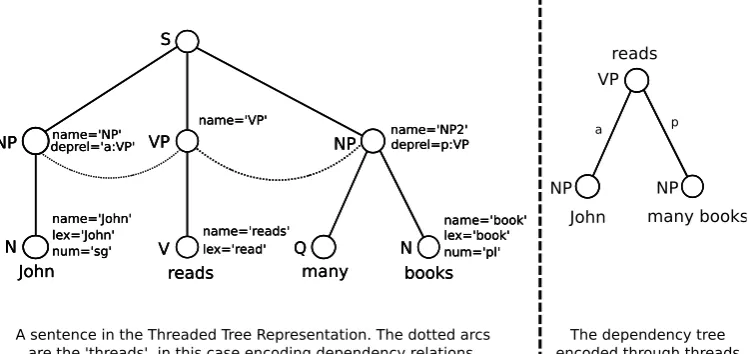
To navigate threads, the node symbols R (referred node) and T (referring node) can be used. For the dependency tree in the example given in Figure 1, VP is the referred node and the two NPs are the referring nodes. Thus the following query:
C.t=’NP’ AND R[’deprel’].t=’VP’
will find all the NPs for which the referred node is a VP. Note that we may have to specify the attribute used for the kind of thread we are searching. The most commonly used of these attributes could be used as a default, so that there is no need to specify it. Since there can be more than one referring nodes, we need to specify the index as well in the case of such nodes:
C.t=’VP’ AND T[’deprel’:2].t=’NP’
7.7. Commands
The language also allows us to specify commands to be executed on the data. For example, if we want to ensure that all the nodes have unique names before we start providing transformation actions, we can give a command like:
reallocateNames
where ‘names’ are the unique node identifiers which are used for marking and navigating threads.
Note that the language supports custom commands, so there is no exhaustive list of commands. The current implemen-tation has some commands that have been found useful so far, but more can be easily added. Commands can also be executed subject to some conditions, i.e., if we write a query with LHS giving the conditions and the RHS giving the command:
C.a[’name’]=’’ -> reallocateNames
This query will ensure that the nodes have unique names when we start marking threads for any kind of extra anno-tation layer.
8.
Applications
Only a few examples have been given in the preceding sections. The query language allows many other kinds of operations using the constructs that have been mentioned. These operations can be used for many purposes, apart from searching. Queries can be written to perform sanity checks on the annotated data. They can be used to automatically mark information that is very predictable (to reduce man-ual work). They can be used to bring the old annotated data in tune with the new annotation specifications without hav-ing to write programs for that purpose, even if the changes require more complex operations than simple global re-placement, as the XC XC NN example given above shows. Queries can also be written to easily extract complex fea-tures for, say, machine learning algorithms. They can be used to make the task of an annotation adjudicator easier.
9.
Comparative Assessment
Lai and Bird (2004) had used seven syntactic queries to compare various tree query languages. These are given in Table 2. The evaluation criterion was at least two fold. First, how many of these queries are expressible in a lan-guage. Second, how concise are those queries.
All seven of these queries can be expressed in our language, but a feature required for the fifth query (‘@’ index for all nodes to match: conjunction, rather than disjunction, as expressed by the ‘*’ index) has not yet been fully imple-mented. These queries are given in Table 3.
Only NiteQL could express all these queries, others (TigerSearch, Emu, CorpusSearch, Tgrep2 and LPath) could not express at least one of these seven queries. How-ever, NiteQL does not have a concise syntax. Thus, in terms of expressive power, our language compares favourably with these languages. It also has comparable conciseness of syntax. Moreover, there are a range of queries that can-not be expressed in other languages because they are can-not
Q1. Find sentences that include the word ‘saw’. Q2. Find sentences that do not include the word ‘saw’. Q3. Find noun phrases whose rightmost child is a noun. Q4. Find verb phrases that contain a verb immediately
followed by a noun phrase that is immediately followed by a prepositional phrase.
Q5. Find the first common ancestor of sequences of a noun phrase followed by a verb phrase. Q6. Find a noun phrase which dominates a word ‘dark’
that is dominated by an intermediate phrase that bears an L-tone.
Q7. Find an noun phrase dominated by a verb phrase. Return the subtree dominated by that noun phrase only.
Table 2: Syntactic Queries for Comparing Tree Query Lan-guages (Lai and Bird, 2004)
Q1. C.l=’saw’−>S
Q2. C.l=’0’ AND C.D[*:0].l/p=’saw’−>S Q3. C.t=’NP’ AND C.D[z].t=’NN’
Q4. C.t=’VP’ AND C.D[*].t ’V*’/p
AND M[p].N.t=’NP’ AND M[p].N[2].t=’NP’ Q5. P[*].t/p=’NP’ and C.t=’VP’ AND
M[p:@].A[*]=C.A[*]/q−>M[q:1] Q6. C.t=’NP’ AND D[*].l=’dark’/p
AND M[p].A[*].a[’tone’]=’LTone’/q AND C.l>M[q].l
Q7. C.t=’NP’ AND C.A[*].t=’VP’
Table 3: Comparison Queries in Our Language
meant for threaded trees and have no equivalents to the R and T nodes that we have.
But a look at the queries in Table 3 also shows some scope for improvement. For example, there is need for ‘dom-inates’ and ‘is-dominated-by’ operators which will make these queries even more concise. As our language was de-veloped initially for annotators working on data that was not huge in quantity, there seem to be some problems from the efficiency point of view too.
Other directions for future work include a study of the for-mal properties of the language and a more rigorous evalu-ation based on various criteria. We are also developing a graphical query designer for this language.
Even in the present condition, the language is being used by many annotators and annotation adjudicators to make their work easier, as well as by a few developers to build substitutes for previously used programs for tasks like san-ity checks, validation (Agarwal et al., 2012) etc. Users with non-computational background have found it easy to learn at least the basics of it, though we have not yet per-formed a proper evaluation of the ease of learning. Our non-empirical experience is that power users can learn it within a few hours, or even less in some cases.
10.
Conclusion
like objects, members, operators, variables, values, nest-ing, aliases, wildcards etc. to allow writing queries that can perform fairly complex operations without the need to write programs for this purpose. Multiple conditions can be given, multiple transformation actions can be specified, multiple return values can be specified and so can be mul-tiple sources and destination. The language can, in fact, be used as a scripting language for annotated data with multiple levels of annotation, where multiple levels are en-coded through ‘typed’ threads. We compared the language to some other query languages and suggested some direc-tions for future work.
11.
References
Rahul Agarwal, Bharat Ram Ambati, and Anil Kumar Singh. 2012. A GUI to Detect and Correct Errors in Hindi Dependency Treebank. In The 8th Interna-tional Conference on Language Resources and Evalua-tion (LREC), Istanbul, Turkey, May. The European Lan-guage Resources Association (ELRA).
S. Ait-Mokhtar, J.P. Chanod, and C. Roux. 2002. Ro-bustness beyond shallowness: incremental deep pars-ing. Natural Language Engineering, 8(2-3):121–144, January.
R. Begum, S. Husain, A. Dhwaj, D.M. Sharma, L. Bai, and R. Sangal. 2008. Dependency annotation scheme for In-dian languages.Proceedings of IJCNLP-2008.
Steven Bird and Mark Liberman. 1998. Towards a formal framework for linguistic annotations. InProceedings of the International Conference on Spoken Language Pro-cessing, Sydney.
Steven Bird and Mark Liberman. 2000. A formal frame-work for linguistic annotation. Speech Communication, 33(1,2):23–60.
Steven Bird, Peter Buneman, and Wang-Chiew Tan. 2000. Towards a query language for annotation graphs. In Proceedings of the Second International Conference on Language Resources and Evaluation, pages 807–814, Athens, Greece.
Steven Bird, Yi Chen, Susan Davidson, Haejoong Lee, and Yifeng Zheng. 2005. Extending xpath to support lin-guistic queries. In Proceedings of Programming Lan-guage Technologies for XML, pages 35–46, Long Beach, California. Association for Computing Machinery. Steven Bird, Yi Chen, Susan Davidson, Haejoong Lee, and
Yifeng Zheng. 2006. Designing and evaluating an xpath dialect for linguistic queries. InProceedings of the 22nd International Conference on Data Engineering, pages 52–61, Atlanta, USA.
Oli Christ. 1994. A modular and flexible architecture for an integrated corpus query system. In Proceedings of COMPLEX’94, Budapest.
Scott Cotton and Steven Bird. 2002. An integrated frame-work for treebanks and multilayer annotations. In Pro-ceedings of the Third International Conference on Lan-guage Resources and Evaluation, pages 1670–1677, Las Palmas, Spain.
H. Cunningham, D. Maynard, K. Bontcheva, and V. Tablan. 2002. GATE: A framework and graphical development
environment for robust NLP tools and applications. In Proceedings of the 40th Anniversary Meeting of the ACL. Crist-Jan Doedens. 1994. Text Databases. One Database Model and Several Retrieval Languages (Language and Computers). Editions Rodopi Amsterdam, Amsterdam and Atlanta.
Laura Kallmeyer. 2000. A query tool for syntactically an-notated corpora. InProceedings of the 2000 Joint SIG-DAT conference on Empirical methods in natural lan-guage processing and very large corpora, pages 190– 198.
Adam Kilgarriff, Pavel Rychly, Pavel Smrz, and David Tugwell. 2004. A query tool for syntactically annotated corpora. InProceedings of Euralex, pages 105–116. Catherine Lai and Steven Bird. 2004. Querying and
updat-ing treebanks: A critical survey and requirements analy-sis. InProceedings of the Australasian Language Tech-nology Workshop, pages 139–146, Sydney, Australia. J.M. Larchevłque. 1995. Optimal incremental parsing.
ACM Transactions on Programing Languages and Sys-tems, 17(1):1–15, January.
Kazuaki Maeda, Steven Bird, Xiaoyi Ma, and Haejoong Lee. 2002. Creating annotation tools with the annota-tion graph toolkit. InProceedings of the Third Interna-tional Conference on Language Resources and Evalua-tion, pages 1914–1921, Las Palmas, Spain.
Philip Resnik and Aaron Elkiss. 2005. The linguist’s search engine: an overview. InACL ’05: Proceedings of the ACL 2005 on Interactive poster and demonstration sessions, pages 33–36, Morristown, NJ, USA. Associa-tion for ComputaAssocia-tional Linguistics.
Anil Kumar Singh and Bharat Ambati. 2010. An integrated digital tool for accessing language resources. InThe Sev-enth International Conference on Language Resources and Evaluation (LREC), Malta, May. The European Lan-guage Resources Association (ELRA).
Anil Kumar Singh. 2008. A mechanism to provide language-encoding support and an nlp friendly editor. In Proceedings of the Third International Joint Conference on Natural Language Processing (IJCNLP), Hyderabad, India.