Design and application of a Gold Standard
for morphological analysis:
SMOR
as an example
of morphological evaluation
Gertrud Faaß, Ulrich Heid, Helmut Schmid
Universit¨at Stuttgart
Institut f¨ur maschinelle Sprachverarbeitung Azenbergstr. 12
D 70174 Stuttgart
faasz,heid,[email protected]
Abstract
This paper describes general requirements for evaluating and documenting NLP tools with a focus on morphological analysers and the design of a Gold Standard. It is argued that any evaluation must be measurable and documentation thereof must be made accessible for any user of the tool. The documentation must be of a kind that it enables the user to compare different tools offering the same service, hence the descriptions must contain measurable values. A Gold Standard presents a vital part of any measurable evaluation process, therefore, the corpus-based design of a Gold Standard, its creation and problems that occur are reported upon here. Our project concentrates on SMOR, a morphological analyser for German that is to be offered as a web-service. We not only utilize this analyser for designing the Gold Standard, but also evaluate the tool itself at the same time. Note that the project is ongoing, therefore, we cannot present final results.
1.
Introduction
1.1. Perspectives on evaluation
There are usually two perspectives to be considered when NLP tools are evaluated: the developer’s and the users’ view. Developers validate their tool by comparing the in-put/output pairs to what they expect, but they also check e.g. for the processing speed or other system parameters. Such validation of specific targets by the developer is de-pendent on the system’s knowledge base (e.g. lexicon con-tents and processing rules), in other words, developers val-idate and report on the performance of their system on the basis of what they expect it to be capable of doing. From the users’ perspective, system performance has to sat-isfy their requirements. We refer to Underwood (1998) who states – for NLP lexicons – that users’ requirements may significantly differ when being compared to what a system has to offer; this ranges from needing far less information than what the system has to offer to needing to extend or modify even the best output. Additionally, in the light of an increasing number of web services offering linguistic anal-ysis (including morphological analanal-ysis), the user should have the possibility to compare between different tools on offer.
When taking both requirements into account, the EAGLES recommendations (EAGLES, 1996) are of use: these state that any NLP system should be evaluated – and measured – according to a given list of features that translate the re-quirements of a user group, thus making systems compara-ble.
Hence, there are actually three evaluation perspectives, i.e. developer’s aims, user’s requirements and the possibility of comparing between systems. Based on these perspectives, we can formulate several basic questions that should be an-swered in the course of an evaluation:
(1) Does the tool do what it is supposed to do (developer’s validation)?
(2) Which features does the system offer (the qualitative aspect)?
(3) How big are the system’s knowledge sources, i.e. how good is its coverage (the quantitative aspect)?
(4) Can (2) and (3) be represented as a list of attribute-value pairs in order to enable users to compare differ-ent systems?
When these questions are applied to a system for inflec-tional morphological analysis, evaluation aspects will con-cern inter alia the correct assignment of base lemmas and parts of speech (henceforth POS), the correctness and com-pleteness of inflectional paradigms and of compounding and derivation, and the system’s coverage when analysing random word forms.
Referring to Underwood (1998), we do not expect the user to have to reduce (or post-process and/or add to) a tool’s output in terms of the coverage or of the granularity of the analyses it provides. There hence will be different version of the Gold Standard necessary to represent the needs of different user groups appropriately, i.e. the several versions will differ with respect to the granularity of analysis: all
will contain the same, if possiblenear-representative, list
of word forms and their expected analyses at a certain level
of granularity. A noun likePriesterweihe(“Priest
ordina-tion”), for example, might be analysed in the different ver-sions of the Gold Standard as a singular and feminine noun
or, additionally, as a compound of the two nounsPriester
andWeihe, or even as a compound of the nounPriesterand
the derived nounWeihe(which has the verbweihen(“[to]
1 Abschluss<NEWORTH><NN>Klausur<+NN><Fem><Nom><Sg>
2 Abschluss<NEWORTH><NN>Klausur<+NN><Fem><Gen><Sg>
3 Abschluss<NEWORTH><NN>Klausur<+NN><Fem><Acc><Sg>
4 Abschluss<NEWORTH><NN>Klausur<+NN><Fem><Dat><Sg>
5 Abschluss<NN><NEWORTH>Klausur<+NN><Fem><Nom><Sg>
6 Abschluss<NN><NEWORTH>Klausur<+NN><Fem><Gen><Sg>
7 Abschluss<NN><NEWORTH>Klausur<+NN><Fem><Acc><Sg>
8 Abschluss<NN><NEWORTH>Klausur<+NN><Fem><Dat><Sg>
Table 4: SMOR analyses ofAbschlussklausur(new orthography)
1 Agrar<KSF>Betrieb<+NN><Masc><Dat><Sg><Old>
2 Agrar<KSF>Betrieb<+NN><Masc><Nom><Pl>
3 Agrar<KSF>Betrieb<+NN><Masc><Gen><Pl>
4 Agrar<KSF>Betrieb<+NN><Masc><Acc><Pl>
5 agrar<KSF>Betrieb<+NN><Masc><Dat><Sg><Old>
6 agrar<KSF>Betrieb<+NN><Masc><Nom><Pl>
7 agrar<KSF>Betrieb<+NN><Masc><Gen><Pl>
8 agrar<KSF>Betrieb<+NN><Masc><Acc><Pl>
Table 5: SMOR analyses ofAgrarbetriebe
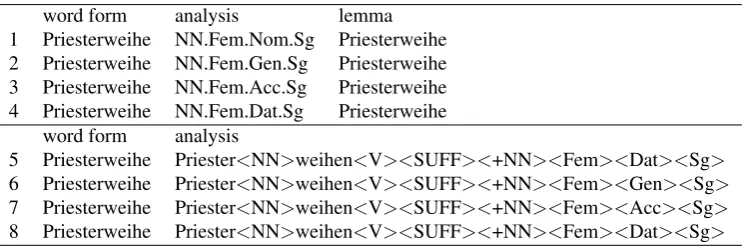
word form analysis lemma
1 Priesterweihe NN.Fem.Nom.Sg Priesterweihe
2 Priesterweihe NN.Fem.Gen.Sg Priesterweihe
3 Priesterweihe NN.Fem.Acc.Sg Priesterweihe
4 Priesterweihe NN.Fem.Dat.Sg Priesterweihe
word form analysis
5 Priesterweihe Priester<NN>weihen<V><SUFF><+NN><Fem><Dat><Sg>
6 Priesterweihe Priester<NN>weihen<V><SUFF><+NN><Fem><Gen><Sg>
7 Priesterweihe Priester<NN>weihen<V><SUFF><+NN><Fem><Acc><Sg>
8 Priesterweihe Priester<NN>weihen<V><SUFF><+NN><Fem><Dat><Sg>
Table 6: Comparison of inflectional and fine grained versions of the Gold Standard
Roland Hausser, editor. 1996. Linguistische
Verifika-tion. Dokumentation zur Ersten Morpholympics 1994. Niemeyer, T¨ubingen, Germany.
Ulrich Heid, Helmut Schmid, Kerstin Eckart, and Erhard Hinrichs. 2010. A corpus representation format for
lin-guistic web services: the D-SPIN Text Corpus Format
and its relationship with ISOstandards. InProceedings
of the seventh international conference on Language Re-sources and Evaluation (LREC), Valetta, Malta, 19 – 21 May 2010. European Language Resources Association (ELRA).
Marie Hinrichs, Thomas Zastrow, and Erhard Hinrichs. 2010. WebLicht: Web-based LRT Services in a
Dis-tributed eScience Infrastructure. In Proceedings of
the seventh international conference on Language Re-sources and Evaluation (LREC), Valetta, Malta, 19 – 21 May 2010. European Language Resources Association (ELRA).
Mikko Kurimo and Matti Varjokallio. 2008. Unsupervised morpheme analysis evaluation by a comparison to a
lin-guistic gold standard – morpho challenge 2008. In
Work-ing Notes for the CLEF 2008 Workshop.
Anke Luedeling, Tanja Schmid, and Sawwas Kiokpa-soglou. 2001. On neoclassical word formation in
ger-man. In Geert Booij and Jaap van Marle, editors,
Year-book of Morphology, pages 253 – 283. Kluwer, Dor-drecht.
Christopher D. Manning and Hinrich Sch¨utze. 2001.
Foundations of Statistical Natural Language Processing. MIT Press, Boston, MA, 4 edition.
Uwe Quasthoff, Matthias Richter, and Christian Biemann. 2006. Corpus portal for search in monolingual corpora. InProceedings of 5th International Conference on Lan-guage Resources and Evaluation (LREC 2006), pages 1799 – 1802, Genoa, Italy.
Michael Schiehlen. 2003. A Cascaded Finite-State Parser
for German. In Proceedings of the 10th Conference of
the European Chapter of the Association for Computa-tional Linguistics (EACL 2003), pages 163 – 166, Bu-dapest, Hungary.
Sprachverarbeitung, and Seminar f¨ur Sprachwis-senschaft, Universit¨at T¨ubingen.
Anne Schiller. 1996. Deutsche flexions- und komposition-smorphologie mit PC-KIMMO. In Roland Hausser, edi-tor,Linguistische Verifikation. Dokumentation zur Ersten Morpholympics 1994, T¨ubingen. Niemeyer.
Tanja Schmid, Anke L¨udeling, Bettina S¨auberlich, Ulrich Heid, and Bernd M¨obius. 2001. Deko – ein system zur
analyse komplexer wrter. In Henning Lobin, editor,
Pro-ceedings der GLDV-Fr¨uhjahrstagung 2001, pages 49 – 57, Universitt Gießen, 28. – 30. Mrz.
Helmut Schmid, Arne Fitschen, and Ulrich Heid. 2004. A German Computational Morphology Covering
Deriva-tion, ComposiDeriva-tion, and Inflection. InProceedings of the
IVth International Conference on Language Resources and Evaluation (LREC 2004), pages 1263 – 1266, Lis-bon, Portugal.
Helmut Schmid. 1994. Probabilistic part-of-speech
tag-ging using decision trees. In International Conference
on New Methods in Language Processing, pages 44 – 49, Manchester, UK.
Helmut Schmid. 2000. Unsupervised Learning od
Pe-riod Disambiguation for Tokenisation. http://www.
ims.uni-stuttgart.de/˜schmid. Internal Re-port, IMS, University of Stuttgart.
Helmut Schmid. 2005. A programming language for finite
state transducers. InProceedings of the 5th International
Workshop on Finite State Methods in Natural Language Processing (FSMNLP 2005), Helsinki, Finland.
Nancy L. Underwood. 1998. Issues in Designing a Flexi-ble Validation Methodology for NLP Lexica. In A.
Ru-bio, N Gallardo, R. Castro, and A. Tejada, editors,