Feature Reduction Using Ensemble Approach
Yingju Xia Cuiqin Hou Zhuoran Xu Jun Sun
Fujitsu Research & Development Center Co.,LTD.
355Unit 3F, Gate 6
,
Space 8,Pacific Century Place,
No.2A Gong Ti Bei Lu, Chaoyang District, Beijing 100027
{yjxia, houcuiqin, xuzhuoran, sunjun}@cn.fujitsu.comAbstract
The performance of many content analysis methods heavily dependent on the features they are applied. A fundamental problem that makes the content analysis difficult is the curse of dimensionality. In this study, we propose a novel feature reduction method which adopts ensemble approach to measure the divergence between the training set and test set and use the divergence to supervise the feature reduction procedure. The proposed method uses pairwise measure to get the diversity between classifiers and selects the complementary classifiers to get the pseudo labels on test set. The pseudo labels are used to measure the divergence between training set and test set. The feature reduction algorithm merges the adjacent feature space according to the divergence, such reduce the feature number. We evaluated the proposed method on several standard datasets. Experiment results shown the efficiency of the proposed feature reduction method.
1
Introduction
A large number of electronic textual documentations are generated everyday on webs and the Internet. For example: books, e-newspapers, e-magazines, and essays in blogs. It is difficult for web administrators to manage and classify numerous electronic documentations manually (Ng et al. 1997; Combarro et al. 2005;
Gao and Chien, 2012; Robati et al., 2015). It makes the content analysis tools more and more important. A main problem is the high dimensions of features which not only increase the processing time but also decrease the performance of analysis tools. Automatic feature reduction or selection methods are usually used to reduce the number of features (Reif and Shafait 2014). Removing irrelevant or redundant features not only improves performance, but also reduces the dimensionality of the data thereby shortening the training and application time of the learning scheme, building better generalizable models, and decreasing required storage. Furthermore, shorter feature vectors help the content analysis tools in better coping with the curse of dimensionality.
There is a vast literature on the feature reduction (How and Kiong, 2005; Garcia et al., 2013; Choudhary and Saraswat, 2014). When dealing with the features with continuous (real) values, the feature reduction can be regarded as discretization procedure which aim at finding a representation of each feature that contains enough information for the learning task at hand, while ignoring minor fluctuations that maybe irrelevant for that task (Ferreira and Figueiredo, 2012). In practice, discretization can be viewed as a feature reduction method since it maps data from a huge spectrum of numeric values to a greatly reduced subset of discrete values (Garcia et al., 2013).
Actually, the techniques in Garcia et al.(2013) can also be adopted to discrete values. The feature reduction task can be defined as following:
Assuming a data set consisting of N examples and
C target classes, for a feature A in this data set with
309
The adjacent intervals which have small change in the distribution will be merged. By elaborately selected moving step and the distribution distance threshold, the feature space will finnally partitioned into several sub-space which will reduce the original feature space.
The algorithm is shown below:
BEGIN
For each classifier i:
Select the L classifiers with high disagreement with the classifier i in the classifier pool
Optimize the weight W of the selected L
classifiers
Make an ensemble model form the selected L
classifiers and the optimal weight W
Get the pseudo labels in the test set using the ensemble model
For each feature fi:
Set the interval merge step: T
For each adjacent T:
Get the Bayesian measure BT using the formula (2)
Get KL Divergence Dp using the formula (3)
IF BT < θb and Dp < θd
Merge the adjacent intervals ELSE
Go to next interval T
END
Here, the θb and θd are the threshold for Bayesian-measure and KL divergence respectively.
3
Experimental Results
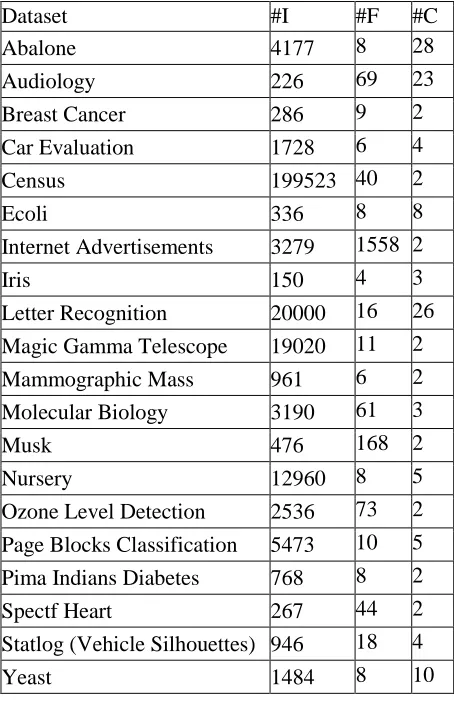
The performance of the proposed method is evaluated on 20 UCI datasets (Frank and Asuncion, 2010). The detailed information of these datasets are shown in Table 2.
In the table 2, '#I' denotes the number of instances, '#F' denotes the feature number and '#C' denotes the classess number. These datasets cover some high-dimensional sets, some large sets, some small sets and some typical/balanced sets. More detailed information can be found on the UCI website.
The classifier pool includes Random Forest, Decision Tree, Gradient boosting, Maximum Entropy and Naïve Bayes. Every model uses the pseudo labels gotten from others to make the feature reduction.
A set of experiments are conducted in the multiple classifier system to show the performance
of the proposed ensemble featrure reduction method. The conventional weighted majority voting approach is adopted as the fusion method for multiply classifier. Some analysis (Kuncheva, 2004; Wozniak and Jackowski, 2009) shown that it is an effective way for fusion of multiply classifier. The algorithm begins by creating a set of experts and assigning a weight to each. When a new instance arrives, the algorithm passes it to and receives a prediction from each expert. The algorithm predicts based on a weighted majority vote of the expert predictions.
The data sets considered are partitioned using the 10-fold cross-validation procedure. The 'Accuracy' is used as the performance measures. The 'Accuracy' is the number of successful hits relative to the total number of classification. It has been by far the most commonly used metric for assessing the performance of classifiers for years (Prati et al., 2011; Witten et al., 2011).
Dataset #I #F #C
Abalone 4177 8 28
Audiology 226 69 23
Breast Cancer 286 9 2
Car Evaluation 1728 6 4
Census 199523 40 2
Ecoli 336 8 8
Internet Advertisements 3279 1558 2
Iris 150 4 3
Letter Recognition 20000 16 26
Magic Gamma Telescope 19020 11 2 Mammographic Mass 961 6 2
Molecular Biology 3190 61 3
Musk 476 168 2
Nursery 12960 8 5
Ozone Level Detection 2536 73 2 Page Blocks Classification 5473 10 5
Pima Indians Diabetes 768 8 2
Spectf Heart 267 44 2
Statlog (Vehicle Silhouettes) 946 18 4
Yeast 1484 8 10
The experimental results on very data set are shown on Table 3. Here, the proposed ensemble method is compared with the typical unsupervised method EW (Equal Width) and the typical supervised method Bayes (Bayesian). The experimental results show that the proposed ensemble method outperform the conventional method (Equal Width and Bayesian) on almost all data set except the 'Iris' data set.
By analysis of the size of dataset, we found that the dataset size will impact the performance. Take the 'Iris' as example, there are only 150 instances in this dataset which lead to a small feature space (only 22 unique values for the first feature). There is little hint to make the feature reduction. It is very difficult to put them into several bins.
Dataset EW Bayes Ensemble Abalone 87.86 88.62 89.58
Audiolog 59.13 59.6 60.06
Breast Cancer 90.6 91.65 92.21
Car Evaluation 84.24 85.12 86.19
Census 84.04 84.39 86.53
Ecoli 77.5 78.35 78.89
Internet 64.09 64.64 65.85
Iris 95.5 94.25 94.25
Letter 87.59 88.21 90.26
Magic 86.72 87.82 90.09
Mammographic 67.6 68.05 69.01
Molecular 70.89 71.64 72.83
Musk 84.42 84.61 85.35
Nursery 83.59 84.29 86.05
Ozone 73.02 73.26 74.95
Page 83.72 84.16 85.63
Pima 69.07 69.52 70.61
Spectf Heart 80.57 80.72 81.19
Statlog 89.05 89.35 90.61
Yeast 60.99 61.84 62.65
Table 3. The experimental results
Since the feature space reduction is conducted on the feature space for each classifier. To further investigate the performance of the proposed feature
reduction method, the compared experiments on each single classifier are also conducted to show the effect of the proposed method. Here, we take the Equal Width as the baseline method and the relative difference is taken as the evaluation measure.
The relative difference is calculated as:
𝐴𝑐𝑐𝑢𝑟𝑎𝑐𝑦𝑟𝑒𝑓− 𝐴𝑐𝑐𝑢𝑟𝑎𝑐𝑦𝑏𝑎𝑠𝑒𝑙𝑖𝑛𝑒 𝐴𝑐𝑐𝑢𝑟𝑎𝑐𝑦𝑏𝑎𝑠𝑒𝑙𝑖𝑛𝑒
(9) Here, the Accuracybaseline is the accuracy of EW on each dataset. The Accuracyref is the accuracy of Bayesian and the proposed ensemble method.
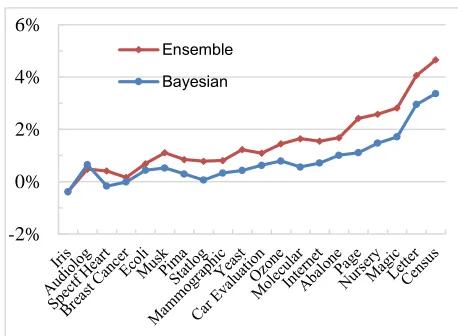
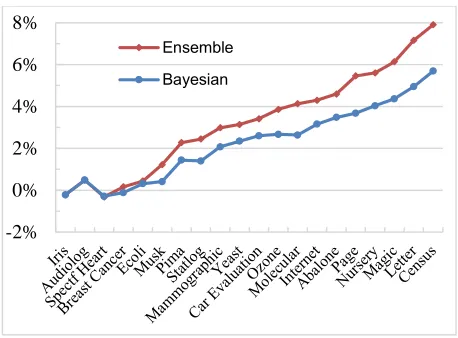
Figure 1 ~ 6 show the experimental results on each individual classifier (Random Forest, Decision Tree, Gradient boosting, Maximum Entropy and Naïve Bayes). Here, the baseline method is Equal Width. The blue line is the relative difference of Bayesian method comparing with the baseline. The red line is the relative difference of the Ensemble method. The x-axis shows the name of the selected datasets which are sorted by the size. The smallest dataset is 'Iris' which only has 150 instances while the largest dataset is the ' Census' dataset which has 199,523 instances.
Figure 1. The experimental results on Random Forest
From Figure 1, we see that for Random Forest classifiers, the more data, the better performance. More than 4% enhancement has been achived on the 'Census' dataset which has 199,523 instances. In most dataset, the proposed ensemble method and Bayesian method are better than the unpervised method Equal Width. When the dataset is small, the performance is not so satisfied. For example, the ensemlbe method and Bayesian method worse than
-2% 0% 2% 4% 6%
the Equal Width method on the 'Iris' dataset. Also we can see that, when the dataset is small, the ensemble method can not beat the Bayesian method (' Audiolog ': 226 instances).
Figure 2. The experimental results on Decision Tree
Figure 2 shows the experimental results using Decision Tree classifier. We can see that the same trend as shown on the Random Forest. The highest enhancement is about 5% which is a little high than Random Forest. It is also gotten from the 'Census' dataset.
Figure 3. The experimental results on Gradient Boosting
Figure 3 shows the experimental results using Gradient Boosting classifiers. It’s similar with the Rodom Forest and Decision Tree. For Gradient Boosting classifier, the ensemble method also does not performance well on the small datasets.
Figure 4. The experimental results on Maximum Entropy
Figure 4 shows the experimental results using Maximum Entropy classifier. The proposed ensemble method achived about 8% enhancement when the dataset is large ('Census': 199,523 instances). However, the performance also fluctuant when the dataset is small. It become stable when the dataset size is larger than 500. This may because the ensemble method need more data to measure the distribution divergence between training set and test set.
Figure 5. The experimental results on Naïve Bayes
Figure 5 shows the experimental results using Naïve Bayes classifier. The enhancement is also great (more than 6%). It is more fluctuanct than the Maximum Entroyp classifier when the dataset is small.
To further investigate the performance on different data size. A set of experiments on ‘Census’ -2%
0% 2% 4% 6%
Ensemble Bayesian
-2% 0% 2% 4% 6%
Ensemble Bayesian
-2% 0% 2% 4% 6% 8%
Ensemble Bayesian
-2% 0% 2% 4% 6% 8%
dataset are conducted. The sub-datasets range from 50 to 190,000 are extracted from the whole dataset. The experiments are intend to compare the performance of EW, Bayesian and the proposed ensemble method. The experimental results are shown as the relative difference with the baseline method (Equal Width method).
Figure 6 shows the experimental results. The x-axis shows the size of each sub-datasets. The y-x-axis shows the relative difference. The expeirments are conducted in the multiply classifier scenario, that is the finnal predciton is made by the ensemble classifier. We can see that the total enhancement is not higher than the Maximum Entropy or the Naïve Bayes classifier. This is because the fusion procedure highly depends on the diversity among the classifiers. It can’t get the highest enhancement as the single classifier.
When the data size is small, both the proposed ensemble and Bayesian method cannot get good performance. For example, when the data size is less than 100, the ensemble and Bayesian methods are worse than EW. It is because that the Bayesian method needs to make statistic on the training set. The ensemble method need more data to calculate the distribution difference between training set and test set. From the Figure 6, we can see that, even there are about 1,000 samples, the ensemble method cannot get great enhancement in comparison with the Bayesian method. The ensemble method is worse than Bayesian method when the data size is small than 200. With the bigger dataset, the ensemble method performance better, about 4% enhancement can be achieved.
Figure 6. The experimental results on dataset size
4
Conclusions and Future Work
In this study, we propose a feature reduction method which uses ensemble approach to get the pseudo labels and utilize the pseudo labels to supervise the feature reduction procedure. The experiments conducted on different type of datasets compared the proposed method with the conventional feature reduction methods. The experimental results shown the effectiveness and efficiency of the proposed method.
The future work includes the scheme on selecting the candidate models for getting the pseudo labels. The measurement on distribution difference between training set and test set also need to be explored. How to improve the performance on small datasets is also research topic.
References
Bai Q. X., Lam H. and Sclaroff S. 2014. A Bayesian Framework for Online Classifier Ensemble. The 31st International Conference on Machine Learning, pages 1584-1592, Beijing, China, 2014.
Bay S. D. 2001. Multivariate Discretization for set Mining. Knowledge information Systems, Vol. 3, pp 491-512
Breiman L. 1996. Bagging predictors. Machine Learning, 24(2), 1996, 123-140
Brown G., Wyatt J., Harris R. and Yao X. 2005. Diversity creation methods: a survey and categorization. Journal of Information Fusion 6(1), 2005, 5–20.
Choudhary A., and Saraswat J. K. 2014. Survey on Hybrid Approach for Feature Selection. International Journal of Science and Research, 3(4), 438-439.
Combarro E. F., Montan E., D′Iaz I., Ranilla J., and Mones R. 2005. Introducing a Family of Linear Measures for Feature Selection in Text Categorization. IEEE Transactions on Knowledge and Data Engineering, Vol. 17, No. 9, pp. 1223-1232
Dietterich T. 2000a. Ensemble methods in machine learning, in: Multiple Classifier Systems. Lecture Notes in Computer Science, vol. 1857, Springer, Berlin, Heidelberg, 2000, 1–15.
Dietterich T. 2000b. An experimental comparison of three methods for constructing ensembles of decision trees: Bagging, boosting and randomization. Machine Learning, 40(1), 2000, 1-22.
Dougherty J., Kohavi R., and Sahami M. 1995. Supervised and unsupervised discretization of -2%
0% 2% 4% 6%
Ensemble
continuous features. In Machine learning: proceedings of the twelfth international conference, Vol. 12, pp 194-202
Ferreira A. J. and Figueiredo M. A. T. 2012. An unsupervised approach to feature discretization and selection. Pattern Recognition 45(2012), pp. 3048– 3060
Frank A. and Asuncion A. 2010. UCI machine learning repository, http://archive.ics.uci.edu/ml.
Freund Y. and Schapire R. E. 1997. A decision-theoretic generalization of on-line learning and an application to boosting. Journal of computer and system sciences, 55(1), 1997, 119-139.
Gama J., zliobaite I., Bifet A., Pechenizkiy M. and Bouchachia A. 2014. A survey on concept drift adaptation. ACM Computing Surveys 46.4 (2014): 44.
Gao L. J. and Chien B. C. 2012. Feature Reduction for Text Categorization Using Cluster-Based Discriminant Coefficient. In Technologies and Applications of Artificial Intelligence (TAAI), 2012 Conference on (pp. 137-142). IEEE.
Garcia S., Luengo J., Sez J., Lpez V. and Herrera F. 2013. A survey of discretization techniques: Taxonomy and empirical analysis in supervised learning. IEEE Transactions on Knowledge and Data Engineering 25, pp. 734–750.
Ho T. 1998. The random space method for constructing decision forests. IEEE Transactions on Pattern Analysis and Machine Intelligence, 20:8, 1998, 832– 844.
How B. C. and Kiong W. T. 2005. An examination of feature selection frameworks in text categorization. In AIRS’05: Proceedings of 2nd Asia information retrieval symposium, PP 558–564.
Kerber R. 1992. ChiMerge: Discretization of Numeric Attributes. Proc. Nat'l Conf. Artifical Intelligence Am. Assoc. for Artificial intelligence, pp 123-128
Kuncheva L. 2004. Combining Pattern Classifiers: Method and Algorithms, Wiley Interscience, 2004
Kuncheva L. and Whitaker C. 2003. Measures of diversity in classifier ensembles and their relationship with the ensemble accuracy. Machine Learning, 51:181-207, 2003.
Jiang F., Zhao Z., and Ge Y. 2010. A Supervised and Multivariate Discretization Algorithm for Rough Sets. Proc. Fifth Int’l Conf. Rough Set and Knowledge Technology (RSKT), pp. 596-603
Li L., Hu Q., Wu X. and Yu D. 2014. Exploration of classification confidence in ensemble learning. Pattern Recognition, 47(9), 2014, 3120-3131.
Li R. P. and Wang Z. O. 2002. An Entropy-based Discretization Method for Classification Rules with Inconsistency Checking. Proc. First Int'l Conf. Machine Learning and Cybernetics. pp 243-246
Liu H. and Setiono R. 1997. Feature selection via discretization. IEEE transactions on knowledge and data engineering, Vol 9, No. 4, 642-645
Liu Y. Yao X. and Higuchi T. 2000. Evolutionary ensembles with negative correlation learning. IEEE Transactions on Evolutionary Computation, 4, 2000, 380-387
Jin R., Breitbart Y. and Muoh C. 2009. Data Discretization Unification. Knowledge and Information Systems, Vol. 19, pp 1-29
Ng H. T., Goh W. B., and Low K. L. 1997. Feature selection, perceptron learning, and a usability case study for text categorization. In SIGIR ’97: Proceedings of the 20th annual international ACM SIGIR conference on Research and development in information retrieval, PP 67–73
Prati R.C., Batista G.E.A.P.A., and Monard M.C. 2011. A Survey on Graphical Methods for Classification Predictive Performance Evaluation, IEEE Trans. Knowledge and Data Eng., Vol. 23, No. 11, pp. 1601-1618, Nov. 2011, doi: 10.1109/TKDE.2011.59.
Quinlan J. R. 1996. Bagging, boosting, and C4. 5. In AAAI/IAAI, Vol. 1, 1996, 725-730
Reif M. and Shafait F. 2014. Efficient feature size reduction via predictive forward selection, Pattern Recognition(2014), Vol. 47, PP 1664-1673
Robati, Z., Zahedi, M., and Fayazi Far, N. 2015. Feature Selection and Reduction for Persian Text Classification. International Journal of Computer Applications, 109(17), 1-5.
Schapire R. E., Freund Y., Bartlett P. and Lee W. S. 1998. Boosting the margin: A new explanation for the effectiveness of voting methods. Annals of statistics, 1998, 1651-1686.
Schapire R. E. and Singer Y. 1999. Improved boosting algorithms using confidence-rated predictions. Machine learning, 37(3), 1999, 297-336.
Singh G. K. and Minz S. 2007. Discretization Using Clustering and Rough Set Theory. Proc. 17th int'l Conf. Computer Theory and Applications, pp 330-336
Skalak D. 1996. The sources of increased accuracy for two proposed boosting algorithms. In Proc. American Association for Artificial Intelligence, AAAI-96, Integrating Multiple Learned Models Workshop
Tang E. K., Suganthan P. N. and Yao X. 2006. An analysis of diversity measures. Mach. Learn. 65(2006)247–271.
Witten I.H., Frank E., and Hall M.A.2011. Data Mining: Practical Machine Learning Tools and Techniques, third ed. Morgan Kaufmann, 2011.
Wozniak M., Grana M. and Corchado E. 2014. A survey of multiple classifier systems as hybrid systems. Information Fusion, 16:3-17, 2014.
Wozniak M. and Jackowski K. 2009. Some remarks on chosen methods of classifier fusion based on weighted voting, in: E. Corchado, X. Wu, E. Oja, A. Herrero, B. Baruque (Eds.), Hybrid Artificial Intelligence Systems, Lecture Notes in Computer Science, vol. 5572, Springer, Berlin/Heidelberg, 2009, pp. 541–548
Wu X. 1996. A Bayesian discretizer for real-valued attributes. The Computer Journal, 39(8), 688-691.
Yang Y. and Webb G. I. 2009. Discretization for Naive-Bayes Learning: Managing Discratization bias and Variance. Machine Learning. vol. 74, No. 1, pp 39-74