Copyright 2012 by Hoai-Thu Vuong, Vinh Van Nguyen, Viet Hong Tran, and Akira Shimazu
Improving Statistical Machine Translation with Processing Shallow Parsing
Hoai-Thu Vuong, Vinh Van NguyenUniversity of Engineering and Technology, Vietnam National University 144, Xuan Thuy, Cau Giay , Hanoi
{thuvh, vinhnv}@vnu.edu.vn
Viet Hong Tran
Department of Information Technology University Of Economic And Technical Industries
456 Minh Khai, Hai Ba Trung, Hanoi [email protected]
Akira Shimazu
Japan Advanced Institute of Science and Technology 1-1, Asahidai, Nomi, Ishikawa, 923-1292, Japan
Abstract
Reordering is of essential importance for phrase based statistical machine translation (SMT). In this paper, we would like to present a new method of reordering in phrase based SMT. We inspired from (Xia and Mc-Cord, 2004) using preprocessing reorder-ing approaches. We used shallow pars-ing and transformation rules to reorder the source sentence. The experiment results from English-Vietnamese pair showed that our approach achieves significant improvements over MOSES which is the state-of-the art phrase based system.
1 Introduction
In SMT, the reordering problem (global reordering) is one of the major problems, since different lan-guages have different word order requirements. The SMT task can be viewed as two subtasks: predicting the collection of words in a translation, and deciding the order of the predicted words (reordering prob-lem). Currently, phrase-based statistical machine translation (Koehn et al., 2003; Och and Ney, 2004) is the state-of-the-art of SMT because of its power in modelling short reordering and local context.
However, with phrase based SMT, long distance reordering is still problematic. In order to tackle the long distance reordering problem, in recent years, huge research efforts have been conducted using syntactic information. There are some studies on integrating syntactic resources within SMT. Chiang (Chiang, 2005) shows significant improvement by
keeping the strengths of phrases, while incorporat-ing syntax into SMT. Some approaches have been applied at the word-level (Collins et al., 2005). They are particularly useful for language with rich mor-phology, for reducing data sparseness. Other kinds of syntax reordering methods require parser trees , such as the work in (Quirk et al., 2005; Collins et al., 2005; Huang and Mi, 2010). The parsed tree is more powerful in capturing the sentence structure. However, it is expensive to create tree structure, and building a good quality parser is also a hard task. All the above approaches require much decoding time, which is expensive.
The approach we are interested in here is to bal-ance the quality of translation with decoding time. Reordering approaches as a preprocessing step (Xia and McCord, 2004; Xu et al., 2009; Talbot et al., 2011; Katz-Brown et al., 2011) is very effective (im-provement significant over state of-the-art phrase-based and hierarchical machine translation systems and separately quality evaluation of reordering mod-els).
• the probability of each target phrase in the hypothesis given the corresponding source phrase.
• the lexical score for each target phrase given the corresponding source phrase.
• the lexical score for each source phrase given the corresponding target phrase.
• the target language model probability for the sequence of target phrase in the hypothesis.
• the word and phrase penalty score, which allow to ensure that the translation does not get too long or too short.
• the distortion model allows for reordering of the source sentence.
The probabilities of source phrase given target phrases, and target phrases given source phrases, are estimated from the bilingual corpus.
(Koehn et al., 2003) used the following distortion model (reordering model), which simply penalizes nonmonotonic phrase alignment based on the word distance of successively translated source phrases with an appropriate value for the parameterα:
d(ai−bi−1) =α|ai−bi−1−1| (2) 4 Shallow Syntactic Preprocessing for
SMT
In this section, we describe the transformation rules and how applying it to shallow tree for reordering an English sentence.
4.1 Transformation Rule
Suppose that Ts is a given lexicalized tree of the source language (whose nodes are augmented to in-clude a word and a POS label). Ts contains n ap-plications of lexicalized CFG rulesLHSi →RHSi (i ∈ 1, n). We want to transformTs into the target language word order by applying transformational rules to the CFG rules. A transformational rule is represented as (LHS→RHS, RS), which is a pair consisting of an unlexicalized CFG rule and a re-ordering sequence (RS). For example, the rule (NP
→JJ NN, 1 0) implies that the CFG rule (NP→JJ NN) in the source language can be transformed into
the rule (NP→NN JJ) in the target language. Since the possible transformational rule for each CFG rule is not unique, there can be many transformed trees. The problem is how to choose the best one (we can see (Nguyen and Shimazu, 2006) for a description in more details). We use the method described in (Nguyen and Shimazu, 2006) to extract the transfor-mation rules from the parallel corpus and induce the best sequence of transformation rules for a source tree. Besides, we also built a small set of transfor-mation rules by hand (the handwritten rules).
4.2 Shallow Syntactic Processing
In this section, we describe a method to build a trans-lation model for a pair English to Vietnamese. We aim to reorder an English sentence to get a new En-glish, and some words in this sentence are arranged as Vietnamese words order.
tom ’s [two blue books]
tom ’s [two books blue]
[two books blue] ’s tom
hai cuốn sách màu xanh của tom
Figure 1: An Example of phrase before and after our pre-processing
Figure 1 gives examples of original and prepro-cessed phrase in English. The first line is the original English phrase with a chunk (two blue books), and the second line is the phrase with a modified chunk (two books blue). This chunk is arranged as the Viet-namese order. However, we aim to preprocess the words outside the chunk (the phrase ”tom ’s” in Fig-ure 1), and the third line is the output of our method. Finally, the fourth line is the Vietnamese phrase. As you can see, the third and fourth line have the same word order.
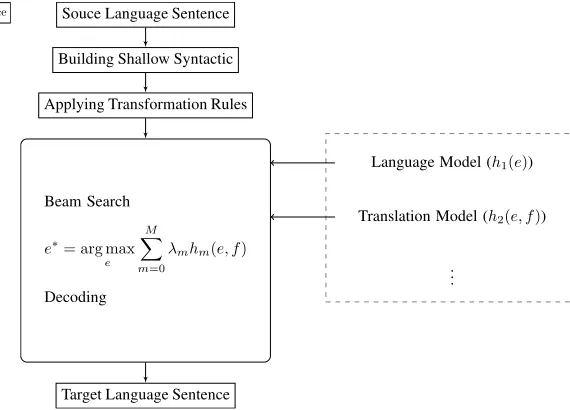
After pre-processed, this new sentence is used in training process to get a phrased translation model, and in decoding process to get a target sentence (by using translation which is trained in training pro-cess). To preprocess, we follow these steps:
Source Language Sentence Target Language Sentence
Building Shallow Syntactic
Applying Transformation Rules
Training Translation Model
Phrase Translation Model
Figure 2: Our training process
• applying transformation rules
So as to build shallow syntactic, we use a method described in (Tsuruoka et al., 2009). Their approach introduced the method to parse an English sentence by using chunking (balance accuracy with speed time). Their method is high accuracy (accuracy with 88.4 F-score) and fast parsing time: using CRFTag-ger to chunk the sentence, and then setup a tree from the chunks and recursive until they cannot chunk the sentence. Their result showed that this method is outstanding in performance with high accuracy. As they did, we also receive a shallow syntactic when parse the source sentence in English. However, we stop chunking after two loop steps. So that,the high-est deep of node in syntactic tree is two. By doing that, we will balance between accuracy and perfor-mance time. We can use the method of (Tsuruoka et al., 2009) to build full parse tree, but that will be leave it for future work.
After building the shallow syntactic, the transforma-tion rules are applied. After finding the matching rule from the top of the shallow tree, we arrange the words in the English sentence, which is covered by the matching node, like Vietnamese words order. And then, we do the same for each children of this node. If any rule is applied, we use the order of orig-inal sentence. Not only rule is learnt automatically from bilingual corpora, we also try applying hand-written rules.
5 Experiment
5.1 Implementation
• We developed the shallow parsing by using the method from (Tsuruoka et al., 2009) to parse a
Souce Language Sentence
Building Shallow Syntactic
Applying Transformation Rules
Beam Search
e∗= arg max e
M
X
m=0
λmhm(e, f)
Decoding
Target Language Sentence
Language Model (h1(e))
Translation Model (h2(e, f))
.. .
Figure 3: Our decoding process
source sentences (English sentences) including a shallow tree.
• The rules are learnt from English-Vietnamese parallel corpus and Penntree Bank Corpus. We used the CFG transformation rules (chunk lev-els) for extraction from (Nguyen and Shimazu, 2006)’s method to reorder shallow tree of a source sentences.
• We implemented preprocessing step during both training and decoding time.
• Using the SMT Moses decoder (Koehn et al., 2007) for decoding.
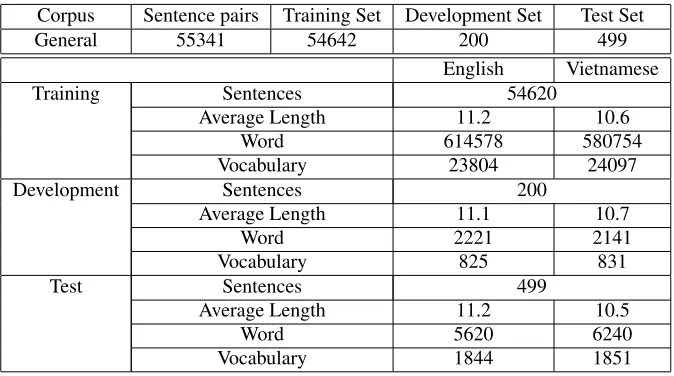
5.2 Data set and Experimental Setup
Corpus Sentence pairs Training Set Development Set Test Set
General 55341 54642 200 499
English Vietnamese
Training Sentences 54620
Average Length 11.2 10.6
Word 614578 580754
Vocabulary 23804 24097
Development Sentences 200
Average Length 11.1 10.7
Word 2221 2141
Vocabulary 825 831
Test Sentences 499
Average Length 11.2 10.5
Word 5620 6240
Vocabulary 1844 1851
Table 1: Corpus Statistical
Besides using preprocessing, we also used default reordering model in Moses Decoder: using word-based extraction (wbe), splitting type of reodering orientation to three class (monotone, swap and dis-continuous – msd), combining backward and for-ward direction (bidirectional) and modeling base on both source and target language (fe) (Koehn et al., 2007). First system in 2 is our baseline system. The second and the third system are the baseline system which is applied the transformation rules (include the automatic and handwritten rules). In these ex-periments, we only use the chunking level. The fifth experiment is the result of our works: applied au-tomatic transformation rules into shallow syntactic. By doing these experiments, we can show the ef-fective of our method. In addition, we also did the fourth and sixth experiment with a specific param-eter for the MOSES Decoder (monotone). By us-ing this flag, we will discard the distortion model, so that, the decoder only do monotone decode.
5.3 BLEU score
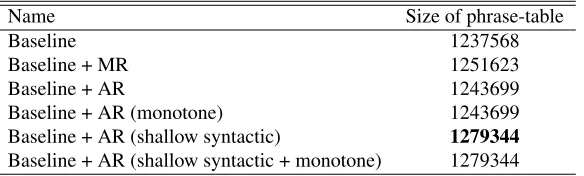
The result of our experiments in table 3 showed our applying transformation rule to process the source sentences. Thanks to this method, we can find out various phrases in the translation model. So that, they enable us to have more options for decoder to generate the best translation.
Table 4 describes the BLEU score (Papineni et al., 2002) of our experiments. As we can see, by
ap-System BLEU (%)
Baseline 36.84
Baseline + MR 37.33
Baseline + AR 37.24
Baseline + AR (monotone) 35.80
Baseline + AR (shallow syntactic) 37.66
Baseline + AR (shallow syntactic + monotone) 37.43
Table 4: Translation performance for the English-Vietnamese task
plying preprocess in both training and decoding, the BLEU score of our best system increase by 0.82 point ”Baseline + AR (shallow syntactic)” system) over ”Baseline system”. Improvement over 0.82 BLEU point is valuable because baseline system is the strong phrase based SMT (integrating lexicalized reordering models). The improvement of ”Baseline + AR (shallow syntactic)” system is statistically sig-nificant atp <0.01.
We also carried out the experiments with handwrit-ten rules. Using some handwrithandwrit-ten rules help the phrased translation model generate some best trans-lation more than the automatic rules. Besides, the result proved that the effect of applying transforma-tion rule on the shallow syntactic when the BLEU score is highest. Because, the cover of handwritten rules is larger than the automatic rules.
Name Description
Baseline Phrase-based system
Baseline + MR Phrase-based system with corpus which is preprocessed
using handwritten rules
Baseline + AR Phrase-based system with corpus which is preprocessed
using automatic learning rules
Baseline + AR (monotone) Phrase-based system with corpus which is preprocessed using automatic learning rules and decoded by monotone decoder
Baseline + AR(shallow syntactic) Phrase-based system with corpus which is shallow syn-tactic analyze and applied automatic transformation rules Baseline + AR(shallow syntactic+monotone) Phrase-based system with corpus which is shallow syn-tactic analyze and applied automatic transformation rules
Table 2: Details of our experimental, AR is named as using automatic rules, MR is named as using handwritten rules
Name Size of phrase-table
Baseline 1237568
Baseline + MR 1251623
Baseline + AR 1243699
Baseline + AR (monotone) 1243699
Baseline + AR (shallow syntactic) 1279344
Baseline + AR (shallow syntactic + monotone) 1279344
Table 3: Size of phrase tables
pair of sentences with the best alignment, and then, we can extract more and better phrase tables. Fi-nally, the BLEU score of using monotone decoder decrease by 1% when we use preprocessing in only base chunk level, and our shallow syntactic de-creased a bit. As, the default reordering model in baseline system is better than in this experiment1.
6 Conclusion
In this paper, we would like to present a new method for reordering in phrase based SMT. We inspired from (Xia and McCord, 2004) using preprocessing reordering approaches. We used shallow parsing and transformation rules for reordering the source sen-tence. Meanwhile, we limit the height of syntac-tic tree to balance the accuracy with performance of system. The experiment results with English-Vietnamese pair showed that our approach achieves significant improvements over MOSES which is the state-of-the art phrase based system. In the future,
1The reordering model in the monotone decoder is distance
based, introduced in (Koehn et al., 2003). This model is a de-fault reordering model in Moses Decoder (Koehn et al., 2007)
we would like to evaluate our method with tree with higher and deeper syntactic structure and larger size of corpus.
Acknowledgment
This work described in this paper has been partially funded by Hanoi National University (QG.12.49 project) and the Vietnam National Foundation for Science and Technology Development (Nafosted).
References
David Chiang. 2005. A hierarchical phrase-based model for statistical machine translation. InProceedings of the 43rd Annual Meeting of the Association for Com-putational Linguistics (ACL’05), pages 263–270, Ann Arbor, Michigan, June.
M. Collins, P. Koehn, and I. Kucerov´a. 2005. Clause re-structuring for statistical machine translation. InProc. ACL 2005, pages 531–540. Ann Arbor, USA.
N. Habash. 2007. Syntactic preprocessing for statisti-cal machine translation. Proceedings of the 11th MT Summit.