862
From Image to Text in Sentiment Analysis via Regression and Deep
Learning
Daniela Onita
Faculty of Mathematics and Computer Science University of Bucharest
Liviu P. Dinu Faculty of Mathematics
and Computer Science University of Bucharest
Birlutiu Adriana
Computer Science Department 1 Decembrie 1918 University
of Alba Iulia
Abstract
Images and text represent types of con-tent which are used together for conveying user emotions in online social networks. These contents are usually associated with a sentiment category. In this paper, we in-vestigate an approach for mapping images to text for three types of sentiment cate-gories: positive, neutral and negative. The mapping from images to text is performed using a Kernel Ridge Regression model. We considered two types of image fea-tures:i)RGB pixel-values features, andii)
features extracted with a deep learning ap-proach. The experimental evaluation was performed on a Twitter data set containing both text and images and the sentiment as-sociated with these. The experimental re-sults show a difference in performance for different sentiment categories, in particu-lar the mapping that we propose performs better for the positive sentiment category in comparison with the neutral and nega-tive ones. Furthermore, the experimental results show that the more complex deep learning features perform better than the RGB pixel-value features for all sentiment categories and for larger training sets.
1 Introduction
A quick look at an image is sufficient for a human to say a few words related to that image. How-ever, this very easy task for humans is a very diffi-cult task for the existing computer vision systems. The majority of previous work in computer vi-sion has focused on labeling images with a fixed set of visual categories. However, even though closed vocabularies of visual concepts are a conve-nient modeling assumption, they are quite
restric-tive when compared to the vast amount of rich de-scriptions and impressions that a human can com-pose.
Some approaches that address the challenge of generating image descriptions have been pro-posed (Kulkarni et al., 2013; Karpathy and
Fei-Fei, 2015). However, these models only rely on
objective image descriptors, and do not take into account the subjectivity which appears when de-scribing an image on social networks.
In this work, we want to take a step forward to-wards the goal of generating subjective descrip-tions of images that are close to the natural
lan-guage that is used in social networks. Figure 1
gives a hint to the motivation of our work by show-ing several samples which were used in the experi-mental evaluation. Each sample consists of an im-age and the subjective text associated to it, and has has a sentiment associated to it: negative, neutral or positive.
The goal of our work is to generate subjective descriptions of images. The main challenge to-wards this goal is in the design of a model that is rich enough to simultaneously reason about con-tents of images and their representations in natural language domain. Additionally, the model should be free of assumptions about specific templates or categories and instead rely on learning from the training data. The model will go beyond the sim-ple description of an image and give also a subjec-tive impression that the image could make upon a certain person. An example of this is shown in the image from bottom-right of Figure1, in which we do not have a captioning or description of the ani-mal in the image but the subjective impression that the image makes upon the looker.
This was so kak sad as a child
They fighting over who more useless
NEWS: Rams mailbag: How much has
Case Keenum improved? #SPORTS #LATIMES Well that's adorable
a. b.
c. d.
Figure 1: Motivation Figure: Our model treats lan-guage as a rich label space and generates subjec-tive descriptions of images. Examples of samples used in the experimental evaluation. Each sam-ple consists of a pair made of an image and the subjective text associated to it. Each sample has a sentiment associated to it: a., b. samples convey a negative sentiment; c. sample conveys a neutral sentiment; d. sample conveys a positive sentiment.
sentence represents the output. We employ a Ker-nel Ridge Regression for the task of mapping im-ages to text. We considered two types of image features:i)RGB pixel-values features, andii) fea-tures extracted with a deep learning approach. We used a bag-of-words model to construct the text
features. In addition, we consider several
sen-timent categories associated to each image-text sample, and analyze this mapping in the context of these sentiment categories.
We investigate data from Twitter. These data contain images and text associated to each image. The text is a subjective description or impression of the image, written by a user. Data from so-cial networks, and espeso-cially Twitter, is usually associated to a sentiment, which could be a pos-itive, neutral or negative sentiment. We designed a system that automatically associates an image to a set of words from a dictionary, these words be-ing not only descriptors of the content of the im-age, but also subjective impressions and opinions of the image.
One of the interesting findings of our work is that there is a difference in performance for dif-ferent sentiment categories, in particular the
map-ping performs better for the positive sentiment cat-egory in comparison with the neutral and negative categories. Furthermore, the experimental results show that the more complex deep learning features perform better than the RGB pixel-value features for all sentiment categories and for larger training sets.
The paper is organized as follows. Section 2
discusses related works. Section 3 describes a
Kernel Ridge Regression model for image to text
mapping. Section4shows the experimental
evalu-ation performed on a real-world data set. Section5 finishes with conclusions and directions for future research.
2 Related Work
Image captioning. The research presented in this paper is in the direction of image captioning, but goes further to map images to text. The texts that we consider are not only descriptions of the im-ages, which is the task of image captioning, but they contain subjective statements related to the images. Mapping images to text is an extension of the image captioning task, and this mapping al-lows us to build some dictionaries of words and select from these dictionaries the words which are the most relevant to an image. The learning set-ting that we investigate in this paper is different to the image captioning setting, because our sys-tem automatically associates an image to a set of words from a dictionary, these words being not only descriptors of the content of the image, but also subjective opinions of the image. Image cap-tioning has been actively studied in last years, a recent survey on image captioning is given in (Bai and An,2018). Several approaches for image cap-tioning are making use of the deep learning tech-niques (Bai and An,2018;P. Singam,2018).
Image description.Several approaches that ad-dress the challenge of generating image descrip-tions have been proposed (Kulkarni et al., 2013; Karpathy and Fei-Fei, 2015; Park et al., 2017; Ling and Fidler, 2017). However, these models only rely on objective image descriptors, and do not take into account the subjectivity which ap-pears when describing an image on social net-works.
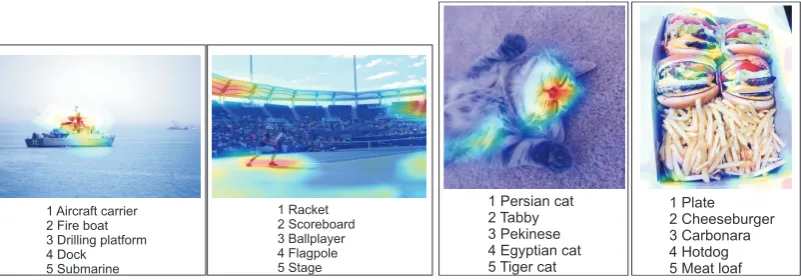
1 Aircraft carrier 2 Fire boat 3 Drilling platform 4 Dock 5 Submarine
1 Racket 2 Scoreboard 3 Ballplayer 4 Flagpole 5 Stage
1 Persian cat 2 Tabby 3 Pekinese 4 Egyptian cat 5 Tiger cat
1 Plate 2 Cheeseburger 3 Carbonara 4 Hotdog 5 Meat loaf
Figure 2: Visualizing heatmaps of class activation in an image.
4.2 Image and Text Features
4.2.1 Image Features
The research on feature extraction from images proceeds along two directions: i) traditional, hand-crafted features, and ii) automatically generated features. With the increasing number of images and videos on the web, traditional methods have a hard time handling the scalability and general-ization problem. In contrast, automated generated feature-based techniques are capable to automat-ically learn robust features from a large number of images (Jindal and Singh, 2015). We discuss below how these two directions for extracting fea-tures from images apply in our case, in particular, we use RGB pixel-values features for the first di-rection and Deep Learning based features for the second direction.
RGB pixel-values.In this approach for extract-ing features from images, we simply convert the images into arrays. Each image was sliced to get the RGB data. The 3-channels RGB image for-mat was preferred instead of using 1-channel im-age format since we wanted to use all the available information related to an image. Using this ap-proach, each image was described by a 2352 (28 x 28 x 3)-dimensional feature vector.
Deep Learning based features. Deep Learning models use a cascade of layers to discover feature representations from data. Each layer of a con-volutional network produces an activation for the given input. Earlier layers capture low-level fea-tures of the image like blobs, edges, and colors. This primitive features are abstracted by the high-level layers. Studies from the literature suggest that while using pre-trained networks for feature extraction, the features should be extracted from the layer right before the classification layer (
Ra-jaraman et al., 2018). For this reason, we ex-tracted the features from the last layer before the final classification, so the entire convolutional base was used for this. The features were extracted us-ing the pre-trained convolutional base VGG16
net-work (Simonyan and Zisserman,2014). For
com-putational reasons, the images were resampled to a 3232 pixel resolution. The model was initialized by the ImageNet weights. For understanding what part of an image was used to extract the features, visualizing heatmaps of class activation technique was employed. This is a technique which illus-trates how intensely the input image activates dif-ferent channels, how important each channel is with regard to the class and how intensely the input image activates the class. Figure2illustrates the heatmaps of class activation for some random im-ages using VGG16 as a pre-trained convolutional base. The VGG16 model makes the final clas-sification decision based on the highlighted parts from each image, and furthermore each image is associated with the five most representative cap-tions.
4.2.2 Text Features
We used a Bag-of-Words (BoW) model (Harris,
text sample. We initialized the BoW model with a maximum of 5000 features. We extracted a vo-cabulary for each sentiment category, and the cor-responding 0-1 feature vector for each text sample.
4.3 Experimental Results
Evaluation Measure
Each output of our model represents a very large vector of probabilities, with the dimension equal to the number of words in the dictionary (approx-imately 5000 components). Each component of the output vector represents the probability of the corresponding word from the vocabulary as being a descriptor of that image. Given this particular form of the output, the evaluation measure was computed using the following algorithm:
1. we sorted in descending order the absolute values of the predicted output vector;
2. we created a new vector containing the first 50 words from the predicted output vector;
3. we computed the Euclidean distance between the predicted output vector values and the ac-tual output vector.
The actual output vector is a sparse vector, a com-ponent in this vector is 1 if the corresponding word from the vocabulary is contained in that particular description of the image.
The values computed in step 3) described above were averaged over the entire test data set and the average value obtained was considered as the er-ror.
Experimental Protocol
We designed an experimental protocol, that would help us answer the following questions:
1. Could our proposed Kernel Ridge Regression model map images to natural language de-scriptors?
2. What is the difference between the two types of image features that we considered? In par-ticular, we are interested whether the more complex deep learning features give a bet-ter performance in comparison to the simple RGB pixel-values features.
3. Is there a difference in performance based on the sentiment associated to each image-text sample?
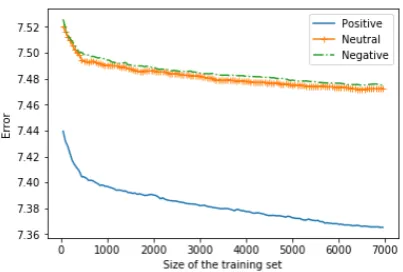
Figure 4: Comparison of the learning performance based on the type of sentiment using the VGG16 image features.
We designed the following experimental proto-col. For each of the three sentiment categories, we randomly split the data 5 times into training and testing, taking 70% for training and the rest for testing. For training the model, we considered dif-ferent sizes of the training set: from 50 to 7000 observations with a step size of 50. For a cor-rect evaluation, the models built on these different training sets, were evaluated on the same test set. The error was averaged over the 5 random splits of the data into training and testing.
Results
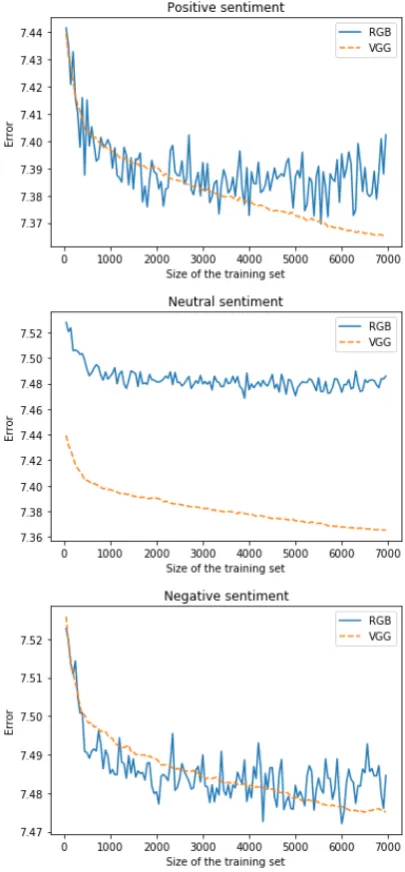
The first two questions raised above can be an-swered by analyzing the experimental results
shown in Figure 3. The plots show the learning
curve (mean errors and standard deviations) for different sizes of the training set and for different sentiment categories. Since the error decreases as the training size increases, we can say that there is a learning involved, thus our proposed model can map images to natural language descriptors.
The plots from Figure3also show the
compar-ison between the RGB pixel-values and VGG16 features for the three categories of sentiments con-sidered. Overall, the more complex deep learning features give a better performance in comparison to the simple RGB pixel-values features.
To answer the third question, we analyzed the
experimental results shown in Figure 4. There
is a significant difference in learning performance for the positive sentiment category in comparison with the other two categories, both using RGB pixel-values features and VGG16 features. The positive category is simpler to be learned because of the subjective part from images: a positive
feel-ing can be interpreted as positive for the majority of the people, but a neutral or a negative sentiment can be interpreted as having a different meaning depending on the people.
Furthermore, analyzing again Figure 3, we see
that the neutral sentiment category has a differ-ent behaviour in comparison with the positive and negative sentiment categories, with respect to the image features used. In the case of neutral sen-timent, the more complex VGG16 features ap-pear to have a better performance than the sim-pler RGB pixel-values features as the size of the data increases. For positive and negative sentiment categories the simpler RGB pixel-values features lead to an error which varies a lot, while using the VGG16 features, the error is more stable.
5 Conclusions and Future Work
In this work, we investigated a method for image to text mapping in the context of sentiment anal-ysis. The mapping from images to text was per-formed using a Kernel Ridge Regression model. We considered two types of image features: i)the
simple RGB pixel-values features, andii)a more
complex set of image features extracted with a deep learning approach. Furthermore, in this pa-per we took a step forward form the image cap-tioning task, which allows us to build some dictio-naries of words and select from these dictiodictio-naries the words which are the most relevant to an im-age. We performed the experimental evaluation on a Twitter data set containing both text and images and the sentiment associated with these. We found that there is a difference in performance for differ-ent sdiffer-entimdiffer-ent categories, in particular the mapping performs better for the positive sentiment category in comparison with the neutral and negative ones for both features extraction techniques.
References
Bai, S. and An, S. (2018). A survey on automatic im-age caption generation. Neurocomputing, 311.
Berlinet, A. and Thomas-Agnan, C. (2011). Reproduc-ing Kernel Hilbert Spaces in Probability and Statis-tics. Springer Science Business Media.
Brouard, C., Szafranski, M., and D’Alch´e-Buc, F. (2016). Input output kernel regression: super-vised and semi-supersuper-vised structured output predic-tion with operator-valued kernels. The Journal of Machine Learning Research, 17(1):6105–6152.
Cortes, C., Mohri, M., and Weston, J. (2005). A gen-eral regression technique for learning transductions. InProceedings of ICML 2005, pages 153–160. ACM Press.
Cortes, C., Mohri, M., and Weston, J. (2007). A general regression framework for learning stringto-string mappings. In Predicting Structured Data. MIT Press.
Harris, Z. (1954). Distributional structure. pages 146– 62.
Jindal, S. and Singh, S. (2015). Image sentiment analysis using deep convolutional neural networks with domain specific fine tuning. In 2015 In-ternational Conference on Information Processing (ICIP), pages 447–451. IEEE.
Karpathy, A. and Fei-Fei, L. (2015). Deep visual-semantic alignments for generating image descrip-tions. In Proceedings of the IEEE conference on computer vision and pattern recognition, pages 3128–3137.
Kulkarni, G., Premraj, V., Ordonez, V., Dhar, S., Li, S., Choi, Y., Berg, A. C., and Berg, T. L. (2013). Babytalk: Understanding and generating simple im-age descriptions. IEEE Transactions on Pattern Analysis and Machine Intelligence, 35(12):2891– 2903.
Ling, H. and Fidler, S. (2017). Teaching machines to describe images via natural language feedback. InProceedings of the 31st International Conference on Neural Information Processing Systems, pages 5075–5085. Curran Associates Inc.
Ma, L. and Zhang, Y. (2015). Using word2vec to pro-cess big text data. In2015 IEEE International Con-ference on Big Data (Big Data), pages 2895–2897. IEEE.
O’Shea, K. and Nash, R. (2015). An introduction to convolutional neural networks. ArXiv e-prints.
P. Singam, Ashvini Bhandarkar, B. M. C. T. K. K. (2018). Automated image captioning using con-vnets and recurrent neural network. International Journal for Research in Applied Science and Engi-neering Technology.
Park, C., Kim, B., and Kim, G. (2017). Attend to you: Personalized image captioning with context se-quence memory networks. In Proceedings of the IEEE Conference on Computer Vision and Pattern Recognition, pages 895–903.
Rajaraman, S., Antani, S. K., Poostchi, M., Sila-mut, K., Hossain, M. A., Maude, R. J., Jaeger, S., and Thoma, G. R. (2018). Pre-trained convolu-tional neural networks as feature extractors toward improved malaria parasite detection in thin blood smear images. PeerJ, 6:e4568.
Simonyan, K. and Zisserman, A. (2014). Very deep convolutional networks for large-scale image recog-nition.arXiv preprint arXiv:1409.1556.
Vadicamo, L., Carrara, F., Cimino, A., Cresci, S., Dell’Orletta, F., Falchi, F., and Tesconi, M. (2017). Cross-media learning for image sentiment analysis in the wild. InThe IEEE International Conference on Computer Vision (ICCV) Workshops.
Wang, J., Fu, J., Xu, Y., and Mei, T. (2016). Be-yond object recognition: Visual sentiment analysis with deep coupled adjective and noun neural net-works. InProceedings of the Twenty-Fifth Interna-tional Joint Conference on Artificial Intelligence, IJ-CAI’16, pages 3484–3490. AAAI Press.
Xing, F. Z., Pallucchini, F., and Cambria, E. (2019). Cognitive-inspired domain adaptation of sentiment lexicons. Information Processing & Management, 56(3):554–564.
You, Q., Luo, J., Jin, H., and Yang, J. (2015). Joint visual-textual sentiment analysis with deep neural networks. In Proceedings of the 23rd ACM Inter-national Conference on Multimedia, MM ’15, pages 1071–1074, New York, NY, USA. ACM.
Yu, Y., Lin, H., Meng, J., and Zhao, Z. (2016). Vi-sual and textual sentiment analysis of a microblog using deep convolutional neural networks. Algo-rithms, 9(2):41.