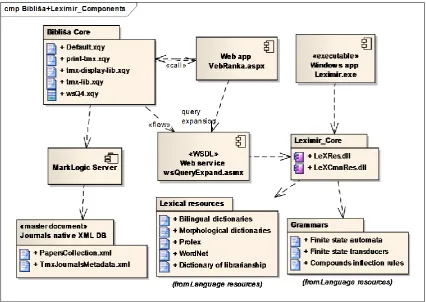
Figure 3. Bibliša+LeXimir UML component model
4.
Supporting resources
Three types of lexical resources are used for the expansion of queries submitted to our collection of documents. The most important resources are Serbian morphological dictionaries of simple words and multi-word units [Krstev, 2008]. These comprehensive resources were developed and are being mainly used within two corpus processing systems: Unitex and Nooj. However, Unitex standalone routines enable the usage of morphological dictionaries developed under Unitex in other environments. The dictionaries are used to generate all inflective forms of query keywords, thus improving the system recall without negative effects on precision. Moreover, for multi-word units not found in dictionaries, there exists a rule-based strategy, which attempts to recognize syntactic structure of the multi-word and how it should be inflected [Stankovic et al., 2011].
Another type of resources used by Bibliša for bilingual and semantic expansion of queries are wordnets. At present we use the Princeton English Wordnet (PWN), version 2.0, as well as the Serbian Wordnet (SrpWN — http://korpus.matf.bg.ac.rs/SrpWN), initially developed in the scope of the BalkaNet project [Tufiş, 2004] and subsequently enhanced and upgraded. Most of the synstes in Serbian Wordnet are aligned with PWN synsets via the Interlingual Index, with the exception of Serbian specific synsets that are not available in PWN. The Interlingual Index enables bilingual query expansion, while synonymous relations expressed by synsets themselves
enable semantic expansion. At present, we do not use other semantic relations available in both Wordnets. Finally, Bibliša also uses the “Dictionary of librarianship: English-Serbian and Serbian-English” that is available online at http://btr.nb.rs. The production of this dictionary started in 2001 at the National Library of Serbia's, with the aim of producing a domain specific dictionary in various formats and on different media. This endeavour was the continuation and upgrade of the international project “Multilingual dictionary of library terminology” that started in the 1990s, with the aim of collecting and presenting the librarianship terminology for 16 European languages [Kovačević et al., 2004].
5.
User interface
The user can search the INFOtheca collection in two different ways. A typical search, yielding a set of aligned concordances is a full text search based on a query, and we will discuss this type of search shortly. However, Bibliša offers also the possibility of a monolingual search of metadata, associated with every article in the collection and described in more detail in Section 2. When performing such a search the user can make use of a form with predefined fields for the most commonly used data: author’s name, words from an article title, year of publication, and article keywords. The search can be performed either in the English or the Serbian part of the collection (Figure 4).
Figure 4. Interface for metadata search
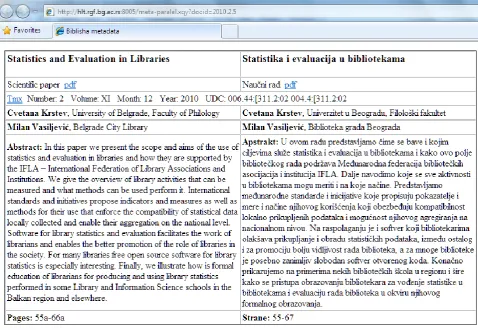
As a result, a list of all articles in the language of the query that fulfill the required conditions is produced with all available metadata. In addition to that, for each article, links are offered to the full text of the article in .pdf format (residing on the official site of the INFOtheca journal) as well as the entire aligned parallel text of the article in .html format.
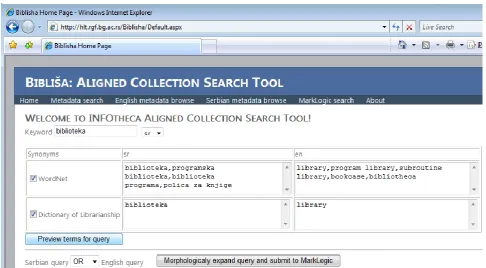
More powerful is the full-text search (Figure 5). The user initiates this search by submitting a keyword in English or in Serbian and choosing the resources to be used for its semantic expansion by checking appropriate boxes (WordNet and/or Dictionary of librarianship). The system responds with several editable lists of keywords depending on what is found in resources chosen for expansion. The user can edit these lists by deleting some keywords or adding new ones. For example, if the user submitted biblioteka, as the query keyword in Serbian, and asked for semantic expansion using wordnets, Bibliša would use the Serbian wordnet to connect to the English wordnet. The English wordnet would then expand the query by the following keywords: library, program library, subroutine library, bookcase and bibliotheca. It is quite probable that the user might want to remove some of these keywords, e.g. bookcase.
Figure 5. Interface for query expansion and submit
After semantic expansion, the set of Serbian keywords chosen and verified by the user is expanded morphologically. Namely, MarkLogic supports stemming in several languages including English but not Serbian. Thus, the morphological forms of English keywords are taken care of by MarkLogic’s stemming capability. As for
Serbian, Bibliša must expand the initial query with all morphological forms of the keywords using the available Serbian resources (SrpRec) (see Section 4).
English keywords will search only through TUVs with xml:lang attribute set to en, while Serbian keywords will search through TUVs with xml:lang attribute set to sr. For instance, if the search is initiated with the English keyword online, and the Dictionary of librarianship is selected as the resource for semantic and bilingual expansion, on-line will be added as another English keyword, and onlajn and u mreži as Serbian keywords. A concurrent search with these two lists will reveal that both English terms: online and on-line are used in Serbian texts as well. However, they will not be looked for and hence not recognized and highlighted in the results.
To illustrate morphological expansion of a query in Bibliša we will use the keyword digitalna biblioteka
(digital library). As we have already mentioned, MarkLogic stemming capability will take care of the morphological forms of the compound in English, while Bibliša needs to expand the query with all morphological forms of the compound in Serbian. The expanded query generated by Bibliša thus consists of several Serbian entries and one English entry:
Morphological expansion is performed automatically and is not transparent to the end user. Part of the XQuery code that follows is used for transforming the expanded query to the proper XQuery form:
cts:or-query((cts:word-query(“digitalna biblioteka”, ("stemmed", "lang= sr") ).
cts:or-query((cts:word-query(“digitalnih biblioteka”, ("stemmed", "lang= sr") ).
cts:or-query( (cts:word-query(“digitalne biblioteke”, ("stemmed", "lang= sr") ),
cts:or-query( (cts:word-query(“digitalnim bibliotekama”, ("stemmed", "lang= sr") ),
...
cts:word-query(digital library, ("stemmed", "lang= en") ) )) )))
Starting from the initial query, processed as outlined, the system finally generates aligned concordances in which all retrieved keywords are highlighted in both languages. Each concordance line is preceded by an identification of the document it originates from. Within this identification is also a link to full metadata of the document. A part of concordances for the initial query digitalna biblioteka is presented in Figure 6.
If the user is interested in metadata, or the full text of a specific document, he/she can obtain it by clicking on the “metadata” link shown in the leftmost column in Figure 6. This opens the metadata window (Figure 7) showing the document metadata in both languages and offering further links to full texts of the document in both languages (pdf), as well as to the full parallel aligned text in TMX format (tmx).
The user can choose between two options for retrieving concordances: either only concordances where one or more keywords were found in both languages (AND), or concordances in which one or more keywords were found in at least one of them (OR). By default, English and Serbian keyword lists are used as if connected by the “OR” operator. This way, the user can obtain text segments in which either the Serbian or the English term was translated in an unexpected way. For instance, for the English term browser the Dictionary of library and information science terminology offers the Serbian translations pretraživač. The system retrieves 14 segments none of which contain both the English and the Serbian highlighted term. Namely, English browser,
referring to web browser program is never translated with either pretraživač, while retrieved occurrences of
pretraživač never refer to a browser.
However, in some specific cases it can be useful to search with English and Serbian keyword lists connected by the “AND” operator. This type of search retrieves only segments that contain both the English and the Serbian term, thus excluding unwanted hits resulting from the ambiguity of terms. For instance, when initiating a search with the Serbian term novine, and expanding it with both the Wordnets and the Dictionary of librarianship the following keyword lists are obtained: newspaper, paper
and press for English and dnevne novine, dnevnik, novine, and štampa for Serbian. If the search is performed with the “OR” option, 238 resulting aligned segments are obtained. However, the English term paper is highly ambiguous and as a consequence, numerous retrieved results containing it are false. By performing the search with the “AND” option the number of concordances is reduced to 29, and all false results disappear.