A Treebank of Spanish and its Application to Parsing
Antonio Moreno
, Ralph Grishman
y, Susana L´opez
,
Fernando S´anchez
, Satoshi Sekine
y
Laboratorio de Ling¨u´ıstica Inform´atica Universidad Aut´onoma de Madrid, Spain
fsandoval, susana, [email protected]
y
Department of Computer Science New York University, U.S.A
fgrishman, [email protected] Abstract
This paper presents joint research between a Spanish team and an American one on the development and exploitation of a Spanish treebank. Such treebanks for other languages have proven valuable for the development of high-quality parsers and for a wide variety of language studies. However, when the project started, at the end of 1997, there was no syntactically annotated corpus for Spanish. This paper describes the design of such a treebank and its initial application to parser construction.
1.
Constructing a Spanish treebank
1.1. Preliminary considerations
This paper presents joint research between a Spanish team and an American one on the development and ex-ploitation of a Spanish treebank. Such treebanks for other languages have proven valuable for the development of high-quality parsers and for a wide variety of language studies. As there was no previous experience in building a syntactically annotated corpus for Spanish, the first effort consisted necessarily in writing a set of annotation guide-lines. The starting point was the existing documentation at that time, especially the Penn Treebank project (Marcus, Santorini and Marcinkiewicz, 1993; Bies et al., 1995), the EAGLES preliminary recommendations (EAGLES, 1996), and the Negra corpus (Skut et al., 1997).
Our experience in developing Spanish NLP systems told us that a pure phrase structure annotation (typical of the English treebanks) would not be enough for inducing relevant rules for Spanish. At the least, information about agreement and syntactic functions is necessary for Spanish, and we wanted to incorporate that information in our trees in the form of features.
The treebank has been created mostly by hand, although some automatic pre-tagging of the data is performed, as de-scribed below, to speed treebank creation.
1.2. Data selection
As of September 1999, the corpus consisted of 1,500 annotated sentences, with a total of 22,695 words and an average of 15.13 words/sentence. The sentences were taken from two different sources, a newspaper on-line edition (El Pa´ıs Digital,http://www.elpais.es/) and a consumer association magazine (Compra Maestra). The selection was made by the human annotators, taking as guidelines their qualitative and subjective knowledge of the complex-ities of Spanish. In accordance with this, the first 500 sen-tences were chosen by difficulty criteria such as discontin-uous constituents, ambiguity, several embedded clauses in one sentence, anaphora and discourse markers, etc. The
idea was to attack the problematic issues from the begin-ning.
In the current phase, we use an automatic selector of sentences from the html version of the sources. The pro-gram allows us to specify the range of sentence length (e.g. from 10 to 35) that the randomly chosen sentences should have, although we have not used this restriction in creating our current treebank. The idea now is to avoid human bias in the selection.
1.3. The annotation guidelines
The 88-page annotation guidelines includes a typed in-ventory of categories and features (a small fragment is shown in Table 1) , the annotation scheme, and specific di-rections for a great variety of Spanish phenomena1. The trees are encoded in a nested, parenthesized structure, with the elements at each level including the (part of speech or phrasal) category, the (syntactic and semantic) features, and the constituent nodes.
” The lexical categories are represented as
(CAT "<string>" "<lexeme>" FEATURE1 FEATURE2 ... FEATUREn)
and the non-terminal constituents as
(CAT1 ... (CAT2 ... ) ( ... ) (CATn ... ))
The structure closely reflects the surface syntax: in par-ticular, we have been very cautious about empty categories. Only null subjects (very frequent in Spanish, not only in non-finite clauses like raising and control, but in finite verb sentences) and elided material (just in conjunctions, not in comparatives or traces) are annotated. In tagging, we fol-low the Penn Treebank schema, with * for null subjects and
1The annotation guidelines are available upon request to
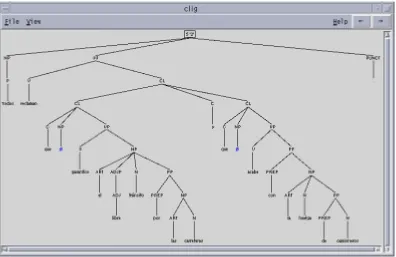
sen-Figure 5: Coordination and ellipsis