Multilingual XML-Based Named Entity Recognition for E-Retail Domains
Claire Grover , Scott McDonald , Donnla Nic Gearailt ,
Vangelis Karkaletsis
, Dimitra Farmakiotou
, Georgios Samaritakis
, Georgios Petasis
,
Maria Teresa Pazienza
, Michele Vindigni
,
Frantz Vichot
, Francis Wolinski
Language Technology Group, University of Edinburgh
grover, scottm, donnlan @ed.ac.uk
Institute for Informatics and Telecommunications, National Centre for Scientific Research “Demokritos”
vangelis, dfarmak, samarita, petasis @iit.demokritos.gr
D.I.S.P., Universita di Roma Tor Vergata
pazienza, vindigni @info.uniroma2.it
Informatique-CDC, Groupe Caisse des Depots
frantz.vichot, francis.wolinski @caissedesdepots.fr
Abstract
We describe the multilingual Named Entity Recognition and Classification (NERC) subpart of an e-retail product comparison system which is currently under development as part of the EU-funded project CROSSMARC. The system must be rapidly extensible, both to new languages and new domains. To achieve this aim we use XML as our common exchange format and the monolingual NERC components use a combination of rule-based and machine-learning techniques. It has been challenging to process web pages which contain heavily structured data where text is intermingled with HTML and other code. Our preliminary evaluation results demonstrate the viability of our approach.
1.
Introduction
We describe the multilingual Named Entity Recogni-tion and ClassificaRecogni-tion (NERC) component of an e-retail product comparison system which is currently under devel-opment as part of the EU-funded project, CROSSMARC. The project applies state-of-the-art language engineering tools and techniques to achieve commercial-strength in-formation extraction from web pages. The core compon-ents of the prototype system are:
spider agents which visit websites and return pages which are likely to contain product descriptions;
a high-quality Information Extraction (IE) component for several languages which locates product descrip-tions in XHTML pages and performs NERC and fact extraction so as to populate a database with informa-tion about vendors’ offers;
a user interface which processes the user’s query, performs user modelling, accesses the databases and presents product information back to the user.
Figure 1 shows the overall processing stages of the CROSS-MARC system. We focus in this paper on the NERC sub-component. Although NERC is a familiar task to the IE research community, there are novel aspects arising from our application area which present significant and interest-ing challenges both for implementation and for evaluation.
2.
Extensibility
The main goal in designing the system is that it should be rapidly extensible both to new languages and to new do-mains. In order to support both of these requirements we use XML as a common exchange format. For each product domain, we define an ontology of the product type using XML schemas, and this ontology is used to shape both the product database and the XML DTDs and schemas which define the common input and output of the NERC and fact extraction modules.
2.1. Multilinguality
English NERC (ENERC)
ENERC is exclusively XML-based and the annotation pro-cess involves incremental transduction of the XHTML page. The page is passed through a pipeline which is composed of calls to a variety of XML-based tools from the LT TTT and LT XML toolsets (Grover et al., 2000; Thompson et al., 1997) as well as the xmlperl program (McKelvie, 1999). The system architecture is similar to the hybrid system which was the LTG’s contribution to the MUC-7 competition (Mikheev et al., 1998): early pro-cessing stages use hand-crafted rules for ‘sure-fire’ named entities while a statistical classifier is used in the later stages to resolve more difficult potential named entities. The processing steps involve word-level tokenisation, part-of-speech tagging, the re-use of existing rules for date and time entities and the use of specialised rules sets for identifying domain specific entities such as laptop manufacturers, pro-cessor names, propro-cessor speeds etc. The pipeline has been made sensitive to the fact it is web pages that are to be pro-cessed and it targets specific rule sets at specific sub-parts of the XHTML tree structure.
French NERC (FNERC)
FNERC builds on previous work and reuses some tech-niques of the TalLab platform, which is I-CDC’s Perl multi-agent framework for the development of NLP applications (Wolinski et al., 1998; Wolinski and Vichot, 2001).
FNERC has been implemented as a standalone module in order to ease its integration into the CROSSMARC mul-tilingual platform. It takes as input XHTML pages pro-duced by Tidy from HTML pages. Due to the wide variety of different web sites, some functions are applied to reduce the high heterogeneity of the corpus and to normalize it for the following part of the processing. These steps are do-main independent. At the next stage, the module performs named entity identification for three kinds of entities: NE,
NUMEX, TIMEX. Some entities are domain independent such as dates, times and prices while others are domain spe-cific such as laptop manufacturers, processor speeds, capa-cities, etc.
Localisation and classification of the named entities is performed by a wide set of regular expressions derived from the XML laptop ontology and language dependent lexicons. The final output is an XHTML file which is input to a demarcation tool which identifies individual product offers.
Hellenic NERC (HNERC)
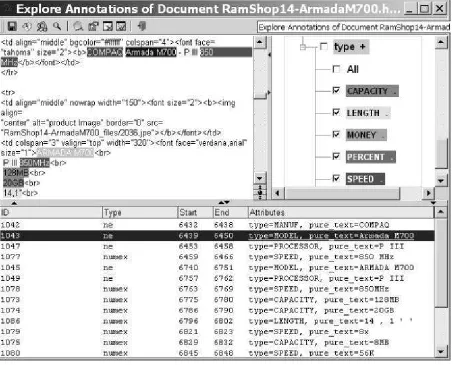
HNERC has been developed using the Ellogon text engin-eering platform (Petasis et al., 2002; Farmakiotou et al., 20002). XHTML Web pages are converted into collections of Ellogon documents and the HNERC system applies a set of modules that add Tipster style annotations to the Ello-gon document, produce an XML document with the system output conforming to the NERC DTD and add named entity mark-up to the original XHTML input page. HNERC has been adapted to web pages and the laptop domain from the MITOS-NERC system (Farmakiotou et al., 2000) which was designed for NERC in Financial News Texts.
Gaz-Figure 2. Screenshot of HNERC
3.
Working with Web Pages
While the CROSSMARC partners all have a strong back-ground in NERC in domains which use flat, discursive text (e.g. the MUC task), we have found the move to work-ing with web pages quite complex and challengwork-ing. Web pages differ from more standard text types in terms of both content and presentation style. In addition to text, they also contain links, images and buttons. Statistical corpus analysis has shown that web page language forms a dis-tinct genre and that it follows separate grammar, paragraph and sentence formation rules and conventions. These kinds of differences can affect the performance of standard NLP techniques when transferred to web pages (Amitay, 1997; Soderland, 1997). An informal comparison of a corpus of web pages and flat texts of the same domain (descriptions of laptops coming from computer magazines) in the context of CROSSMARC showed the following:
Paragraphs and sentences in web pages are usually much shorter than ones frequently encountered in free text.
Itemized lists and tabular format are used more fre-quently in web pages than free text.
On-line laptop descriptions require more domain knowledge on the part of the reader than flat text
de-scriptions. A vast number of on-line descriptions of computer goods present the reader with phrase frag-ments and numeric expressions without their measure-ment units e.g. P3 800 256 14 TFT, whereas flat text descriptions contain complete sentences and phrases, e.g. a Pentium III processor with 256 MB of RAM, that facilitate text understanding. Full phrases contain contextual information for the classification of NEs, whereas phrase fragments found in web pages require more knowledge of the writing conventions (e.g. a number following the name of a processor is the pro-cessor’s speed) and names that are easier to recognize must be used as the context for other possible names or expressions of interest.
Unlike flat text, which is processed word by word, the processing of web pages must take into account the fact that the web page source is typically comprised of HTML tags intermingled with free text and JavaScript (or other) code. The HTML parts of a page contain layout information that can be crucial for NERC and fact extraction. The fact that HTML documents are frequently far from well-formed im-poses greater difficulty in their processing and makes the use of programs such as Tidy1imperative for the produc-tion of well-formed (XHTML) pages.
addi-G. Petasis, V. Karkaletsis, addi-G. Paliouras, I. Androut-sopoulos, and C. D. Spyropoulos. 2002. Ellogon: A new text engineering platform. In Proceedings of the Third
International Conference on Language Resources and Evaluation (LREC 2002), Las Palmas, Canary Islands,
Spain.
E. Riloff and R. Jones. 1999. Learning dictionaries for information extraction by multi-level boot-strapping. In
Proceedings of the Sixteenth National Conference on Ar-tificial Intelligence, pages 1044–1049, Orlando, FL.
S. Soderland. 1997. Learning to extract text-based inform-ation from the world wide web. In Proceedings of 3rd
International Conference in Knowledge Discovery and Data Mining (KDD-97), pages 251–254.
S .Soderland. 1999. Learning information extraction rules for semi-structured and free text. Machine Learning, 34:233–272.
H. S. Thompson, R. Tobin, D. McKelvie, and C. Brew. 1997. LT XML. Software API and toolkit for XML processing. http://www.ltg.ed.ac.uk/ software/.
F. Wolinski and F. Vichot. 2001. Des multi-agents pour d´evelopper des applications de contenu en ligne.
Tech-nique et Science Informatiques, 20(2):213–232.
F. Wolinski, F. Vichot, and O. Gr´emont. 1998. Producing NLP-based on-line contentware. In Natural Language
Processing and Industrial Applications (NLP+IA), pages
253–259, Moncton, Canada.
R. Yangarber and R. Grishman. 2000. Machine learning of extraction patterns from un-annotated corpora. In
Pro-ceedings of the Workshop on Machine Learning for In-formation Extraction, 14th European Conference on Ar-tificial Intelligence (ECAI 2000).
R. Yangarber, R. Grishman, P. Tapanainen, and S. Hut-tunen. 2000. Automatic acquisition of domain know-ledge for information extraction. In Proceedings of