Towards Reusable NLP Components
Amalia Todirascu , Eric Kow , Laurent Romary ,
Equipe Langue et Dialogue, INRIA
LORIA, Campus scientifique, BP 239, 54506 Vandoeuvre Cedex
todirasc, kow, romary @loria.fr
Abstract
We propose a methodology for transforming NLP modules into reusable components that can be integrated it into a distributed and open architecture. We illustrate the methodology by showing the adaptations needed to transform an LTAG parser into a bundle of parsing and lexical services.
1.
Introduction
The availability of various NLP tools and linguistic re-sources for several languages opens the possibility that they be heavily shared and reused. Unfortunately, most of the tools provide low portability, often as a consequence of their application-specific resource representations. Build-ing an NLP tool or adaptBuild-ing it for other languages requires considerable effort in creating or updating linguistic re-sources (often incomplete) as well as in integrating them into new applications.
This paper proposes a methodology to transform an ele-mentary NLP module into a reusable component which can be integrated into an open and distributed NLP architec-ture. The methodology requires standardised input/output, paramater resource and communication protocol between various components. We developed methodology through experiments on the modularisation of a Lexicalized Tree Adjoining Grammars (LTAG) parser, experiments which il-lustrated the problems which arise in a real and somewhat complex situation.
The underlying objective of this work was originally to integrate such a parsing component into various larger NLP environments representing various degrees of complexity from a language engineering point of view: a man-machine dialogue system in the context of the IST/MIAMM project1
(a dialogue environment providing speech, graphical and haptic interface to a musical database), an information ex-traction environment (a message filtering application on computer security in collaboration with the EADS/MSI company), an on-line network of NLP services based on GRID techniques2.
2.
General background and objectives
2.1. Existing initiatives towards integration of NLP components in unified architectures
A lot of research efforts have concentrated on the is-sue of building reusable NLP components within specific integrating frameworks. Several challenges were identified (B.Gamback and F.Olson, 2000) when transforming exist-ing NLP modules into reusable components: software chal-lenges (defining APIs for each type of module),
seman-1
see http://www.loria.fr/projets/MIAMM
2
see http://www.loria.fr/projets/Guirlande
tic challenges (the output of various modules are not al-ways semantically consistent), and “political” changes (al-gorithms and resources not always being publicly available for the research community).
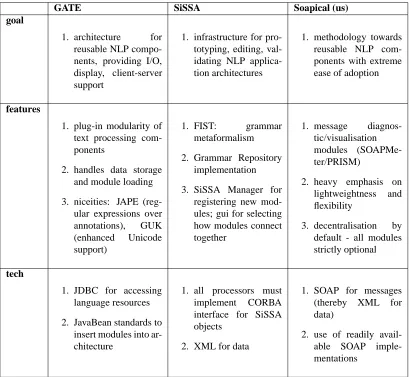
Several projects propose environements for building NLP complex applications, based on existing modules. GATE is one of the most widely known, providing an en-vironement for integrating several NLP tools from various platforms, using readily NLP modules (a POS tagger, a parser, a discourse expert, etc.) (D.Maynard et al., 2002). GATE supports the reuse of resources (as CELEX (Baayen et al., 1995) and WordNet (C.Fellbaum, 1998)) and algo-rithms, and provides technical support for the I/O inter-face, graphical interface and client-server structure for NLP tools. The I/O interface conforms with a standard TIP-STER annotation module. It provides such interesting fea-tures as JAPE (regular expressions over annotations) and GUK (enhanced unicode support). GATE is relatively old (four years) and its use in extremely widespread (for exam-ple, the SVENSK project for reusing resources and algo-rithms for the Swedish langauge) (B.Gamback and F.Olson, 2000). This degree of experience with the subtle difficul-ties that can arise in creating any distributed application, especially one consisting of such disparate modules, would make GATE extremely attractive; however, there are also a small number of noticeable blemishes that might cause one to hesitate. Namely, it requires huge amount of com-puter resources (memory, disk space) on a single comcom-puter environment, is not user friendly and imposes a pipe-line architecture.
</node>
<node cat="np" id="np_1" type="subst" /> </node>
</node> </node> </node> </tree>
<tree name="r1tn1">
</tree> </family>
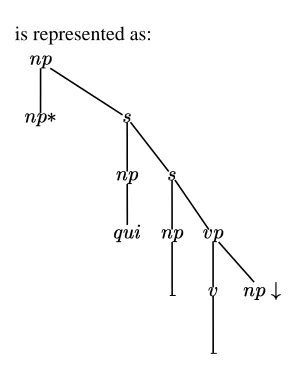
is represented as:
3.4. SOAP protocol
As our system uses the parser and the resource ac-cessing module distributed as service over various sites, we needed a communication protocol between the vari-ous components, ideally a homegenevari-ous way to handle all the data: messages, input/output, resources. SOAP is a XML-based standard (***, 2000) for exchanging messages between components of a distributed application, and we chose it because of its simplicity and flexibility.
There are two ways to look at SOAP. The first is on a higher level, as a format for messages between agents in any distributed system. A SOAP message consists of an envelop, which wraps a header and a body. This header is where standard SOAP metadata, such as the actors required to understand a message, go, and the body, the actual data we are interested in. While SOAP does also offer some of its own metadata, exceptions (faults), and some default primitives (ints and strings, for example), it is actually a more useful understanding of the protocol to pretend that in its entirety, SOAP is only composed of those three tags: envelop, header, and body. Because it specificies exactly so little, we are free to design the contents of the body and add things to the header at will. For instance, our SOAP bodies would merely be in TAGML (see figure 3.4.). This is what we mean by flexibility.
On a second, lower level, we can think of what peo-ple actually do with SOAP, or rather, how it is used as a communication protocol. One path of very little resistance is to bind these SOAP enveloppes to HTTP headers and send the resulting message along its way. In fact, this is what most default implementations of SOAP do; they are little programs (CGI scripts, servlets) that can be attached to webservers. Any software that uses such a SOAP imple-mentation thus only worries about producing and consum-ing data, leavconsum-ing it to the SOAP implementation to wrap such data into SOAP envelops, or unwrap such SOAP en-velops and turn it back into useful data. Some sophisticated implementations, like Apache SOAP even go a step further,
and provide a Remote Procedural Call mechanism on top of this, such that function calls are translated into SOAP mes-sages, unwrapped by the server, then called accordingly, with the resulting data then being itself wrapped and sent back to the client. Once attached to a such a SOAP imple-mentation, a client then concerns itself with function calls, and the server to the provision of these functions. This is what we mean by simplicity.
We feel that SOAP will bring us to our goal of hav-ing a widely adopted methodology towards reusability, and we feel this way not because SOAP is any more techno-logically interesting than other object-sharing mechanisms, but because it is easy. Rather than dictate plausibily cor-rect specifications for inserting an NLP module into spe-cific architecture, we instead propose a protocol that spec-ifies just enough: data and metadata. It is lightweight, built upon pre-existing standards, tied to familiar transport mechanisms, and has thus been widely implemented (Even the Mozilla web browser has a SOAP implementation). In short, we find SOAP to be useful because its standardness and familiarity provides a path towards reusability, but at a mental cost low enough to compete with the ad hoc ap-proach favoured by the computational linguist of today.
<?xml version=’1.0’ encoding=’UTF-8’?>
<SOAP-ENV:Envelope ...> <SOAP-ENV:Header/> <SOAP-ENV:Body>
<tag>
<family name="tmpfam_Jean"><tree name="np"> <node cat="np" id="np_" type="anchor"/> </tree></family></tag>
</SOAP-ENV:Body> </SOAP-ENV:Envelope>
Figure 2: a simplified example of a SOAP message
4.
System architecture
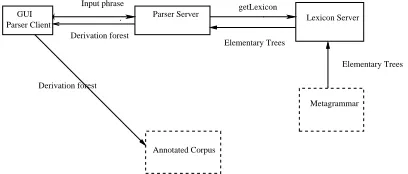
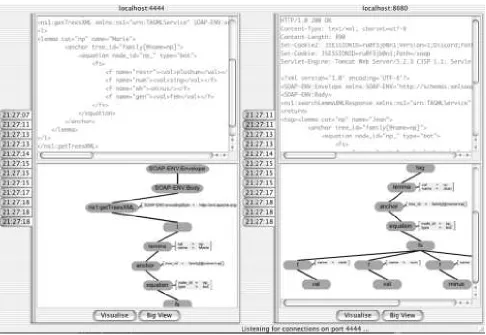
To experiment this methodology, we split the parser into various modules: the module implementing the connected-routes-based algorithm (P.Lopez, 1999), the visual work-bench and the resources. We integrate all these mod-ules into a distributed, flexible architecture. Each module contains a XML-based communication level for data ex-changes, via the SOAP protocol. We used for tests small resources for French (338 lexical words, 50 trees) and En-glish (279 words, 421 trees).
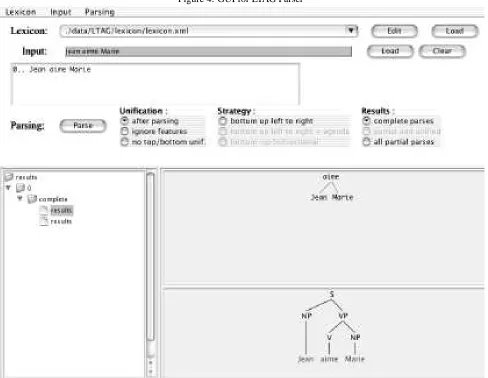
Figure 4: GUI for LTAG Parser
computer security. The applications have various degrees of complexity and the resources are very different: Vulcain is an information-extraction system using local grammars and domain-specific lexicons, but MIAMM uses resources handling dialogue and reference resolution. Both appli-cations integrate heterogeneous modules and offer a good framework to apply the methodology we propose.
6.
Conclusion
The paper illustrates a methodology for transforming a NLP module into a reusable, parametrizable component for a particular case: a LTAG parser. The methodology requires input/output and resource format standardization (XML-compatible) and the definition of a communication protocol (SOAP). The methodology will be validated by transform-ing other NLP modules into reusable components, access-ing resources available on-line. The SOAP protocol will be extended with more complex functions (handling XML ref-erences, implementing XML query for updating resources, extending the mechanisms for handling errors). The parser component will be integrated into an open architecture han-dling human-machine dialogues.
7.
References
***. 2000. The world wide web consortium (http://www.w3c.org).
A.Kinyon A.Abeill´e, L.Cl´ement. 2000. Building a tree-bank for french. In Proceedings of LREC Conference, Athens.
A.Lavelli, F.Pianesi, E.Maci, I.Prodanof, L.Dini, and G.Mazzini. 2000. Sissa: A software infrastructure for developping distributed nlp applications. In ?, ?
A.Sarkar. 2000. Statistical Parsing Algorithms for
Lexical-ized Tree Adjoining Grammars. Ph.D. thesis, University
of Pennsylvania.
R.H. Baayen, R.Piepenbrock, and L. Gulikers. 1995. The celex lexical database (release 2) [cd-rom]. Technical re-port, Linguistic Data Consortium, University of Pennsyl-vania.
B.Gamback and F.Olson. 2000. Experiences of language engineering algorithm reuse. In Proceedings of LREC
Conference, Athens.
N. Calzolari and J.McNaught. 1996. Eagles guidelines. C.Fellbaum. 1998. WordNet: An Electronic Lexical
Database. MIT Press.
D.Maynard, V.Tablan, and H.Cunningham. 2002. Archi-tectural elements of language engineering robustness.
Natural Language Engineering, pages 00–00.
Prac-Figure 5: Visualising the Lexicon service with the SOAPMeter and PRISM
tical aspects in compiling tabular tag parsers. In
Pro-ceedings of TAG+5 workshop, pages 27–32, Universit
Paris 7, Jussieu, Paris, France.
N.Ide and L.Romary. 2001. Standards for language re-sources. In Proceedings of IRCS Workshop on Linguistic
Databases, 11-13 December 2001, pages 148–153,
Uni-versity of Pennsylvania, Philadelphia.
P.Bonhomme and P.Lopez. 2000. Tagml: Xml encoding of resources for lexicalized tree adjoining grammars. In
Proceedings of LREC Conference, Athens.
P.Lopez. 1999. Robust Parsing with Lexicalized Tree