CSEIT1846115 | Published – 08 May 2018 | May-June 2018 [ (4 ) 6 : 617-324 ]
National conference on Engineering Innovations and Solutions (NCEIS – 2018)
International Journal of Scientific Research in Computer Science, Engineering and Information Technology
© 2018 IJSRCSEIT | Volume 4 | Issue 6 | ISSN : 2456-3307
617
A Survey on Jamming Organization in Wireless Sensor
Networks
Dr. Reshma Banu
1, Ayesha Taranum
21Prof & Head, Department of ISE, GSSSIETW, MYSURU, Karnataka, India 2Asst Prof, Department of ISE, GSSSIETW, MYSURU, Karnataka, India
ABSTRACT
Jamming in wireless sensor networks creates a lot of issues like packet collision, buffer overflow, queuing delay and many to one data transference scheme. This leads to degrade the quality of service parameters like packet delivery ratio, end to end delay and Average energy consumption of the wireless nodes. In this work is used to describe some of the jamming Organization mechanisms used in the WSNs and classifies them into four major categories traffic rate Organization, supply organization, traffic rate and supply organization and priority based jamming Organization. The comparative analysis is used to compare the popular jamming Organization protocols with each other in terms of jamming detection, jamming notification and its advantages and disadvantages.
Keywords: Wireless Sensor Networks, Jamming Detection, Jamming Notifications, Jamming Organization
I. INTRODUCTION
A wireless sensor network consists of huge number of sensors, which are responsible for monitoring physical or environmental conditions like temperature, sound, vibration, pressure at various locations. In the recent centuries numbers of applications of WSN [1] are increased vigorously. Some of the applications are health monitoring, industry production, home automation and environmental monitoring. These sensors are small in size as well as limited processing and computing supply. Jamming is occurred in the sensor network at the time of a sensor node is carrying much amount of traffic than it can handle. It will creates a series issue in the network such as queuing delay, packet loss, increases response time and decrease the throughput. To handle this situation in an effective manner a number of jamming Organization protocol should be used. Any jamming Organization mechanism follows
three steps i) Jamming detection ii) jamming notification iii) jamming Organization.
II. JAMMING DETECTION MECHANISMS
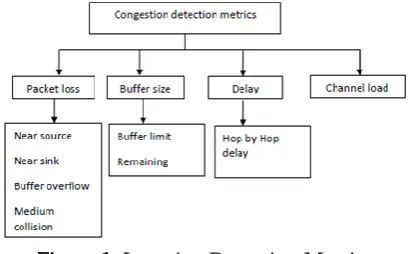
In literature, the authors considered more number of metrics for detecting jamming in a network such as packet loss, buffer size, channel load and delay. This paper is used to describe some of the parameters and Figure1 contains jamming detection metrics [2].
A. Packet Loss
Packet loss is an important metric to detect the jamming in the network. The packet loss is occurred in the network in the following manner.
to the source; the source will adjust its traffic rate consequently. The local de-synchronization of source and supply is also an effective technique to reduce jamming in a network.
Near sink: Sensor nodes are deployed in a sparse region will generate a hot spot in a sensor field but farther from source, near a sink. To handle this situation very effectively localized back pressure and packet dropping techniques can be followed. Use of multiple sinks uniformly scattered across the sensor field is an alternative solution for the above said problem.
Medium collision: In a certain area, many nodes start its transference at a same time creates interference of data leads to packet loss in the network. By using explicit local synchronization among neighbors and reduce this type losses. But this type of situation cannot be eliminated completely because non-neighboring nodes are still interfering with transference.
Buffer over follow: Generally, a queue or buffer is used to hold the packets at the time of transference. A buffer can received more number of packets than it can transmit, at that time buffer over follow will occur leads to packet loss in the network.
B. Buffer Size
Buffer size is a second important metric to detect the jamming in the network. It can be measured in 2 ways as follows.
Buffer limit: Each and every node in the WSN has limited buffer to hold the data to transmit. A buffer size is can be used as threshold, if incoming packets cross buffers threshold leads to packet loss.
Remaining Buffer: During transference of packet the buffer capacity is periodically tested and finds the remaining buffer length out of the overall size or the difference between the remaining buffer and the
traffic rate can be used as the best jamming indicators.
C. Delay
Delay is a third important metric to detect the jamming in the network. It can be measured in 2 ways as follows.
Figure 1. Jamming Detection Metrics
Hop by Hop delay: The packets are generated at the sender and forwarded to the next hop .The time is taken for transfer a packet from one hop to another hop. The one hop delay is also an important factor for detecting jamming in a network because it includes packet waiting time in a buffer, collision resolution and packet transference time at the MAC layer. The one hop delay is varied according to the channel load and buffer capacity.
End-to-End delay: The packets are generated at the sender and successful forwarded to the end point or receiver. The time is taken for transfer a packet from one end hop to another end hop.
D. Channel Load
III. JAMMING NOTIFICATION
After identification of jamming, it should be intimated to the upstream nodes to take a necessary action and Organization jamming. Jamming information can be propagated by using explicit or implicit jamming notification. Some protocols notify the jamming by setting jamming notification bit in the packet header.
A. Explicit jamming notification:
In this type the Organization packets are generated at the time of jamming and which are forwarded to either source or sink to intimate jamming level. Since additional Organization packet, generate an additional load to the network. A fewer number of jamming Organization mechanism follow this method.
B. Implicit jamming notification:
Unlike explicit method, this method does not give any additional load to the congested node. During jamming the congested nodes implicitly creates piggybacking information and inform its jamming level to its upstream nodes. In some cases ACK packets are used to indicate the jamming state. A larger number of jamming Organization mechanism follows this method.
IV. JAMMING ORGANIZATION ALGORITHMS IN SENSOR NETWORKS
After notification of jamming the source or sink node take a necessary action to Organization the jamming in a network otherwise it leads to buffer overflow, packet loss, delay and supply wastage. To Organization, jamming in a network number of strategies can be followed such as traffic
rate Organization, supply organization or
combination of traffic Organization and supply
organization and priority based jamming
Organization mechanisms, which are depicted in the Figure2.
A. Traffic Rate Organization:
In the traffic rate Organization technique, jamming is Organization by reducing number of packets injected into wireless sensor networks. It is divided into additive increase multiplicative decrease AIMD or a rate based method. In AIMD verify networks available bandwidth and slowly increase size of the jamming window. During jamming the protocol decreases the jamming window significantly. In the following session is used to describing some of the traffic rate based jamming Organization methods.
1. CODA
C.Y. Wan and his team introduced Jamming detection and Avoidance in a sensor networks. This is an energy efficient jamming Organization protocol. In this method buffer length and channel load metrics are used to detect the jamming. At the time of jamming the congested node notifies its congested situation to its upstream nodes through open loop hop by hop back pressure to decrease its traffic rate. At the same time sink generates an ACK through closed loop to source to reduce its data generation rate. The CODA [4] consumes an additional energy to transfer
an ACK and backpressure.
Organization which increases timelines and reduces reliability of the network.
2. ARC
A. Woo and his colleague introduced Adaptive Rate Organization (ARC).In ARC [5] there is no jamming detection or notification mechanism instead it uses AIMD concept. In which an intermediate node increases its data transfer rate by a constant rate „a‟ at the time of successful packet forwarding by its parent node otherwise multiplies its sending rate by a factor ‟b‟.In ARC two independent traffic set is maintained for giving fairness to the traffic such as factor „a‟ is called source traffic and „b‟ is called transit traffic. In ARC there is no jamming detection or implicit or explicit jamming notification mechanisms. The ARC rate adjustment scheme is also introduces a packet loss.
3. CCF
Ee and R. Bajcsy introduced jamming Organization and fairness protocol is a distributed and scalable mechanism for many to one routing in WSNs.Here jamming are detected based on packet service time and jamming Organizations through reduction of rate of traffic. CCF [6] Organization jamming in a hop by hop manner and each node adjusts its traffic rate based on its available service rate and child node number. In CCF rate adjustment is a function of packet service time leads to low utilization of sensor nodes and creates significant packet error rate. It does not includes current buffer capacity leads to queuing delay and buffer overflow as well as the number of re-transference of packet is increased.
4. CADA
Fang et al introduced CADA [7] - Jamming Avoidance Detection and Alleviation in Swanskin this algorithm the jamming is detected by an aggregation of buffer occupancy and channel load. Here considered the growing rate of
buffer occupancy to a certain limit, after that limit they are considered as congested. For the moment the packet delivery ratio is decreased considerably at the time of local channel load is reaches the maximum channel utilization it leads to jamming in the channel .Jamming occurs due to the traffic emergence it will be detected instantaneously by the hotspot depends on a combination of buffer occupancy and channel utilization. Moreover, jamming is alleviated reactively by either dynamic traffic Organization or source rate regulation according to specific hotspot scenarios. CADA optimizes throughput, energy consumption and average end-to-end delay.
5. ECODA
Enhanced jamming detection and avoidance was introduced to detect jamming in WSN by using dual buffer threshold and weighted buffer difference. ECODA [8] uses the packet scheduler to detect the priority of the packet and during jamming low priority packets are dropped. ECODA is used to handle both transient and persistent jamming in a smooth manner. The transient jamming is Organization by implicit hop by hop back pressure method and reduction of data rate at source is used to Organization persistent jamming.
B. Supply Organization
1. TARA
J. Kang et al introduced Topology Aware Supply Adaptation protocol which is used to adapt the network’s additional supply at the time of jamming .A graph coloring strategy is used to find the needed topology for the adaption of additional supply. TARA [9] considers both buffer capacity and channel load to detect the jamming. TARA utilizes distributor and merger, distributor is used to distribute the traffic between the original path and detour path and merger merges two flows. During jamming, traffic is deflected from the hotspot through the distributor node along the detour and reaches the merger node. The main drawback of this protocol is not suitable for large scale sensor networks.
2. HTAP
C. Sergiou proposed Hierarchical Tree Alternative Path protocol which is scalable and distributed for reducing the jamming and assuring reliable data transferences. It is a hop by hop algorithm and implicitly informing jamming to other nodes. By using supply Organization mechanism the jamming are mitigated by choosing an alternative path from source to the sink, which are formed by using unused nodes of the network. Through simulation they prove that use of these nodes leads to balance the energy consumption and avoid the creation of holes in the network and prolonging the network life time. HTAP[10] consists of four different schemes topology Organization, hierarchical tree creation, alterative path creation and handling of powerless nodes. In topology Organization scheme, the nodes belonging to the topologies are updated in the neighbor table. In hierarchical tree creation, the tree is created and source node is act as a tree’s root. The connection is created between transmitter and receiver using 2-way handshake method and which is used to indicate the jamming level from receiver node to transmitter node. In alternative path production, the transmitter node selects a node from its neighbor table that has no jamming. In the final part, if the battery of a
sensor node is deplete, the neighbor table of will be updated.
3. CONSISE
Vedanta introduced an adaptive and explicit rate Organization protocol is called as Jamming Organization from Sink to Sensor (CONSISE).It deals the jamming Organization in a different manner from sink to sensors instead of sensor to sink. In CONSISE [11] the jamming is detected by the sensor node and they adjust their sending rate based on the jamming level in end of each period. Upstream nodes informed the jamming level to downstream nodes by using explicit jamming notification. The downstream nodes adjust its data rate based on information received through explicit notification. It uses the available supply in a efficient way with minimum overhead.
C. Traffic Rate Organization and Supply Organization This is a hybrid method to combine advantages of both traffic Organization and supply organization. It is an application dependent. The traffic Organization method is suitable for transient jamming whereas supply Organization method is applied in the permanent jamming Organization situation. In the following session is used to describing some of the traffic rate based and supply organization based jamming Organization methods.
1. TALONet
location and build an imaginary square grids. The nodes in the grids are called TOLEN or normal nodes. In the data dissemination phase the data are disseminated by the TOLEN nodes. After receiving Organization packets from sink the networks are updated in the network updating phase. It gives a better result in terms of power consumption and packet drops compared to TARA.
2. TCEER
Arpita Chakraborty and their team introduced Trust integrated Jamming Aware Energy Efficient Routing algorithm. In this malicious nodes are isolated from the data path. The node potential is computed based on the trust. By using fuzzy logic Organizationler the jamming status identified with the input of residual energy and distance of the node from the base station. The source node is responsible for initiating the routing process by selecting the node with high potential in its one hop radio range. The node present in one hop radio range is light weight but more energy efficient. It is suitable for larger WSN. Through simulation results the author show that TCEER [13] is 25% more efficient than other protocol in terms of number of rounds and network performance. The major drawback in TCEER algorithm is, it has been tested against small networks.
D. Precedence Based Jamming Organization
In this section is used to discuss some of the priority based jamming Organization protocols in wireless sensor network. Also, compare their mechanisms with one another.
1. PCCP
Wang introduced Priority based jamming
Organization protocol. In PCCP the author gives an equal fairness to each and every sensor nodes in a multi hop WSN. In PCCP [14] different priority indexes are maintained such as a node with higher priority utilizes higher bandwidth and node with higher data rate uses more bandwidth. It is used to measure the jamming degree as the
ratio between packet arrival time and its service time along with its priority index and hop by hop cross layer based jamming Organization mechanisms followed. The implicit jamming notifications are done with the help of piggybacking the jamming information along the header of the data packet and avoid use of unnecessary Organization packets. In PCCP the energy efficiencies optimized. The PCCP gives lot of advantages such as lower buffer utilization, low packet utilization and low delay. The main draw back in PCCP as there is no packet recovery mechanisms followed.
2. DPCC
Heikalabad introduced dynamic prediction based jamming Organization algorithm. The DPCC [15] is used to dynamically predict the jamming in a sensor node and fairly broad casting the traffic to the entire network. It is used to increase the throughput and reduce the number of packet loss with low overhead. In DPCC three steps are followed backward and forward node selection, predictive jamming detection and dynamic priority based rate adjustment. In the forward and backward node selection, the forward and backward nodes are selected for data handling. In the second and third steps are used to detect the jamming and through implicit notification the rate of the packets are adjusted and jamming are eliminated at the MAC layer.
3. PASCCC
packets are discarded. Through an experimental result the author show that the PASCCC [16] significantly improves lifetime of the network, energy consumption and data delivery between CHs and BS.The PASCCC has two disadvantages, it is an application dependent and there is no packet recovery.
V. COMPARATIVE ANALYSIS OF PROTOCOLS
In this section is used to compare the different jamming Organization protocols with each other with respect to the following factors: jamming detection metrics, jamming notification, advantages and disadvantages. Table 1, 2, 3, and 4 demonstrates these comparison according to their jamming Organizationing techniques such as traffic rate Organization(Table 1), supply organization(Table 2), traffic rate and supply organization(Table 3) and priority based jamming Organization (Table 4).
VI. CONCLUSION AND FUTURE WORK
From the discussion, it was known that jamming Organization is one of the major as well as unpredictable events of the WSNs. The jamming in the network leads to energy waste, throughput reduction and number of packet loss results in network’s performance degradation. This paper is used to describe a survey of some of the popular jamming Organization protocols in wireless sensor networks. This paper clearly describes about the jamming detection metrics, jamming notification and jamming Organization mechanisms in a detailed manner. The comparative study shows that the pros and cons of the popular jamming Organization protocols. The main objective of this work as improve the life time of the WSNs by the selecting of the best jamming Organization mechanisms for the given application. The future work of this paper mainly focused on designing energy efficient and trust based jamming Organization protocol which also
includes one or more features like decentralized, self-adapted, distributed, scalable, autonomous, generalized and secured jamming Organization strategies.
VII. REFERENCES
[1] I. Akyildiz, W. Su, Y.
Sankarasubramaniam, and E.Cayirci. A survey on sensor networks. Communications Magazine, IEEE, 40(8):102 – 114, Aug 2002. [2] Mohamed Amine Kafi, Djamel Djenouri, Jalel
Ben Othman, Abdelraouf Ouadjaout, Nadji Badache,” Jamming Detection Strategies in Wireless sensor Networks: A Comparative Study with Test bed Experiments”, The 5th
International Conference on Emerging
Ubiquitous Systems and Pervasive Networks EUSPN-2014.
[3] Ali Ghaffari,”Jamming Organization
mechanisms in wireless sensor networks: A survey” Journal of Network and Computer Applications March 2015.
[4] C.Y. Wan, A.T. Campbell and S.B. Eisenman, “CODA: jamming detection and avoidance in sensor networks”, in Proceedings of the 1st international Conference on Embedded Networked Sensor Systems: (SenSys ‟03), ACM, 2003, pp. 266–279.
[5] A. Woo and D. E. Culler, “A Transference Organization Scheme for Media Access in Sensor Networks,” in Proceedings of the 7th annual International Conference on Mobile Computing and Networking (Mobi-Com‟01), 2001, pp.221–235.
[6] C. T. Ee and R. Bajcsy, “Jamming Organization and Fairness for Many-to-One Routing in Sensor Networks,” in SenSys ‟04: proceedings of the 2nd international Conference on Embedded Networked Sensor Systems, 2004, pp. 148–161.
[7] W.W. Fang, J.M. Chen, L. Shu, T.S. Chu and D.P. Qian, “Jamming avoidance, detection and alleviation in wireless
University- SCIENCE C, Vol. 11, no.1, 2010, pp. 63-73.
[8] L. Tao and F. Yu, “ECODA: enhanced jamming detection and avoidance algorithm for multiple class of traffic in sensor networks”, IEEE Transactions on Consumer Electronics, Vol. 56, no. 3, 2010, pp. 1387-1394.
[9] J. Kang, Y. Zhang, and B. Nath, “TARA: Topology-Aware Supply Adaptation to Alleviate Jamming in Sensor Networks,” IEEE Transactions on Parallel and Distributed Systems, vol. 18, no. 7, pp. 919–931,2007. [10] C. Sergiou, V. Vassiliou, and A. Paphitis,
“Hierarchical Tree Alternative Path (HTAP) Algorithm for Jamming Organization in Wireless Sensor Networks,” Ad Hoc Network., vol. 11, no. 1, pp. 257–272, Jan. 2013.
[11] Vedantham R, Sivakumar R, Park S-J. Sink-to-sensors jamming Organization. Ad Hoc Netw 2007;5(4):462–85.
[12] J.-M. Huang, C.-Y. Li, and K.-H. Chen, “TALONet: A Power-Efficient Grid-Based Jamming Avoidance Scheme Using Multi-Detouring Technique in Wireless Sensor
Networks,” in Wireless
Telecommunications Symposium, 2009, pp. 1 – 6.
[13] CHAKRABORTY ET AL Trust Integrated Jamming Aware Energy Efficient Routing for Wireless Multimedia Sensor Networks (TCEER). Journal of Computing and Information Technology - CIT 23, 2015, 2, 95– 109.
[14] C. Wang, K. Sohraby, V. Lawrence, B. Li, and Y. Hu, “Priority-based jamming Organization in wireless sensor networks,” International Conference on Sensor
Networks, Ubiquitous, and Trustworthy
Computing,vol. 1, pp. 22–31,2006.
[15] Heikalabad SR, Ghaffari A, Hadian MA, Rasouli H. DPCC: dynamic predictive jamming Organization in wireless sensor
networks. IJCSI Int J Comput Sci Issues 2011;8(1):472–7.
[16] Mian Ahmad Jan, Priyadarsi Nanda, Xiangjian He , Ren Ping Liu ,” PASCCC: Priority-based application-specific jamming
Organization clustering