CSEIT1846175 | Published – 08 May 2018 | May-June 2018 [ (4 ) 6 : 924-929 ]
National conference on Engineering Innovations and Solutions (NCEIS – 2018)
International Journal of Scientific Research in Computer Science, Engineering and Information Technology
© 2018 IJSRCSEIT | Volume 4 | Issue 6 | ISSN : 2456-3307
924
Solar Based Air Conditioning Using Peltier.
Arpitha. V1, Geeta. S. Rudagi1, Mukta. Hombaradi1, Prameela.m1, Dr. Vagdevi. S2
1Students, Department of Electrical and Electronics Engineering, GSSSIETW, Mysuru, karnataka, India
2Dean Academics, Professor and Head, Department of Electrical and Electronics Engineering, GSSSIETW,
Mysuru, karnataka, India
ABSTRACT
In view of depletion of the conventional energy resources like coal, petroleum etc., it is necessary to utilize renewable energy resources to meet the world energy demand. The objective of this project is to draw a picture about a promising solar cooling concept, based on the use of solar panel and to define the aspects that need to be considered in future development. The total energy emitted from the sun is around 5200 times that of the global energy requirement. According to International Institute of Refrigeration, air conditioning and refrigeration consumes around 15% of the total worldwide electricity and also contributes to the emission of CFCs, HCFCs, CO2 etc. Solar energy is typically used to heat water or generate electricity. This work is based on the Peltier effect with which we can cool a specific area without using compressor which take a huge consumption of electricity.
Keywords. Solar panel, Arduino, Peltier, Battery
I.
INTRODUCTION
As day by day increasing in the consumption of energy due to modernization in living standard of human being, due to industrialization globally. Because of this rate of consumption of energy is going high day by day and that is why the available limited fossil fuels like coal ,petroleum etc. is consuming at high rate all over the world. To overcome the environmental problem of pollution, global warming, ozone layer depletion research on the free available energy sources like solar, wind, hydro, geothermal etc. are been area of interest. Solar energy is a clean source of energy for power generation and most abundant available. Solar energy is the energy obtained from the sun that can be utilize in both way as thermal as well as electrical energy after conversion. Thermal energy is obtained from solar collectors and electrical energy is obtained from photo voltaic cells. The energy emitted from
potable water via distillation and disinfection, day lighting, hot water, thermal energy for cooking, and high temperature process heat for industrial purposes. Sunlight can be converted into electricity using photovoltaics (PV), concentrating solar power (CSP), and various experimental technologies. PV has mainly been used to power small and medium-sized applications, from the calculator powered by a single solar cell to off-grid homes powered by a photovoltaic array. A solar cell, or photovoltaic cell (PV), is a device that converts light into direct current using the photoelectric effect. The first solar cell was constructed by Charles Fritts in the 1880s. Although the prototype selenium cells converted less than 1% of incident light into electricity, both Ernst Werner von Siemens and James Clerk Maxwell recognized the importance of this discovery. The system is equipped by heat sinks, peltier (thermoelectric module) element, etc. It is the system which is designed to produce cooling but the main objective behind the project is that the thermoelectric module (peltier module) to produce cooling effect. This means that cooling of space is done without the use of greenhouse gases which would ultimately reduce the global warming which is usually caused by other air conditioning system which uses coolants. Thermoelectric cooling, also known as "The Peltier Effect“, is a solid-state method of heat transfer through dissimilar semiconductor materials. Thermoelectric cooler (TEC), or Peltier Cooler uses the Peltier effect for the exchange of heat.The modern commercial TEC consists of a number of p- and n- type semiconductor couples. The heat pumping direction can be altered by altering the polarity of the charging DC current. Heat will be rejected through the module from inner side to the outer surface. Inner module face will be cooled while the outer face is simultaneously heated.
II.
LITERATURE REVIEW
Riffat and Qiu compared the performance of the thermoelectric based air conditioning system with the conventional vapor compression and vapor
absorption air conditioning and found that the COP was quite low than that of the conventional one.
Abdullah et al. They performed experimental study on a combined solar thermoelectric-adsorption cooling system for eight days. During the day time the cooling effect was produced by peltier effect by means of thermoelectric element. On the other hand the cooling effect during night time is produced by the adsorption cooling system. The overall COP of the system was average of the two combine system i.e. thermoelectric cooling (COP=0.152) and adsorption (COP=0.131).
Luo.et al performed an experiment and found that the heating effect produced by the thermoelectric based system is quite more efficient than the electrical heating system.
III.
METHODOLOGY
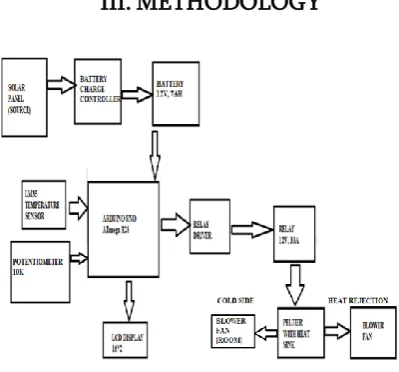
Figure 1. Block diagram of solar based air conditioning using peltier.
WORKING PRINCIPLE.
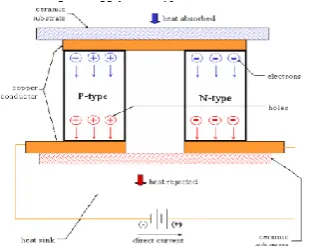
The cooling effect produced by the system is basically based on Peltier effect. Peltier effect is a temperature difference obtained by applying a voltage between two electrodes connected to a sample of semiconductor material to create a hot side and a cold side. Basically the heating and cooling effect is produced because of the electron-hole presented inside the P- N type superconductor. Thus the electron-hole are the heat carrier here in the system same as the refrigerant in conventional AC. The cold side of the peltier module is kept inside the chamber to be cooled while the Hot side is kept outside for removal of heat. DC fan with fins are assembled toward hot side for easily and quick removal of heat.
Figure 2. Working of peltier module
IV.
HARDWARE DESCRIPTION
SOLAR PANEL
Solar photovoltaic module is the array of number of electrically connected solar cell mounted on a frame. Modules are designed to supply the electricity at certain voltage. The efficiency of the module and current supply by it is totally depend upon the amount of solar radiation fall on the surface of the PV module. Solar panel of 5watts, 12volts is used here.
ARDUINO
Arduino is an open-source electronics platform based on easy-to-use hardware and software. Arduino are able to read input light on a sensor, a finger on a button,activating a motor, turning on an LED, publishing something online.The arduino uno
is microcontroller board based on
ATmega328(datasheet).it has 14 digital input/output,16 MHz ceramic resonator,a USB connection, power jack and ICSP header and reset pin it contains everything needed to support the microcontroller.
PELTIER MODULE
A thermoelectric module consists of arrangements of number of P-type and N-type semiconductor which are heavenly doped with electron carrier and sandwiched between two ceramic substrates.
These elements are arranged in a way that is electrically connected in series but thermally connected in parallel. In this project we have used the Peltier module model TEC1-12706.
BATTERY
DC FAN AND HEAT SINK
Cooling fan works on 12V DC been used here to remove the heat from the hot side. Heat sink is a passive heat exchanger that cools a device by dissipating the heat into surrounding medium, it consists of fin blade due to which the surface area for cooling increase and hence the cooling effect obtained.
V.
SOFTWARE DESCRIPTION
ARDUINO COMPILER
The open –source arduino software(IDE) makes it easy to write code and upload it to the board. It runs on windows, mac OS X, and linux. The environment is written in java and based on processing and other open-source software. This software can be used with any arduino board.
The program is dumped to arduino board to run it. The programing part is done in a way which displays the cold temperature and set temperature.
ADVANTAGES OF PELTIER MODULE
1. Direction of thermoelectric heating pump is reversible by changing the polarity of current, so it can work as cooler and heater too.
2. Thermoelectric module does not have moving part to wear and tear; therefore there is no need of any maintenance.
3. It has capacity to work for more than 200,000 hours in steady state.
4. It resists shock and vibration.
5. It can work in too severe or sensitive environment.
6. It does not contain any harmful material like chlorofluorocarbons (CFCs) which can damage environment.
7. It does not dependent on gravity. Thus, it can be placed in any direction.
8. Temperature can be maintained in fraction of degree, even below ambient temperature using thermoelectric module by controlling the power load provided to the module.
9. Temperature can work between 100ºC to 100ºC of heat sink temperature.
DISADVANTAGES
The main disadvantage of thermoelectric module is lower efficiency when compare to non-thermoelectric modules when working as power generator. It is usually 0.3 or lower.
VI.
RESULTS
Once the whole hardware component is installed with proper connection, the system can be operated and the desired effect can be obtained. Following result is obtained after the designed system is switch on.
Table 1 SET
TEMPERATURE (℃)
COLD
TEMPERATURE (℃)
18 20
20 25
30 35
VII.
CONCLUSION
A solar thermoelectric air cooling system is designed which can be better for use in remote areas where temperature of 18℃.Thus the designed system attains the temperature difference of 17℃, which can further improved by using more number of peltier module. As the system is eco-friendly it can be better alternatives for the future use as considering the depleting of non-renewable sources.
VIII.
FUTURE SCOPE
The units of energy production can be developed in the various regions by these days the society face the energy crisis and also the harmful effects of pollution. The thermoelectricity generate electricity without any harmful effects. Thermoelectric devices achieve an importance in recent years and in future it still increase a variable solution for application such as spot cooling of electronic components, remote power generation in space station and satellites etc. The low cost, eco friendly nature are enough inputs to motivate the engineers for their implementations in almost all the suitable application of daily life in near future.
IX.
ACKNOWLEDGMENT
Any project completed successfully gives a great sense of achievement and satisfaction. The project would remain incomplete if the people who made it possible and whose constant guidance and encouragement go without mention.
We wholeheartedly thank our Guide, Dr. Vagdevi S Dean Academics, Professor and Head, Department of Electrical & Electronics, GSSSIETW, Mysuru for having shared a genuine desire to make a positive
contribution to address the challenges associated with every element of the project.
X.
REFERENCES
[1] Riffat, S. B., Qiu, G. (2004). Comparative Investigation of Thermoelectric Air-Conditioners versus Vapour Compression and Absorption Air-Conditioners. Applied Thermal Engineering, 24, 1979–1993.
[2] Abdullah M. 0., J. L. Ngui, K. Abd.Hamid, S. L. Leo, and S. H. Tie, (2009).Cooling Performance of a Combined Solar Thermoelectric Adsorption Cooling System. An Experimental Study, Energy Fuels, 23. 5677-5683.
[3] Luo, D., Zhao, F. Y, Yang, H. X., & Tang, G. F. (2015). Thermoelectric mini cooler coupled with micro thermosyphon for CPU cooling system. Energy, 83, 29-36.
[4] Gillott Mark, Liben Jiang and SaffaRiffat, (2010).An investigation of thermoelectric cooling devices for small-scale space conditioning applications ill buildings, International Journal ofEnergy Research, 34. 776-786.
[5] Bansal, P.K.Martin, A (2000).Comparative Study of Vapour Compression, Thermoelectric and Absorption Refrigerators. International Journal of Energy Research, 24, 93–107
[6] Mayank Awasthi, K V Mali (2012), ―Design
And Development Of Thermoelectric
Refrigerator, International Journal of Mechanical Engineering and Robotics, Vol. 1, No. 3, October 2012.
[7] Manoj kumar Rawat,et al. “Developed and experimental study of solar powered Thermoelectric Refrigeration system” July-august 2013 ,International Journal of engineering research and application page 25432547.
[9] Zhang, L.Z. and Niu, J.L., 2002, “Performance comparisons of desiccant wheels for air dehumidification and enthalpy recovery”, Applied Thermal Engineering, Vol. 22, pp.1347-1367.
[10] Riffat and Guoquan, “Comparitive
investigation of thermoelectric air- conditioners versus vapour compression and absorption air- conditioners”, Journal of Applied Thermal Engineering, vol .24 , pp. 1979-1993,2004.
[11] Huang.B, C.J. Chin and C.L. Duang, “A design
method of thermoelectric cooler”,
International Journal of Refrigeration 23, pp. 208-218,1999
[12] Edson and jose, DW,“Performance analysis of a thermoelectric air conditioning", Applied Thermal Engineering, vol. 9-10, pp. 9-11,2004 [13] Sujin ,Vora and Seetawan, “Analyzing of
Thermoelectric Refrigerator Performance”, Proceedings of the 2ndInternational Science, Social-Science, Engineering and Energy Conference, pp. 154–159,2010
[14] Alfred Erhard and Erich Hahne, “Test and simulation of a solar-powered absorption cooling machine”, Energy. Vol. 59, No. 4-6, pp. 155-162, 1997
[15] A. De Francisco, R. Illanes, J. L. Torres, M. Castillo, M. De Blas, E. Prieto and A. García, “Development and testing of a prototype of
low-power water–ammonia absorption
equipment for solar energy applications”, Renewable Energy, vol. 25, No. 4 , pp. 537-544, 2002.
[16] Adnan SOzen and Mehmet Ozalp, “Solar-driven ejector-absorption cooling system”, Applied Energy, vol. 80, No.1, pp. 97-113, 2005.
[17] Velmurugan V., RajaBalayanan S.R., Surendhra Babu K. and Sakthivadivel D., “Investigation of
a Novel Solar Powered Absorption
Refrigeration System with Solar Point Collector”, Research Journal of Chemical Sciences, Vol.1(7), pp. 51-56, 2011.
[18] Dr. Nimai Mukhopadhyay and ER. Someshwar Chowdhury, “Performance Analysis of Solar Assisted Cascade Refrigeration System of Cold Storage System”, International Journal of Advanced Research in Electrical, Electronics and Instrumentation Engineering, Vol. 2, No.4, pp.1248-1254, 2013.
[19] ASHRAE Handbook. Fundamental
volume,1993.