Master Thesis
Internationally franchising the SDC by J.J.P de Vries
University of Twente, Enschede, the Netherlands Master Business Administration
International Management
2
Franchising the SDC internationally
Master Thesis
Author J.J.P. de Vries Student Number s0134465
Date September 2008
Study Master Business Administration Specialisation International Management University University of Twente
Supervisors:
Trude Buitenhuis Business developer- Enviu
Ir. S.J. Maathuis School of Business, Public Administration and Technology - International Management
Prof. Dr. Ir. E.J. de Bruijn School of Business, Public Administration and Technology – Chair holder International Management
University of Twente Drienerlolaan 5 7522 NB Enschede Enviu
3 Executive summary
This research and report are based on the problem formulation:
How can SDC successfully franchise the SDC concept internationally?
For this research four research questions were formulated to structure and guide the research and in the end answering the main question. In the first part the theory regarding franchising is reviewed; on aspects such as what is franchising, how can it be implemented and advantages of franchising. These theories laid down the baseline for the research and also presented parts that needed extra attention; such as franchisee selection and internationalisation factors such as distance management, cultural adaptability, control, market attractiveness and risks. In the final part of this chapter the success factors for international franchising according to the literature are defined.
The franchising success factors alone however are not sufficient. Best practice examples are needed to be researched in order to benchmark the success factors found in the literature. McDonald was chosen due to its success and relative closer link to SDC (Food and drinks industry). The Body shop is chosen due to its corporate responsibility to their clients. The Body shop only sells products that are naturally produced as well as not tested on animals. At the end this chapter the success factors according to best practice examples are defined.
After defining the critical success factors from best practice examples and combining them with those factors found in the literature a gap analysis between these factors and the SDC was done. It became clear that SDC is not able to implement franchising at this moment. Focus of the research thus changed from implementation to evaluation of the SDC concept, to see if the concept is suitable for franchising or not.
Proving SDCs business concept can be done through project management specifically monitoring and evaluating their projects. Monitoring is can be done throughout the project, evaluating only at the closure phase of the project. Five monitoring criteria are defined by the EU, for each one of these criteria objectives need to be developed as well as indicators that can prove if objectives are met. Indicators (OVIs) need to be defined SMART specific (Specific, Measurable, Achievable, Relevant and Time related) and afterwards sources of information need to be defined and should be: appropriate form/presentation, specific enough, reliable, accessible, reasonable costs for obtaining the information.
SDC should define their objectives, indicators and sources of verification before the first of January, because the monitoring of the Club WATT project should be at least one year, afterwards SDC should be able to evaluate if the first year was successful or not, if successful would be able to go forward with franchising as an international franchising option.
4 Preface
This report is the end result of a research that was started in September 2007 for Enviu/SDC. I received the contact with Enviu via Ir. S.J. Maathuis. I suggested to Enviu the possibility of researching the internationalisation of the SDC.
I would also to like to use this opportunity to thank those people without whom this research was not possible. First I would like to thank Trude Buitenhuis for providing me with information of SDC and guiding me and Wouter Kersten for helping me with the aim of the research. I would also like to thank my supervisors from University of Twente, Ir. S.J. Maathuis and Prof. Dr. Ir. E. J. de Bruijn. Last I want to thank all other persons and organisations who contributed their part to this research and whom are not mentioned by name here.
5
Table of content
CHAPTER 1: INTRODUCTION 7
1.1OBJECTIVE OF THE RESEARCH...7
1.2PROBLEM FORMULATION...7
1.3RESEARCH QUESTIONS...7
1.4RESEARCH APPROACH...7
1.5RESEARCH STRUCTURE...8
CHAPTER 2: SUSTAINABLE DANCE CLUB 9 2.1THE HISTORY OF SDC...9
2.2THE STRATEGY OF THE SDC ... 10
2.3PRODUCTS/SERVICES... 11
2.4SDC PROJECTS... 14
2.5SWOT OVERVIEW... 14
CHAPTER 3: CRITICAL SUCCESS FACTORS FOR (INTERNATIONAL) FRANCHISING 16 3.1DEFINITIONS OF FRANCHISING: ... 16
3.2REASONS FOR FRANCHISING A BUSINESS... 18
3.3FRANCHISE IMPLEMENTATION... 19
3.4INTERNATIONAL FRANCHISING FACTORS... 21
3.5PEST... 23
3.6BERIINDEX... 24
3.7CONCLUSION... 25
CHAPTER 4: BENCHMARKING 27 4.1MCDONALDS... 27
4.2BODY SHOP... 28
4.3CONCLUSION... 29
CHAPTER 5: GAP ANALYSIS 30 5.1GAP ANALYSIS:HOW SDC RELATES TO THE CRITICAL SUCCESS FACTORS... 30
5.2CONCLUSION... 32
CHAPTER 6: SUGGESTIONS FOR THE POSSIBLE FRANCHISING OF THE SDC 33 6.1PROJECT MANAGEMENT... 33
6.2MONITORING AND EVALUATING PROJECTS... 34
6 CHAPTER 7: CONCLUSION, RECOMMENDATIONS AND REFLECTIONS 39
7.1CONCLUSION... 39 7.2RECOMMENDATIONS... 40 7.3REFLECTION ON THE RESEARCH... 41
LITERATURE 42
7
Chapter 1: Introduction
1.1 Objective of the research
Main goal of this research is contributing in the roll out of the Sustainable Dance Club (SDC from now on) by investigating if internationally franchising is possible for SDC and if so under which conditions.
1.2 Problem formulation
Based upon the background of the research and the formulated objective the following aspects are of importance.
The objective of the study can be categorized as a strategic objective, as the research entails the analysis of the company as well as analyzing theory and best practice examples on critical success factors/conditions (Countries abroad) the word strategy implies a path or plan of actions to achieve previously made objectives and goals.
The next part of the research will be a gap analysis between the characteristics of the SDC and the critical success factors that were found in the theory analysis.
The last part of the research will entail suggestions for improvement of the SDC based on the theory and best practice examples as well as how to implement these suggestions.
Based upon the above statements the problem formulation is defined as follows: How can SDC successfully franchise the SDC concept internationally?
To answer the main question several sub-questions have to be drawn up. The first sub-question has to be about the SDC, the second on conditions for international franchising, the third
question will have to deal with possible suggestions for improvement and the last question to be answered will be about recommendations. This lead to the following research questions:
1.3 Research questions
1. What is the Sustainable dance club?
2. Under what conditions can SDC successfully franchise the SDC concept internationally? a. According to literature
b. According to best practice
3. What are possible suggestions for improvement for SDC?
4. What recommendations on implementation can be formulated for SDC’s international franchising?
1.4 Research approach
8 The research consists out of 5 parts; the first will be a description and analysis of the SDC. This is done through the history of the SDC, its products and a SWOT analysis. Next part is an analysis of the theory on franchising and internationalization theory. This means a description of the concept, through the use of books, internet, web of science and articles.
The third part is the description of best practice examples. In this part I have searched for related examples such as Body Shop, as well as examples that are a bit further away such as Burger King or McDonalds.
Next part will be taking a look at the critical success factors of the literature and best practice examples and how they relate to the SDC. The critical success factors that come forward need to be tested in the next step. This is done by a Gap analysis. In this testing phase it should come forward if franchising is an option for SDC and what suggestions can be derived from the analysis.
The last part will be the recommendations to the SDC, whether franchising is a good option for SDC, what methods need to be used, what parts are suitable for franchising and what the next steps are.
After the recommendations a reflection will be done on three parts; theoretical, empirical and methodological reflections.
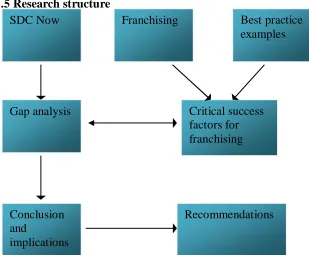
1.5 Research structure
Figure 1, Research structure
SDC Now Franchising
Gap analysis Critical success
factors for franchising
Conclusion and
implications
9
Chapter 2: Sustainable Dance Club
In this chapter an analysis will be done on the SDC; its history, products, strategy and Swot Analysis in order to answer the first sub-question: What is the Sustainable Dance Club? 2.1 The history of SDC
In 2004 the idea of a sustainable dance club came to life in Stef van Dongen’s mind, the founder of Enviu. At the beginning of 2005, Enviu involved Döll – atelier voor bouwkunst. The
popularity of the project could be seen right away, while the first brainstorm session already attracted approximately 70 people who volunteered.
After more research, developing more ideas and visualizing these in presentations, a dance club interested in the subject was found: Nighttown (also situated in the centre of Rotterdam).
Unfortunately Nighttown failed for bankruptcy later on. Nevertheless Döll and Enviu decided to continue the development of the concept independently from a location or existing club, and meanwhile keep an eye open for possible investors.
The first concept to be elaborated is the energy generating dance floor In September 2006 Enviu and Döll came in contact with Anouk Randag, a graduation student of the faculty of Industrial Engineering, who was willing to develop this concept. The dance floor should be the first working product for the sustainable dance club. Later on Ontwikkelingsbedrijf Rotterdam (OBR), division of the congregation presented the new plans for Now&Wow and The Creative Factory to be built above it. These plans came true to be very similar plans as the concept of the sustainable dance club.
The press and other clubs continuously are showing interest. Along more and more detailed questioning raised, while everything was still a concept. Also implementation possibilities and usage from more than 1 or 2 clubs is needed to provide reliable solutions.
In April 2007 Paradiso is interested to involve the SDC in the building of a new pop stage in Amsterdam South East. In May 2007 the congregation has plans to rebuild club Nighttown. Negotiations are still afoot for the SDC to play a role in this reconstruction.
On the first of June a second sustainable dance party was organized in Amsterdam, club 11. It was the kick off of the “sustainable week” of Amsterdam. It was a great success with lots of (international) media attention.
In June 2007 Beatriz Garcia (also from the faculty of Industrial Design Engineering) started her graduation project on designing a sustainable bar. In the beginning of July the Energy
10 2.2 The strategy of the SDC
In the previous part the history of the SDC was explained, in the next part SDCs strategy is going to be explained as the strategy is the main driver of the SDC.
Vision:
We dream of a world where young people have a sustainable lifestyle. “SDC’s core values are:
Creativity, enthusiasm and inspiration Honesty
Sustainability
Innovation and youth Open and co-creating Mission:
To realize a worldwide network of Sustainable Dance Clubs, starting in Rotterdam, made by young creative persons that inspire young people to adopt a sustainable lifestyle!”
The definition of a sustainable club solution according to SDC: creative and efficient solutions for clubbing processes, using sustainability as starting point. This means people; planet and profit are in balance.
The proposition to the customer (club/festival/real estate owner): You will get a unique implementation of the Sustainable Dance Club solution, which will give you a competitive advantage. You will be able to give clubbers a great clubbing experience, while reducing the impact to the environment and saving costs on the longer term.
The proposition to cities and NGOs: You will have a highly appealing showcase for sustainable entrepreneurship, which will enable you to involve companies and young people to find
solutions for today’s challenges related to sustainability themes such as CO2 reduction. At the same time the Sustainable Dance Club will directly and indirectly contribute to reduction targets for emissions and waste.
The proposition to suppliers: You will get reach to all Sustainable Dance Clubs and you can use co-branding. By doing so, you can benefit from the image of the Sustainable Dance Club (Business plan SDC, 2007)
11 Strategy
The SDC delivers a high quality sustainable club solution, as a complete package, or parts that suit the customer’s needs, for existing and new clubs and festivals. The SDC offers access to a possible international network of sustainable dance clubs, young creative and suppliers. Their definition of a sustainable club solution: creative and efficient solutions for clubbing processes, using sustainability as starting point. This means people, planet and profit are in balance.
To deliver their products and services, SDC is undertaking the following main activities: starting with a specific customer request, we develop a tailor made SDC proposal. This may exist of an analysis of the company processes, providing management consultancy (regarding the program as well as the organization of a club) and a technical and esthetical design. The SDC facilitates the implementation and coordinate the realization. They develop and maintain an international network of young creative people, sustainable dance clubs and suppliers
Partnerships
The SDC aims for partnerships in the following areas:
Idea generation, research, development and testing of new concepts and products
They will work with our own networks of local young talents and establish contacts with networks local to our customers, to develop innovative sustainable solutions. By working with local young talents they will create a community building tailor made solutions for local needs, whereby elements can be reused for other customers. Networks of young professionals, students and young creative people, universities and colleges (like TU Delft, Erasmus, and In Holland) 2.3 Products/services
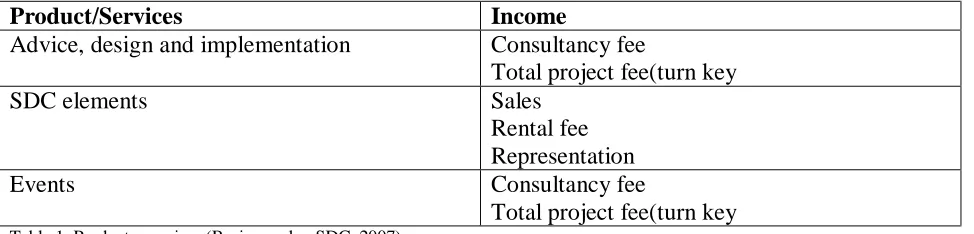
In the table below the three product/services of the SDC are presented, in the this part of the research these three parts will be explained
Product/Services Income
Advice, design and implementation Consultancy fee
Total project fee(turn key
SDC elements Sales
Rental fee Representation
Events Consultancy fee
Total project fee(turn key Table 1, Product overview (Business plan SDC, 2007)
• Advice, design and implementation( “Providing sustainable clubbing advice”)
Studies have shown that the majority of young people has a keen interest in the environmental impact of their activities and would be willing to pay more for a sustainable clubbing experience.*(Brochure SDC, 2008)
12 integrated at every level of your business, from the lighting, waste and marketing right through to creating a unique clubbing experience for your clientele.
• Sustainability Scan
To check the current sustainability status of an organisation SDC offers two types of scans:
The CO2 quick scan calculates the carbon footprint of your club or festival. It also offers the possibility to offset this by investing in compensation projects such as planting trees. The in depth scan takes a detailed look at your company’s environmental impact, along with the economical and organisational aspects of the company. It then provides comprehensive advice on the possible improvements your club could make.
• Workshops
SDC consultants offer workshops for organisations by demonstrating how sustainability can be implemented. Using their knowledge and imaginative approach, SDC’s consultants will work with an organisation to initiate a creative process that will continue even if the results are met. .
• Sustainable trademark
SDCis creating an international network of sustainable dance clubs where the use of the sustainable trademark and logo is synonymous with an exciting and ethical clubbing experience. Becoming an official Sustainable Dance Club gives a business a more positive image, provides new media exposure and access to a network of young designers, creative people and suppliers. To qualify as a Sustainable Dance Club your club must reach a certain level of sustainability as defined by the 5 SDC guidelines: 30% less environmental impact than average clubs,
Sustainability integrated in both building and organisation,
Installation of 3 SDCspectaculars that show sustainability to the public
Communication plan on how to inform the public about sustainability, Sustainable business plan with yearly targets and evaluation
In a survey conducted by SDC in 2007 66% of clubbers said they would be willing to pay more for a sustainable club night. (SDC Brochure, 2008)
SDC Elements
SDC elements are products that embody the beliefs of the company. They make a contribution to sustainability whilst communicating a positive message in an exciting and engaging way. Within SDC’s creative network, many ideas for new club applications are continually generated. The most innovative ideas are developed into SDC Elements, products that have real benefit for the prospective client
13
• Energy Generating Dance Floor
The revolutionary concept of the Energy Generating Dance floor has attracted international media coverage. The dance floor enables the customer to become an energy source, which can contribute to power a club as well as motivating the DJ and other clubber to reach a maximum energy level possible.
As with all SDCTM elements the dance floor can be adapted to specific needs. It can be seamlessly integrated into a club and comes with optional additions to match your corporate style. From autumn 2008 a mobile version will also be available for hire.
• Mini-Sustainable Dance Club
To showcase the potential of a Sustainable Dance Club, we have designed a miniature version.
Ideal for events and expos, the mini-SDC is a club which houses two people at a time, their dancing powering the lights and visual displays.
This serves as a vital promotional tool that can generate a great deal of positive publicity.
• Zero Waste bar
SDC is currently developing a bar that saves energy, water, waste and time. All the products in the bar run on tap from large containers, including wine and spirits. This system keeps the waste produced by the bar to an absolute minimum, speeds up service and saves personnel the time of filling the fridges. SDC™ is working with the company Steel Stuff from Tilburg to manufacture the Zero Waste Bar which will be available from September 2008.
• Trees for dance
Trees for Dance is a program run by SDC™ to compensate CO2 that is produced by clubs and clubbers. Trees for Dance calculates the carbon footprint of different clubbing activities and offers the possibility to offset this CO2 by investing in compensation projects. www.treesfordance.nl
• Events
High impact events with low impact on the environment, SDCTM has an experienced event management team, who, with their specialist knowledge in sustainable clubbing can produce unique events or simply advise on exciting SDCTM elements available for hire. From large congresses and festivals to personal parties and small corporate events, SDC provides an inventive and seamless service for every occasion.
14 2.4 SDC projects
In the previous sections the history, products and strategy of the SDC were elaborated on. In the next part in short the projects of the SDC will be explained.
Club WATT
Club WATT is the first project for SDC in making a club more sustainable. The new club that is supposed to open in September 2008 is situated in the former Nighttown in Rotterdam. Club WATT will be the first sustainable club in the world and therefore the first club that has the SDC elements such as the energy generating dance floor as well as the sustainable conduct of
business.
Although SDC believes that their business concept has promise, as mentioned above SDC’s business system has not been proven by practice. Club WATT will be the first project that will be put into action; this could therefore be of large influence for the franchising research. 2.5 SWOT overview
In this part a SWOT overview is done; to analyse the Strengths, Weaknesses, Opportunities and Threats for the SDC. A SWOT analysis is a strategic tool that analysis the four factors mentioned above involved in a project/business. It involves specifying the objectives of the business and identifying what internal and external factors are favourable or unfavourable to achieving that objective.
The SWOT overview below is based on the original analysis that is in the SDC business plan. However several parts were included due to own experience and analysis of the information. The SWOT overview will point out the critical factors for the SDC both positive and negative.
Strengths Weaknesses
The first Sustainable dance club in the Netherlands (EU?), Rotterdam has a premiere (Club Watt)
Unproven business concept
SDC elements (bar, dance floor, led wall) Size of the company and the ability to serve demand
Modular design interior The time for implementation Know-how on making clubs sustainable and
creating successful concepts
Budget
No customer selection criteria Experience
Network of creative people
15
Opportunities Threats
People want to visit the new club, people want to be surprised.
Other clubs will copy the concept (which is actually a good thing for the environment) Free publicity; TV, radio, magazines,
newspapers
Copying the systems, methods and know-how of the SDC
To make the image of the ‘green club’ groovy and cool
People do not want to come because they think the ‘eco club’ is for environmentalists and goat-woollen-socked people.
Excellent platform for Enviu and partners to generate brand recognition
Risk that people perceive the sustainable concept as hype and will turn their backs to it Profit increase Costs for sustainability in relation to entrance
prices. Increase of brand awareness and knowledge
on sustainability of the client. Current emphasis on sustainability Table 2. SWOT overview
Table 2 shows that although there are a significant amount strengths and opportunities they are a large amount of weaknesses and threats. Most important weakness of the SDC is the fact that the concept is unproven in practice.
2.6 Conclusion
Sustainable Dance Club is a business that provides clubs with services that focus on making clubs more sustainable as well as showing clubbers that sustainability does not have to be boring and that it is attractive for many customers. The SDC offers several services: Consultancy, SDC elements, Events
SDCs focuses on consultancy, this is their most important service; as it has the most potential for impact on both club owners as well as clubbers, making them aware of sustainability. SDC currently has one consultancy project that is already put into action. Club WATT (the current project that is being put into actions) is going to open in September 2008 and will be the first sustainable club in the world.
The SWOT analysis based on the analysis done by SDC put forward that there are a large amount of threats and weaknesses that need to be addressed such as the current size and
financial situation of the company, image, selection criteria, their inexperience in handling large projects and the business concept. The strengths of the SDC are also their competitive
advantage, for example the energy generating floor and the Zero Waste bar, these products as well as the business concept however still need to be proven in practice.
16
Chapter 3: Critical success factors for (International) franchising
In this chapter the concept of franchising will be explained, how it works and what the advantages and disadvantages are and finally the second sub-question:
3.1 Definitions of franchising:
“Franchising is a method of marketing goods and services which knows no boundaries in terms of business categories; it has the following features of business transactions, methods and practices (Mendelsohn, 1992)
The ownership by one person of a trademark, service mark, an idea, a secret process, patent or a specialised piece of equipment and the goodwill and know-how associated with it.
The grant of a license by that person to another permitting the exploitation of such a trademark, service mark, idea, process, patent or equipment and the goodwill and know-how associated with it.
The inclusion in the agreement granting the license of regulations and controls relating to the operations of the business in the conduct of which the licensee exploits his rights
The payment by the licensee of a royalty or some other consideration in the nature of a
continuing fee for the rights which are obtained and for any services with which the licensor will provide the licensee “(Mendelsohn, p.2, 1992)
Other definitions for franchising are:
IFA (International Franchise Association)
“A franchise operation is a contractual relationship between the franchisor and franchisee in which the franchisor offers or is obliged to maintain a continuing interest in the business of the franchisee in such areas as know-how and training; wherein the franchisee operates under a common trade name, format and/or procedure owned or controlled by the franchisor, and in which the franchisee has or will make a substantial capital investment in his business from his own resources.”
BFA (British Franchise Association)
“A contractual license granted by one person (the franchisor to another (franchisee) which: a.) permits or requires the franchisee to carry on during the period of the franchise business under or using a specified name belonging to or associated with the franchise.
b.) entitles the franchisor to exercise continuing control during the period of the franchise over the manner in which the franchisee carries on the business which is the subject of the franchisee. c.) Obliges the franchisor to provide the franchisee with assistance in carrying on the business which is the subject of the franchisee (in relation to the organisation of the franchisees business, the training of staff, merchandising, management or otherwise.)
d.) Requires the franchisee periodically during the period of the franchise to pay to the
17 e.) which is not a transaction between a holding company and its subsidiary (as defined in
Section 153 of the company act 1954 or between subsidiaries of the same holding company or between an individual and a company controlled by him.
Definitions are essentially the same except for the last paragraph, they both confirm the
contractual relationship between the franchisor and franchisee, confirms that the right or license to carry doing business under a trade- or service mark. Interesting is that it is not stated that the franchisee owns his own business.
Mendelsohn (Guide to franchising, 1992) mentions basic features that have to be present in every “business format” franchise.
1. “A franchise relationship is founded upon a contract which should contain all the terms agreed upon.
2. The franchisor must first develop a successful business format which is identified with a brand name which may be a trademark, service mark and/or trade name.
3. The Franchisor must initiate and train the franchisee in all aspects of the system prior to the opening of the business so that the franchisee is equipped to run the business
effectively and successfully and assist in the opening.
4. After the business is opened the franchisor must maintain a continuing business relationship with the franchisee in the course of which it provides the franchisee with support in all aspects of the operation of the business.
5. The franchisee is permitted under the control of the franchisor to operate under the branding (trademark, service mark, trade name) format the business systems developed and owned by the franchisor and to benefit from goodwill generated elsewhere.
6. The franchisee must make a substantial capital investment form his own resources 7. The franchisee must own their business.
8. The franchisee will pay the franchisor in own way of another for the rights which he acquired and for the continuing services with which he is provided.”
Mendelsohn later narrowed it down to 5 elements as mentioned in "Franchising Law", Kluwer, 2004:
1. “ Brand name (registered as a brand name and/or a trademark, )which serves as the umbrella sign for network, and a rallying sign for the consumer and public),
2. A license to the use the brand, granted to the franchisee by the franchisor,
3. A business system - a business concept formatted into a duplicable value "package" founded on the franchisor's tested Know How and his continued assistance during the term of the agreement),
4. Payment by the franchisee of a financial consideration, either in a direct form, such as an entrance fee and/or continuing fee ("royalty"), and/or an indirect form such as a mark-up on supplied goods.
18 The Block Exemption regulation for Franchise Agreements: This regulation defines a franchise in the following terms:
“Franchise means a package of industrial or intellectual property rights relating to trademarks, trade names, shop signs utility models, designs, copyrights, know-how or patents, to be
exploited for the resale of goods or the provisions of services to end users” (Block Exemption, EU)
There are 2 sorts of franchising: Hard franchising where everything is done exactly as stated by the franchisor, Soft franchising give the franchisee more freedom to fill in parts of the franchise themselves for example the look of the outlet or special local products.
Critical factors:
From the above the following success factors can be derived:
The franchisor must first develop a successful business format which is identified with a brand name which may be a trademark, service mark and/or trade name.
The franchisee must make a substantial capital investment from own resources The franchisee must own their business.
Type of franchising (hard or soft)
Now that franchising has been defined as a concept, it is needed to look at the advantages and disadvantages that are linked with franchising. The following part will go deeper into this subject.
3.2 Reasons for franchising a business
When a company opts for franchising, they do so for 2 fundamental advantages of 2 resources: Financial: When a possible franchisee opts to take on a franchise it has to use its own capital. It could not be otherwise because otherwise the franchisor would own the new outlet. Therefore the opening of a new franchise outlet does not require any capital from the franchisor.
Manpower
The franchisee will be responsible for the day to day conduct of business. What this means is that the franchisee will be responsible for the hiring, training, motivating and supervising his staff.
From the 2 before mentioned resources flow a number of other benefits:
The franchisor will only need a compact organisation, only needing a few highly specialized managers in various aspects of the business with which the organisation is concerned, and their support staff. The franchisor can earn a reasonable profit without becoming involved in high risk or in the day-to-day detail and problems which arise in the management of scattered outlets. Since the franchisor is using others resources and can by his training programmes equip them to carry on his business system, his organisation has the ability to expand more rapidly on a
19 The franchisor will find it easier to exploit territorial areas which are not already within scope of the organisation as franchisees with local interest and knowledge can be obtained.
A franchisor has fewer staff problems with which to cope as he is not involved in the staff problems of each individual outlet. Franchising offers the scope of an existing single owner of a multiple chain to develop its future outlets by a franchise system rather than expanding its own outlets, thus reducing the calls upon its capital and manpower resources.
Franchising also has it difficulties; the main problem with franchising mostly has to do with the dealings of the franchisor with the franchisee as “people”. The relationship between franchisor and franchisee is constantly put under strain. Symptoms that are experienced regularly are: The franchisor has to make sure that the standards of quality, services and goods are maintained. Their field support staff has to ensure these qualities, as will as providing support to the
franchisee. Their staff has to make sure that they do not cut any corners en changing the system to their liking, because a small untreated change in the system today may lead to a large problem in system in the future. The franchisee may not have selected the right franchise and the
franchisor may not have used the correct selection procedures. The franchisee may not be using the franchise system properly
Trust between the franchisor and franchisee may break down due to the incompatibility between the franchisee and the responsible person in the franchisors organisation the training of a
franchisee may create a competitor in the future. The franchisor has to select suitable franchisees to make sure that business does break down. An unsuitable person should not be allowed to take on the franchise. Profit obtained by the franchisor will always be lower than the franchise potential of the outlet.
Now that the advantages of franchises of franchising are defined and no definite success factors are found, it is necessary to look at franchise implementation, which is done in the next part 3.3 Franchise implementation
In previous part the concept of franchising and reasons for franchising were explained, this however did not provide critical success factors. Therefore I needed to look at the
implementation part of franchising. In this chapter the first two steps of the implementation of franchising will be explained, besides that critical success factors/conditions need to be derived from the information.
There are 7 elements involved when creating and developing a franchised business: 1. The basic business concept
2. Pilot operation
3. Developing the franchise package 4. Developing the operational package 5. Marketing the franchise package 6. Selecting franchisees
7. Developing the franchisor’s organisation
20 In order to start a franchise the business concept should be developed. The most important thing when one wants to set up a franchise is to keep it simple, because others have to be taught to operate successful. The more complex the business concept is, the more difficult it will be to recruit, train and sustain franchisees. Good examples are Burger King and McDonalds food restaurant, the lay-out of the kitchen, décor, take-out and restaurant area, it is simple to
implement these because the franchisor kept the design simple. Next is to analyse and anticipate the needs of the customer. Another important part is the definition of the market at which the business is aimed, as there is no point in creating a business that has no market. Also important is to keep in mind that the consumer at first will choose for the established brand first as this is familiar.
Attracting franchisees with sufficient financial resources to successfully establish the outlet may be a factor that needs to be taken into account, as well as their ability to acquire the skills
required for the business as well as teaching them to their staff.
In the article of Clarkin and Swavely (2006) 6 selection criteria are mentioned financial net worth, general business experience, specific industry experience, formal education.
Psychological profile; personal interview
Jambulingham and Nevin (1999) also identified selection criteria: financial. Experience and managerial skills, businesses, and manage operations, prior experience, prior self-employment, own other, demographic characteristics, Attitudes and personality.
The franchisor should also take into account factors such as premise; finding a suitable premise which will enable the franchisee to do their business successfully, consumer demand, can the franchisor use, allocate their resources to establish sufficient market demand. Last factor that needs to be looked at is the market/business sectors health; how is it doing, staying power. The business concept should be distinctive, it should have a competitive edge; all successful franchises have their own distinctive concept that sets it apart from the competition
In the business concept phase the trademark to be used is chosen, it is important that it is easily pronounceable, not capable of being translated (Well known is the “Chevy nova” “doesn’t go” principle), it should be possible to register and short.
Most important criteria:
1. The concept must be proven by practical experience to be successful
2. The business should be distinctive in its image as well as in its methods and system. 3. The system and method must be capable of being passed on successfully to others within
a reasonable time frame.
4. The financial returns from the business should be sufficient to enable the franchisee to obtain a sufficient return on capital, the franchisee should obtain a reasonable return for his labour and the franchisee is able to pay the franchisor a fee for the services he continuously supplies.
21 When the business concept is developed the next step should be the pilot operation. How many pilots should be done is dependant on the how re-presentable the pilots are. In order for a possible franchisor to know that they are ready for a franchise, they should experiment. A franchisor should have a proven package of know-how. If they do not prove their ability to operate the package with success and put their own money at risk, they should not start up a franchise. A franchise should not be established by trial and error.
A pilot will fulfil functions like:
The viability of the concept will be developed and established as acceptable and exclusively. It will identify problem areas and enable the franchisor with solutions to factors such as;
marketing, acceptability and availability of services, methods of marketing, promotion, regulations, legal aspects and taxation. They will try out decors, use of equipment, Experience with trading and the operation of the outlet. Show how training can be used successfully, pitfalls. Information needed for an operations manual will become available.
The pilot operation basically should prove is the viability of the concept. In the Next part other important factors that are concerned with franchising will be explained.
The previous two parts of franchising implementation offered the most critical success factors, the rest of the 7 steps can be found in the appendix.
3.4 International franchising factors
In the previous part general information on franchising and parts of franchise implementation was given. There are however other factors that are important and will therefore be deliberated on.
3.4.1 Building partnerships/stakeholder management
Partnerships are based upon the collaboration between two specific stakeholders. Partnerships can occur when several parties want to respond to a common problem domain, but individually they do not control enough relevant resources to respond as effectively as they want. Meaning that, several groups may work together if they consider that this would bring them more benefits (synergy effects) than acting alone. (Araujo and Bramwell, 2002)
Mohr and Speckman developed a model in which the attributes for successful partnerships are mentioned. These attributes include commitment, coordination, interdependence and trust. These attributes are the basic requirements for a successful partnership, without them a partnership will fail. Second factor of importance is communication behavior, which has three attributes; quality (accuracy, timeliness, and credibility of the information shared), information sharing and
participation (the degree to which partners jointly plan and set goals.)
In the next part the several critical success factors according to the literature of Stephen Choo (Choo, Stephen Determining the Critical Success Factors of International
22 3.4.2 Partnership Management
Franchising provides a unique organisational relationship in which the franchisor and franchisee each bring important qualities to the business or partnership (Falbe and Dandridge, 1992). The franchise system enables the advantages of a proven business format offered by the franchisor and the local knowledge of the franchisee to join together (Stanworth, 1995). (Choo, p1, 2003)
3.4.3 Distance Management
Many franchise services are location dependent, thus creating a network of service outlets that are physically distant from the franchisor. For the franchisor, the problem of incomplete information regarding their franchisee-agent’s behaviour is aggravated by this decentralised service delivery system whose geographical scope extends beyond national boundaries (Norton, 1988). These problems of geographic distance and franchisee-agent monitoring intensify the problems facing the franchisors’ entrepreneurial capability, where both time and distance can raise the level of uncertainty and widen the information gap (Norton, 1988). Despite technological improvements that may facilitate the transmission of information, it is still difficult and costly to gather and receive complete and timely knowledge about foreign operations. Furthermore, the management of geographic distant locations may involve as much “art” as “science” which is often gained through experience (Aharoni, 1966). The ability of a franchisor to monitor its franchisee-agents over long distances involves a complex set of skills that may not be commonly possessed by the entrepreneurs or managers operating franchise firms and does not necessarily substitute for experience (Huszagh, Huszagh and McIntyre, 1992). These abilities, which include supervisory skills, have been shown to be important for international expansion (Shane, 1996a). (Choo, p2, 2003)
By carefully observing franchisee behaviour, franchisors can control opportunistic behaviour (Norton, 1988). If people are carefully observed, they perceive a greater livelihood of being caught and so reduce their opportunism. Franchisors can monitor against opportunism by inspecting franchisee facilities, examining their records, and by specifying and verifying equipment usage or minimum standards. Therefore, monitoring is a capability that franchisors develop.
A second important aspect of distance management is the structure of the international
franchising contract, which is a central aspect of the franchisor-franchisee relationship (Rubin, 1978; Lafontaine and Kaufmann, 1994). (Choo, 2003)
3.4.4 Cultural Adaptability
23
3.4.5 Control
Control (the ability to influence systems, methods, and decisions) has a critical impact on the future of a foreign enterprise. Without control, a firm finds it more difficult to coordinate actions, carry out strategies, revise strategies, and resolve the disputes that invariably arise when two
parties to a contract pursue their own interests (Davidson 1982). Further, the entrant can use its control to obtain a larger share of the foreign enterprise’s profits. In short, control is a way to obtain a higher return. Yet control, while obviously desirable, carries a high price (Vernon 1983). (Choo, p3, 2003)
Based on the before mentioned theory it is possible to derive the following critical factors: Stakeholder management
Partnership management Distance management Cultural adaptability Control
In the previous part factors related to internationally franchising are mentioned and explained for international franchising, these theories however are not sufficient. Additional information on internationalisation such as market potentials and risks concerned with foreign direct investment is necessary for assessing franchising as an expansion method. Franchising itself is not
concerned factors such as economic growth, technical issues(roads, trains and such) climate and so son, more emphasis on those aspects is therefore needed. In the next part the PEST tool is explained which deals with market indicators.
3.5 PEST
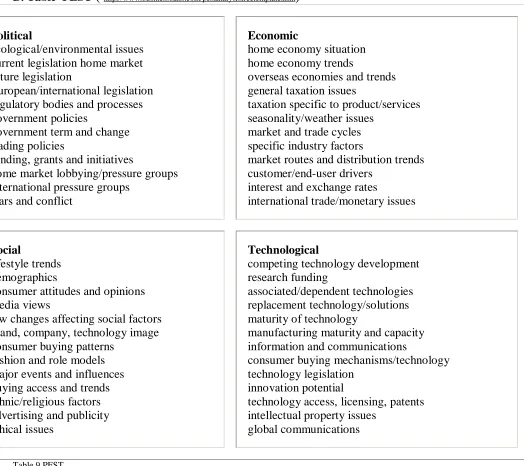
The first tool that can be used by SDC is PEST (Political, Economical, Social, Technological) (See appendix for Framework), because it addresses external factors that are represent the market. In the next part the concept will be explained and how it works
A PEST (DEPEST) analysis is one of the most common measures used for looking at market potential. In general a SWOT analysis measures(chapter 2) a business unit or proposition, whereas a PEST analysis takes a look at the market potential and situation, particularly growth or decline of the factors, as well as measuring market attractiveness, business potential, and suitability of access - market potential and 'fit' in other words. PEST analysis uses four perspectives: Political, Economic, Social and Technological.
A market is defined by what is addressing it, be it a product, company, brand, business unit, proposition, idea, so be clear about how to define the market that is being analysed. The PEST subject should be a clear definition of the market being addressed, which might be from any of the following standpoints:
24 3.6 BERI Index
In the previous part the PEST analysis was explained, the PEST analysis alone however does not provide enough information on foreign market, especially risks that are involved in international expansion. In this part therefore the country analysis according to the BERI Index will be
explained. The BERI index is a country risk assessment that is a well known and established model that can help with classifying the possible risk related to a country. A relatively stable country will be more suited for international expansion than a high risk country.
The DEPEST analysis offers general information about a countries market; this however does not take into account possible risk. This means that a country that looks attractive according to DEPEST, the BERI index could prove otherwise.
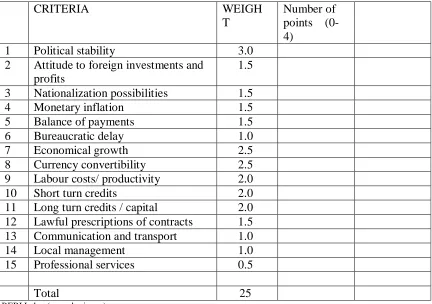
The Index works as follows, there are 15 criteria mentioned in the table below, theses criteria are assigned a weight and after carefully analysing; the criteria are scored from 0-4. These scores are multiplied by the weight and these scores are summed up. This total score can be categorised. A total score of 65 means that a country has a moderate degree of risk related to it.
CRITERIA WEIGH
T
Number of points (0-4)
1 Political stability 3.0
2 Attitude to foreign investments and profits
1.5 3 Nationalization possibilities 1.5
4 Monetary inflation 1.5
5 Balance of payments 1.5
6 Bureaucratic delay 1.0
7 Economical growth 2.5
8 Currency convertibility 2.5
9 Labour costs/ productivity 2.0
10 Short turn credits 2.0
11 Long turn credits / capital 2.0 12 Lawful prescriptions of contracts 1.5 13 Communication and transport 1.0
14 Local management 1.0
15 Professional services 0.5
Total 25
25 Guidelines on Risk
The categories below have been developed to assist in interpreting the ratings.
v 70-100 Stable environment, typical of an advanced industrialized economy. Problems for foreign businesses are offset by the country's efficiency, market opportunities, financial system, and advanced infrastructure.
v 55-69 Moderate-risk countries with complications in day-to-day operations. Usually the political structure is sufficiently stable to permit consistent operations without serious disruption. Dynamic economic expansion often has the potential for attractive profits.
v 40-54 High risk for foreign-owned businesses. Only special situations should be considered, e.g., scarce raw materials or unusual profit potential. Selection of management is critical to success in this risk range.
v 0-39 Unacceptable business conditions for foreign-owned businesses. (www.beri.com) Information on legal issues regarded with franchising is mentioned in appendix C.
Critical factors
From the international theory the following factors came forward as being important:
• International factors
• PEST
• BERI
• Legal issues
3.7: Conclusion
Conditions for internationally franchising the SDC according to literature
Franchising is an agreement between two parties by which the franchisor grants the franchisee the right to conduct their business under the brand name and by using their products and know-how. There are 2 sorts of franchising, hard and soft franchising.
Franchising offers two advantages (manpower, financial) that lead to a number of opportunities such as: maintaining a compact small business with a number of specialised managers, gaining profit without a large amount risk and daily involvement.
The development of a franchise entails 7 phases: 1. The basic business concept
2. Pilot operation
3. Developing the franchise package 4. Developing the operational package 5. Marketing the franchise package 6. Selecting franchisees
7. Developing the franchisor’s organisation
26 For international franchising more factors have to be taken into account, concepts such as
DEPEST, BERI index. provide the company with the data on what factors of the prospective country are important/interesting. The BERI index score shows how high the risk of
investing/doing business in a country is and if it would be advisable to do so
In the previous part the theory of franchising is summarized this theory put forward a lot of success factors which were mentioned at the end of each part, these conditions are mentioned below and will be used in the chapter with the overall critical success factors.
The conditions below are a summary of all of the critical factors that were mentioned. Critical factors
The franchisor must first develop a successful business format which is identified with a brand name which may be a trademark, service mark and/or trade name.
The franchisee must make a substantial capital investment from private resources The franchisee must own their business.
Type of franchising (hard or soft)
The concept must be proven by practical experience to be successful
The business should be distinctive in its image as well as in its methods and system. The system and method must be capable of being passed on successfully to others within a reasonable time frame.
The financial returns from the business should be sufficient to enable the franchisee to obtain a sufficient return on capital, the franchisee should obtain a reasonable return for his labour and the franchisee is able to pay the franchisor a fee for the services he continuously supplies. Brand Image/Clear Identity
The franchisor should make a sufficient profit from the fees he receives. Franchisee Selection criteria
Stakeholder management Partnership management Distance management Cultural adaptability Control
International Market assessment Table 4. literature Success factors
27
Chapter 4: Benchmarking
In this chapter the success factors will be put forward of two franchising best practice examples. McDonalds and Body Shop were chosen due to their success in the restaurant/fast food business (McDonalds) and in corporate responsibility/goal of the business (Body Shop) whereas their goal is getting people to use products that are all animal cruelty free, and many with fairly traded natural ingredients. First I will elaborate on McDonalds and the success factors that came
forward.
4.1 McDonalds
McDonald’s was founded in 1954 when Ray Kroc discovered the brothers McDonald hamburger stand in Riversdale, California. Kroc quickly recognized the potential for systematizing their operation and fast service, assembly –line meals, not just in a single location but in many McDonald’s outlets. McDonald’s knowledge is systematized and replicated through operating manuals, videos and training programs. The business system used by McDonald’s is highly mechanistic, including reliance on highly standardized, formalized working practices that are carefully operated in the company’s operating procedures. This system can only work by McDonald’s carefully controlling its inputs to reduce variation: potatoes are carefully selected for size and shape, managers are carefully selected and trained, consumer tastes and
expectations are carefully managed through promotion and advertising. For McDonald’s restaurants, knowledge management is primarily concerned with implementing the McDonald’s system. This is a detailed set of rules and operating practices that extend from the company’s values down to the placing of a pickle on a bun of a Big Mac and the procedure for servicing a McDonald’s milkshake machine. The essence of the McDonald’s system is the systematization of knowledge into a detailed set of rules that must be followed in each McDonald’s outlet. McDonalds is able to pursue a low cost leadership strategy (Porter, 1979) without there product becoming an undifferentiated commodity. They are able to offer a low-price, no-frills offering which is also associated with clear market positioning and a unique brand image. This in such a way that the fast-food restaurants, franchising and standardized operating systems pioneered by the company, have resulted in the sector becoming dominated by a few major corporations. This does not mean however that McDonald’s doesn’t differentiate its products, differentiation extends beyond the physical characteristics of the product or the service to encompass anything about the product or service that influences the value customers derive from it.
Notable in the international expansion of McDonalds is that, unlike the national expansion, the first outlets in new countries are wholly owned subsidiaries. Differentiation of the products offered by McDonalds is done on a national basis. National preferences and dislikes are taken into account to alter the overall menu. In this McDonalds follows a global localization strategy (Morita, 1996) (Franchising in India, Lewis et al, paper for Enviu)
From the above mentioned information it is possible to derive several success factors which are: Proven business and business system
Standardization
28 Market positioning and a unique brand image
The first outlets in new countries are wholly owned subsidiaries A global localization strategy
Table 5. Success factors McDonalds
4.2 Body Shop
In 1976 Anita Roddick opened the first Body Shop in a back street in Brighton in 1976. The roof leaked and the ugly unpainted walls were covered with green garden lattice primarily because it was cheap. The shop sold only about a dozen inexpensive ‘natural’ cosmetics, all herbal creams and shampoos, all in simple packaging. Pot plants were placed between the products to fill the space. Anita thought these products would only appeal to a small number of customers that shared her values.
Franchisees pay an initial fee plus an annual operating charge for a fixed term, renewable franchise. Franchisees buy a ‘turn-key’ system with a tightly controlled retail format providing shop fitting and layout, staff training, financial and stock control systems and even help with site identification. Body Shop can also help arrange finance to purchase the franchise. Body Shop also, of course, makes a margin on the products it sells to the franchisees.
Franchisees receive regular visits from company representatives who provide assistance with display, sales promotion and training. Information packs, newsletters, videos and free
promotional material are made available and franchisees have to return a monthly report on their sales. This enables the company to monitor both trading results and the local sales performance of individual products. The company closely monitors the use of The Body Shop trade mark in all franchisees’ literature, advertising and other uses.
Franchisees are selected partly upon their ‘fit’ with Body Shop ideals. Employees receive regular newsletters and videos concentrating on Body Shop campaigns and achievements. In 1995 the firm introduced in-store satellite transmitted radio. Body Shop takes every opportunity to put forward its values and beliefs which it believes sets it out as distinctive and different to its high street competitors. The company is said to bring together like-minded people and motivate staff in what otherwise is a sector with high staff turnover. The franchisees generated sufficient cash to finance early expansion until 1984 when the company went to the stock market, although it still maintained the franchise model.
Overseas expansion followed the same model as in the UK. In most countries a head franchisee was granted exclusive rights as user of the trade mark, distributor and, after an initial trial of running a few shops themselves, the right to sub-franchise. In this way the firm built upon local market knowledge and minimised its risks. This model was not always followed because of the quality of the head franchisee. For example, the firm took back control of the franchise. Body Shop remains an international franchise chain of shops. Body Shop International Ltd. is the franchisor. (www.palgrave.com/business/burns/students/pdf/06%20Body%20Shop.pdf)
From the before mentioned information it is possible to derive several success factors which are: Innovation
29 Tightly controlled retail format providing shop fitting and layout, staff training, financial and stock control systems and even help with site identification
Large amount of assistance and control Franchisee selection criteria (fit)
International strategy (Master franchise)
Focus on Franchise formula instead on products Corporate culture, beliefs
Table 6. Success factors Body shop
Pitfalls
In 2002 a research for the mayor pitfalls of franchising was done by the Dutch Website www.zibb.nl; the results of the research were put into a top 10 of pitfalls which are: 1. Unproven franchising formula
2. An insufficient franchising manual with an explicitly described formula. 3. An insufficient amount of research into the interest for the formula 4. Unspecific franchising agreement
5. Not enough attention to selection materials and procedures
6. Too much attention for expansion and not enough focus on maintenance 7. Franchise selection criteria
8. Not enough financial resources to finance growth
9. Franchise development does not receive a separate law position 10. No structural communication between with franchisees
The analysis of the best practice examples and pitfalls provided conditions/critical success factors that have to be related to the conditions/ critical success factors. In the next chapter all of these factors have to be put into more general factors. That will be used for answering the sub-question
4.3 Conclusion
All of the success factors mentioned before in chapters 3 and 4 can be put into the following 7 overall success factors(See appendix C):
• Proven concept and business system
• Transferable business system
• Franchisee selection (criteria)
• Brand Image
• International entry factors
• Ongoing services and training
• Finance
30
Chapter 5: Gap analysis
This chapter deals with how SDC relates to the critical success factors that were found in both literature and best practice. A method that is going to be used is the gap analysis, the gap analysis deals with two important questions:
Where are we?
Where do we want to be?
(www.marketingteacher.com/Lessons/lesson_gap_analysis.htm )
In the first part of the analysis the part of SDC that is most suited for franchising, it is necessary for the gap analysis to give a clear description about the current situation of the SDC.
5.1 Gap Analysis: How SDC relates to the critical success factors
In this part the relation between the questions; where are we and were do we want to go, will be answered. This will be done through relating the SDC the critical success factors that were put forward in chapter 4 to the conclusion made in Chapter 2.
Proving the concept/business system
According to the theory and best practice, this is the most important success factor/condition that has to be satisfied. Possible franchisees will not be interested in a franchise if the franchisor can not show that their concept/business system is successful in practice.
The SDC has been developing their concept and business the last year and have been active in assisting and developing Club WATT in Rotterdam, however the concept of a Sustainable Dance Club still needs to be proved in practice(See weaknesses in SWOT) (for example through Club WATT). If they are successful then SDC would prove their business concept/system, if so then franchising would become a serious option for international expansion. Due to the fact that there is no project/operating business of SDC at this moment lead to a MINUS in the table Transferable business system
The SDC deliverable/BP on Mytown (Club WATT) showed advice from start to finish, it basically entailed a business system and how the club should be run by the owners. This business plan could be the input for an easily transferable business system once the
concept/system is proved in real life. The transferability of the business system however also needs to be proven by practice; although it looks like an easily transferable system it is
impossible to say on forehand that it will be successful. This part is therefore directly linked to the weakness; unproven concept.
Franchisee selection Criteria
31 Brand Image.
Brand Image/Identity came forward in both literature and best practice as being something that can either make or break a business. The SDC has caught the attention of both the national and international press with the critical mass party at Off_Corso in Rotterdam, as well as their idea for the energy generating dance floor. The idea of sustainability as an integrated part of clubs does not appeal to everybody. Although the SDC has a well know brand in the sustainability branch they will have to start appealing to the general public, the risk mentioned in the threats; sustainability being a hype is also related to brand image.
Internationalization factors
International entry factors are always a risk when a company wants to expand to other countries, however franchising offers advantages as the franchisee would have to invest in acquiring the franchise. The franchisee would have more knowledge on the local factors such as culture, trade barriers, legislation and taxes. This would benefit the SDC, as they lack this knowledge and experience with international business. Hiring new personnel with practical knowledge on international expansion and franchising would also be a possibility in aiding the expansion of the SDC.
Ongoing training and services
Ongoing training and services is currently one of the products that the SDC has (See strengths SDC); focus however is on sustainability and not on franchising. SDC will need to develop training and services that are also related to franchising. The available know-how on how to give a training and on sustainability in general is an advantage. The current relationship with Club WATT has to prove that SDC is capable of providing a client with sufficient training and services that would enable the client to conduct their business properly.
Finance
The SDC at this moment is a small company with a relatively weak financial situation. The financial situation is not sufficient for franchising. It became apparent in the SWOT overview that the budget/finance of the SDC is a weakness and it can be related to the success factor finance. The financial status however is also related to the fact that the concept has to be proved by practice. If the concept is proven to be successful this will have a positive effect on the financial status of the company.
All of the before mentioned and success factors have been be put into a table that outlines how they relate to the SDC: A minus means the success factors that it is not available/satisfied, a plus/minus means that the success factor is both positively and negatively related to the SDC.
Success factors How does SDC relate to the Success Factors
Proven concept and business system Not available (-)
Transferable business system Not proven, but with promise as it looks replicable (+/-)
Franchisee selection (criteria) Not established (-)
Brand Image Large amount of interested part/Unknown if
general public is interested (+/-) International entry factors (Risk, barriers,
legislation.)
No experience with internationalisation processes/Enviu(foundation) however has the experience(+/-)
Ongoing services and training Experience in training and services, however no experience with franchising +/-
32
Table 7 Gap analysis
5.2 Conclusion
The gap analysis between the SDC and the literature/best practice examples showed a number of critical factors that are not satisfied for the implementation of franchising (See table above), this answers the sub-question under what conditions can SDC successfully franchise the SDC concept internationally: The conditions are:
Condition 1: Proving the concept by practice Condition 2: Developing franchisee criteria Condition 3: Improving the financial situation
As these three conditions are not met by the current situation at SDC, franchising or any other international expansion method is not possible/ advisable at this moment, however the second and third condition are directly linked to the first condition.
The most important condition that has to be fulfilled is: proving the business concept and business format (system). This step is part of the first of 7 steps that need to be taken in
franchising a business, so fulfilling it is necessary; proving that the business concept and format works can be done in several ways: for example monitoring a project. The club WATT project could be used because it is the first project done by SDC and it could provide SDC with the necessary information needed. In the next part the methods performance measurement; how they work and how to implement them will be explained.
33
Chapter 6: Suggestions for the possible franchising of the SDC
In order for SDC to fulfil the first condition mentioned before they have to prove that their concept works. The first project that they are doing as mentioned
before is the CLUB WATT project. Project monitoring and project management are closely related therefore project management should be explained which is done in the next part.
6.1 Project management
SDC needs to prove their business concept, to do so they need to use Project Management (which is the discipline of planning, organizing, and managing resources to bring about the successful completion of specific project goals and objectives) as their backbone for monitoring and evaluating their business concept. Project management life cycle entails 4 phases:
• Project Initiation
• Project planning
• Project execution
• Project closure
Project Initiation
Project initiation is the 1st phase in the Project Management Life Cycle. In it the project is started up. A new project is started by defining its objectives, scope, purpose and deliverables that need to be produced. Next step is hiring a project team, setting up the Project Office and reviewing the project, to gain approval to begin the next phase. SDC/WATT has already passed this phase so the information that is generated should be monitored and evaluation should be done.
Project planning
Project planning is the second phase in the project life cycle. It involves creating a set of plans that help the project team through the execution and closure phases of the project.
The plans created during this phase will help with the management of time, cost, quality, change, risk and issues. SDC/WATT has already passed this phase, as Club WATT is due to be opened in September. This phase should be evaluated.
Project execution
Project execution is the third phase in the project life cycle. In this phase, the physical project deliverables will be built and presented to the customer for the ok. The Project Execution Phase is normally the phase in the project life cycle that takes the most time and it normally consumes the most energy and the most resources.
To enable you to monitor and control the project during this phase, Performance indicators have to be set. Monitoring and control of the project can be done by comparing planned performance