CSEIT1831436 | Received : 16 Feb 2018 | Accepted : 28 Feb 2018 | January-February-2018 [(3) 1 : 1824-1829 ]
International Journal of Scientific Research in Computer Science, Engineering and Information Technology © 2018 IJSRCSEIT | Volume 3 | Issue 1 | ISSN : 2456-3307
1824
Constancy of Color using Histogram and Gradient Based
Smoothening
Rohit Sharma
PG Department of Computer Science, SGAD College Khadur Sahib, Punjab, India
ABSTRACT
Color constancy is a procedure that measures the influence of the different light sources on a digital image. Lots of different techniques were used to achieve the color constancy. Earlier learning based and statistics methods used. Gray world, Max RGB method and Gray edge methods, Grey edge 1st order derivative and Grey edge 2nd order derivative are applied to digital image for color correction. In this paper, improved saturation weighting algorithm using histogram stretching and smoothening has been proposed which overcomes the drawbacks of previous techniques.
Keywords : Arduino, Wi-Fi (ESP 8266), Load cell, Database System
I.
INTRODUCTION
Saturation weighting scheme:
The capability based on the intensity values and saturation values were observed [5], there was a similar method using this type of characteristic. The gray method gives high weights to the high values of each RGB channel according to the Minkowski norm
p. Even if the method does not use the intensity channel but uses each RGB channel, since the values of each RGB channel can be thought as the independent intensity values of each channel, similar effects are expected. Therefore, the shades of gray method gives much better results than the gray world method. This method is based on the strong tendency of the performance changes according to the saturation values. Differently weighted pixels based on their saturation values will surely improve the performance of the color constancy. So a saturation weighting function added into the gray world method, which is called the gray world with saturation weighting (GWSW) given by
Where s denotes the saturation strength factor, w(.) is the saturation weighting function,
where w( f (x)) = (1− S( f (x))), S(.) is the saturation value of the pixel.
The saturation weighting function is designed according to the observations. Since the pixels which have low saturation values tend to contain more information related to the light source than the pixels which have high saturation values. The value of the saturation weighting function decrease as the saturation value of a pixel increases. The saturation strength factor S added to the weighting function so as to adjust the strength of the weights.
For s = ∞, our method becomes the “do nothing” approach. Only when the saturation value is equal to zero, the weight becomes one but otherwise the weight becomes zero. Since the pixels whose saturation values are equal to zero are achromatic, they do not have color information, which results in estimating the light source as the canonical light source, i.e., the “do nothing” approach.
Finally this method was improved as general gray world with saturation weighting (GGWSW) presented as
The scale of smoothing operation σ handles local correlation between pixels. The smoothing operation reduces the influence of noise in an image and it was proven to be beneficial for improving the color constancy. In this way, we get better results than gray world method.
II.
PROPOSED ALGORITHM
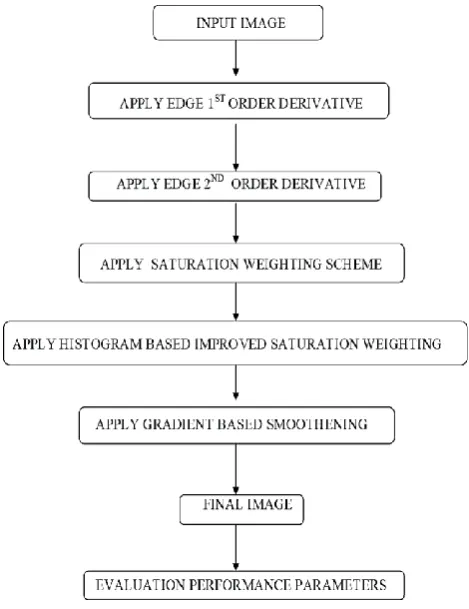
This section contains the various steps to achieve the objectives of this research work: Figure has shown various steps required to get the final image using the proposed algorithm. Subsequent are the various steps with brief detail:-
Step 1: First of all given image will be acquire and converted into a digital image to apply vision processing operations.
Step 2: Apply gray edge 1st order derivative to the
digital image.
Step 3: Apply gray edge 2nd order derivative to the
digital image.
Step 4: Apply saturation weighting scheme after edge applying.
Step 5: Apply histogram to the improved saturation weighting.
Step 6: Apply gradient based smoothing to preserve edges.
Step 7: Evaluate performance parameters.
Fig. 1 Flow chart of proposed algorithm
III.
EXPERIMENTAL SETUP
In this research work, we have taken 15 different images .Proposed algorithm can be implemented in MATLAB software using Image processing toolbox.
TABLE 1EXPERIMENTAL IMAGE
Sr no. Name Format
1 Image 1 JPEG
2 Image 2 JPEG
3 Image 3 JPEG
4 Image 4 JPEG
5 Image 5 JPEG
6 Image 6 JPEG
7 Image 7 JPEG
8 Image 8 JPEG
9 Image 9 JPEG
10 Image 10 JPEG
11 Image 11 JPEG
IV.
EXPERIMENTAL RESULTS
There are 15 different images are under observations. And then applied first order derivative, 2nd order
derivative, saturation weighting algorithm and then to histogram based proposed algorithm to the digital image .After then applied smoothening to reduce the noise. This section contains result one of the 15 images which shows the improvisation of the proposed algorithm over the other technique.
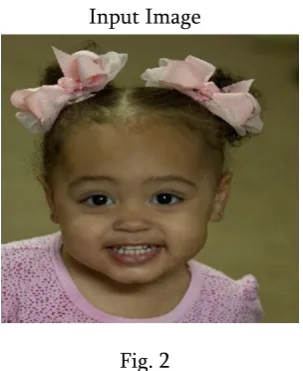
Fig. 2 shows the input image. This image has less brightness, low intensity and effect of red color is much. Our goal is to improve the brightness of the image and produce the actual color of the source.
Input Image
Fig. 2
Fig. 3 is the output image produced by 1st order
derivative which has more brightness as compare to the input image but effect of red color is more.
Gray edge 1 result
Fig. 3
Fig. 4 is the output image produced by 2nd order
derivative. It produced the image with more brightness as compare to 1st order but there is no
effect of green channel.
Gray edge result
Fig. 4
Fig. 5 shows the result produced by saturation weighting algorithm .It produced the better image than previous technique but it darks the image slightly.
Saturation weighting result
Fig. 5
Sr no. Name Format
13 Image 13 JPEG
14 Image 14 JPEG
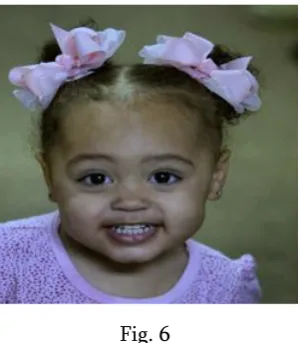
Fig. 6 shows the output given by histogram based proposed algorithm. This output image with much intensity and it also decreases the effect of red channel.
Histogram based improved saturation weighting
Fig. 6
Fig. 7 after applying histogram, smoothening is done. Fig. 7 is the output image produced after the smoothening has been done. So the effect of noise has been reduced.
Result of edge preserved image
Fig. 7
V.
PERFORMANCE ANALYSIS
This section contains the calculation of different parameter of the images under different algorithms. These parameters show the comparison between these different algorithms and also show the better results of proposed algorithm than previous algorithm.
A. RMSE:
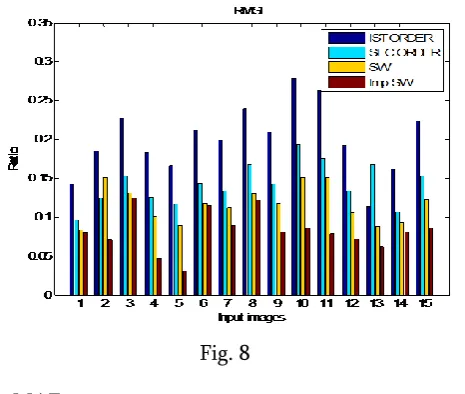
Fig 8 has shown the analysis of Root Means Square Error. RMSE requires being less for the proposed algorithm for obtaining better results than previous techniques. As shown in the table 1 the results for proposed algorithm are less in every case. RMSE decreases shows that the color constancy is achieved by applying the proposed algorithm. This shown the efficiency of proposed algorithm.
TABLE 1:ROOT MEANS SQUARE ERROR
Histogram based Improved saturation weighting
Fig. 8
B. MAE:
Fig. 9 has shown the analysis of Median Angular Error (MAE). MAE requires being less for the proposed algorithm for obtaining better results than previous techniques. As shown in the table 2 the results for proposed algorithm are less in every case. MAE decreases shows that the color constancy is achieved by applying the proposed algorithm. This shown the efficiency of proposed algorithm.
Fig. 9
TABLE 2: MEDIAN ANGULAR ERROR
VI.
CONCLUSION
comparison analysis between previous and proposed techniques has shown the significant improvement of the proposed technique. This research work has proposed improved saturation weighting color constancy based algorithms by using histogram stretching and smoothening. As known in prior that color constancy reduce the illuminate from the given image. Therefore lead to the darker image. So the use of histogram stretching has removed the problem of darker output of saturation weighting based color constancy.
VII.
REFERENCES
[1]. Shinde, Bhausaheb Shivajirao, and A. R. Dani "The Origins of Digital Image Processing & Application areas in Digital Image Processing Medical Images."IOSR Journal of Engineering 1, no. 1: 066-071.
[2]. Madi, Abdeldjalil, and Djemel Ziou "Color constancy for visual compensation of projector displayed image." Displays 35.1 (2014): 6-17. [3]. Joze, Hamid Reza Vaezi, and Mark S. Drew
"Exemplar-Based Colour Constancy and Multiple Illumination." IEEE Transactions on Pattern Analysis and Machine Intelligence (2013): 1.
[4]. Ahn, Hyunchan, Soobin Lee, and Hwang Soo Lee "Improving color constancy by saturation weighting." Acoustics, Speech and Signal Processing (ICASSP), 2013 IEEE International Conference on. IEEE, 2013
[5]. Hyunchan Ahn, Soobin Lee, and Hwang Soo Lee “Improving color constancy by saturation weighting.”IEEE Transactions on June 2013:1909-1912.
[6]. Gijsenij, Arjan, Rui Lu, and Theo Gevers. "Color constancy for multiple light sources." Image Processing, IEEE Transactions on 21.2 (2012): 697-707.
[7]. Chakrabarti, Ayan, Keigo Hirakawa, and Todd Zickler "Color constancy with spatio-spectral statistics." Pattern Analysis and Machine Intelligence, IEEE Transactions on 34.8 (2012): 1509-1519.
[8]. Vazquez-Corral, Javier, et al "Color constancy by category correlation." Image Processing, IEEE Transactions on 21.4 (2012): 1997-2007. [9]. Gijsenij, Arjan, Theo Gevers, and Joost Van
De Weijer "Improving color constancy by photometric edge weighting." Pattern Analysis and Machine Intelligence, IEEE Transactions on 34.5 (2012): 918-929.
[10]. Bianco, Simone, and Raimondo Schettini "Color constancy using faces."Computer Vision and Pattern Recognition (CVPR), 2012 IEEE Conference on. IEEE, 2012.
[11]. Monari, Eduardo "Color Constancy Using
Shadow-Based Illumination Maps for
Appearance-Based Person Re-identification."
Advanced Video and Signal-Based
Surveillance (AVSS), 2012 IEEE Ninth International Conference on. IEEE, 2012. [12]. Cepeda-Negrete, Jonathan, and Raul E.
Sanchez-Yanez "Combining color constancy
and gamma correction for image
enhancement." Electronics, Robotics and Automotive Mechanics Conference (CERMA), 2012 IEEE Ninth. IEEE, 2012.
[13]. Lee, Woo-Ram, Dong-Guk Hwang, and Byoung-Min Jun "Comparison of color constancy methods for skin color under colored illuminants." Digital Content, Multimedia Technology and its Applications (IDCTA), 2011 7th International Conference on. IEEE, 2011.