Classifying Idiomatic and Literal Expressions Using Vector Space
Representations
Jing Peng
Montclair State University
Anna Feldman Montclair State University
Hamza Jazmati Montclair State University
Abstract
We describe an algorithm for automatic classification of idiomatic and literal ex-pressions. Our starting point is that idioms and literal expressions occur in different contexts. Idioms tend to violate cohesive ties in local contexts, while literals are ex-pected to fit in. Our goal is to capture this intuition using a vector representation of words. We propose two approaches: (1) Compute inner product of context word vectors with the vector representing a tar-get expression. Since literal vectors pre-dict well local contexts, their inner prod-uct with contexts should be larger than idiomatic ones, thereby telling apart erals from idioms; and (2) Compute lit-eral and idiomatic scatter (covariance) ma-trices from local contexts in word vec-tor space. Since the scatter matrices rep-resent context distributions, we can then measure the difference between the dis-tributions using the Frobenius norm. We provide experimental results validating the proposed techniques.
1 Introduction
Despite the common belief that idioms are always idioms, potentially idiomatic expressions, such as hit the sackcan appear in literal contexts. Fazly et al. (2009)’s analysis of 60 idioms from the British National Corpus (BNC) has shown that close to half of these also have a clear literal meaning; and of those with a literal meaning, on average around 40% of their usages are literal. Therefore, idioms present great challenges for many Natural Lan-guage Processing (NLP) applications. Most cur-rent translation systems rely on large repositories of idioms. In this paper we describe an algorithm for automatic classification of idiomatic and literal
expressions. Similarly to Peng et al. (2014), we treat idioms as semantic outliers. Our assumption is that the context word distribution for a literal ex-pression will be different from the distribution for an idiomatic one. We capture the distribution in terms of covariance matrix in vector space.
2 Previous Work
Previous approaches to idiom detection can be classified into two groups: 1) type-based extrac-tion, i.e., detecting idioms at the type level; 2) token-based detection, i.e., detecting idioms in context. Type-based extraction is based on the idea that idiomatic expressions exhibit certain lin-guistic properties such as non-compositionality that can distinguish them from literal expressions (Sag et al., 2002; Fazly et al., 2009). While many idioms do have these properties, many idioms fall on the continuum from being compositional to being partly unanalyzable to completely non-compositional (Cook et al., 2007). Katz and Gies-brech (2006), Birke and Sarkar (2006), Fazly et al. (2009), Sporleder and Li (2009), Li and Sporleder (2010), among others, notice that type-based ap-proaches do not work on expressions that can be interpreted idiomatically or literally depending on the context and thus, an approach that considers tokens in context is more appropriate for idiom recognition.To address these problems, Peng et al. (2014) investigate the bag of wordstopic represen-tation and incorporate an additional hypothesis– contexts in which idioms occur are more affective. Still, they treat idioms as semantic outliers.
3 Proposed Techniques
We hypothesize that words in a given text segment that are representatives of a common topic of dis-cussion are likely to associate strongly with a lit-eral expression in the segment, in terms of projec-tion (or inner product) of word vectors onto the
vector representing the literal expression. We also hypothesize that the context word distribution for a literal expression in word vector space will be dif-ferent from the distribution for an idiomatic one. 3.1 Projection Based On Local Context
Representation
The local context of a literal target verb-noun con-struction (VNC) must be different from that of an idiomatic one. We propose to exploit recent ad-vances in vector space representation to capture the difference between local contexts (Mikolov et al., 2013a; Mikolov et al., 2013b).
A word can be represented by a vector of fixed dimensionalityqthat best predicts its surrounding words in a sentence or a document (Mikolov et al., 2013a; Mikolov et al., 2013b). Given such a vec-tor representation, our first proposal is the follow-ing. Letv andnbe the vectors corresponding to the verb and noun in a target verb-noun construc-tion, as in blow whistle, where v, n ∈ <q. Let
σvn = v+n ∈ <q. Thus,σvn is the word vec-tor that represents the composition of verbv and noun n, and in our example, the composition of blowandwhistle. As indicated in (Mikolov et al., 2013b), word vectors obtained from deep learn-ing neural net models exhibit llearn-inguistic regulari-ties, such as additive compositionality. Therefore,
σvnis justified to predict surrounding words of the composition of, say,blowandwhistle.
For a given vocabulary ofmwords, represented by matrixV = [v1, v2,· · · , vm]∈ <q×m, we cal-culate the projection of each wordviin the vocab-ulary ontoσvn
P =Vtσvn (1) whereP ∈ <m, andtrepresents transpose. Here we assume that σvn is normalized to have unit length. Thus,Pi = vtiσvn indicates how strongly word vectorviis associated withσvn. This projec-tion forms the basis for our proposed technique.
LetD={d1, d2,· · · , dl}be a set ofltext seg-ments, each containing a target VNC (i.e., σvn). Instead of generating a term by document ma-trix, where each term is tf-idf (product of term frequency and inverse document frequency), we compute a term by document matrixMD ∈ <m×l, where each term in the matrix is
p·idf, (2)
the product of the projection of a word onto a tar-get VNC and inverse document frequency. That
is, the term frequency (tf) of a word is replaced by the projection (inner product) of the word onto
σvn (1). Note that if segmentdj does not contain word vi,MD(i, j) = 0, which is similar totf-idf estimation. The motivation is that topical words are more likely to be well predicted by a literal VNC than by an idiomatic one. The assumption is that a word vector is learned in such a way that it best predicts its surrounding words in a sentence or a document (Mikolov et al., 2013a; Mikolov et al., 2013b). As a result, the words associated with a literal target will have larger projection onto a target σvn. On the other hand, the projections of words associated with an idiomatic target VNC ontoσvn should have a smaller value.
We also propose a variant ofp·idf representa-tion. In this representation, each term is a product ofpand typicaltf-idf. That is,
p·tf ·idf. (3) 3.2 Local Context Distributions
Our second hypothesis states that words in a local context of a literal expression will have a differ-ent distribution from those in the context of an id-iomatic one. We propose to capture local context distributions in terms of scatter matrices in a space spanned by word vectors (Mikolov et al., 2013a; Mikolov et al., 2013b).
Let d = (w1, w2· · · , wk) ∈ <q×k be a seg-ment (docuseg-ment) ofkwords, wherewi ∈ <qare represented by a vectors (Mikolov et al., 2013a; Mikolov et al., 2013b). Assumingwis have been centered, we compute the scatter matrix
Σ =dtd, (4)
where Σrepresents the local context distribution for a given target VNC.
Given two distributions represented by two scat-ter matrices Σ1 and Σ2, a number of measures
can be used to compute the distance betweenΣ1
andΣ2, such as Choernoff and Bhattacharyya
dis-tances (Fukunaga, 1990). Both measures require the knowledge of matrix determinant. In our case, this can be problematic, because Σ (4) is most likely to be singular, which would result in a de-terminant to be zero.
We propose to measure the difference between Σ1 andΣ2 using matrix norms. We have
experi-mented with the Frobenius norm and the spectral norm. The Frobenius norm evaluates the differ-ence betweenΣ1andΣ2 when they act on a
evaluates the difference when they act on the di-rection of maximal variance over the whole space.
4 Experiments 4.1 Methods
We have carried out an empirical study evaluat-ing the performance of the proposed techniques. For comparison, the following methods are eval-uated: 1 tf-idf: compute term by document ma-trix from training data withtf-idfweighting;2 p-idf: compute term by document matrix from train-ing data with proposedp-idfweighting (2);3 p*tf-idf: compute term by document matrix from train-ing data with proposed p*tf-idf weighttrain-ing (3); 4 CoVARFro: compute literal and idiomatic
scat-ter matrices from training data (4). For a test ex-ample, compute a scatter matrix according to (4). Calculate the distance between the test scatter ma-trix and training scatter matrices using Frobenius norm; and 5 CoVARSp: compute literal and
id-iomatic scatter matrices from training data (4). For a test text segment, compute a scatter matrix ac-cording to (4). Calculate the distance between the test scatter matrix and training scatter matrices us-ing the spectral norm.
For methods from1 to3, we compute a latent space from a term by document matrix obtain from the training data that captures 80% variance. To classify a test example, we compute cosine sim-ilarity between the test example and the training data in the latent space to make a decision.
4.2 Data Preprocessing
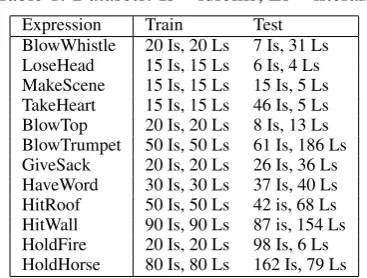
We use BNC (Burnard, 2000) and a list of verb-noun constructions (VNCs) extracted from BNC by Fazly et al. (2009), Cook et al. (2008) and la-beled as L (Literal), I (Idioms), or Q (Unknown). The list contains only those VNCs whose fre-quency was greater than 20 and that occurred at least in one of two idiom dictionaries (Cowie et al., 1983; Seaton and Macaulay, 2002). The dataset consists of 2,984 VNC tokens. For our experi-ments we only use VNCs that are annotated as I or L. We only experimented with idioms that can have both literal and idiomatic interpretations.
We use the original SGML annotation to extract paragraphs from BNC. Each document contains three paragraphs: a paragraph with a target VNC, the preceding paragraph and following one.
Since BNC did not contain enough examples, we extracted additional from COCA, COHA and
Table 1: Datasets: Is = idioms; Ls = literals Expression Train Test
BlowWhistle 20 Is, 20 Ls 7 Is, 31 Ls LoseHead 15 Is, 15 Ls 6 Is, 4 Ls MakeScene 15 Is, 15 Ls 15 Is, 5 Ls TakeHeart 15 Is, 15 Ls 46 Is, 5 Ls BlowTop 20 Is, 20 Ls 8 Is, 13 Ls BlowTrumpet 50 Is, 50 Ls 61 Is, 186 Ls GiveSack 20 Is, 20 Ls 26 Is, 36 Ls HaveWord 30 Is, 30 Ls 37 Is, 40 Ls HitRoof 50 Is, 50 Ls 42 is, 68 Ls HitWall 90 Is, 90 Ls 87 is, 154 Ls HoldFire 20 Is, 20 Ls 98 Is, 6 Ls HoldHorse 80 Is, 80 Ls 162 Is, 79 Ls
GloWbE (http://corpus.byu.edu/). Two human an-notators annotated this new dataset for idioms and literals. The inter-annotator agreement was rela-tively low (Cohen’s kappa = .58); therefore, we merged the results keeping only those entries on which the two annotators agreed.
4.3 Word Vectors
For our experiments reported here, we obtained word vectors using the word2vec tool (Mikolov et al., 2013a; Mikolov et al., 2013b) and the text8 corpus. The text8 corpus has more than 17 million words, which can be obtained from mattmahoney.net/dc/text8.zip. The resulting vocabulary has 71,290 words, each of which is represented by aq = 200dimension vec-tor. Thus, this 200 dimensional vector space pro-vides a basis for our experiments.
4.4 Datasets
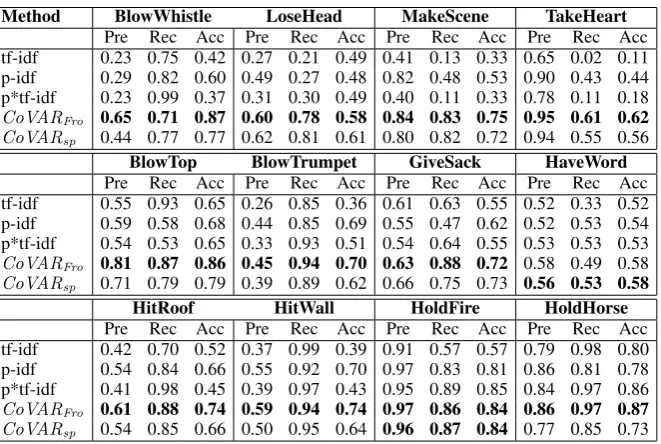
Table 2: Average accuracy of competing methods on 12 datasets Method BlowWhistle LoseHead MakeScene TakeHeart
Pre Rec Acc Pre Rec Acc Pre Rec Acc Pre Rec Acc tf-idf 0.23 0.75 0.42 0.27 0.21 0.49 0.41 0.13 0.33 0.65 0.02 0.11 p-idf 0.29 0.82 0.60 0.49 0.27 0.48 0.82 0.48 0.53 0.90 0.43 0.44 p*tf-idf 0.23 0.99 0.37 0.31 0.30 0.49 0.40 0.11 0.33 0.78 0.11 0.18
CoVARFro 0.65 0.71 0.87 0.60 0.78 0.58 0.84 0.83 0.75 0.95 0.61 0.62
CoVARsp 0.44 0.77 0.77 0.62 0.81 0.61 0.80 0.82 0.72 0.94 0.55 0.56
BlowTop BlowTrumpet GiveSack HaveWord Pre Rec Acc Pre Rec Acc Pre Rec Acc Pre Rec Acc tf-idf 0.55 0.93 0.65 0.26 0.85 0.36 0.61 0.63 0.55 0.52 0.33 0.52 p-idf 0.59 0.58 0.68 0.44 0.85 0.69 0.55 0.47 0.62 0.52 0.53 0.54 p*tf-idf 0.54 0.53 0.65 0.33 0.93 0.51 0.54 0.64 0.55 0.53 0.53 0.53
CoVARFro 0.81 0.87 0.86 0.45 0.94 0.70 0.63 0.88 0.72 0.58 0.49 0.58
CoVARsp 0.71 0.79 0.79 0.39 0.89 0.62 0.66 0.75 0.73 0.56 0.53 0.58
HitRoof HitWall HoldFire HoldHorse Pre Rec Acc Pre Rec Acc Pre Rec Acc Pre Rec Acc tf-idf 0.42 0.70 0.52 0.37 0.99 0.39 0.91 0.57 0.57 0.79 0.98 0.80 p-idf 0.54 0.84 0.66 0.55 0.92 0.70 0.97 0.83 0.81 0.86 0.81 0.78 p*tf-idf 0.41 0.98 0.45 0.39 0.97 0.43 0.95 0.89 0.85 0.84 0.97 0.86
CoVARFro 0.61 0.88 0.74 0.59 0.94 0.74 0.97 0.86 0.84 0.86 0.97 0.87
CoVARsp 0.54 0.85 0.66 0.50 0.95 0.64 0.96 0.87 0.84 0.77 0.85 0.73
out still pumping and offered to the god on a plate. BlowTop:Yellowstone has no large sources of wa-ter to create the amount of steam to blow its top as in previous eruptions.
5 Results
Table 2 shows the average precision, recall and ac-curacy of the competing methods on 12 datasets over 20 runs. The best performance is in bold face. The best model is identified by considering precision, recall, and accuracy together for each model. We calculate accuracy by adding true pos-itives and true negatives and normalizing the sum by the number of examples.
As for the individual model performance, the CoVAR model outperforms the rest of the mod-els. Interestingly, the Frobenius norm outperforms the spectral norm. One possible explanation is that the spectral norm evaluates the difference when two matrices act on the maximal variance direc-tion, while the Frobenius norm evaluates on a stan-dard basis. That is, Frobenius measures the differ-ence along all basis vectors. On the other hand, the spectral norm evaluates changes in a particular direction. When the difference is a result of all ba-sis directions, the Frobenius norm potentially pro-vides a better measurement. The projection meth-ods (p-idf and p*tf-idf) outperform tf-idf overall but not as pronounced asCoVAR.
Finally, we have noticed that even the best model (CoVARFro) does not perform as well on
certain idiomatic expressions. We hypothesized that the model works the best on highly idiomatic expressions. Idiomaticity is a continuum. Some idioms seem to be more easily interpretable than others. We conducted a small experiment, in which we asked two human annotators to rank VNCs in our dataset as “highly idiomatic” to “eas-ily interpretable/compositional” (in context) on a scale of 5 to 1 (5: highly idiomatic; 1: low id-iomaticity). While we cannot make strong claims based on a such small-scale experiment, the results of our pilot study suggest that there is a correla-tion between the idiomaticity scores and the per-formance of our model – the highly idiomatic ex-pressions seem to be detected better. We plan to conduct an experiment with more human annota-tors and on an larger dataset to verify our hypoth-esis.
6 Conclusions
Acknowledgements
This material is based in part upon work supported by the U.S. National Science Foundation under Grant Number 1319846. Any opinions, findings, and conclusions or recommendations expressed in this material are those of the authors and do not necessarily reflect the views of the National Sci-ence Foundation.
References
Julia Birke and Anoop Sarkar. 2006. A clustering approach to the nearly unsupervised recognition of nonliteral language. In Proceedings of the 11th Conference of the European Chapter of the Asso-ciation for Computational Linguistics (EACL’06), pages 329–226, Trento, Italy.
Lou Burnard, 2000. The British National Corpus Users Reference Guide. Oxford University Computing Services.
Paul Cook, Afsaneh Fazly, and Suzanne Stevenson. 2007. Pulling their weight: Exploiting syntactic forms for the automatic identification of idiomatic expressions in context. In Proceedings of the ACL 07 Workshop on A Broader Perspective on Multi-word Expressions, pages 41–48.
Paul Cook, Afsaneh Fazly, and Suzanne Stevenson. 2008. The VNC-Tokens Dataset. In Proceedings of the LREC Workshop: Towards a Shared Task for Multiword Expressions (MWE 2008), Marrakech, Morocco, June.
Anthony P. Cowie, Ronald Mackin, and Isabel R. Mc-Caig. 1983. Oxford Dictionary of Current Idiomatic English, volume 2. Oxford University Press. Afsaneh Fazly, Paul Cook, and Suzanne Stevenson.
2009. Unsupervised Type and Token Identification of Idiomatic Expressions. Computational Linguis-tics, 35(1):61–103.
K. Fukunaga. 1990. Introduction to statistical pattern recognition. Academic Press.
Graham Katz and Eugenie Giesbrech. 2006. Au-tomatic Identification of Non-compositional Multi-word Expressions using Latent Semantic Analysis. In Proceedings of the ACL/COLING-06 Workshop on Multiword Expressions: Identifying and Exploit-ing UnderlyExploit-ing Properties, pages 12–19.
Linlin Li and Caroline Sporleder. 2010. Using gaus-sian mixture models to detect figurative language in context. InProceedings of NAACL/HLT 2010. Tomas Mikolov, Kai Chen, Greg Corrado, and Jeffrey
Dean. 2013a. Efficient estimation of word represen-tations in vector space. InProceedings of Workshop at ICLR.
Tomas Mikolov, Ilya Sutskever, Kai Chen, Greg Cor-rado, and Jeffrey Dean. 2013b. Distributed repre-sentations of words and phrases and their composi-tionality. InProceedings of NIPS.
Jing Peng, Anna Feldman, and Ekaterina Vylomova. 2014. Classifying idiomatic and literal expres-sions using topic models and intensity of emotions. In Proceedings of the 2014 Conference on Em-pirical Methods in Natural Language Processing (EMNLP), pages 2019–2027, Doha, Qatar, October. Association for Computational Linguistics.
Ivan A. Sag, Timothy Baldwin, Francis Bond, Ann Copestake, and Dan Flickinger. 2002. Multiword expressions: A Pain in the Neck for NLP. In Pro-ceedings of the 3rd International Conference on In-telligence Text Processing and Computational Lin-guistics (CICLing 2002), pages 1–15, Mexico City, Mexico.
Maggie Seaton and Alison Macaulay, editors. 2002. Collins COBUILD Idioms Dictionary. Harper-Collins Publishers, second edition.