Edit Distance: A New Data Selection Criterion for Domain Adaptation
in SMT
Longyue Wang
1, Derek F. Wong
1,
Lidia S. Chao
1, Junwen Xing
1, Yi Lu
1, Isabel Trancoso
21
Natural Language Processing & Portuguese-Chinese Machine Translation
La-boratory, University of Macau, Macau S.A.R., China
2L2F Spoken Language Systems Lab, INESC-ID, Lisboa, Portugal
{mb15505,derekfw,lidiasc,mb15470,mb25435}@umac.mo,
[email protected]
Abstract
This paper aims at effective use of training da-ta by extracting sentences from large general-domain corpora to adapt statistical machine translation systems to domain-specific data. We regard this task as a problem of filtering training sentences with respect to the target domain1 via different similarity metrics. Thus,
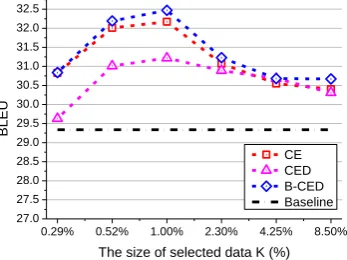
we give new insights into when data selection model can best benefit the in-domain transla-tion. Based on the investigation of the state-of-the-art similarity metrics, we propose edit dis-tance as a new data selection criterion for this topic. To evaluate this proposal, we compare it with other methods on a large dataset. Com-parative experiments are conducted on Chi-nese-English travel dialog domain and the re-sults indicate that the proposed approach achieves a significant improvement over the baseline system (+4.36 BLEU) as well as the best rival model (+1.23 BLEU) using a much smaller training subset. This study may have a significant impact on mining very large corpo-ra in a computationally-limited environment.
1
Introduction
A well-known problem of statistical machine translation (SMT) (Brown et al., 1993) is that the data-driven system is not guaranteed to perform optimally if the data for training and testing are not identically distributed. Domain adaptation for SMT has been explored at different component
1 It could be modeled by an in-domain corpus or text to
be translated.
levels: word level, phrase level, sentence level and model level. For example mining unknown words from comparable corpora (Daume III and Jagarlamudi, 2011), weighted phrase extraction (Mansour and Ney, 2012), mixing multiple mod-els (Civera and Juan, 2007; Foster and Kuhn, 2007; Eidelman et al., 2012), etc. Recently, data selection as a simple and effective way for this special task has attracted attention.
Under the assumption that there exists a large general-domain corpus (general corpus) includ-ing sufficient domains, the task of data selection is to translate a domain-specific text using the optimized translation model (TM) or language model (LM) trained by less but more suitable data retrieved from the general corpus. To state it formally, R is an abstract model of target domain and sG is a sentence or a sentences pair in the
general corpus G. The score of each sG is given by
(
G)
( , )
GScore s
Sim s R
(1)which means if we could find a better function to measure the similarity between sG and R, G could be replaced by a new sub-corpus Gsub for training
a domain-specific SMT system.
We focus on two data selection criteria that have been explored for domain adaptation. One comes from the realm of information retrieval (IR), which is defined as the cosine of the angle between two vectors based on term frequency-inverse document frequency (TF-IDF). Hilde-brand et al. (2005) showed that it is possible to apply this standard IR technique for both TM adaptation and LM adaptation. It is also similar to the offline data optimization approach pro-posed by Lü et al. (2007), who sample and
source-side cross-entropy difference (CED),
bi-0.29% 0.52% 1.00% 2.30% 4.25% 8.50% 27.0
0.29% 0.52% 1.00% 2.30% 4.25% 8.50% 27.0
over 4.36 BLEU points and B-CED over 1.23 points.
5
Conclusions
In this paper, we regard data selection as a prob-lem of scoring the sentences in a general corpus via different similarity metrics. After revisiting the state-of-the-art data selection methods for SMT adaptation, we propose edit distance as a new selection criterion for this topic. In order to evaluate the proposed method, we compare it with four other related methods on a large data set. The methods we implemented are standard information retrieval model, source-side cross-entropy, source-side cross-entropy difference, bilingual cross-entropy difference as well as a baseline system. We can analyze the results from two different aspects:
Translation Quality: The results show a sig-nificant performance of the proposed method with increasing 4.36 BLEU points than the base-line system. And it also outperforms other four methods over 1-3 points.
Filtering Noises: Fuzzy matching could dis-card about 99.5% data of the general corpus without reducing translation quality. However, other methods will drop their performance when using the same size of data. The proposed metric has a very strong ability to filter noises in general corpus.
Finally, we can draw a composite conclusion that edit distance is a more suitable similarly model for SMT domain adaptation.
Acknowledgments
The authors are grateful to the Science and Technology Development Fund of Macau and the Research Committee of the University of Macau for the funding support for our research, under the reference No. 017/2009/A and MYRG076(Y1-L2)-FST13-WF. The authors also wish to thank the anonymous reviewers for many helpful comments.
References
Amittai Axelrod, Xiaodong He, and Jianfeng Gao. 2011. Domain adaptation via pseudo in-domain da-ta selection. In: Proceedings of EMNLP. pp. 355–362.
Peter F. Brown, Vincent J. Della Pietra, Stephen A. Della Pietra, and Robert L. Mercer. 1993. The mathematics of statistical machine translation: Pa-rameter estimation. Computational Linguistics. 19:263–311.
Jorge Civera and Alfons Juan. 2007. Domain adapta-tion in statistical machine translaadapta-tion with mixture modelling. Proceedings of the Second ACL Workshop on Statistical Machine Translation. pp. 177–180.
Hal Daumé III and Jagadeesh Jagarlamudi. 2011. Domain adaptation for machine translation by min-ing unseen words. In: Proceedings of ACL-HLT. pp. 407–412.
Vladimir Eidelman, Jordan Boyd-Graber, and Philip Resnik. 2012. Topic models for dynamic transla-tion model adaptatransla-tion. Proceedings of ACL:
Short Papers. Vol. 2. pp. 115–119.
Marcello Federico, Nicola Bertoldi, and Mauro Cetto-lo. 2008. IRSTLM: an open source toolkit for han-dling large scale language models. Proceedings of Interspeech. pp. 1618–1621.
G. Foster and R. Kuhn. 2007. Mixture-model adapta-tion for SMT. Proceedings of the Second ACL Workshop on Statistical Machine Translation. pp. 128 – 136.
Jianfeng Gao, Joshua Goodman, Mingjing Li, and Kai-Fu Lee. 2002. Toward a unified approach to statistical language modeling for Chinese. ACM Transactions on Asian Language Information Processing (TALIP). 1:3–33.
Almut Silja Hildebrand, Matthias Eck, Stephan Vo-gel, and Alex Waibel. 2005. Adaptation of the translation model for statistical machine translation based on information retrieval. Proceedings of EAMT. pp. 133–142.
Johannes Leveling, Debasis Ganguly, Sandipan Dan-dapat and Gareth J.F. Jones. 2012. Approximate Sentence Retrieval for Scalable and Efficient Ex-ample-based Machine Translation. Proceedings of COLING 2012. pp. 1571-1586.
Philipp Koehn. 2005. Europarl: A parallel corpus for statistical machine translation. MT Summit. Vol. 5. pp. 79–86.
Philipp Koehn, Hieu Hoang, Alexandra Birch, Chris Callison-Burch, Marcello Federico, Nicola Ber-toldi, Brooke Cowan, Wade Shen, Christine Moran et al. 2007. Moses: Open source toolkit for statisti-cal machine translation. Proceedings of ACL. pp. 177–180.
Philipp Koehn and Jean Senellart. 2010. Convergence of translation memory and statistical machine translation. Proceedings of AMTA Workshop on MT Research and the Translation Industry. pp. 21– 31.
training data selection and optimization. Proceed-ings of EMNLP-CoNLL. pp. 343–350.
Saab Mansour and Hermann Ney. 2012. A Simple and Effective Weighted Phrase Extraction for Ma-chine Translation Adaptation. Proceedings of IWSLT. pp. 193-200.
Robert C. Moore and William Lewis. 2010. Intelli-gent selection of language model training data.
Proceedings of ACL: Short Papers. pp. 220– 224.
Franz Josef Och and Hermann Ney. 2003. A system-atic comparison of various statistical alignment models. Computational Linguistics. 29:19–51.
Kishore Papineni, Salim Roukos, Todd Ward, and Wei-Jing Zhu. 2002. BLEU: a method for automat-ic evaluation of machine translation. Proceedings of ACL. pp. 311–318.