CSEIT1725123 | Received : 05 Oct 2017 | Accepted : 16 Oct 2017 | September-October-2017 [(2)5: 725-732]
International Journal of Scientific Research in Computer Science, Engineering and Information Technology © 2017 IJSRCSEIT | Volume 2 | Issue 5 | ISSN : 2456-3307
725
Agricultural Loan System Using Data Replication Method
Zarni Sann
*1, Thi Thi Soe
2*1Faculty of Computer System and Technology, Computer University, Mandalay, Myanmar
2
Faculty of Computer Science, Computer University, Mandalay, Myanmar
ABSTRACT
Replication is the process of sharing information so to ensure consistency between redundant resources, such as software or hardware components. A good way to increase the performance in a database system is to use replication techniques. There are two methods of replication; eager replication (synchronous) and lazy replication (asynchronous). This system is used lazy replication method for agricultural loan database in agricultural department. This system can support reliable replicated data for agricultural loan system between replicated databases. Database replication can be used on many database management systems, usually with a master/slave relationship between the original and the copies. Replication is the process of copying and maintaining database objects, such as tables, in multiple databases that make up a distributed database system.
Keywords : Database replication, lazy replication, Linear Interaction, Update Everywhere
I.
INTRODUCTION
A good way to increase the performance in a database system is to use replication techniques. There are two methods of replication; eager replication (synchronous) and lazy replication (asynchronous). This system is used lazy replication method for agricultural loan database in Magwe division’s farmers. This system can support reliable replicated data for agricultural loan system between replicated databases.
Database replication can be used on many database management systems, usually with a master/slave relationship between the original and the copies. Replication is the process of copying and maintaining database objects, such as tables, in multiple databases that make up a distributed database system. Replication means that the same data is available at multiple locations.
Depending on the application, data to be replicated may be stored in a file or a file collection, a database or a database table, or an object stored in a file or in a database. When several replicas of a database are present, they can divide the workload of incoming requests between each other [2]. Replication uses distributed database technology to share data between multiple sites, but a replicated database and a
distributed database are not the same. In a distributed database, data is available at many locations, but a particular table resides at only one location. Replication means that the same data is available at multiple locations. Lazy replication or asynchronous replication is known for high scalability and performance, but low data consistency and therefore fail to meet the consistency requirement [2, 9].
This system can be study data replication methods and techniques provide high availability and low database latency. The objectives are to achieve fast data access and load distribution, to reduce cost and time consuming for manual recording information, to get computerized agricultural loan database system, and to know replication of databases is a good way to get a well working database system.
Ssystem. Also this section includes the implementation process with figures. Finally, Section 5 presented the conclusions and further extension items.
A. System Background for Agricultural in
Myanmar
Myanmar Agricultural Development Bank (MADB) under Minister of Agriculture and Irrigation (MOAI) provides agricultural credit for the farmers. To purse poverty reduction particularly on rural poor and ensure sustainable agriculture development, the government has laid down the measures which in fact may have direct impact to improve the livelihood of rural populace.
Myanmar government is recently trying to increase agricultural productivity and employment to achieve economic development for farmers and to alleviate poverty through various schemes such as micro-credit program, increased agricultural loan, establishing small cooperative groups, encouraging to use prescribed package technology, and etc. Myanmar Agriculture Development Bank (MAB) have borrowed increasing amount of loans to farmers year by year [5].
II.
DATABASE REPLICATION TECHNIQUES
To get a reliable and fast system with distributed databases, a number of different techniques can be used. The main areas to take into account when choosing the technique is performance, consistency and redundancy. When handling with a replicated database system, a number of actions are done during an execution of a transaction. Five phases where presented to describe the different steps in the system. The steps are: Request The first step of the transaction, where the client sends its request to a node in the system [1].
Replication can be performed in either synchronous or asynchronous mode. Synchronous replication guarantees continuous data integrity during the replication process with no extra risk of data loss. However, the impact on the performance of the application can be significant and is highly dependent on the distance between the sites. Asynchronous replication overcomes the performance limitations of synchronous replication, but some data loss must be accepted [3].
A. Replicated Data
Replicated data are becoming more and more of interest lately. The use of data replication has many advantages including the increased read availability (many operations can be handled locally, reducing communication costs and delays) and reliability (if one site is down, or has lost some of its data, the data is likely to be available at another node) but makes the data updating more complicated.
While data copying can provide users with local and much quicker access to data, the problem is to provide these copies to users so that the overall systems operate with the same integrity and management capacity that is available within a centralized model [4].
B. Update Everywhere
A database system using Update Everywhere does not contain a primary node, instead all nodes in the system are considered equal. When a user wants to execute a transaction it can arrive at any of the available nodes. The node which receives the transaction then uses some method to propagate the updates to the other nodes and to make sure that the information in all nodes is consistent. A distributed database system using Update Everywhere strategies can be both of lazy and eager type, depending on the way updates are propagated between the different databases [4].
C. Linear Interaction
Linear interaction protocols handle each replicated operation on an individual basis, which means that communication overhead can reach unacceptable levels in an environment where hundreds of Update, Delete and Insert (UDI) transactions occur every second. Even when replicated operations are bundled in a single transaction, each operation results in communication between master and slave. In a situation where only a few nodes are replicated the communication overhead of linear interaction is negligible, but in a highly scaled environment replica lag results. Replica lag is the lag time between a delegate server and its slaves. High replica lag means low data availability which can be critical in financial institutions where data such as exchange rates are replicated [4].
Volume 2 | Issue 5 | September-October-2017 | www.ijsrcseit.com | UGC Approved Journal [ Journal No : 64718 ] Lazy replication also contains both Primary Copy and
Up-date Everywhere although they work in a slightly different way. Even though the problems that can occur with lazy replication, many systems today still uses this technique as it gives a better performance in the system.
In an asynchronous mode of operation, I/O operations are written to the primary storage system and then sent to one or more remote storage systems at some later point in time. Due to the time lag, data on the remote systems is not always an exact mirror of the data at the primary site. This mode is ideal for disk-to-disk backup or taking a snapshot of data for offline processes, such as testing or business planning. The time lag enables data to be replicated over lower-bandwidth networks, but it does not provide the same level of protection as synchronous replication [6, 9].
A. Lazy Update Everywhere
With Lazy Update Everywhere no synchronization is made between different nodes during the execution of a transaction. This gives a substantial performance gain during the transaction but presents a complicated problem during the synchronization points in the system. When the different nodes synchronize there is a risk that inconsistencies exist in the system as the same data item could have been updated in different nodes at the same time. This require a decision in the system on which transaction to keep and which transactions to undo [6, 9].
B
. Multimaster Replication
Multimaster replication (also called peer-to-peer or n-way replication) enables multiple sites, acting as equal peers, to manage groups of replicated database objects. Each site in a multimaster replication environment is a master site, and each site communicates with the other master sites. Applications can update any replicated table at any site in a multimaster configuration. Asynchronous replication is the most common way to implement multimaster replication [8].
When the system uses asynchronous replication, information about a data manipulation language change on a table is stored in the deferred transactions queue at the master site where the change occurred. These changes are called deferred transactions. The deferred transactions are pushed (or propagated) to the other participating master sites at regular intervals. The
system can control the amount of time in an interval [7].
IV.
SYSTEM DESIGN AND IMPLEMENTATION
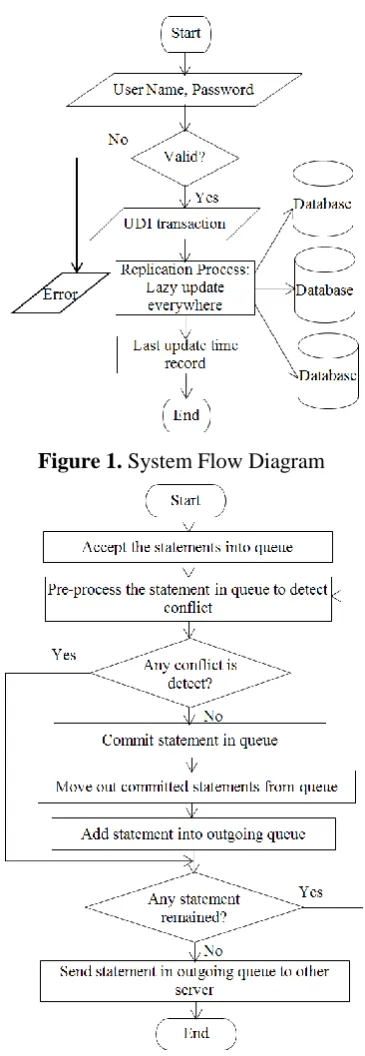
This system is developed by using ASP.net. It can duplicate the SQL database to the client as shown in Fig1..By using this system, the user can get the Agricultural Loan from Myanmar Agriculture Development Bank in efficient way. The design and implementation of the system as well as the structure of the program are described in this chapter.
Figure 2. System Flow Diagram for Replication Process
The system has the following components:
1. Login- The system allows the user to enter user name and password for insert, update, and retrieve data.
2. Data Entry- The system allows the user to insert data to get loan.
3. Update- The system allows the user to pay monthly interest and return loan.
4. Delete- The system allows the user to return loan. 5. Replicate- The system replicates the updated data
to another site.
6. Retrieve – The system show the information about loan to the user.
Replication provides fast, local access to shared data because it balances activity over multiple sites. Some users can access one server while other users access different servers, thereby reducing the load at all servers. Users can also access data from the replication site that has the lowest access cost, which is typically the site that is geographically closest to them. Replication Process is shown in Fig 2..
A. Lazy Replication Procedure
Void RequestFromClient (String trans, String sqlStatement)
{ //(1) Check read or update transaction if (trans == read-transaction)
{ (2) Answered directly from the secondary DB Query DB (sqlStatement); } stored in the Register table with their password. Before data entry to the database table, the system confirms the username and password.
Register table has 8 fields: UserID, UserName, Password, Email, Sex, DOB, Town, and PhoneNo. The primary key is UserID. Borrower table has 12 fields: AutoNum, BorrowerName, FatherName, DOB, NRC, Career, PhoneNo, QuaterName, TownshipName, DivisionName, RecommenderName, R_Career and TownshipCode.
TABLE 4.1 REGISTER TABLE DESIGN
TABLE 4.2 BORROWER TABLE
Column Name Data Type Data Size
AutoNum int 4
BorrowerName nvarchar 200
FatherName nvarchar 200
DOB nvarchar 200
Column Name Data Type Data Size
UserID int 4
UserName nvarchar 50 Password nvarchar 50 Email nvarchar 50
BorrowerName nvarchar 200 FatherName nvarchar 200
DOB nvarchar 200
NRC nvarchar 200
Career nvarchar 200
Volume 2 | Issue 5 | September-October-2017 | www.ijsrcseit.com | UGC Approved Journal [ Journal No : 64718 ] TABLE 4.3 RECOMMENDER TABLE
Recommender table has 10 fields: AutoNum, RecommenderName, FatherName, DOB, NRC, Career, PhoneNo, QuaterName, TownshipName and DivisionName.
TABLE 4.4 LOAN TABLE DESIGN
Column Name Data Type Data Size
BorrowerName int 4
NRC nvarchar 50
PossessAcre int 4
Get_Loan nvarchar 200 DateOfBorrow datetime 8 MonthlyInterest nvarchar 200 TotalReturnLoan nvarchar 200 LastReturnDate datetime 8
January nvarchar 50
February nvarchar 50
March nvarchar 50
April nvarchar 50
May nvarchar 50
June nvarchar 50
July nvarchar 50
August nvarchar 50
September nvarchar 50
October nvarchar 50
November nvarchar 50 December nvarchar 50 DateOfReturnLoan datetime 8 TownshipCode nvarchar 50
Loan table has 22 fields: BorrowerName, NRC, PossessAcre, Get_Loan, DateOfBorrow, MonthlyInterest, TotalReturnloan, LastReturnDate, January, February, March, April, May, June, July,
August, September, October, November, December, DateOfReturnLoan and TownshipCode.
C. Implementation Process
This system can give the data entry, update and retrieval with easy and less time. In agricultural loan system, there are 24 townships, and about 9 quarters in each township of Magwe Division. All the farmers can borrow the agricultural loan and automatically process with particular officer using this system.
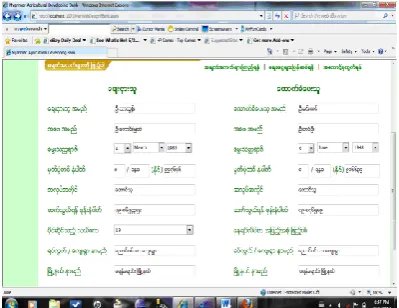
Each farmer can borrow twenty thousand Kyats per acre with two percent interest per month. The total amount will return within one year. If the user wants to borrow the agricultural loan, the user entry the information as shown in following Figure to get the agricultural loan.
Figure 3. Loan person and recommender entry process
If the officer wants to return total loan, officer will fill name, NRC and code for township. This system will display the total loan, and interest amount. The officer must type bank account and click Interest button. Deleted process is done and it can be replication as shown in figure 4.
Column Name Data Type Data Size
NRC nvarchar 200
Career nvarchar 200
PhoneNo nvarchar 200
QuaterName nvarchar 200
TownshipName nvarchar 200
Figure 4. Return loan process
Figure 5. Updated data replication Process
This system can apply for monthly interest process in each quarter as shown in figure 5. This process is update data and this transaction is replicated to other database.
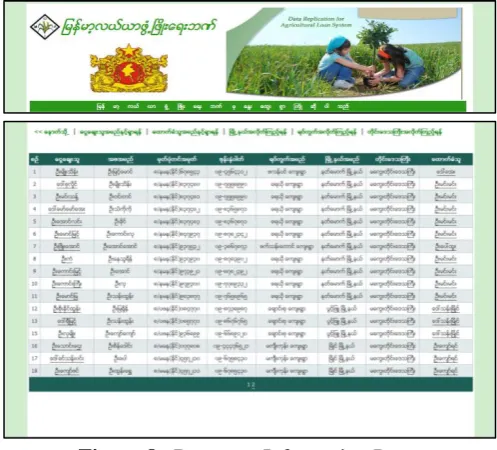
Figure 6. Loan Information Retrieval Process
If the user from particular’s township and quarters wants to know the information, the total information will display in figure 6.
Figure 7. Monthly notice list
If the person did not give monthly loan, this system will list and calculate the extra return loan in figure 7.
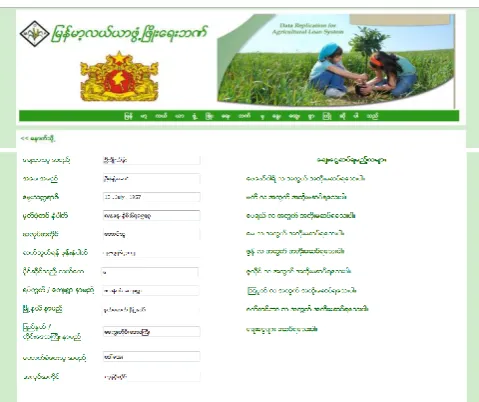
Fig 8. displays the borrower information. If the user wants to see detail information about borrower, the user can click borrower name link. The user can also see detail recommender information on recommender name link. User can search by borrower name, recommender name, township and quarter name.
Figure 8. Borrower Information Page
Volume 2 | Issue 5 | September-October-2017 | www.ijsrcseit.com | UGC Approved Journal [ Journal No : 64718 ] Figure 9. Individual User or Borrower Information
Page
V.
CONCLUSION
Replication can be used to distribute data over multiple regional locations. Then, applications can access various regional servers instead of accessing one central server. This configuration can reduce network load dramatically. Replication supports a variety of applications that often have different requirements. Some applications allow for relatively autonomous individual materialized view sites. Data replication consists of maintaining multiple copies of data, called replicas, on separate computers. It is an important enabling technology for distributed services. Replication improves availability by allowing access to the data even when some of the replicas are unavailable.
A. Advantages of System
A good way to increase the performance in a database system is to use replication techniques so that the database system can be separated into different servers. Performance in a distributed database system is increased with the introduction of more replicas of the database into the system. When several replicas of a database are present, they can divide the workload of incoming requests between each other.
This system can provide the computerized agricultural loan database that is replicated in different site. So particular quarter and township officers can access reliable data quickly and can support easy to use this system. Using web application with Myanmar language, farmers and officers can understand with easily.
B. Limitation and Further Extension
Applications such as call centers and Internet systems require data on multiple servers to be synchronized in a continuous, nearly instantaneous manner to ensure that the service provided is available and equivalent at all times. Here, data consistency is more important than site autonomy. Using lazy replication, data consistency cannot support. If the data consistency can get for reliability, eager replication should use. This system can extend the comparison result of lazy and eager replication method. Advanced Replication can be used for each of the types of applications described in the previous paragraphs, and for systems that combine aspects of both types of applications.
VI.
REFERENCES
[1]. Breitbart, Y., Komondoor, R., Rastogi, R., Seshadri, S., and Silberschatz, A. 1999. Update propagation protocols for replicated databases. In Proceedings of the 1999 ACM SIGMOD international Conference on Management of Data (Philadelphia, Pennsylvania, United States, May 31 - June 03, 1999). SIGMOD '99.
[2]. Frank, L., 1999, “Evaluation of the Basic Remote Backup and Replication Methods for High Availability Databases”, Software - Practice & Experience, Vol. 29, issue 15, pp 1339-1353. [3]. Fredrik Nilsson, and Patrik Olsson, A survey on
reliable communication and replication techniques for distributed databases, School of Innovation, Design and Engineering, School of Innovation, Design and Engineering, 2007. [4]. M. Wiesmann, F. Pedone, A. Schiper, B.
Kemme, and G. Alonso., Understanding replication in databases and distributed systems. In Proceedings of 20th International Conference on Distributed Computing Systems (ICDCS’2000), pages 264–274, Taipei, Taiwan, R.O.C., April 2000. IEEE Computer Society Los Alamitos California.
[5]. Nay Myo Aung, Agricultural efficiency of Rice farmers in Myanmar, September 2011.
[7]. Sousa, A.; Pereira, J.; Soares, L.; Correia, A., Jr.; Rocha, L.; Oliveira, R.; Moura, F., "Testing the dependability and performance of group communication based database replication protocols," Dependable Systems and Networks, 2005. Proceedings. International Conference on , vol., no., pp. 792-801, 28 June-1 July 2005. [8]. The Art of Data Replication, and Multi-Master
Replication, An Oracle Technical White Paper, September 2011,