Article
1
Improving Decisions to Mitigate the Risks of
2
Organizational Accidents
3
Scott Jackson 1 and Avi Harel2
4
1 Burnham Systems; [email protected]
5
* Correspondence: [email protected]; Tel.: +01-949-726-2003
6
2 Ergolight; [email protected]; Tel: +972-54-453-4501
7
Abstract: This paper examines cognitive biases which affect the ability of decision makers to make rational
8
decisions in an organizational context. The motivation for this analysis begins with the observation of
9
catastrophic accidents caused by human error but in an organizational context. This paper expands on the
10
concept of cognitive bias to define organizational biases which are the factors that affect decisions in an
11
organizational context. The paper distinguishes between organizational biases, which are the focus of this paper,
12
and individual biases, which are biases experienced by individuals but may have organizational consequences.
13
The purpose of this paper is to identify methods to mitigate the risks of organizational accidents, accidents
14
which involve many people operating at different levels of an organization. The methodology is to identify
15
those decisions that would address the specific organizational biases. The focus of this paper is the decisions for
16
mitigating the risks associated with decisions in an organizational context. Results are shown for seven
17
organizational biases, six specific case studies, and four decision options. This paper concludes that
18
organizational biases are intrinsically different from individual biases and that these differences lead to different
19
decision options from those that mitigate individual biases; however, they may exist concurrently.
20
Keywords: cognitive bias; organizational bias; decision options; risk; catastrophic, organizational
21
accidents; human error; hierarchy; culture; policy; procedures
22
23
1. Introduction
24
This paper examines accidents that occur in an organizational context, the biases that may contribute
25
to those accidents, and the organizational characteristics that may contribute to those biases. These
26
biases are an extension of the individual cognitive biases identified by Kahneman [1] and Thaler [2].
27
This paper is also an extension of previous work by the author in [3] and [4]. Section 1 summarizes
28
past work pertaining to the concepts of biases, rationality, and organizational accidents. Section 1
29
also discusses areas of disagreement regarding the concept of cognitive biases. Section 2 introduces
30
and defines the concept of organizational biases and explains how they differ from individual biases.
31
Section 3 presents case studies which illustrate the effects of organizational biases. Section 4 identifies
32
options that have the potential for improving decisions in the face of organizational biases.
33
1.1 Organizational accidents
34
Reason [5] (p. 1) states that an organizational accident is different from an individual accident. He
35
says that organizational accident as accidents that occur in an organizational context. He says that an
36
individual accident is one in which a specific “individual person or group is often both the agent and
37
victim of the accident.” An organizational accident, on the other hand, is an accident with “multiple
38
causes involving many people at different levels of a company.” A hierarchical structure is an
39
example characteristic of an organization that may contribute to organizational accidents. The
40
organization’s culture is another characteristic.
41
1.2 Cognitive bias and irrational decisions
42
Accidents can be caused by irrational decisions at both the individual and organizational level. The
43
root cause of irrational decisions is called cognitive bias as defined by Chegg [6] as “a mistake in
44
reasoning, evaluating, remembering, or other cognitive process, often occurring as a result of holding
45
onto one's preferences and beliefs regardless of contrary information.” Wikipedia [7] has compiled
46
an extensive list of cognitive biases from various sources. Most of the cognitive biases listed in the
47
literature qualify as individual biases since they are biases experienced by individuals. One of the
48
more well known individual biases is the confirmation bias which according to Wikipedia [7] is “the
49
tendency to search for, interpret, focus on and remember information in a way that confirms one's
50
preconceptions.” This bias, and others, may have organizational consequences, but the focus of this
51
paper is on biases that have an organizational origin.
52
Some researchers have noted that in some instances biases may be beneficial. For example,
53
Haselton et al [8] state that biases enable “selection may favor useful short-cuts that tend to work in
54
most circumstances.” Nevertheless, the focus of this paper is on biases that have been shown to
55
degrade the ability of a decision-maker to make decisions in an organizational context and have been
56
a factor in major catastrophes.
57
Other researchers for example Soll et al [9] have observed that there are two methods of
58
reducing bias: modify the person or modify the environment. These two methods are compatible
59
with the biases discussed in this paper. Modifying the person, for example, pertains to internal biases,
60
that is individual biases. Modifying the environment, in this paper, has to do with modifying the
61
organization which is the root of the organizational biases, the subject of this paper. Hence, for the
62
purpose of this paper, the organization is the environment of interest. These categories, in particular
63
modifying the environment, allow us to focus on the organizational biases.
64
In the end this paper concludes that organizational biases are intrinsically different from
65
individual biases and that these differences lead to different decision options from those that mitigate
66
individual biases. It also concludes that implementation of these decisions is dependent on whether
67
the organization is overseen by an outside authority or is an independent enterprise.
68
1.3 Rationality
69
The definition by Webster [10] of rationality is “the quality of being based on or in accordance with
70
reason or logic.” In the context of economics and decisions, according to Kahneman [1] (pp. 411-412)
71
“rationality is logical coherence, reasonable or not.” In general a decision is often called rational if
72
it is supported by explicit data. This paper pertains to decisions that can be irrational, that is, they are
73
supported by data which may be ignored or biased by other factors such as stress or organizational
74
characteristics.
75
1.4 Decisions
77
Most literature on decision analysis assumes that decisions are rational and objective. The
78
International Council on Systems Engineering (INCOSE) handbook [11] (p. 110) states that the
79
purpose of the Decision Management process is to
80
Provide a structured analytical framework for objectively (italics added)
81
identifying, characterizing, and evaluating a set of alternatives for a decision at
82
any point in the life cycle and select the most beneficial course of action
83
There is no discussion of decisions that are not made objectively or what the risks might be if they
84
were not objective or why they may not be objective. Of course objective decisions are always the
85
goal, but whether this can be achieved depends on the degree of bias either individual or
86
organizational.
87
The Nobel committee awarded both Kahneman and Thaler the Nobel prize for their findings
88
and for their studies related to cognitive bias and nudges. Thaler [2] defines a nudge as any aspect of
89
a choice architecture that alters people’s behavior in a predictable way without significantly changing
90
their economic incentives.” This paper simply uses the term decision option for nudge. Kahneman
91
also recognizes the contributions of Amos Tversky who passed away before Kahneman’s prize was
92
awarded. Most, but not all, of the biases studied by Kahneman and Thaler are individual biases.
93
1.5 Areas of disagreement
94
The findings relative to cognitive bias have not been without their disagreements. These
95
disagreements fall into three categories:
96
• Smart people do not suffer from cognitive bias and do not make bad decisions. According to
97
Lewis [12] (p. 318) a critic of Kahneman and Tversky stated, “I am not interested in studying
98
the psychology of stupid people.” Kahneman and Tversky did not see their work that way.
99
According to Lewis, “their very first experiments, dramatizing the weakness of people’s
100
statistical intuitions, had been conducted on professional statisticians.” Kahneman [1] (p.430)
101
states “Experienced researchers are also prone to the same biases when they think intuitively.”
102
Kahneman [1] (p. 49) quotes Stanovich as saying that “high intelligence does not make one
103
immune to biases.”
104
• People will always make good decisions if they think about them. To address this disagreement
105
Kahneman [1] defines with two modes of thinking, fast and slow. Kahneman calls these two
106
modes System 1 and System 2 (pp. 20-21). Fast thinking is when a person makes a decision
107
based primarily on intuition. People, even smart people, make these decisions automatically.
108
Slow thinking is based on thought and analysis. However, slow thinking does not always result
109
in non-biased decisions. On the contrary, Kahneman [1] (p. 415) states that slow thinking may
110
even reinforce the biases that were present in fast decisions. Sunstein [13] states that “System 2
111
can and does err, but System 1 is distinctly associated with identifiable behavioral biases.”
112
Three conclusions can be reached: First, decisions can be called rational if they are based
113
on explicit data. Decisions are called proper or rational if they are supported by explicit data.
114
Second, decisions based on intuition (System 1) are not necessarily bad decisions. It depends on
the circumstances and the decision maker’s knowledge of the issue involved. Third, decisions
116
based on slow thinking (System 2) are not necessarily better than intuitive decisions.
117
• People will make good decisions if they are important enough. Thaler and Sunstein [2] (p. 76)
118
state that “there is little evidence that performance improves when stakes go up.” For example,
119
the biases that may contribute to buying a car may also apply to the irrational decisions
120
pertaining to a space system launch.
121
In summary, Kahneman according to Lewis [12] and Thaler and Sunstein [2] have refuted all three
122
assertions with experimental proof.
123
In addition to the disagreements listed above, Evans [14] (p. 93) says that “Kahneman and
124
Tversky were subject to many attacks for apparently demonstrating or claiming that human beings
125
are irrational.” One critic “believed that their experiments were unrepresentative or misleading.”
126
Nevertheless, Evans [14] (p. 3) himself states that “many mistakes are due to one or more cognitive
127
biases.” Thus, the weight of history is on the side of Kahneman, Thaler, and Tversky.
128
2. Results of organizational bias analysis
129
The focus of the paper is on organizational biases which this paper defines as being factors beyond
130
the well documented individual biases that may lead to irrational decisions and possibly catastrophic
131
consequences.
132
2.1 Definition of organizational bias
133
Organizational biases are those biases that are dependent on specific characteristics of an
134
organization. Typical characteristics include a hierarchical structure, the presence of many people
135
who may be either the genesis of the biases or the victims, and the culture of the organization. These
136
biases will be present and exacerbate any individual biases of the decision maker.
137
Frequently encountered organizational biases are the rankism bias, the culture bias, the protocol
138
rules bias, the groupthink bias, the loss aversion bias, the accountability bias, and the responsibility bias.
139
Murata et al [15] discuss many of these biases
140
including the confirmation bias, the groupthink
141
bias and the loss aversion bias. These include
142
both individual and organizational biases as
143
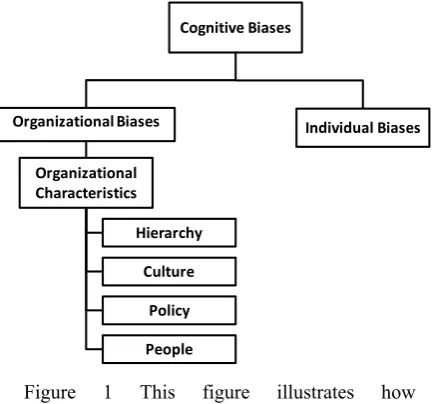
currently defined. Figure 1 is a hierarchical
144
view of how organizational biases contribute
145
to cognitive biases. This figure shows that
146
both individual biases and organizational
147
biases are part of cognitive biases. The
148
following paragraphs discuss the individual
149
and organizational biases.
150
2.2 How organizational bias differs from
151
individual bias
152
It is impossible to separate organizational
153
biases completely from individual biases
154
Cognitive Biases
Organizational Biases Individual Biases
Organizational Characteristics
Hierarchy
Culture
Policy
People
since leaders may suffer from individual biases which may affect their decisions which may have
155
organizational consequences.
156
Although organizational bias itself is anindividual bias in the sense that it is a reflection of the
157
mental state of the decision maker, it is organizational in the sense that it is influenced by the
158
characteristics of the organization, its structure, and its culture.
159
2.3 Aspects of organizational properties that contribute to organizational bias
160
The aspects of organizations that give rise to biases include the organization’s structure, primarily
161
hierarchical, the presence of many people in the organization, its culture, and the policies
162
documented within the organization.
163
2.4 Summary of organizational biases
164
The organizational biases discussed below are those biases that occur in an organizational context
165
and are stimulated by the characteristics of the organization.
166
2.4.1 The rankism bias
167
Rankism is a key topic in an organizational context and is described by Fuller [16]. Rankism can be
168
described as the mental attitude of people in positions of authority who assume that their decisions
169
are superior to persons of lower organizational rank. The rankism bias is therefore influenced by the
170
hierarchical characteristic of most organizations.
171
2.4.2 The culture bias
172
The Columbia Accident Investigation Report [17] (p. 184) states, for example, that there was a “broken
173
safety culture” at NASA. Regarding the Challenger disaster, Vaughn [18] (p. 190) that there was a
174
culture of “normative risks”, that is to say, that no particular attention was given to risks. There is no
175
implication in the culture bias pertains to any ethnic culture but rather to the culture of the
176
organization.
177
Reason [5] emphasizes the importance of a safety culture which he defines as “shared values
178
(what is important) and beliefs (how things work) that interact with an organization’s structures and
179
control systems to produce behavioral norms (the way we do things around here).” Hence it can be
180
inferred that the Columbia and Challenger organizations did not have these shred values and beliefs.
181
It can also be inferred that the “broken safety culture” existed at all level of the organization in
182
accordance with the hierarchical structure.
183
Jackson [19] (pp. 91-119) examines the cultural factors that may result in faulty decisions.
184
2.4.3 The groupthink bias
185
The groupthink bias can be considered to be an integral part of the culture bias. According to Murata
186
et al [15] groupthink is characterized by “overestimation of the group, closed mindedness and pressure
187
toward conformity.” The groupthink bias is particularly applicable to large organizations and
188
therefore tends to exacerbate the probability of catastrophe in an organizational context.
2.4.4 The protocol rules bias
190
This bias occurs when a protocol takes precedence over a common-sense opportunity to prevent a
191
catastrophe. The United 93 incident described in the 9/11 Commission report [20] (p. 11) is an
192
example. Most large organizations have written protocols.
193
2.4.5 The responsibility bias
194
According to Madigan [21] the responsibility bias is the tendency to exaggerate one’s own
195
contributions and minimize the contributions of others. This is, by definition an organizational bias
196
since multiple persons are involved. Wikipedia [7] also lists the egocentric bias which is essentially the
197
same as the responsibility bias.
198
2.4.6 The accountability bias
199
According to Dekker [22] (pp. 91-103), this is the refusal to take responsibility for accidents. This bias
200
qualifies as an organizational bias since the decision maker is blaming others for a lack of
201
responsibility.
202
2.4.7 The loss aversion bias
203
A bias described by Kahneman [1] (p. 302) is loss aversion. The concept is that decision makers fear
204
losses more than the possibility of gains. If that is the case, then why do they make decisions with a
205
high probability of failure? One possibility is that they fear disapproval of organizational superiors.
206
Another possibility is that they do not have a sufficient appreciation of the probability of failure.
207
Therefore, this is an organizational bias since organizational superiors are involved.
208
3 Results for Case studies
209
The following cases are examples of catastrophes in which organizational bias was a factor.
210
3.1 Challenger
211
The trigger physical cause of the Challenger accident was the failure of the O-rings. However, cultural
212
factors were more serious and constituted the root cause of the accident. The philosophy of the
213
“normalization of deviance” prevailed on Challenger as documented by Vaughn [18] (p. 190). Hence,
214
Challenger stands as an example of the culture bias. This bias could only exist in an organizational
215
context since, by definition culture is organizational.
216
3.2 Columbia
217
Columbia is a well-documented event by NASA [17] for which the causes are known and an approach
218
recommended. The trigger physical cause was a debris strike as described by NASA [17] (p. 34).
219
However, deeper analysis shows that the root cause was more cultural than technical. NASA [17]
220
(pp. 99-120) shows that the same flawed practices that dogged Challenger were still present on
221
Columbia.
The Columbia Accident Investigation Board (CAIB) NASA [17] (p. 184) states that NASA had a
223
“broken safety culture”. So we can say that that is the organizational bias right there and one that is
224
clearly organizationally focused. This is an example of the culture bias.
225
3.3 Tenerife
226
This accident occurred between two 747s on the island of Tenerife in the Atlantic. One
227
aircraft was already in motion for takeoff, and the other was in the hold mode waiting to take off, but
228
the Air Traffic Control (ATC) had not given the clearance. The second aircraft took off prematurely
229
resulting in a collision and the loss of all occupants. This was the largest commercial aircraft accident
230
in history from the point of view of fatalities in which 585 persons died. McCreary et al [23] provide
231
a detailed account of this accident from a human factors perspective.
232
This was an organizational accident with the rankism bias from two perspectives. First, there was
233
rankism between the pilot and the co-pilot. Secondly, there was rankism between the pilot and the
234
company (KLM). With respect to the pilot and the co-pilot, there is evidence that the co-pilot
235
attempted to warn the pilot not to take off prematurely. The pilot simply ignored any signals from
236
the co-pilot due to the pilot’s rank; that is to say, he was in charge of the airplane and could make
237
whatever decisions he wanted. Secondly, with regard to the KLM policies there is evidence that the
238
pilot was motivated to take off prematurely because of company mandated deadlines.
239
The airline company at the time of the Tenerife disaster had a culture in which rankism prevailed.
240
In addition the company had policies that motivated pilots to hurry back to the headquarters. Hence,
241
this is an example of a policy bias.
242
3.4 Honda Point
243
According to the web site [24] the Honda Point disaster occurred on 8 September 1923 off the coast
244
of California. Seven US Navy ships were grounded and 23 sailors died. The commanding officer
245
ignored navigational information and ordered the ships into a dangerous route. Other captains
246
followed the orders even though they knew of the navigational errors. Thus, they were suffering from
247
the groupthink bias.
248
The military concept that all ships should follow the lead ship may have contributed to this
249
event. Thus the protocol rules bias may have been a factor also.
250
3.5 Bhopal
251
The largest industrial disaster in history occurred in Bhopal, India on 2-3 December of 1984.
252
According to Reason [5] (p. 89), at least 2500 died and many others were injured when water was
253
incorrectly spilled into a methyl isocyanate tank.
254
Causes were identified as botched decision making and poor maintenance. This disaster falls
255
into the culture bias category.
256
3.6 Deepwater Horizon
257
The basic characteristic of this system was that it was a multi-layer system with BP at the top and
258
Deepwater Horizon as a supplier. Friction within the company became apparent when the BP CEO
259
blamed Deepwater Horizon for the tragedy. So did BP develop safety standards and flow them down
to DH? This is not known; however general systems principles would assert that BP owns the entire
261
system and was therefore responsible. The courts later found BP responsible. So this problem would
262
also have roots in rankism, this case the assertion that the top level system could hold the lower level
263
system responsible. This disaster is described by Britannica [25].
264
This is also a responsibility and an accountability bias, that is the reluctance to take responsibility
265
for one’s actions. The primary organizational property that contributed to the Deepwater Horizon
266
disaster was the hierarchical nature of the BP system and the lack of communication and division of
267
responsibility between them.
268
3.7 United 93
269
According to the 9/11 Commission report [20] (p. 11), the FAA failed to notify the pilots of this aircraft
270
that there was a possibility of terrorists on board. The FAA claimed that it was not their responsibility
271
to contact the pilots but rather the airline. The result was that valuable time was lost, the terrorists
272
attacked, and all on board were lost. The Commission stated that the FAA did not understand their
273
responsibility.
274
This is an example of the protocol rules bias. This bias states that when a person in either an
275
individual situation or an organizational situation has a decision between following an existing
276
protocol or making a wiser decision, will follow the protocol.
277
3.8 Korean Airlines Flight 801
278
According to the NTSB report [26] a Korean Airlines 747-300 crashed into a hill in Guam on 6 August
279
1997 killing 228 of the 254 persons on board. The primary cause of the crash according to the NTSB
280
[26] was the captain’s failure properly to execute the approach. However, FlightGlobal
[27]
cites this281
disaster as an example of a cockpit with personnel with a former military experience in which “a
282
command and control culture that discourages subordinates from questioning superiors.” This
283
statement describes the rankism bias as described in this paper. Hence both the culture bias and the
284
rankism bias were factors in this accident.
285
3.9 Asiana Flight 214
286
According to the NTSB [28] Asiana Flight 214, a Boeing 777-200ER, crashed into a seawall upon
287
attempting a landing at San Francisco airport on 6 July 2013. Like Korean Airlines the report focuses
288
on the lack of cockpit communication as being the primary cause of the crash. In post-accident
289
interviews the PF (pilot flying) admitted that he was unfamiliar with the procedure for landing
290
without glideslope guidance. He was reluctant to admit this to the PM (pilot monitoring). This is an
291
indication of the rankism bias that was part of the airline culture of this aircraft.
292
4 Results for decision options in an organizational context
293
Either an organization leader, such as a CEO, decision options or the organizational policies will drive
294
the decision options. Individuals may make decisions that are organizational in nature, but the
295
decision choices themselves will depend on the organizational biases that generated the risks that
296
need to be mitigated. In addition, the individual biases that may have existed concurrently need to
297
be mitigated. Kahneman [1] and Thaler [2] give many examples of how this can be done.
4.1 Goal of decision options
299
Decision options in an organizational context pertain to those biases that are influenced by the
300
characteristics of the organization. Decision options for individual biases identified by Kahneman [1]
301
and Thaler [2] may also be beneficial in an organizational context.
302
There is no assertation that organizational decisions will prevent disasters; therefore, decisions
303
are not solutions. There is only the goal of identifying decisions that will influence the leader to make
304
better, less risky, decisions. A better decision may result in the avoidance of the disaster completely,
305
or it may result in reduced consequences.
306
4.2 Definition of decision architecture in an organizational context
307
Decision options pertain to the decisions that a leader might make in an organizational context.
308
4.3 How decisions in an organizational context differ from decisions in an individual context
309
Decisions in an organizational context pertain to all the organizational structural and procedural
310
options that may influence the decisions of the organization leader, for example, a program manager
311
or a CEO. Decisions in an individual context only pertain to the decisions made by an individual,
312
such as the leader. These individual decisions may also influence the decisions of the leader, but the
313
focus of this paper is on organizational decisions which may exist concurrently with individual
314
biases.
315
4.4 Importance of libertarian paternalism in an organizational context
316
Thaler’s concept of libertarian paternalism is important in an organizational context. This concept says
317
that someone either the leader in our case or the individual in individual cases will make the final
318
decision, whatever that decision may be. However, libertarian paternalism does not mean that decision
319
will always be correct, that is, that it will prevent a catastrophe. It only says that the leader will be
320
influenced to make a decision that is better than the one he would have made if the options had not
321
been exercised. These decisions will be influenced by both individual biases and organizational
322
biases.
323
4.5 Summary of decisions in an organizational context
324
The decision options below are initial judgments that might apply to the case studies in this paper.
325
There is no claim that this list is exhaustive. Other decisions may be appropriate.
326
4.5.1 Independent review
327
The only approach recommended by the CAIB in he Columbia case is the Independent Technical
328
Authority (ITA) described by NASA [17] (p. 227). There is no indication that the CAIB intended that
329
the ITA would have veto power over the program leader for decisions such as launch or delay launch.
330
Hence it can be assumed that this approach complies with the libertarian paternalism policy. So the
331
ITA merely influences the decision; it does not override it.
332
The organizational property that influenced this decision option is the broken safety culture
333
which led the CAIB to mistrust the decision process on the program
4.5.2 Pre-mortem
335
The pre-mortem is a decision option suggested by Kahneman [1] (pp. 264-265). The pre-mortem
336
consists of organizing a group of individuals who can identify the potential negative aspects of any
337
decision.
338
The pre-mortem is not mentioned by the CAIB. This decision option is not significantly different
339
from the ITA except that the pre-mortem would be internal to the program rather than external. The
340
post-mortem decision would also apply to the Honda Point disaster.
341
4.5.3 Policy change
342
Both biases in the Tenerife case could be addressed to some extent by a change in company policies.
343
First, in the Tenerife case there must be a policy to force the pilot to comply with warnings from the
344
co-pilot. Secondly, the company must remove any policies that would force the pilot to take off
345
prematurely. There may be other approaches more appropriate to the individual biases.
346
A second policy change would be to remove the authority of rank which the captain asserted.
347
In the Honda Point case the most obvious approaches to this problem are changes in official
348
actions documented in Navy manuals.
349
In the Korean Airlines Flight 801 case the airline instituted improvements in their crew
350
management system (CMS) to comply with new policies directed at improved communications.
351
In general, policy change decisions should focus on specific reporting responsibilities and
352
actions and should avoid vague statements.
353
4.5.4 Protocol change
354
The obvious approach to the United 93 problem described by the 9/11 Commission report [20] (p. 11)
355
is to change the protocol with the outside influence of the 9/11 Commission. In subsequent
356
communications the FAA has declined to state whether their protocols have been changed. In
357
addition to a specific protocol a policy change would be necessary to require personnel the
358
responsibility of making decisions that violate specific protocols if human safety is involved.
359
4.6 Implementation of decisions in an organizational context
360
For the three decision options listed below, the implementation of these decisions is largely
361
dependent on whether the organization is overseen by a higher authority, such as the FAA or is
362
completely an independent enterprise. In the latter case implementation will depend on the
363
organization’s leadership.
364
4.6.1 Independent review
365
The independent review decision option by definition would need to be implemented external to the
366
program in question. Independent implies organizational and financial independence. This could be
367
done either voluntarily by the program or mandated by an external authority, such as the FAA. The
368
Columbia Accident Investigation Board (CAIB) in NASA [17] (p. 227) suggested the independent
369
review option in NASA
4.6.2 Pre-mortem
371
It would be up to the leader to organize the pre-mortem as described by Kahneman [1] (pp. 264-265)
372
As stated before, this approach would have to be institutionalized before it could be
373
implemented. This raises the question of how it would be implemented. It could be implemented
374
either by organizational policy or by an external entity such as NASA, the FAA, or a DoD branch.
375
A practical and current implementation of the pre-mortem approach is crew management
376
resource (CRM) as described by FlightGlobal [27]. This source has observed that aircraft crashes can
377
be attributed, in part, to the lack of communications among crew members. CRM calls for flight crew
378
members to alert the captain if they have any concerns, such as the aircraft is heading into a
379
catastrophic event. Moreover, the communication should be relayed in an assertive way so that the
380
captain is aware of the situation. These procedures can be considered a special application of the
pre-381
mortem approach.
382
383
4.6.3 Policy change
384
It seems that the basic approach to this problem is to change the company policies. An external
385
independent authority would be required to make sure this happens. For independent enterprises,
386
policy changes would be the responsibility of the decision makers.
387
5 Discussion
388
389
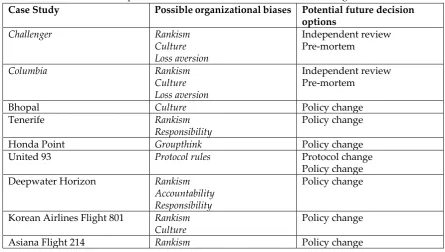
Table 1 summarizes the case studies, the organizational biases that appear to have been present, and
390
the possible decision choices that may be appropriate for future cases of these types. These biases and
391
options are not meant to be exhaustive but rather typical for cases of these types. This table does not
392
list individual biases which are thoroughly discussed by Kahneman [1] and Thaler [2].
393
394
Table 1. Potential decision options for selected case studies and associated organizational biases
395
Case Study Possible organizational biases Potential future decision options
Challenger Rankism Culture Loss aversion
Independent review Pre-mortem
Columbia Rankism Culture Loss aversion
Independent review Pre-mortem
Bhopal Culture Policy change
Tenerife Rankism
Responsibility
Policy change
Honda Point Groupthink Policy change
United 93 Protocol rules Protocol change
Policy change Deepwater Horizon Rankism
Accountability Responsibility
Policy change
Korean Airlines Flight 801 Rankism Culture
Policy change
Culture
Cognitive biases should be seen as a departure from previous reliance on the assumption of rational
396
thinking. Kahneman [1] and Thaler [2] have performed a service by bringing this new perspective to
397
light.
398
It is recommended that future work be focused on implementing the concepts described in this
399
paper in enterprises particularly vulnerable to catastrophic failures. Space systems and commercial
400
aircraft systems would be priority enterprises. Priority should given to those concepts recommended
401
by authoritative bodies, such as the Columbia Accident Investigation Board (CAIB). It is impossible
402
to estimate how many fatalities could he avoided by these measures; however this paper outlines one
403
of the more scientifically validated approaches.
404
6. Materials and Methods
405
The cognitive biases examined were extracted from many sources including Wikipedia [7], Madigan
406
[21], Kahneman [1], Dekker [22], Murata et al [15], and Fuller [16]. The protocol rules bias was inferred
407
from the United 93 case in the 9/11 Commission report [20]. The culture bias was inferred from the
408
Challenger case described by Vaughn [18] (p. 190), the Bhopal case described by [5] (p. 89), and NASA
409
[17] (p. 184) for Columbia.
410
The protocol rules bias was inferred from the 9/11 Commission report [20] for the United 93 case.
411
The case studies were described by Vaughn [18] (p. 190) for the Challenger case, NASA [17] (p.
412
184) for the Columbia case, McCreary et al [23] for the Tenerife case, Wikipedia [24] for the Honda
413
Point case, Reason [5] (p. 89) for the Bhopal case, Britannica [25] for Deepwater Horizon, the 9/11
414
Commission report [20] for the United 93 case, the NTSB reports for the Korean 801 [26] and Asiana
415
214 [28] cases.
416
Decision options were described by NASA [17] (p. 227) for the independent authority, by
417
Kahneman [1](pp. 264-265) for the pre-mortem. Policy change was inferred from the case studies.
418
The division of cognitive biases into individual biases and organizational biases was performed
419
by the author using reason based on organizational characteristics. The development in this paper of
420
the concept of organizational bias is a departure from and an expansion of the previous work focusing
421
on individual biases. However, as stated above the individual biases may exist simultaneously with
422
organizational biases and may, by themselves, have organizational consequences.
423
7 Conclusions
424
Organizational biases are fundamentally different from individual biases and are a result of
425
organizational characteristics. In addition, organizational biases are an extension of individual biases.
426
Decisions in an organizational context are unique to each organization and each bias and the
427
situation in which the decision is necessary. Hence, organizational biases and organizational
428
decisions should be addressed as separate phenomena from individual biases and decisions because
429
they require an added degree of analysis to synthesize. Organizational biases and organizational
430
decisions depend both on the mental state of the decision maker and the characteristics of the
431
organization.
432
Decision options often call for cultural changes in organizations. However, these cultural
433
changes should be implemented in specific responsibility changes and in specific required actions.
Implementation of organizational decisions is the major challenge and are primarily dependent
435
on organization management to implement them or some outside entity to mandate them.
436
437
8 Author contributions
438
Dr. Jackson has explored the topic of cognitive bias for a number of years beginning with
439
Jackson [19] (pp. 91-119). Other contributions in this field include Jackson and Harel
[3]440
and Jackson [4]. The latter two papers contributed to the examination of cognitive bias as part of the
441
decision process within systems engineering.