A Quantitative Prediction Method for Fracture
1
Density Based on the Equivalent Medium Theory
2
Liang Sun 1,2, Suping Peng 1,2*, Dengke He 1,2, Shu Wang 1,2
3
1 State Key Laboratory of Coal Resources and Safe Mining, China University of Mining and Technology
4
(Beijing), Haidian, Beijing 100083, China; [email protected] (L.S.); [email protected] (D.H.);
5
[email protected] (S.W.)
6
2 College of Geoscience and Surveying Engineering, China University of Mining and Technology (Beijing),
7
Haidian, Beijing 100083, China
8
* Correspondence: [email protected]
9
10
Abstract: Fracture density, a critical parameter of unconventional reservoirs, can be used to evaluate
11
potential of unconventional reservoirs and location of production wells. Many technologies, such
12
as amplitude variation with offset and azimuth (AVOA) technology, vertical seismic profiling (VSP)
13
technology, and multicomponent seismic technology, are generally used to predict fracture of
14
reservoirs. they can qualitatively predict fractureby analyzing seismic attributes, including seismic
15
wave amplitudes, seismic wave velocities, which are sensitive to fracture. However, it is important
16
to quantitatively describe fracture of reservoirs. In this study, based on a double-layer model, the
17
relationships between fracture density and the double-layer model’s physical parameters, such as
18
velocity of fast shear-wave, velocity of slow shear-wave, and density, were established, and then a
19
powerful quantitative prediction method for fracture density was proposed dramatically.
20
Afterwards, the Hudson model for crack was used to test the applicability of the method. The result
21
shown that the quantitative prediction method for fracture density can be applied suitable to the
22
Hudson model for crack. Finally, the result of validation models indicated that the method can
23
predict fracture density effective, in which absolute relative deviation (ARD) were less than 5% and
24
root-mean-square error (RMSE) was 4.88×10⁻³.
25
Keywords: Fracture density; Double-layer model; Unconventional reservoirs; Multicomponent
26
seismic; Shear-wave splitting
27
28
1. Introduction
29
Unconventional resources have received widespread interest in recent years because of their
30
emergence as a source of clean energy, and they are now being developed and produced in North
31
American shales, Southern North China shales, etc. [1-3]. As self-sourced reservoirs, the fracture
32
space controls not only the potential of unconventional reservoirs but also location of production
33
wells [4]. Thus, the accurate prediction of fracture density plays an important role in the exploration
34
and development of unconventional reservoirs. In particular, knowing the fracture density variation
35
between zones within a reservoir can help in the accurate determination of well locations [5].
36
Many achievements have been made with the continuous improvements by researchers for
37
predicting the fracture in sedimentary strata [6-9]. Sedimentary strata, such as unconventional
38
reservoirs, are usually described as anisotropic mediums on the scale of seismic waves, and the
39
anisotropy of a medium is produced by skeleton orientated arrangement and fracture development
40
[10-11]. Ruger (1997, 2002) researched the relationship among P-wave reflection coefficients, offset,
41
and azimuth named AVOA technology, which was found to be suitable for analyzing the anisotropy
42
of a medium [12-13]. While, some researchers used the AVOA technology to predict the anisotropy
43
of fractured reservoirs for analyzing the fracture development, and the results in these studies were
44
presented by anisotropic parameters to reflect the fracture development [9, 13-15]. Thus, the AVOA
45
technology was a non-direct way to predict the fracture development of reservoirs clearly.
46
Using the vertical seismic profiling (VSP) technology to predict the fracture development of
47
reservoirs is realized by the splitting property of the S-wave, the S-wave split into fast S-wave and
48
slow S-wave when passing through fracture with an angle[16-17], which is obviously different from
49
AVOA technology. The difference between the velocities of these waves can be estimated by
50
measuring the increase of the time delay between them with the depth [18]. Meadows et al. [19],
51
Pevzner et al. [20], and Shevchenko et al. [21] used VSP technology to predict the fracture of
52
reservoirs. The prediction results shown that the VSP technology can estimate the S-wave anisotropy
53
of reservoirs by the difference between the fast S-wave velocity and the slow S-wave velocity, which
54
was useful for representing the fracture development of reservoirs. However, this technology
55
requires a borehole that is available for the exploration area. Thus, it only has the ability to reflect
56
the fracture development near the borehole, actually. Ata et al. [22], Gaiser [23] and Vetri et al. [24]
57
used multicomponent seismic technology to predict the fracture development of reservoirs by
S-58
wave splitting property. Compare with the VSP technology, multicomponent seismic data did not
59
have the advantage of recording data near the reservoirs, which can bypass complications introduced
60
by the overburden. Fortunately, with the improvement of multicomponent seismic data acquisition
61
and processing technology [25-31], the application of multicomponent seismic technology has
62
gradually increased, providing favorable technical support for identifying the fracture of reservoirs
63
[32-33]. However, Using the splitting property of the S-wave to predict the fracture of reservoirs is
64
also a non-direct way yet.
65
During the past few decades, the equivalent medium theory, a method for digitizing rocks, has
66
attracted the attention of many researchers [34-36]. Backus [37] demonstrated that a multilayer
67
transversely isotropic medium was equivalent anisotropic if the wavelength of seismic wave is much
68
larger than the monolayer of the multilayer transversely isotropic medium, and then the equivalent
69
elastic tensor of this medium was given. Eshelby [38] studied the situation of a single elliptical
70
inclusion in isotropic media, and then Cheng [39] gave the equivalent elastic tensor of the situation.
71
Hudson [40] researched the condition that fracture is represented as a gap or inclusion with a thin
72
coin-shaped ellipsoid, and provided the equivalent elastic tensor. Schoenberg [41] ignored the shape
73
and microstructure of fracture and considered the fracture was an infinitely thin and very soft
74
stratum satisfying the linear sliding boundary condition. While, a linear sliding model was proposed.
75
Subsequently, the equivalent medium theory has been developed and promoted [42-46].
76
Based on the equivalent medium theory, this study established the relationships among fracture
77
density, multicomponent seismic response, density. As a result, a powerful quantitative prediction
78
method for fracture density was proposed. Furthermore, the applicability of the quantitative
79
prediction method for fracture density was verified by the Hudson model for crack. In this study,
80
Section 2 addresses details to construct a quantitative prediction method for fracture density based
81
on an equivalent medium model. Section 3 verifies the quantitative prediction method for fracture
82
density with the Hudson model for crack. The data to test the proposed method and discussion in
83
this study are presented in Section 4. Finally, conclusions are presented in Section 5.
84
2. Method Assumptions and Establishment
85
In this section, firstly, we make some idealized assumptions in order to achieve a powerful
86
method for predicting fracture density. Secondly, the relationships between the fracture density and
87
the physical parameters of target layer, such as fast S-wave velocity, slow S-wave velocity, root mean
88
square (RMS) velocity, and density, are developed under the idealized assumptions. Finally,
89
calculation Eqs. for the fracture density are given in detail, and then a quantitative prediction method
90
for fracture density is established.
91
2.1 Assumptions
92
As a result of their genesis, sedimentary strata, such as unconventional reservoirs, can be
93
exhibited in a thin interbedded medium. In this work, we assume that the thin interbedded medium,
94
shown in Fig. 1, is composed of two components: rock skeleton layer (matrix) represented by black
95
Moreover, following assumptions and simplifications are made to generate a practical method for
97
predicting the fracture density which is defined by the volumetric proportion between the fracture
98
layer and the total layer.
99
100
Figure 1. Thin interbedded medium
101
(1) The rock layer and rock fracture layer of the thin interbedded medium are assumed isotropic,
102
homogeneous, and linear elastic.
103
(2) There are no sources of intrinsic energy dissipation, such as friction or viscosity, between
104
the rock skeleton layer and the rock fracture layer.
105
(3) The thickness of the rock skeleton layer and the rock fracture layer must be much smaller
106
than a seismic wavelength, which the seismic wavelength must be at least ten times a layer
107
thickness.
108
According to the aforementioned assumptions, we can divide the thin interbedded medium into
109
two parts: a skeleton layer and a fracture layer, and then the thin interbedded medium can be
110
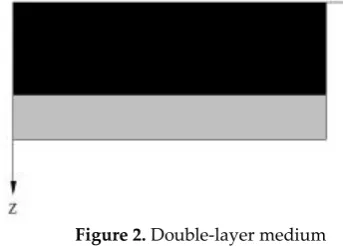
equivalent to a double-layer medium. Fig. 2 shows the double-layer medium, in which the black part
111
represents the skeleton layer and the gray part indicates the fracture layer.
112
113
Figure 2. Double-layer medium
114
2.2 The relationships between S-wave velocities and fracture density
115
Notable, Backus (1962) demonstrated that if the wavelength of seismic wave is much larger than
116
the monolayer of the thin interbedded medium, it will be equivalent anisotropic [37]. Thus, the
117
stiffness tensor (
C
) of the double-layer medium can be represented facile by Backus Average, which118
depicted with the P-wave velocity (
V
P), the S-wave velocity (V
S), the density (
), and the volume119
of each layer.
120
Table 1 Physical parameters of the double-layer medium
121
P-wave velocity (m/s) S-wave velocity (m/s) Density (kg/m3) Volume (m3)
Skeleton layer VP1 VS1 d1
Fracture layer VP2 VS1 d2
Tab. 1 shows the physical parameters of the double-layer medium, and then the stiffness tensor
122
(
C
) of the double-layer medium can be described through Backus average [37] and Levin formula123
11 12 13
12 11 13
13 13 33
44
55
66
0
0
0
0
0
0
0
0
0
0
0
0
0
0
0
0
0
0
0
0
0
0
0
0
c
c
c
c
c
c
c
c
c
C
c
c
c
(1)
125
where
c
55
c
44;
c
66
0.5
c
11
c
12
;
126
2
2 2
1
2 2 1
11 2 2
2
2 2
1
2 2 1
12 2 2
2 2
1 2 1
13 2
1 2 1 33
1 2 1 44
2 66
4
1
1 2
(
)
2
1 2
1 2
(
)
1 2
(
)
(
)
(
)
S S
S P
P P
S S
S P
P P
S
P P
P S S
V
V
c
V
V
V
V
V
V
c
V
V
V
V
V
c
V
V
c
V
c
V
c
V
127
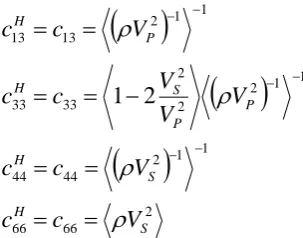
The brackets
indicates averages of the enclosed properties weighted by their volumetric128
proportions, which is often called the Backus average. As a result, we can represent the fast S-wave
129
velocity (
V
Fast) and the slow S-wave velocity (V
Slow) of the double-layer medium as follows:130
2 2
66
(
1 1 1 2 2 2) (
1 1 2 2)
Fast all S S
V
c
f
V
f
V
f
f
(2)131
2 2 1
44
(
1 1 1 2 2 2)
(
1 1 2 2)
Slow all S S
V
c
f
V
f
V
f
f
(3)
132
where
all
f
1
1
f
2
2 denotes the average density, kg/m3;1
1
f
represents the133
volumetric proportion between the skeleton layer and the total layer with the range (0, 1],
134
dimensionless;
f
2
indicatesthe volumetric proportion between the fracture layer and the total135
layer with the range [0, 1), dimensionless;
d
2
d
1
d
2
is the fracture density with the range136
[0, 1), dimensionless.
137
2.3 The relationships between root mean square (RMS) velocities and fracture density
138
On the basis of above-mentioned, we can develop the relationships between root mean square
139
(RMS) velocities and the fracture density. In this study, the P-wave RMS velocity (
V
P) in thedouble-140
layer medium can be expressed as:
141
2 1
2 2 2 2
1 1
t
t
V
t
V
t
V
P PP
where
t
1
d V
1 P1 represents the vertical propagation time of P-wave in the skeleton layer, s;143
2 2 P2
t
d V
denotesthe vertical propagation time of P-wave in the fracture layer, s. Moreover, the144
physical parameters of the skeleton layer and the fracture layer, shown in Table 1, are substituted
145
into Eq. (4), we can obtain:
146
2 2
1 1
2 2 2 2 2
1 1 1
P P
P P P P P
V
d
V
d
V
V
d
V
V
d
V
(5)147
Through further simplification, the Eq. (5) can be rewritten:
148
11 221
1
1
1
1
P P
P
P P
V
V
V
V
V
(6)149
In the same way, the S-wave RMS velocity (
V
S) can be obtained as follows:150
11 221
1
1
1
1
S S S
S S
V
V
V
V
V
(7)151
2.4 The relationship between P-wave velocity and density
152
Gardner [48] and Castagna [49] studied the relationship between the P-wave velocity and the
153
density in different lithology, and then determined their relationships. Gardner [48] suggested an
154
empirical relation between the P-wave velocity (
V
G) and the density (
G) that represents an average155
over many rock types:
156
25 . 0
741
.
1
GG
V
(8)
157
where
V
G is in km/s and
G is in g/cm3, or158
25 . 0
23
.
0
GG
V
(9)159
where
V
G is in ft/s.160
2.5 The quantitative prediction method of fracture density
161
Through aforementioned Eqs. on the relationships between the fracture density and the physical
162
parameters of the double-layer medium, such as the fast S-wave velocity, the slow S-wave velocity,
163
the root mean square (RMS) velocity, and the density, the key issue required to be solved is how to
164
establish a practical method for predicting fracture density.
165
After the analysis on the correlations of the Eqs. above, we consider to build the relationship
166
between the P-wave velocity and density of a target layer firstly, which is according to the studies by
167
Gardner [48] and Castagna [49]. Actually speaking, a certain amount of core analysis and logging
168
data will be finished before development of an unconventional reservoir, and as a result the
non-169
linear relationships between the P-wave velocity and the density of the target layer can be obtained:
170
25 . 0
1 1
aV
P
(10)171
25 . 0 2 2
bV
P
(11)where coefficient a reflects the relationship between the P-wave velocity and the density of the
173
skeleton layer, dimensionless; coefficient b indicates the relationship between the P-wave velocity
174
and the density of the fracture layer, dimensionless. Meanwhile, the average density (
all) of the175
target layer can also be obtained:
176
2 2 1
1
all
f
f
(12)177
Furthermore, taking Eq. (10) and Eq. (11) into Eq. (6), and its expression Eq. was as follows:
178
4 4
1 2
4 4
1 2
1
1 (
)
(
)
1
1 (
)
1 (
)
P
a
b
V
a
b
(13)179
Notable, the RMS velocities about the P-wave and wave, and the velocities about the fast
S-180
wave and the slow S-wave of the prospecting stratum are acquired from a conventional data
181
processing of multicomponent seismic exploration. Moreover, the average density can be obtained
182
from the core analysis and logging data of survey area. Finally, the fracture density can be achieved
183
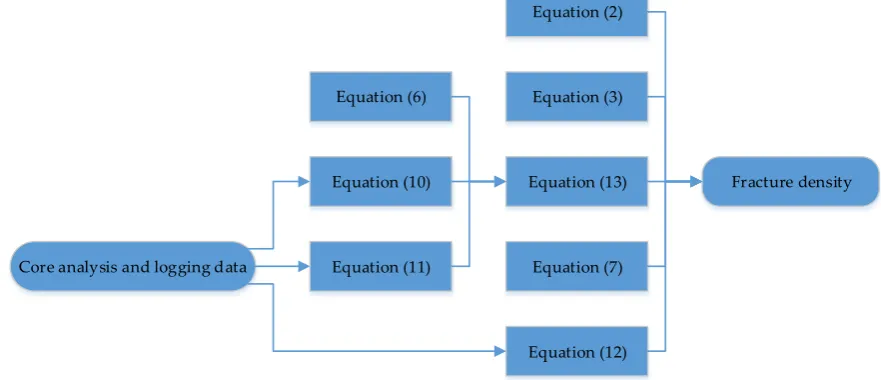
through solving the Eq. (2), Eq. (3), Eq. (7), Eq. (12), and Eq. (13), and the flowchart of the calculation
184
is illustrated in Fig. 3. According to the aforementioned analysis, we established the quantitative
185
prediction method of fracture density for the first time in this way.
186
Equation (2)
Equation (3)
Equation (13)
Equation (7)
Equation (12) Core analysis and logging data
Equation (10) Equation (6)
Equation (11)
Fracture density
187
Figure 3 Flowchart of the calculation
188
3. Application in Hudson Model for Crack
189
3.1 The quantitative prediction method of fracture density application analysis in Hudson Model for crack
190
The quantitative method above assumed that a sedimentary stratum consisted of a layered
191
skeleton and a layered fracture. However, fractured strata are often depictedwith the Hudson model
192
in seismic prospecting [40], in whichthe fracture is represented as a gap or inclusion with a thin
coin-193
shaped ellipsoid. It is feasible to predict the fracture density about the Hudson model by the new
194
method if the velocities about the fast S-wave and slow S-wave are acquired from the seismic data
195
processing and the RMS velocities about the P-wave and S-wave can be converted by some skills.
196
Actually speaking, the velocity group consisted of the four velocities above is just the seismic
197
responses about the given model, including the Hudson model and the other equivalent models,
198
which is the concrete links for predicting the fracture density about the Hudson model by the new
199
method based on the double-layer model. The stiffness tensor is the essential factor for the seismic
200
responses. Therefore, the new method can predict the fracture density of the Hudson model if the
201
parameters about the double-layer model can be determined by the stiffness tensor of the Hudson
202
model according to the Eq. (1), which can deduce the RMS velocities about the P-wave and S-wave.
203
The key for applying and verifying the new method to the Hudson model is how to represent the Eq.
204
the velocities about the double-layer model by the Hudson model parameters according to the Eq.
206
(1).
207
208
Figure 4. Hudson model for crack
209
Fig. 4 represents the Hudson model, in which black denotes the skeleton part and gray indicates
210
the fracture part. The physical parameters of the Hudson model are shown in Tab. 2, includingthe
211
P-wave velocity, the S-wave velocity, the density, and the volume of each part, which can depict the
212
stiffness tensor of the Hudson model at any crack width ratio (
H ). Meanwhile, the fracture density213
(
) is also defined by the volumetric proportion between the fracture part and the total part.214
Table 2 Physical parameters of the Hudson model for crack
215
P-wave velocity (m/s) S-wave velocity (m/s) Density (kg/m3) Volume (m3)
Skeleton part 1
H P
V
H1S
V
1H1
H
d
Fracture part 2
H P
V
2H S
V
2H
2H
d
According to above analysis, we consider that the
1,
2, and
of the double-layer model216
are equal to
1H ,
2H , and
H of the Hudson model, respectively. By adjusting theV
P1,V
S1,217
2
P
V
, andV
S2 to make the stiffness tensor of the double-layer model equals to the stiffness tensor of218
the Hudson model, and then the equivalent RMS velocities about the P-wave and S-wave of the
219
Hudson model can be obtained, which is the key for applying and verifying the new method to the
220
Hudson model. As a result, the above issue is converted to another form that is whether an unique
221
solution set of the
V
P1,V
S1,V
P2, andV
S2 is existence to make the stiffness tensor of thedouble-222
layer model equal to the stiffness tensor of the Hudson model.
223
3.2 Unique solution set determination
224
In order to obtain the unique solution set of the
V
P1,V
S1,V
P2, andV
S2, the components of225
the stiffness tensor (
c
13,c
33,c
44,c
66) of the double-layer model are used to represent the226
components of the stiffness tensor (
c
13H,H
c
33,c
44H ,c
66H) of the Hudson model, respectively, which is227
as follows:
228
2 66
66
1 1 2 44
44
1 1 2 2
2
33 33
1 1 2 13
13
2
1
S H
S H
P P
S H
P H
V
c
c
V
c
c
V
V
V
c
c
V
c
c
(14)
229
2 2 2 2 2 1 1 1 66 2 2 2 2 2 1 1 1 44 2 2 2 2 2 2 1 2 1 1 33 13 2 2 2 2 2 1 1 1 13
1
)
2
1
(
)
2
1
(
1
S S H S S H P S P S H H P P HV
f
V
f
c
V
f
V
f
c
V
V
f
V
V
f
c
c
V
f
V
f
c
(15)231
For further simplification, we have defined some intermediate variables shown in Eqs. (17), and
232
then Eqs. (15) can be rewritten:
233
2 2 1 1 4 2 2 1 1 3 2 2 2 1 1 1 2 2 2 1 1 12
2
1
S
b
S
b
y
S
a
S
a
y
P
S
f
P
S
f
y
P
a
P
a
y
(16)234
where235
Hc
y
13 11
, HH
c
c
y
33 132
, Hc
y
44 3
1
,y
4
c
66H236
1 1 1
f
a
,2 2
2
f
a
,b
1
f
1
1 ,b
2
f
2
2 (17)237
2 1 11
PV
P
, 22 2
1
PV
P
,S
1
V
S21,2 2
2
V
SS
238
There are two sets of solutions about the variables including the
S
1,S
2,P
1, andP
2 which239
has a certain relation with the
V
P1,
V
S1,
V
P2,
and
V
S2, respectively, through solving the Eqs. (16),240
and its expressions are as follows:
241
2 2 2 2 2 2 1 2
4 1 1 2 2 3 4 1 1 1 2 1 2 1 1 3 4 2 2 2 2 3 4 3 4
3 1'
1
2 2 2 2 2 2 1 2
2 2 1 1 3 4 1 1 1 2 1 2 1 1 3 4 2 2 2 2 3 4 3 4
2'
2 3
2 2 2 2 2' 1
1'
2 1 1' 1 2 2'
1
(
(
2
2
2
) )
2
(
2
2
2
)
2
2
2
y
a b
a b
y y
a b
a a b b
a b y y
a b
a b y y
y y
y
S
b
a b
a b
y y
a b
a a b b
a b y y
a b
a b y y
y y
S
b y
a y
a
f S y
P
a f S
a f S
P
1 2 1 1 1' 1
2'
2 1 1' 1 2 2'
2
2
2 2 2 2 2 2 1 2
4 1 1 2 2 3 4 1 1 1 2 1 2 1 1 3 4 2 2 2 2 3 4 3 4
3 1*
1
2 2 2 2 2 2 1 2
2 2 1 1 3 4 1 1 1 2 1 2 1 1 3 4 2 2 2 2 3 4 3 4
2*
2 3
2 2 2 2 2* 1
1*
2 1 1* 1 2 2*
1
(
(
2
2
2
) )
2
(
2
2
2
)
2
2
2
y
a b
a b
y y
a b
a a b b
a b y y
a b
a b y y
y y
y
S
b
a b
a b
y y
a b
a a b b
a b y y
a b
a b y y
y y
S
b y
a y
a
f S y
P
a f S
a f S
P
1 2 1 1 1* 1
2*
2 1 1* 1 2 2*
2
2
a y
a
f S y
a f S
a f S
244
(19)245
where apostrophe denotes the first set of solutions; asterisk represents the other set of solutions.
246
Substituting Eqs. (17) into Eqs. (18) and Eqs. (19), we can obtain:
247
2 2 66 66 2 2 2 66 2 2 2 1 2
66 44 2 1 1 2 1 2
2 44 44 44
1'
1 1
2 2 66 66 2 2 2 66 2 2 2 1 2
44 2 1 1 2 1 2
2 44 44 44
2'
2 2
2 2
2 1 2 1' 2 1 2 2' 1
1' 2
1
(
((
)
2(
)
(
) ) )
2
1
(
((
)
2(
)
(
) ) )
2
2(
)
H H H
H H
H H H
S
H H H
H
H H H
S
S S
P
c
c
c
c
c
f
f
f
f
f
f
c
c
c
V
f
c
c
c
c
f
f
f
f
f
f
c
c
c
V
f
f f V
f f V
V
f
213 2 33 2 2 2 2' 33
2 2
2 1 2 1' 2 1 2 2' 1
2' 2
1 13 1 33 1 1 1 1' 33
2
2(
)
2
H H H
S
S S
P H H H
S
c
c
f
f V
c
f f V
f f V
V
f c
c
f
f V
c
(20)248
2 2 66 66 2 2 2 66 2 2 2 1 2
66 44 1 2 1 2 1 2
2 44 44 44
1*
1 1
2 2 66 66 2 2 2 66 2 2 2 1 2
44 1 2 1 2 1 2
2 44 44 44
2*
2 2
2 2
2 1 2 1* 2 1 2 2* 1
1*
1
(
((
)
2(
)
(
) ) )
2
1
(
((
)
2(
)
(
) ) )
2
2(
)
H H H
H H
H H H
S
H H H
H
H H H
S
S S
P
c
c
c
c
c
f
f
f
f
f
f
c
c
c
V
f
c
c
c
c
f
f
f
f
f
f
c
c
c
V
f
f f V
f f V
V
f
22 13 2 33 2 2 2 2* 33
2 2
2 1 2 1* 2 1 2 2* 1
2* 2
1 13 1 33 1 1 1 1* 33
2
2(
)
2
H H H
S
S S
P H H H
S
c
c
f
f V
c
f f V
f f V
V
f c
c
f
f V
c
(21)249
According to the Appendix A, Eqs. (20) is not the reasonable solution for the
V
S21,V
S22,V
P21,250
and
V
P22 under the requirement that the S-wave velocity of the skeleton part (V
S21) should be larger251
than the S-wave velocity of the fracture part (
V
S22) in the actual situation. Hence, the Eqs. (21) is theonly solution for the
V
S21, 22
S
V
,V
P21, and2 2
P
V
. Moreover, it is obviously that there will be have 16253
sets of solutions for the
V
S1,V
S2,V
P1, andV
P2, due to the four parameters at the left of the Eqs.254
(21) are quadratic. Finally, the Eqs. (22) is the only solution about the Eqs. (21) with the positive
255
number, owing to the other solutions are eliminated under the actual situation that the seismic wave
256
velocities (
V
S1,V
S2,V
P1,V
P2)must be real numbers larger than zero, which is as follows:257
2 2 66 66 2 2 2 66 2 2 2 1 2
66 44 1 2 1 2 1 2
44 44 44
1*
1 1
2 2 66 66 2 2 2 66 2 2 2 1 2
44 1 2 1 2 1 2
44 44 44
2*
2 2
2 2
1 2 1* 2 1 2 2* 1
1*
2 1
1
(
((
)
2(
)
(
) ) )
2
1
(
((
)
2(
)
(
) ) )
2
2(
)
H H H
H H
H H H
S
H H H
H
H H H
S
S S
P
c
c
c
c
c
f
f
f
f
f
f
c
c
c
V
f
c
c
c
c
f
f
f
f
f
f
c
c
c
V
f
f f V
f f V
V
f c
23 2 33 2 2 2 2* 33
2 2
1 2 1* 2 1 2 2* 1
2* 2
1 13 1 33 1 1 1 1* 33
2
2(
)
2
H H H
S
S S
P H H H
S
c
f
f V
c
f f V
f f V
V
f c
c
f
f V
c
(22)
258
Based on the above analysis, there is a set of the P-wave and the S-wave velocities (
V
P1,V
P2,259
1
S
V
,V
S2) that make the stiffness tensor of the double-layer model and the stiffness tensor of the260
Hudson model equal. Meanwhile, the density of the skeleton part, the density of the fracture part,
261
and the fracture density of the two models are equal. Thus, the quantitative prediction method of
262
fracture density can be applied to the Hudson model.
263
4. Method Validation and Discussion
264
4.1 Validation model
265
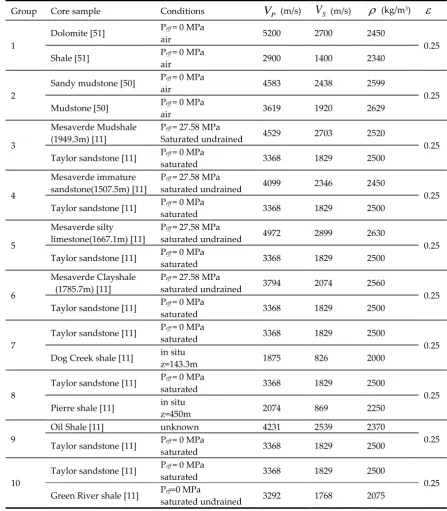
In order to examinethe effective ofthe quantitative prediction method of fracture density, ten
266
groups of test models are established to validate the prediction method of fracture density in Tab. 3.
267
Due to the assumptions that the rock skeleton layer and rock fracture layer of a medium are isotropic,
268
homogeneous, and linear elastic, etc. Ten groups of commercial numerical modelsare performed to
269
validate the application effect of the proposed method in this paper. Each group of test model
270
contains two different core samples. Moreover, the core sample with high velocity and density is
271
defined as a skeleton layer, and the low is defined as a fracture layer, which is conform to the
272
assumptions in Sec. 2.1. As a result, each group of model can be used as a double-layer model. Tab.
273
3 compiles and condenses the virtually published core samples to establish test models [11,50-51], in
274
which contains the core sample testing conditions and some related materials, including the P-wave
275
velocity (
V
P), the S-wave velocity (V
S), the density (
) and the fracture density (
).276
Table 3 The core sample parameters of models
278
Group Core sample Conditions
V
P (m/s)V
S (m/s)
(kg/m3)
1
Dolomite [51] Peff = 0 MPa
air 5200 2700 2450
0.25 Shale [51] Peff = 0 MPa
air 2900 1400 2340
2
Sandy mudstone [50] Peff = 0 MPa
air 4583 2438 2599
0.25 Mudstone [50] Peff = 0 MPa
air 3619 1920 2629
3
Mesaverde Mudshale (1949.3m) [11]
Peff = 27.58 MPa
Saturated undrained 4529 2703 2520
0.25 Taylor sandstone [11] Peff = 0 MPa
saturated 3368 1829 2500
4
Mesaverde immature sandstone(1507.5m) [11]
Peff = 27.58 MPa
saturated undrained 4099 2346 2450
0.25 Taylor sandstone [11] Peff = 0 MPa
saturated 3368 1829 2500
5
Mesaverde silty limestone(1667.1m) [11]
Peff = 27.58 MPa
saturated undrained 4972 2899 2630
0.25 Taylor sandstone [11] Peff = 0 MPa
saturated 3368 1829 2500
6
Mesaverde Clayshale (1785.7m) [11]
Peff = 27.58 MPa
saturated undrained 3794 2074 2560
0.25 Taylor sandstone [11] Peff = 0 MPa
saturated 3368 1829 2500
7
Taylor sandstone [11] Peff = 0 MPa
saturated 3368 1829 2500
0.25 Dog Creek shale [11] in situ
z=143.3m 1875 826 2000
8
Taylor sandstone [11] Peff = 0 MPa
saturated 3368 1829 2500
0.25 Pierre shale [11] in situ
z=450m 2074 869 2250
9
Oil Shale [11] unknown 4231 2539 2370
0.25 Taylor sandstone [11] Peff = 0 MPa
saturated 3368 1829 2500
10
Taylor sandstone [11] Peff = 0 MPa
saturated 3368 1829 2500
0.25 Green River shale [11] Peff=0 MPa
saturated undrained 3292 1768 2075
Abbreviations: Peff represents effective stress under triaxial compression; air denotes natural unsaturated state;
279
in situ indicates in-situ measurement.
280
4.2 Validation model forward
281
Tab. 3 provides ten groups of model, which are regard as the double-layer model. Thus, the
282
physical parameters of the models can be calculated according to the above Eqs. in Sec. 2. Tab. 4
283
shows the fast S-wave velocity (
V
Fast), the slow S-wave velocity (V
Slow), the P-wave RMS velocity (284
P
V
), the S-wave RMS velocity (V
S), the average density (
all), the coefficient a, and the coefficient b,285
which are calculated with the Eq. (2), Eq. (3), Eq. (6), Eq. (7), Eq. (12), Eq. (10), and Eq. (11), respectively.
286
Actually speaking, the fast S-wave velocity, slow S-wave velocity, P-wave RMS velocity, S-wave RMS
287
velocity of the prospecting stratum can be obtained from a conventional data processing of
288
coefficient b can be achieved from the core analysis and logging data of survey area. Finally, the
290
fracture density (
) is predicted by the method of fracture density through solving the Eq. (2), Eq.291
(3), Eq. (7), Eq. (12), and Eq. (13).
292
Table 4 The physical parameters of models
293
Group
V
Fast (m/s)V
Slow (m/s)V
P (m/s)V
S (m/s)
all (kg/m3) a b1 2450 2068 4480 2281 2423 1.622 1.793
2 2318 2272 4319 2296 2607 1.776 1.906
3 2514 2373 4204 2449 2515 1.727 1.845
4 2226 2179 3902 2204 2463 1.722 1.845
5 2681 2456 4507 2580 2598 1.761 1.845
6 2017 2002 3683 2010 2545 1.834 1.845
7 1669 1242 2900 1488 2375 1.845 1.709
8 1658 1316 2978 1509 2438 1.845 1.875
9 2375 2296 3996 2338 2402 1.653 1.845
10 1816 1805 3349 1814 2394 1.845 1.541
4.3 Results
294
According to the quantitative prediction method of fracture density in Sec. 2.5 and the
295
aforementioned physical parameters of models in Tab. 4, we can predict the fracture density (
).296
Moreover, we used the quasi-Newton method to solve the Eq. (2), Eq. (3), Eq. (7), Eq. (12), and Eq.
297
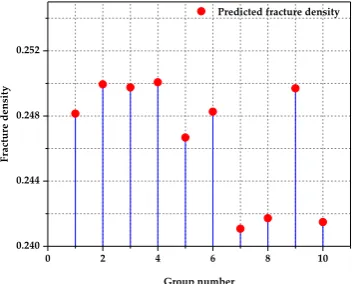
(13) for predicting the fracture density in this study. Fig. 5 shows the predicted values of the fracture
298
density (
'). It can be seen that the predicted fracture density is 0.24-0.25 for the ten models, which299
indicates the effective of the predicted values for the fracture density. The minimum value located in
300
the seventh model, with a value of about 0.241,and the maximum value, 0.249 is located in the fourth
301
model.
302
303
Figure 5. The predicted fracture density.
304
In addition to the predicted values for the fracture density, the root-mean-square error (RMSE)
305
and absolute relative deviation (ARD) were used as indexes to evaluate the prediction effects. The
306
smaller the root-mean-square (RMSE) and ARD were, the more favorable the prediction effect was.
307
The root-mean-square error (RMSE) was used to weight the deviation between the prediction result
308
and the actual value, and its calculation Eq. was Eq. (23).The ARD was usually used to evaluate the
309
accuracy of method through comparing the prediction value and the actual value. Its calculation Eq.
310
is Eq. (24), as follows:
311
0 2 4 6 8 10
0.240 0.244 0.248 0.252
Group number
Fra
cture
de
nsity
'
2 1n
i i i
RMSE
n
(23)312
'
100
i ii
ARD
i
1, 2,...,
n
(24)313
In Eq. (23) and Eq. (24),
i' represents the prediction fracture density;
i denotes the actual fracture314
density; and n indicates the number of the validation models.
315
316
Figure 6. The RMSE and ARD of the predicted fracture density.
317
Fig. 6 shows the results of RMSE and ARD. It was shown thatARD were less than 5% and RMSE
318
was 4.88×10⁻³. It indicated that the fracture density predicted by the method developed in this study
319
were in agreement with the actual data. The results demonstrated that the quantitative prediction
320
method proposed in this study was capable for predicting fracture density data.
321
In this study, for establishing a practical method to predict the fracture density quantitatively,
322
we assume that a thin interbedded medium is composed of two components: rock skeleton layer
323
(matrix) and rock fracture layer (including filling, water, oil, and gas), and the rock skeleton layer
324
and rock fracture layer of the thin interbedded medium are isotropic, homogeneous, and linear elastic,
325
etc., which is an idealized hypothesis. As a result, the thin interbedded medium can equivalent to the
326
double-layer medium under these assumptions. Actually speaking, these assumptions will involve
327
in deviation to this method, and the effect of these assumptions on the prediction method of fracture
328
density will be the focus in the future research. However, it is significant that the new method can
329
provide a scale in predicting the fracture density. Besides, the new method can be applied to the
330
Hudson model, and then the scope of the prediction method of fracture density is extended, which
331
is verified in Sec. 3.
332
Based on the above assumptions, the relationships between fracture density and the seismic
333
response is established. In Sec. 2.2-2.3, we use the fast S-wave velocity, the slow S-wave velocity, the
334
P-wave RMS velocity, and the S-wave RMS velocity as constraints to predict the fracture density,
335
which can be obtained from a conventional data processing of multicomponent seismic exploration.
336
Therefore, the processing quality of the multicomponent data will affect the application of the
337
prediction method for fracture density. Besides, only concerns the wave velocity as a function of
338
density in Sec. 2.4 is imprecise, which is to simplify the prediction method. In fact, the velocity is
339
related to several factors among which for instance the Young’s modulus. Moreover, there will be an
340
error in predicting the average density of a target layer by the core analysis and logging data. The
341
influence of these factors on the prediction results will be reported in the later article.
342
5. Conclusions
343
The accurate prediction of fracture density plays an important role in the exploration and
344
development of unconventional reservoirs which have received widespread interest in recent years.
345
0 2 4 6 8 10
-2 -1 0 1 2 3 4 5
Group number
A
R
D
(%
)
ARD
In this study, we consideredthat a thin interbedded medium is composed of the rock skeleton layer
346
and rock fracture layer, besides the rock skeleton layer and rock fracture layer are isotropic,
347
homogeneous, and linear elastic, etc. Under the above assumptions, the thin interbedded medium
348
can be equivalent to a double-layer medium, and then the relationships between the fracture density
349
and the physical parameters of a target layer, such as the fast S-wave velocity, the slow S-wave
350
velocity, the root mean square (RMS) velocity, and the density, were established, which makes up
351
the gap between the fracture density and the seismic response. While, a quantitative prediction
352
method for fracture density was proposed. Afterwards, the Hudson model was used to test the
353
applicability of this method. The result shown that the new method can be applied to the Hudson
354
model. Moreover, the quantitative prediction method of fracture density was used tothe ten groups
355
of validation model, in which RMSE and ARD were as the index of evaluation. The RMSE=4.88×10
-356
3 demonstrated that the fracture density predicted by the method developed in this study are in
357
satisfactory agreement with the actual data. Meanwhile, the ARD of the fracture density were less
358
than 5%, which indicated that this method can accurately predict fracture density. All in all, a
359
powerful method for predicting fracture density is proposed in this study, and the method can be
360
used topredict the fracture density of unconventionalreservoirs, which provided a new idea for the
361
study of reservoirs fracture.
362
Acknowledgments: This research is financially supported by the National Science and Technology Supporting
363
Program (2012BAB13B01), National Key Scientific Instrument and Equipment Development Program
364
(2012YQ030126), National Natural Science Foundation of China (41504041).
365
Author Contributions: Suping Peng was the director of the project. Dengke He proposed the idea of the method.
366
Liang Sun was responsible to build the method, models and write this draft. Shu Wang made some constructive
367
suggestions for the test data.
368
Conflicts of Interest: The authors declare no conflict of interest.
369
Nomenclature
370
a Coefficient between the P-wave velocity and the density for the skeleton layer (dimensionless)
b Coefficient between the P-wave velocity and the density for the fracture layer (dimensionless)
C Stiffness tensor (N/m2)
CH Stiffness tensor of Hudson model (N/m2)
d1 Volume of the skeleton (m3)
𝑑1𝐻 Volume of the skeleton in Hudson model (m3)
d2 Volume of the fracture (m3)
𝑑2𝐻 Volume of the fracture in Hudson model (m3)
f1 Volumetric proportion between the skeleton layer and the total layer (dimensionless)
f2 Volumetric proportion between the fracture layer and the total layer (dimensionless)
Peff Effective stress (MPa)
t1 Vertical propagation time of P-wave in the skeleton layer (s)
t2 Vertical propagation time of P-wave in the fracture layer (s)
VFast Fast S-wave velocity (m/s)
VG P-wave velocity in Gardner empirical formula (m/s)
VP P-wave velocity (m/s)
𝑉𝑃
̅̅̅ Root mean square velocity of P-wave (m/s)
𝑉𝑃1𝐻 P-wave velocity of the skeleton in Hudson model (m/s)
VP2 P-wave velocity of the fracture (m/s)
𝑉𝑃2𝐻 P-wave velocity of the fracture in Hudson model (m/s)
VS S-wave velocity (m/s)
𝑉̅𝑆 Root mean square velocity of S-wave (m/s)
VS1 S-wave velocity of the skeleton (m/s)
𝑉𝑆1𝐻 S-wave velocity of the skeleton in Hudson (m/s)
VS2 S-wave velocity of the fracture (m/s)
𝑉𝑆2𝐻 S-wave velocity of the fracture in Hudson (m/s)
VSlow Slow S-wave velocity (m/s)
Greek letters
371
𝛼 Fracture width ratio (dimensionless)
𝜀 Fracture density (dimensionless)
𝜀𝐻 Fracture density of Hudson model (dimensionless)
𝜀′ Prediction value of fracture density (dimensionless)
ρ Density (Kg/m3)
ρ1 Density of the skeleton (Kg/m3)
𝜌1𝐻 Density of the skeleton in Hudson model (Kg/m3)
ρ2 Density of the fracture (Kg/m3)
𝜌2𝐻 Density of the fracture in Hudson model (Kg/m3)
ρall Average density (Kg/m3)
ρG Density in Gardner empirical formula (Kg/m3)
References
372
1. Montgomery, S.L.; Jarvie D.M.; Bowker, K.A.; Pallastro, R.M. Mississippian Barnett shale, Fort Worthbasin,
373
north-central Texas: Gas-shale play with multitrillion cubic foot potential. AAPG Bulletin 2005, 90, 963-966,
374
doi: 10.1306/09170404042.
375
2. Dang, W.; Zhang, J.C.; Tang, X.; et al.Investigation of gas content of organic-rich shale: A case study from
376
Lower Permian shale in southern North China Basin, central China. Geoscience Frontiers 2018, 9, 559-575,
377
doi: 10.1016/j.gsf.2017.05.009.
378
3. Wang, Y.; Zhu, Y.M.; Liu, Y.; Chen, S.B. Reservoir characteristics of coal-shale sedimentary sequence in
379
coal-bearing strata and their implications for the accumulation of unconventional gas. Geoscience Frontiers
380
2018, 9, 559-575, doi.org/10.1016/j.gsf.2017.05.009. Journal of Geophysics and Engineering 2018, 15, 411-420,
381
doi: 10.1088/1742-2140/aa9a10.
382
4. Wang, X.Z.; Zhang, L.X.; Jiang, C.F.; Fan, B.J. Hydrocarbon storage space within lacustrine gas shale of the
383
Triassic Yanchang Formation, Ordos Basin, China. Interpretation 2015, 3, SJ15-SJ23, doi:
10.1190/INT-2014-384
0125.1.
385
5. Saidian, M.; Ghazanfari, M.H.; Masihi, M.; Kharrat, R. Five-spot injection/production well location design
386
based on fracture Geometrical Characteristics in Heavy Oil Fractured Reservoirs during Miscible
387
Displacement: An Experimental Approach. Chemical Engineering Communications 2012, 199, 306-320, doi:
388
10.1080/00986445.2011.577849.
389
6. Johansen, T.A.; Jensen, E.H.; Mavko, G.; Dvorkin, J. Inverse rock physics modeling for reservoir quality
390
prediction. Geophysics 2013, 78, M1-M18, doi: 10.1190/GEO2012-0215.1.
391
7. Far, M.E.; Hardage, B.; Wagner, D. Fracture parameter inversion for Marcellus Shale. Geophysics 2014, 79,
392
C55-C63, doi: 10.1190/GEO2013-0236.1.