Type of the Paper (Article)
1
A Unified Model for Salient Object Detection
2
Abdullah J. Alzahrani*, Hina Afridi
3
1
Affiliation
1;
[email protected]
, University of Ha’il, KSA
4
2
Affiliation
2;
[email protected]
, COMSATS University of Islamabad, Pakistan
5
* Correspondence: [email protected];
6
7
Abstract:
We propose a novel method for salient object detection in different images. Our method
8
integrates spatial features for efficient and robust representation to capture meaningful information
9
about the salient objects. We then train a conditional random field (CRF) using the integrated
10
features. The trained CRF model is then used to detect salient objects during the online testing
11
stage. We perform experiments on two standard datasets and compare the performance of our
12
method with different reference methods. Our experiments show that our method outperforms the
13
compared methods in terms of precision, recall, and F-Measure.
14
Keywords:
Salient object; local binary pattern; histogram features; conditional random field.
15
16
17
1. Introduction
18
Human eyes build on the ability to grab the interested regions accurately and rapidly in different
19
scenes. This ability is called visual attention mechanism or saliency mechanism. Saliency is inferred
20
from visual uniqueness, rarity, unpredictability, or surprise, which is often caused by variations of
21
characteristics in images such as illumination, gradient, textures, color, boundaries, and edges.
22
Traditional saliency detection methods consider different saliency cues. One of them is contrast,
23
which aims at analyzing the uniqueness of each image patch or image pixel with respect to local
24
contexts or global ones. On one hand, these methods usually fail to preserve object details. On the
25
other hand, they are often incapable to detect salient objects with large sizes. Itti et al. [1] computes
26
image saliency using centre-surround differences over multiple scales image features. Ma et al. [2]
27
evaluate saliency using color contrast in a neighborhood. Harel et al. [3] propose a graph based
28
saliency method, which normalizes different feature maps by the balance distribution of Markov
29
chains to present dominant regions. In [4][5], a hybrid model is proposed to detect salient regions.
30
For this purpose, they combine local low-level cues [6][7][8], global features [9][10], visual
31
organization rules [11], and high-level factors [12][13]. Xie et al. [14] consider local low-level features
32
[15] and mid-level cues [16][17] within the Bayesian framework to detect saliency. Wang et al. [18]
33
propose a bottom-up visual saliency detection algorithm. Zhang et al. [19] propose a novel
34
multi-scale spectral-spatial gradient based salient object detection method. Syed et al. [20] propose
35
an efficient and robust method for face detection on a 3D point cloud represented by a weighted
36
graph [21], Mu et al. [22] propose a novel deep neural network framework embedded with
37
covariance descriptor [23] for salient object detection in low-contrast images [24]. Ren et al. [25] take
38
color difference as the most important cue to detect salient objects. Peng et al. [26] propose a novel
39
structured matrix decomposition method [27][28] with two regularizations: (1) a tree-structured
40
sparsity-inducing regularization that absorbs the image structure [29] and enforces patches from the
41
same object to have similar saliency information, and (2) a Laplacian regularization [30] that
42
increases the gaps between salient objects and the background. Song et al. [31] propose a novel
43
depth-aware salient object detection and segmentation framework [32][33][40] via multiscale
44
discriminative saliency fusion and bootstrap learning for RGBD [34]. Hou et al. [35] present a deeply
45
supervised salient object detection with short connections.
46
Li et al. [36] Propose a novel deep neural network framework embedded with low-level features
47
(LCNN) [37][38] for salient object detection in complex images. Qu et al. [39] propose a new
48
convolutional neural network (CNN) [41] to automatically learn the interaction mechanism for
49
RGBD salient object detection. Chen et al. [42] presents a method for salient object detection. Their
50
method exploits spatial and temporal cues as well as a local constraint to achieve a global saliency
51
optimization. Liang et al. [43] extend the concept of salient object detection to material level based on
52
hyperspectral imaging and propose a material-based salient object detection method which can
53
distinguish objects with similar perceived color but different spectral responses. Xiao et al. [44]
54
propose a saliency detection model with a combination of superpixel segmentation and eye tracking
55
data. Wang et al. [45] propose a deep learning model [46] to efficiently detect salient regions in
56
videos. Fu et al. [47] present a method, spectral salient object detection, that aims at maintaining
57
objects holistically during pre-segmentation in order to provide more reliable feature extraction [48]
58
from a complete object region and to facilitate object-level saliency estimation.
59
60
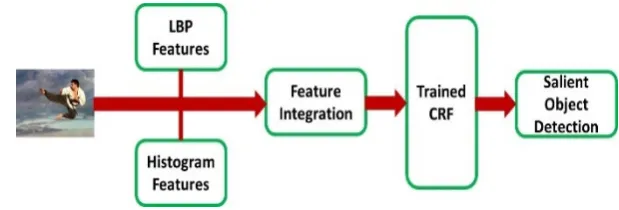
Figure 1.
We combne LBP feature and histogram features y exploiting our integration model that
61
transforms these features to a distinctive space. The trained CRF detect the salient object in an image.
62
To deal with the challenges of salient object detection, we propose a feature integration approach as
63
shown in Fig. 1. Our method is based on the following observations:
64
(a) The accuracy of the saliency maps is sensitive to the orientation and size of regions as the salient
65
objects may appear at different scales and orientations. The integration of different features can
66
improve its robustness.
67
(b) Our integration method detects different objects regardless of their orientations and sizes.
68
Moreover, our method uniformly highlights the contained regions.
69
(c) Considering huge training data comprising of different variations in terms of objects can improve
70
the performance of saliency maps.
71
The contribution of proposed method is the integration model for combining spatial features to
72
distinctively represent salient objects. Our method is composed of two major steps. Firstly, two
73
different spatial features are integrated together to extract and formulate unique features. Secondly,
74
these features are fed to the conditional random fields to learn the characteristics of salient object
75
during the training stage and detect the salient objects during the testing stage. The experimental
76
results demonstrate that our proposed method achieves very good performance in terms of
77
precision, recall, and F-Measure.
78
The rest of the paper is organized as follows. Section 2 presents the feature integration model. The
79
conditional random field (CRF) is presented in Section 3. In Section 4, the experimental results are
80
2. Feature Integration Model
82
According to Singh et al. [49], the LBP operator is defined for the gray scale images. The general
83
form of the operator for a circularly symmetric neighbor set of P members on a circle of radius R and
84
center (xc, yc), depicted by LBP {P, R} (xc, yc) is formulated:
85
86
87
(1)
88
89
90
In the equations, I(x, y) represents the intensity at pixel location (x, y) in the image I. For
91
calculation of LBP, 8 neighborhood pixels P = 8 of a pixel at (x, y) are exploited. This is a faster
92
approach to compute the LBP without considering a circular symmetry of the members which
93
requires interpolation. The general case of the LBP presents P equally spaced locations on a circle of
94
radius R and center (xc, yc) whose coordinates are formulated as:
95
96
97
(2)
98
99
It is stated that p =0, 1, ... , P-1. The intensities that do not confine to the original positions
100
are interpolated using bilinear interpolation. The parameter P computes the angular space between
101
neighbors and the parameters R computes the size of the window. The purpose of a grid is to depict
102
the locations of the neighbors which fall on the original positions of the pixels of the image I. It is
103
worth noticing that the LBP operator of Singh et al. [49] is based on the concept of dividing or
104
thresholding color pixels using a hyper-plane in m dimensions. Therefore, it is formulated as:
105
106
(3)
107
108
Where
109
(4)
110
111
The LBP operator considers texture patterns for a color image instead of considering gray scale
112
images. It treats a color pixel as a vector having m components and creates a hyperplane. This
113
hyperplane is exploited as a boundary to divide pixels into two classes. A color pixel in the
114
neighborhood is assigned a value 1 if it lies on or above the plane, and the value 0, otherwise.
115
Therefore, the LBP operator provides spatial relationship among color pixels, which represents local
116
texture features for salient object in the scene.
117
Salient object patterns have much information including color cues and orientation components
118
configurations. The spatial histogram features (SHF) [50] combine color cues and spatial structures.
119
Histogram is a global representation of salient object patterns, which is translation invariant. We
120
enlarge discrimination information in the histograms by two methods. First, we adopt color
121
extract salient object shape information. The spatial histogram is represented by the average spatial
123
histogram of salient object samples which is formulated as:
124
(5)
125
where Pj is an object sample, m(i) is the measurement and rect(x,y,w,h) is the spatial template.
126
The histogram feature is defined as the distance to the average histogram formulated as:
127
128
(6)
129
130
We integrate the two feature as formulated:
131
132
(7)
133
134
Our feature integration model transforms the features to a distinctive space. Therefore, the
135
integration represents high quality description of salient object in term of most distinctive
136
information. The integration models the evolving relative spatial relationships among parts of any
137
salient object present in a scene.
138
3. Conditional Random Field
139
The features we extracted are used to train conditional random field (CRF). Initially, a grid of particles is
140
disposed on the image plane. Each particle represents a block of pixels of predefined size. The extracted
141
features with the corresponding label sequence are used to learn the CRF parameters during the training stage,
142
and the salient objects are inferred on the test samples. The collected features are latched to build a feature
143
vector for each particle.
144
The goal of the feature filtering and identification is to isolate and filter out the features that would be
145
possible to contribute less if considered singularly, but that they do contribute to the detection of salient
146
objects if considered collectively.
147
A Conditional Random Field (CRF) is a discriminative technique exploited for labeling various structured
148
and unstructured data. It mentions the probability of a particular label sequence, given the observation
149
sequence. In general, x is our resultant sequence, comprising of N samples gathered within a sample set (i.e. x
150
= x
1, x
2, . . . , x
N), showing the extracted features. Provided the observation sequence, the CRF thus shows the
151
most probable label in terms of dominant feature, computing the output label y (y = y
1, y
2, . . . , y
M) of the
152
respective salient object, as formulated in the equation:
153
(8)
154
In the equation, F
j(x, y) is a feature function, which contains the mapping of input and output in the form of
155
F
j: X * Y -
R. In the CRF, each feature function provides the score for any output label y in the form of its
156
affiliation to the input observation feature x. The part of the equation that is the denominator in the above
157
(9)
159
Therefore, the function Z is working as a normalization element in the equation. Considering the extracted
160
features x, the corresponding label is formulated as:
161
162
(10)
163
For each j, we computer various F
jfunctions, depending on the parameter w
jand the provided input x. The
164
major target in getting the probabilistic score for each target label is that it is important to show the most
165
probable feature and label for each observation, which can detect the salient object as the scene dynamically
166
considering the entire dataset.
167
The objective of the training stage is to identify the proper magnitudes for the parameters w
j, so as to
168
increase and maximize the conditional probability of the training samples. To handle this problem, we explore
169
the stochastic gradient ascent to maximize the conditional log-likelihood (CLL) of the set of training samples,
170
which is formulated as:
171
(11)
172
Considering each weight parameter w
j, the partial derivative of CLL is analyzed for single training samples,
173
i.e., one weight for each feature function F
j. The partial derivative with respect to w
jrelates to the i-th
174
magnitude of the feature function for its targeted label y, minus the averaged magnitudes of the feature function
175
for all possible labels y. Therefore, the equation can be reformulated as:
176
(12)
177
For the computation purpose, we need to maximize the conditional log-likelihood by stochastic gradient
178
ascent, wj is updated according to the equation where alpha is the learning rate.
179
(13)
180
4. Experimental Results
181
We evaluate our method on two benchmark datasets namely MSRA-B [51] and SOD [52]. The MSRAB
182
dataset consists of 5000 images and all images are labeled with pixel-wise ground truth [52]. This dataset is
183
widely used for salient object detection. Most of the images comprise of only one salient object. The SOD
184
dataset contains 300 images. Pixel-wise ground truth annotations for salient objects are contributed by Jiang et
185
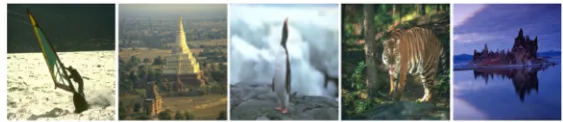
al. [52]. The images in SOD dataset consists of different salient objects of various sizes and positions. Five
186
sample images from MSRA-B and SOD datasets are depicted in Fig. 2 and Fig. 3, respectively.
187
189
Figure 2.
MSRA-B dataset. Five sample images from MSRA-B dataset are depicted where salient objects are
190
localized in the center of the images.
191
192
Figure 3.
SOD dataset. Five sample images from SOD dataset are depicted where salient objects are localized
193
in the center of the images.
194
195
We present quantitative results of our method on the two datasets and compare them with SIFT features
196
[53], LBP features [49] only, and SHF [50] features only. We consider three performance metrics namely
197
precision, recall, and F-Measure to extensively evaluate the experimental results. The results in terms of
198
precision, recall, and F-Measure for the reference methods and our proposed method are presented in Table 1.
199
Our proposed method outperforms all the reference methods considering the three performance metrics. For the
200
individual features SIFT, LBP, and temp, we used the same set of training data to maintain consistency with
201
our model.
202
Table 1.
Precision. The precision of our proposed method is higher than other reference methods.
203
Therefore, our method outperforms in salient object detection considering the two datasets.
204
Datasets
SIFT
LBP
SHF
Our
MSRA-B
0.48
0.53
0.58
0.78
SOD
0.51
0.57
0.54
0.77
205
5. Conclusions
206
We proposed a novel method for salient object detection in images. Our method represented high quality
207
description of salient objects in term of most distinctive information. The performance of our proposed
208
method is evaluated on two datasets and compared to different reference methods. The performance metrics
209
precision, recall, and F-Measure show that our method outperformed the reference methods.
210
As a future work, we would also extend our proposed method to detect various other salient objects by
211
considering more datasets.
212
Author Contributions: Both authors contributed equally.
213
Funding: This research is supported by the University of Ha’il, Ha’il, Kingdom of Saudi Arabia.
214
Conflicts of Interest: There is no conflict of interest.
215
References
216
[1] Itti, L., Koch, C., & Niebur, E. (1998). A model of saliency-based visual attention for rapid scene analysis. IEEE Transactions on
217
Pattern Analysis & Machine Intelligence, (11), 1254-1259.
[2] Ma, Y. F., & Zhang, H. J. (2003, November). Contrast-based image attention analysis by using fuzzy growing. In Proceedings of
219
the eleventh ACM international conference on Multimedia (pp. 374-381). ACM.
220
[3] Harel, J., Koch, C., & Perona, P. (2007). Graph-based visual saliency. In Advances in neural information processing systems (pp.
221
545-552).
222
[4] Goferman, S., Zelnik-Manor, L., & Tal, A. (2012). Context-aware saliency detection. IEEE transactions on pattern analysis and
223
machine intelligence, 34(10), 1915-1926.
224
[5] Ahmad, K., Conci, N., & De Natale, F. G. (2018). A saliency-based approach to event recognition. Signal Processing: Image
225
Communication, 60, 42-51.
226
[6] Ullah, H., Altamimi, A. B., Uzair, M., & Ullah, M. (2018). Anomalous entities detection and localization in pedestrian flows.
227
Neurocomputing, 290, 74-86.
228
[7] Saqib, M., Khan, S. D., Sharma, N., & Blumenstein, M. (2017, December). Extracting descriptive motion information from crowd
229
scenes. In 2017 International Conference on Image and Vision Computing New Zealand (IVCNZ) (pp. 1-6). IEEE.
230
[8] Khan, W., & Ullah, H. (2010). Authentication and Secure Communication in GSM, GPRS, and UMTS Using Asymmetric
231
Cryptography. International Journal of Computer Science Issues (IJCSI), 7(3), 10.
232
[9] Saqib, M., Khan, S. D., & Blumenstein, M. (2016, November). Texture-based feature mining for crowd density estimation: A study.
233
In Image and Vision Computing New Zealand (IVCNZ), 2016 International Conference on (pp. 1-6). IEEE.
234
[10] Ullah, H., Ullah, M., & Uzair, M. (2018). A hybrid social influence model for pedestrian motion segmentation. Neural Computing
235
and Applications, 1-17.
236
[11] Bisagno, N., Zhang, B., & Conci, N. (2018, September). Group LSTM: Group Trajectory Prediction in Crowded Scenarios. In
237
European Conference on Computer Vision (pp. 213-225). Springer, Cham.
238
[12] Ahmad, F., Khan, A., Islam, I. U., Uzair, M., & Ullah, H. (2017). Illumination normalization using independent component analysis
239
and filtering. The Imaging Science Journal, 65(5), 308-313.
240
[13] Ullah, H., Uzair, M., Ullah, M., Khan, A., Ahmad, A., & Khan, W. (2017). Density independent hydrodynamics model for crowd
241
coherency detection. Neurocomputing, 242, 28-39.
242
[14] Xie, Y., Lu, H., & Yang, M. H. (2013). Bayesian saliency via low and mid level cues. IEEE Transactions on Image Processing,
243
22(5), 1689-1698.
244
[15] Trabelsi, R., Jabri, I., Melgani, F., Smach, F., Conci, N., & Bouallegue, A. (2017, November). Complex-Valued Representation for
245
RGB-D Object Recognition. In Pacific-Rim Symposium on Image and Video Technology (pp. 17-27). Springer, Cham.
246
[16] Ullah, M., Ullah, H., & Alseadonn, I. M. (2017). Human action recognition in videos using stable features.
247
[17] Xu, M., Ge, Z., Jiang, X., Cui, G., Zhou, B., & Xu, C. (2019). Depth Information Guided Crowd Counting for Complex Crowd
248
Scenes. Pattern Recognition Letters.
249
[18] Wang, J., Lu, H., Li, X., Tong, N., & Liu, W. (2015). Saliency detection via background and foreground seed selection.
250
Neurocomputing, 152, 359-368.
251
[19] Zhang, L., Zhang, Y., Yan, H., Gao, Y., & Wei, W. (2018). Salient object detection in hyperspectral imagery using multi-scale
252
spectral-spatial gradient. Neurocomputing, 291, 215-225.
253
[20] El Sayed, A. R., El Chakik, A., Alabboud, H., & Yassine, A. (2017). 3D face detection based on salient features extraction and skin
254
colour detection using data mining. The Imaging Science Journal, 65(7), 393-408.
255
[21] Alameda-Pineda, X., Ricci, E., & Sebe, N. (2019). Multimodal behavior analysis in the wild: An introduction. In Multimodal
256
Behavior Analysis in the Wild (pp. 1-8). Academic Press.
257
[22] Mu, N., Xu, X., Zhang, X., & Zhang, H. (2018). Salient object detection using a covariance-based CNN model in low-contrast
258
images. Neural Computing and Applications, 29(8), 181-192.
259
[23] Ullah, M., Ullah, H., Conci, N., & De Natale, F. G. (2016, September). Crowd behavior identification. In Image Processing (ICIP),
260
2016 IEEE International Conference on(pp. 1195-1199). IEEE.
261
[24] Kim, H., Han, J., & Han, S. (2019). Analysis of evacuation simulation considering crowd density and the effect of a fallen person.
262
Journal of Ambient Intelligence and Humanized Computing, 1-11.
263
[25] Ren, Y., Wang, Z., & Xu, M. (2017). Learning-based saliency detection of face images. IEEE Access, 5, 6502-6514.
264
[26] Peng, H., Li, B., Ling, H., Hu, W., Xiong, W., & Maybank, S. J. (2017). Salient object detection via structured matrix
265
decomposition. IEEE transactions on pattern analysis and machine intelligence, 39(4), 818-832.
266
[27] Hao, Y., Xu, Z. J., Liu, Y., Wang, J., & Fan, J. L. (2019). Effective crowd anomaly detection through spatio-temporal texture
267
analysis. International Journal of Automation and Computing, 16(1), 27-39.
268
[28] Ullah, H., Ullah, M., Afridi, H., Conci, N., & De Natale, F. G. (2015, September). Traffic accident detection through a
269
hydrodynamic lens. In Image Processing (ICIP), 2015 IEEE International Conference on (pp. 2470-2474). IEEE.
270
[29] Shimura, K., Khan, S. D., Bandini, S., & Nishinari, K. (2016). Simulation and Evaluation of Spiral Movement of Pedestrians:
271
Towards the Tawaf Simulator. Journal of Cellular Automata, 11(4).
272
[30] Ullah, H. (2015). Crowd Motion Analysis: Segmentation, Anomaly Detection, and Behavior Classification (Doctoral dissertation,
273
University of Trento).
274
[31] Song, H., Liu, Z., Du, H., Sun, G., Le Meur, O., & Ren, T. (2017). Depth-aware salient object detection and segmentation via
275
multiscale discriminative saliency fusion and bootstrap learning. IEEE Transactions on Image Processing, 26(9), 4204-4216.
276
[32] Kang, D., Ma, Z., & Chan, A. B. (2018). Beyond counting: Comparisons of density maps for crowd analysis tasks-counting,
277
detection, and tracking. IEEE Transactions on Circuits and Systems for Video Technology.
278
[33] Rota, P., Ullah, H., Conci, N., Sebe, N., & De Natale, F. G. (2013, September). Particles cross-influence for entity grouping. In
279
Signal Processing Conference (EUSIPCO), 2013 Proceedings of the 21st European (pp. 1-5). IEEE.
280
[34] Ullah, H., Ullah, M., & Conci, N. (2014, March). Real-time anomaly detection in dense crowded scenes. In Video Surveillance and
281
Transportation Imaging Applications 2014(Vol. 9026, p. 902608). International Society for Optics and Photonics.
282
[35] Hou, Q., Cheng, M. M., Hu, X., Borji, A., Tu, Z., & Torr, P. H. (2017). Deeply supervised salient object detection with short
283
connections. In Proceedings of the IEEE Conference on Computer Vision and Pattern Recognition (pp. 3203-3212).
284
[36] Li, H., Chen, J., Lu, H., & Chi, Z. (2017). CNN for saliency detection with low-level feature integration. Neurocomputing, 226,
285
212-220.
[37] Arif, M., Daud, S., & Basalamah, S. (2013). Counting of people in the extremely dense crowd using genetic algorithm and blobs
287
counting. IAES International Journal of Artificial Intelligence, 2(2), 51.
288
[38] Ullah, M., & Alaya Cheikh, F. (2018). A Directed Sparse Graphical Model for Multi-Target Tracking. In Proceedings of the IEEE
289
Conference on Computer Vision and Pattern Recognition Workshops (pp. 1816-1823).
290
[39] Qu, L., He, S., Zhang, J., Tian, J., Tang, Y., & Yang, Q. (2017). RGBD salient object detection via deep fusion. IEEE Transactions
291
on Image Processing, 26(5), 2274-2285.
292
[40] Khan, W., Ullah, H., & Hussain, R. (2013). Energy-Efficient Mutual Authentication Protocol for Handhled Devices Based on
293
Public Key Cryptography. International Journal of Computer Theory and Engineering, 5(5), 754.
294
[41] Ullah, M., Mohammed, A., & Alaya Cheikh, F. (2018). PedNet: A Spatio-Temporal Deep Convolutional Neural Network for
295
Pedestrian Segmentation. Journal of Imaging, 4(9), 107.
296
[42] Chen, Y., Zou, W., Tang, Y., Li, X., Xu, C., & Komodakis, N. (2018). SCOM: Spatiotemporal constrained optimization for salient
297
object detection. IEEE Transactions on Image Processing, 27(7), 3345-3357.
298
[43] Liang, J., Zhou, J., Tong, L., Bai, X., & Wang, B. (2018). Material based salient object detection from hyperspectral images. Pattern
299
Recognition, 76, 476-490.
300
[44] Xiao, F., Peng, L., Fu, L., & Gao, X. (2018). Salient object detection based on eye tracking data. Signal Processing, 144, 392-397.
301
[45] Wang, W., Shen, J., & Shao, L. (2018). Video salient object detection via fully convolutional networks. IEEE Transactions on
302
Image Processing, 27(1), 38-49.
303
[46] Khan, Sultan Daud, and Habib Ullah. "A survey of advances in vision-based vehicle re-identification." Computer Vision and Image
304
Understanding (2019).
305
[47] Fu, K., Gu, I. Y. H., & Yang, J. (2018). Spectral salient object detection. Neurocomputing, 275, 788-803.
306
[48] Ullah, Habib, Muhammad Uzair, Arif Mahmood, Mohib Ullah, Sultan Daud Khan, and Faouzi Alaya Cheikh. "Internal Emotion
307
Classification Using EEG Signal with Sparse Discriminative Ensemble." IEEE Access (2019).
308
[49] Singh, C., Walia, E., & Kaur, K. P. (2018). Color texture description with novel local binary patterns for effective image retrieval.
309
Pattern Recognition, 76, 50-68.
310
[50] Zhang, H., & Zhao, D. (2004, November). Spatial histogram features for face detection in color images. In Pacific-Rim Conference
311
on Multimedia (pp. 377-384). Springer, Berlin, Heidelberg.
312
[51] Liu, T., Yuan, Z., Sun, J., Wang, J., Zheng, N., Tang, X., & Shum, H. Y. (2011). Learning to detect a salient object. IEEE
313
Transactions on Pattern analysis and machine intelligence, 33(2), 353-367.
314
[52] Jiang, H., Wang, J., Yuan, Z., Wu, Y., Zheng, N., & Li, S. (2013). Salient object detection: A discriminative regional feature
315
integration approach. In Proceedings of the IEEE conference on computer vision and pattern recognition (pp. 2083-2090).
316
[53] Lowe, D. G. (2004). Distinctive image features from scale-invariant keypoints. International journal of computer vision, 60(2),
317
91-110.