IJEDR1602168
International Journal of Engineering Development and Research (www.ijedr.org)963
Human Opinion Dynamics Used for Efficient
Multiple Object Tracking
1Alisha Johar, 2Parvinder Kaur 1Student, 2Assistant Professor
1, 2Dept. of Computer Science and Engineering, S.U.S.C.E.T, Punjab, India
________________________________________________________________________________________________________
Abstract - Object tracking is a technique that is being used from past centuries. This technique includes an application called surveillance that helps to detect the threats on public places that may be the crowded public place or a mall or public transport with the help of CCTV cameras. In the object tracking process the object is considered to be in motion if its location is changing with respect to its background. This paper propose a system using human opinion dynamics tuned particle filter that detects the motion and to compare its results with the performance with former systems.
Keywords - Object Tracking, Particle Filter, Computer Vision, Optimization
________________________________________________________________________________________________________
I. INTRODUCTION
Now day’s vision based techniques area unit used for tracking several objects. But it's still a difficult task for a few reasons like occlusion or incomplete foreground extraction. It's thus essential to adopt few probabilistic models with some learning method to discover and track the item. During this, a way is introduced to trace multiple objects mistreatment each the background modeling and particle filter. Particle filter has one among a way for tracking objects mistreatment color. Several researchers have used the particle filter for several object tracking. Pan et al. proposed the best particle allocation in mistreatment particle filter to trace several objects. Kenji et al. used the particle filter for tracking of various players in hockey match. Since the particle filter is to estimate the posterior density of state variables provided observation variables, the performance of filter may be degenerated relying upon importance sampling method. To avoid this issue, specializing in the item of interest is important. Some techniques area unit devised to the present finish and that they embrace background modeling to extract foreground or mistreatment colour data to target involved object. A number of illustrious techniques of background modeling include the Gaussian average, kernel density estimation, Gaussian mixture model. Particle filter uses color data for tracking objects.
The problem of tracking multiple non-stationary positions, i.e. together estimate the quantity of targets and individual states, directly from the video information during not the requirement for detection. Most of the multi-target tracking approaches for video information include detection operation to take the purpose measurements before multi-target filtering is applied. This popular target tracking algorithm that doesn't need color-based visual trailing, detection embodies woody plant, multi-modal distribution, theorem existence method. In theory, the detection incurs data loss which may considerably degrade trailing performance, particularly in the low signal to noise magnitude relation. Tracking process directly from the video information is of elementary interest because it ignores this kind of knowledge loss. A later approach to the multi-target trailing that has been attracted substantial interest is that the random finite set of framework. This is impelled by elementary thought in the estimation theory or estimation error. This approach displays the set of target states, called as target state, as a finite set. RFS multi-target filtering techniques such as particle chance hypothesis density and mathematician mixture filters which are applied to tracking from the video information via detection. RFS-based techniques are used for tracking various targets directly from the video information that has been investigated with success incontestable on tracking of sport players. However, like several detection free strategies, this system requires previous data concerning the visual look of required targets that are either obtained from the coaching information. There has a tendency to associate the degree of RFS-based algorithmic program for tracking of several non-stationary objects from video information which requires neither detection nor previous data on right track visual look. This technique is a combination of multi- Bernoulli filtering and kernel density estimation. Victimization kernel density estimation algorithmic program updates and learns the background that is deducted from the video frames yielding grey-scale foreground pictures. The tractable multi-target activity model for ensuing grey-scale foreground image is projected that permits the sequence of grey-scale foreground pictures to be processed directly by multi-Bernoulli filter projected. Preliminary results are rumoured. This correspondence presents a lot of complete study, along with improved answer. Case studies from the caviar information set display improved performance of accuracy and machine value, compared to later tracking strategies that use background subtraction.
IJEDR1602168
International Journal of Engineering Development and Research (www.ijedr.org)964
temporal window, given bound the international constraints. Such ways use offline detectors to search out targets and associate them with tracks. Though they'll handle several difficulties like uncertainty within range of targets, model drift and occasional occlusions in long term; they still suffer once moon-faced with the look changes and occlusion. Especially, once tracking crowd of pedestrians, the information association typically fail within the said approaches because of develop variations, background changes and partial occlusions. During this work, a tendency to address the difficulties by proposed a part-based illustration in tracking-by-detection framework. Whereas the deformable part-based model is displayed glorious performance in the static pictures, however it's not been absolutely explored in tracking issue.II. RELATED WORK
AsmaAzim and Olivier Aycardet al. In this paper, the reliable perception of the surrounding environment is a very important step for an intelligent vehicle. . The proposed approach uses an octree based occupancy grid map- ping of the environment in 3D.Weiming Hu, Tieniu Tan, et al. In this paper author compare the Visual surveillance in dynamic scenes, especially for humans and vehicles, is currently one of the most active research topics in computer vision JeromeBerclaz, et al. In this paper Multi-object tracking can be achieved by detecting objects in individual frames and then linking detections across frames. Philip Lenz, Julius Ziegler et al. In this paper modern driver assistance systems such as collision avoidance or intersection assistance need reliable information on the current environment. Extracting such information from camera-based systems is a complex and challenging task for inner city traffic scenarios. This paper presents an approach for object detection utilizing sparse scene flow
Boris Kluge Christian Kohler Erwin Prassler et al .In this paper we focus on the task of tracking multiple moving objects in
rapidly changing, dynamic environments. Objects are extracted from laser range finder images and correspondences between successive images are established by network optimization techniques. The approach is implemented on a robotic wheelchair, used in two applications and evaluated experimentally Tao Zhao, Ram Nevatia et al. In this paper tracking of humans in dynamic scenes has been an important topic of research. This paper present a method that can track humans in crowded environments, with significant and persistent occlusion by making use of human shape models in addition to camera models, the assumption that humans walk on a plane and acquired appearance models. Experimental results and a quantitative evaluation are included Shih-Chia Huangetal. In this research paper object detection is detecting the moving objects from a particular scene of random video. A. Amer, E. Duboisetal. In this paper object tracking is an essential component of an intelligent video surveillance system A.McIvoret al. In this research paper background subtraction model can be used for detecting multiple objects having different color contrasts. There are various filters that can be used for subtraction of background in real time object tracking i.e. mean shift and kalman filters. Thresholding technique is the widest used technique for extracting the background and foreground of the image. In this method unnecessary details can be removed from that image and can easily extract the required things from a real time image.
Rajabi and Nahvi [16] proposed a modified contour-based multiple object tracking algorithm using point processing. This approach has the advantage of multiple objects tracking. Their system can detect and track the peoples in indoor environments videos. In their method they have used Gaussian mixture model (GMM) based background modeling for background estimation. Tao Yang, Stan Z.Li, Quan Pan, Jing Li In this research paper dynamics scenes are used for real time multiple object tracking.
III. METHODOLOGY
Decision making is a process of an individual in a society which is governed by his own considerations or the opinions of others. Opinions are formed by the direct or indirect influence of cultural interactions, norms and mass media. Social influence is a combined effect of these influences, due to these, individuals act in accordance to the expectations and beliefs of others. This forms the third rudiment of an algorithm. However, for simplicity of the modeling, only local dynamics representing is a social influence which has been considered in this work. Therefore, the social influence has been formulated by considering two factors example distance between two individuals and the social ranking of the individuals 11. The social ranking of the individuals is determined by their respective fitness values. These fitness values are the output values of an objective function to be minimized. The individual with minimum fitness value is assigned the largest SR, the highest possible SR being the number of individuals. The individuals with same fitness values are assigned the same SR.
IJEDR1602168
International Journal of Engineering Development and Research (www.ijedr.org)965
Fig.1: CODO schemaThe proposed optimizer has been tested on benchmark functions for 10 and 30 dimensions or compared with local best PSO, one of the variants of popular PSO. A best PSO has been selected for comparison due to its related structural similarity to the proposed algorithm; in general, the proposed algorithm runs better as compared to best PSO. The algorithm has been investigated for effects of disintegrative forces in the society. The conclusion suggests that, the interplay or balance of integrative and disintegrative forces in the society may be utilized for solving the complex mathematical problems.
IV. RESULTS
The experimental results display the tracking information of several objects when there is similar color object placed in background. Results are accepted from both methods of one is background subtraction and second is without subtracting background. Results show the without background subtraction in particles that are disturbed because of presence of yellow strip in background. It displays the phenomenon in other particles which are spreading too much. It shows the obtained conclusion with background subtraction in all the particles which are on the object. When the background is subtracted, apart from disturbance due to existence of similar colored object in background has removed and particles focus only on foreground. In another problem of particle filter is to specify the accurate blob’s centroid value. The blob’s centroid value has affected by minimum variation of light. If blob’s centroid value, which has not specified correctly, the particles can be disturbed because of taking equivalent weight in particles that are spreading too much because of few blob’s centroid values exist in the background. In this, problem can minimized because the particles can get the weight either from foreground or 0 from the background. As there is high difference in weight so particles can be moved on object.
Fig.2 Frames with detected and tracked objects
IJEDR1602168
International Journal of Engineering Development and Research (www.ijedr.org)966
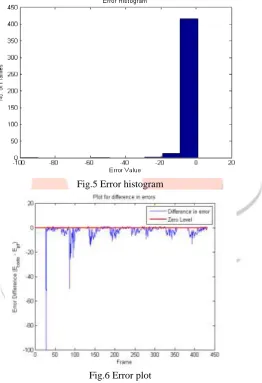
Fig.4 Frames representing the continuity of the tracked objectsFigure 5 is an error histogram for error differences in terms of pixels for each frame. Error histogram gives the distribution of error. If the mean is less than 0 then the proposed method has less error than the base method. This is because Error=Error(HOD) - Error(MLE).
Fig.5 Error histogram
Fig.6 Error plot V. CONCLUSION
Utilizing the human opinion dynamic, we introduce an enhancing dynamic optimization into particle filtering for multiple object tracking. It combines opinion operator into continuous dynamic optimizer. Optimization-seeking procedure of human opinion dynamic can shift particles to the local maxima of the subsequent density and reduce implicitly the particle failure problem at the same time. The experimental results on multiple target or object tracking with noises demonstrate that compared to the conventional particle filter, the proposed algorithm can produce more robust tracking and has smaller computation cost.
The experiments demonstrate that the proposed method has performed well in some complex scene. In future, we need to enhance the efficiency of the Human Opinion Dynamic algorithm in the particle filter so as to guide the particles to distribute reasonably when occlusion occurs, which is our next research.
REFERENCES
IJEDR1602168
International Journal of Engineering Development and Research (www.ijedr.org)967
[2] I.Haritaoglu, D.Harwood, and L.S.Davis, W4: real-time surveillance of people and their activities. IEEE Transactions onPattern Analysis and Machine Intelligence, Aug. 2000.
[3] Shih-Chia Huang,” An Advanced Motion Detection Algorithm with Video Quality Analysis for Video Surveillance Systems” IEEETRANSACTIONS ON CIRCUITS AND SYSTEMS FOR VIDEO TECHNOLOGY, JANUARY 2011. [4] PritiP.Kuralkar, Prof. V.T.Gaikwad,” Human Object Tracking using Background Subtraction and Shadow Removal
Techniques,” in International Journal of Advanced Research in Computer Science and Software Engineering, 2012. [5] A. Yilmaz, O. Javed and M. Shah,”Object Tracking: A Survey” in ACM Journal of Computing Surveys,” 2006.
[6] PritiP.Kuralkar, Prof. V.T.Gaikwad,” Human Object Tracking using Background Subtraction and Shadow Removal Techniques,” in International Journal of Advanced Research in Computer Science and Software Engineering, 2012. [7] M. Hedayati, Wan Mimi Diyana Wan Zaki, AiniHussain, “AQualitative and Quantitative Comparison of Real-time
Background Subtraction Algorithms for Video Surveillance Applications” Journal of Computational Information Systems “, 2012.
[8] Zhifang L. and Zhisheng Y., “A Real-Time Vision-Based Vehicle Tracking and Traffic Surveillance,” in Proceedings of the International Conference on Software Engineering, Artificial Intelligence, Networking, and Parallel/Distributed Computing, Qingdao, 2007.
[9] S. S. Blackman, “Multiple hypothesis tracking for multiple target tracking,” Aerospace and Electronic Systems Magazine, IEEE, 200
J. Ferryman, “Eleventh ieee international workshop on performance evaluation of tracking and surveillance,” in Proc. IEEE Int., 2009.
[10]A. Bobick and J. Davis, The Recognition of Human Movements Using Temporal Templates, IEEE Transactions on Pattern Analysis and Machine Intelligence, March 2001.
[11]A. K. Jain, A. Ross, S. Prabhakar, An Introduction to Biometric Recognition, IEEE Transactions on Circuit and Systems for Video Technology, Special Issue on Image- and Video-Based Biometrics, January 2004.
[12]W.Y. Yoo and J.Lee: Analysis of Camera Operations in Compressed Domain based on Generalized Hough Transform. Proceedings of IEEE Pacific Rim Conference on Multimedia, 2001.
[13] H. Kartik, D. Schonfeld, P. Raffy, F. Yassa: Object Tracking Using Block Matching. IEEE conference on Image Processing Jul 2003.
[14]M. Fotouhi, A. R. Gholami, S. Kasaei, "Particle filter-based object tracking using adaptive histogram," IEEE international Conference of Machine Vision and image Processing, 2011.