R e v e r s i b l e d e l a y e d l e x i c a l c h o i c e in a b i d i r e c t i o n a l f r a m e w o r k
G r a h a m W i l c o c k *
C e n t r e f o r C o m p u t a t i o n a l L i n g u i s t i c s U n i v e r s i t y o f M a n c h e s t e r I n s t i t u t e
o f S c i e n c e a n d T e c h n o l o g y P O B o x 88, M a n c h e s t e r M 6 0 1 Q D
U n i t e d K i n g d o m grahamOccl, u m i s t , a c . uk
Y u j i M a t s u m o t o
G r a d u a t e S c h o o l o f I n % r m a t i o n S c i e n c e N a r a I n s t i t u t e o f S c i e n c e a n d % c h n o l o g y 8 9 1 6 - 5 T a k a y a m a , I k o m a , N a r a 6 3 0 - 0 1
, J a p a n
m a t s u ~ i s , a i s t - n a r a , a c . j p
A b s t r a c t
We describe a bidirectional framework for natural language parsing and genera- tion, using a typed feature formalism and an HPSG-based grammar with a parser and generator derived from parallel pro- cessing algorithms. We present an ap- proach to delayed lexical choice in gener- ation, based on subsumption within the sort hierarchy, using a lexicon of nnder- instantiated signs which at'(; derived fi'om the normal lexicon by lexical rules. We then show how delayed lexical choice can be used in parsing, so that some types of ill-formed inputs can be parsed, but well- formed outputs are generated, using the same shared linguistic information.
1 A b i d i r e c t i o n a l f r a m e w o r k
In our bidirectional framework for a natural lan- guage engine, the linguistic descriptions in the grammar and lexicon are shared resources which are used, in appropriately compiled forms, for both parsing and generation. Like the Core Lan- guage Engine (CLE) (Alshawi, 1992), we use a unification-based phrase structure grammar, a logical form representation, a bottom-up chart parser and a semantic head-driven generation al- gorithm. However, we (lifter from CLE by exploit- ing recent developments in processing algorithms and in linguistic representation formalisms. We will clarify the similarities and differences at; the relevant points.
1.1 Processing algorithms
The SAX parser is a concurrent SICStus Prolog implementation of the PAX parallel pro'sing algo- rithm (Matsutnoto and Sugimura, 1987; Matsu- moto et al., 1994). Like the earlier BUP parser to which the CLE parser was closely related, SAX uses partial execution to compile the gramlnar for efficient bottom-up parsing. However, instead of
*Visiting researcher of Information Systems Prod- uct Development Lalmratories, Sharp Corporation.
building the chart by asserting edges into the Pro- log database, SAX implements the chart by cre- ating concurrent processes. For compiled rather than interpreted Prolog systems, this is a highly etficient form of chart, parsing, even on sequen- tim machines. The terminal and non-terminal symbols of the grammar are realized as processes which communicate via streams to build larger structures. A meta-process monitors tile strealns and controls l;he whole parsing process.
The SGX generator is a concurrent SICStus Prolog implementation of the BCG parallel bidi- rectional chart generation algorithm (Haruno et al., :1993; Den, 1.994). SGX uses partial execu- tion to compile the grammar lot' efficient gener- ation. Like the CLE generator, SGX follows the semantic head-driven (SHD) generation algoril;hm (Shieber et al., 1990) to ensure efficient ordering of the geImration process. However, SGX also imple- ments tile suggestion of Shieber et.al, thal; back- tracking and recomputation of results should be avoided by using a chart, as in chart parsing. Like SAX, SGX implements the chart by concurrent processes and coininunication streants monitored by a meta-process.
SAX and SGX accept definite clause grammars, with specific requirements to eliminate nondeter- minism. Prolog code can be added to DCG rules as extra conditions, but tile extra conditions must be deterministic. E m p t y categories are not sup- ported in normal processing, 1 and SGX does not allow non-chain rules with uninstantiated logica.1 forms.
1.2 Grammar formalism
Large DCG-t)ased grammars typically have many rules, many categories, and many arguments per category. Such grammars could be efficiently pro- tossed by SAX and SGX, but are ditficult to de-
veh)p and debug. C L E addressed this t)roblem t)y adopting G P S G g r a m m a t i c a l theory mid ext)ress- ing linguistic descriptions as flmture structures, but the CI,E grmnmm' still had m a n y arguments per category and m a n y rules. We adopt Itl)SG g r a m m a t i c a l theory (Pollard and Sag, 1994) and express linguistic descriptions in a l;yI)e(1 feature formalism, lint we still ilnt)le, ii~lent the g r a m m a r in 1)CG forln.
Sin(:e H P S G colle('.ts all fe, atures into a strut> tured sign , the m a n y I ) C G a.rguments are repla(:ed by a single H P S G sign. As H1)SG generalizes fl'om category-based rules (for S, NP, el;t:.) to schenms for phrasal signs, the m a n y 1)CG rules are rel)lat;ed 1)y a few generalized rules. We sl)ec- ify a sepa.rate logi(:al form (LF) f()r generation, as in (Shieber et al., ]990). Our I)CG' categories therefore have the fin'mat w o r d ( S i g n ) / L F and p h r a s e (S i g n ) / L F . 2
p h r a s e ( s y n s e m ! l o c ! ( c a t ! ( h e a d ! H F g
s u b c a t ! @ l i s t l ( S u b j S y n s e m )
c o n t ! C o n t ) ) / i f ( C o n t )
# w o r d ( s y n s e m ! l o c ! (
c a t ! ( h e a d ! H F &
s u b c a t ! @ l i s t l ( S u b j S y n s e m ) ) &
c o n t ! C o n t ) ) / I f ( C o n t ) .
Figure 1: T h e sour(:e form of a g r a m m a r rule
Figure 1 shows the source form of a simplified version of I t P S G Scheina 2 with zero eoint)h',nmnt daughters. ~ l i s t 1 is a l;emplate which ext)ands to a list; wil;h one meml)ei'. The # symbol is required by SGX to identify the semantic, head of ~ chain rule for SlID generation.
1.3 G r a m m a r c o m p i l a t i o n
T h e P r o F I T system (Erbaeh, 1995) iv an exten- sion of fq'olog whic, h SUl)ports a typed feature for- malisin with multiple inheiitalwe. C L E used a sort hierarchy only for senlantie seleetional restric- tions. H P S G uses a sort hierarchy also for syntac- tic resl;rictions, aim exploits multiple inheritmme for lexicon organization.
2In this pape, r we follow (Shieber et al., 1990) and (Pollard add Sag, 1.994) in equating logical form with semmltic content. A separate logical form is therefore redundant, as the. c o n t e n t fe.ature could /)e used to <:ontrol SHD generation. Itowever, logical form may need to include other inforination, suet, as unscot)ed quantifiers (HPSG qstore), i)resul)positions (IIPSG context), pragmatic and discourse factors (in fact Shieber et al. include mood ot)erators ). An impor- tant consequence of this is that a semmttic head in the sense of the IIPSG Content Princil)le is not necessar- ily a semantic head in the sense of the StID generation algorithm.
P r o F I T compiles the, typed hmture formalism into Prolog terlns, which can be used with any a p p r o p r i a t e parser or generator. We therefore use I ) r o F I T in order to combine I [ P S G g~ra,lrllIl&r with the SAX l)a,i'ser and the S G X generator, 1)y (;{)tit- piling the g r m n m a r in two separate stages.
In the tirst stage, the typed feature structures in the I ) C G rules are compiled by I ' r o F I T into ef- ficient Prolog terms. Like CI,E, P r o F f l ' t:ompiles feature, structures into terms, so t h a t relatively slow unification of fe, ature strucl;ures is ret)laced t)y relatively fast mfitication of terins. Also like CLE, l'rol!Tl' uses the technique of (Mellish, 1988) tbr compiling finite domains such as index agreement into booh;an vectors for fast unification.
In the second stage, tlle resulting I)C(] contain- ing only Prolog terms is COml)ih',d sel)a.rately by the SAX l, rmmlator t'or pa,rsing mid 1)y the SGX trallsl&tor for generation. (~rgtHin&r rules Call 1)e labelled to be compiled only by SAX or only by SGX, st) thai, parsing could for e, xaml)le use some rules with wider coverage l;han others used in gen- ergttion, while sharing I[IOSt of t h e gra, innl&r.
Like the earlier B U P parser, the SAX transla- t;or uses t)art;ial execution to t)roduee efficient code for bol;1;om-ut) (:hart t)arsing. The SGX transla, tor eontl)iles tal)les of chain rules and also uses partial ex(~eution to l)rt)dut:e efliehmt code for Sill) (:ha,rt ge, ncration.
1.4 L e x i c o n c o m p i l a t i o n
We, do not compile tile lexicon off:line ill/;() a static list of signs. Instead, the existence of a lexieal sign is proved on-line by lexical inlhrence rules. We specify a morph, ological lexicon inl;erfiu:e
m o r p h _ l e x ( F o r n , , C a t , [LF, S i g n ] )
where N ) r m is ~.~ specific morl)hological form, and S i g n is a typed li,~atut'e structure. A lexieal infer- ence ruh, is shown in simplified form in Figure 2. In P r o F I T , sorts axe writl;en as < s o r t and fea- tures as f e a t u r e ! v a l u e .
morph_lex(Vbse, word, [if(Cont), synsem!loc!(
cat!(head!(vform!<bse &
aux!<n & i n v ! < n ) &
subcat!@listl(loc!( cat!(head!<noun
subcat!<elist cont!(Subj g
index!<ref)))) cont!(Cont ~ <psoa &
q u a n t s ! < e l i s t & n u c l e u s ! ( r e l n ! R e l n
R o l e ! S u b j ) ) ) ] )
verb(Vbse, Rein, [np/Role]).
We use lexical inference rules to derive flfll H P S G lexical signs from a d a t a b a s e of simple Pro- log clauses. Such rules can partially re-use avail- able n o n - H P S G lexical information. T h e example assumes a lexical entry such as
verb(walk, walk1, [np/agent])
specifying a verb with base form walJg and sense, walk1, which subcategorizes for a noun phrase subject assigned to a t h e m a t i c role agent.
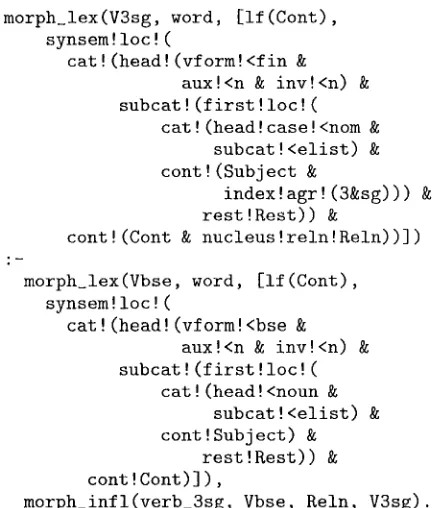
We also use rules like normal H P S G lexical rules, to derive new signs fl'om other lexical signs for morphological derivations, complement extrac- tion and so on. We have no a u t o m a t i c defaults, so these rules must be written carefully. T h e sim- plified example in Figure 3 instantiates nomina- tive and 3rd singular in the first subcat item, and copies the rest of subcat by unification.
morph_lex(V3sg, word, [if(Cont), synsem!loc!(
cat!(head!(vform!<fin aux!<n & inv!<n) subcat!(first!loc!(
cat!(head!case!<nom subcat!<elist) cont!(Subject
index!agr!(3&sg))) rest!Rest))
cont!(Cont & nucleus!reln!Reln))])
morph_lex(Vbse, word, [if(Cont), synsem!loc!(
cat!(head!(vform!<bse aux!<n & inv!<n) subcat!(first!loc!(
cat!(head!<noun subcat!<elist) cont!Subject) g
rest!Rest)) cont!Cont)]),
morph_infl(verb_3sg, Vbse, Reln, V3sg).
Figure 3: Lexical rule for 3rd singular verb form
T h e t y p e d feature structures in the lexical rules are compiled by P r o F I T into Prolog terms. T h e resulting rules arc then compiled by SICStus Pro- log, together with the d a t a b a s e of simple lexical entries.
2
D e l a y e d lexical choice
Delayed lexical choice is an established technique in n a t u r a l language generation. When a back- tracking algorithm is combined with a lexicon of morphological forms, there is considerable non- determinism during syntactic generation, because features required for a deterministic choice of mor- phological form are not yet instantiated. With de- layed lexical choice, a lexicon of stems is used dur-
ing syntactic generation, and the choice of mor- phological form is delayed to a postprocess. In- stead of producing a string of word forms, syntac- tic generation produces a string of lexical items. T h e morphological postprocess converts the lexi- cal items to final lexical forms, when all required syntactic features have become instantiated.
2.1
Monotonicity
Describing the implementation of delayed lexical choice in the MiMo2 system, Shieber et al. (1990) pointed out t h a t only monotonic rules (which tilt- ther instantiate the feature structure of a lcxi- cal item but do not change it) can be delayed. For example, the choice of singular or plural verb i'orm can be delayed until after the subject has been generated, by perforIning syntactic genera- tion with a lexical item based on the verb stem, which does not specify singular or plural. By con- trast, a lexical rule for passivization which changes the order of items on the subcat list is nonmono- tonic. Both the active and the passive variants must be made available as distinct lexical items during syntactic generation, a
In an inheritance-based t y p e d feature formal- ism, monotonicity is tmilt into the subsumption relation in the sort hierarchy. A sort subsumes its subsorts, which m a y further instantiate its fea- tures, but cannot change them. We exploit tile monotonicity of subsumption in the sort hierarchy in our implementation of delayed lexical choice.
2.2
Syntactic-semantic lexicon
In place of the MiMo2 lexicon of stems, we specify a syntactic-semantic lezicon interface
synsemJex(Lex, Cat, [LF, Sign])
where L e x has no significance for generation. En- tries in tile syntactic-seInantic lexicon are derived by a small number of lexical rules from entries in the morphological lexicon. Like the m o r p h J e x rules, the synsem_lex rules are compiled first, by P r o F I T and then by SICStus Prolog.
To implement delayed lexical choice, we use the synsem_lex interface during syntactic generation, and then use the morph_lex interface in the mor- phological postprocess. We must therefore ensure t h a t the delayed morph_lex rules will be mono- tonic. We do t h a t by ensuring t h a t tile synsem_tex entries subsume the m o r p h J e x entries from which they are derived.
Figure 4 shows a simplified form of a synsem_lex rule for verbs. T h e rule derives the s y n s e m J e x en- t r y from tile m o r p h J e x base form entry, in which v f o r m has a vahm of sort <bse. The s u b c a t of the synsem_lex entry is unified with the s u b c a t of the
[image:3.596.83.301.312.566.2]morph_lex entry, so that the synsem_lex entry sub- categorizes for the appropriate synt;actic comple- inents. The morptl_lex base form entry is used so that the agreement Datures of tile subject, will not t)c restricted. The c o n t e n t vahte, s are also unified, so that the synseni_lex entry inchldes the appro- I)riate semantic roles. However, the h e a d Datures are not unified. Tile synsemJex vform has a value. of sort <vform, wtfich is tim immediate supersort of the mort)hJex vform sort, < b s e . Instead of flfll unification, the synselnJex hea(l feat,ures sut)sumc those of the morI)hJex entry.
s y n s e m _ l e x ( L e x , w o r d , [If(Cont g <psoa), synsem!loc!(
cat!(head!(vform!<vform aux!<n & inv!<n) subcat!Subcat)
cont!Cont)])
morph_lex(Lex, word, [if(Cont), synsem!loc!(
cat!(head!(vform!<bse aux!<n & inv!<n) subcat!Subcat)
cont!Cont)]).
Figure. 4: A synsem_le.x rule for verbs
2 . 3 G r a m m a r - l e x i c o n i n t e r f a c e
In I)CG-based systems, the interface between the g r a m m a r and the lexicon can often }m speciiied by a DCG rule which accesses the lexicon by means of an extra condition. In our fl'amework, such a rule might, be:
word ( S i g n ) / L F - - >
[Word] ,
{morph_lex(Word, word, [LF, Sign])}.
Ilowevcr, since our concurrent t)roeessing algo- rithms require extra conditions to be determinis- tic, such a rule would find only one lexical entry (the first unifiable one), which would depend on the order of lexical rules and lexical entries.
For parsing this is not a problem because, like CLE, wc use a morphological preprocess which performs lexicon access, building a morpheme lat- tice to be passed to the syntactic parsing pro- tess. Lexicon access is therefore separated from the parsing algorithm, and is not required to be deterministic.
For generation with delayed lexical choice, we use a modified form of the nile:
s g x w o r d ( S i g n ) / L F - - >
[Sign],
{synsem_lex(Word, word, [LF, Sign])}.
The label 'sgx' shows that the rule is to be com- piled only by SGX, not by SAX. It differs from the
previous rule not only by accessing the synt,act,ic- semantic lexicon instead of dm morphological lex- icon, but also by speci[ying that the lexical item is [Sign] instead of [Word]. T h a t is, the output of syntactic geueration is a string of HPSG signs.
2 . 4 S e m a n t i c h e a d - d r i v e n g e n e r a t i o n
When syntactic generation begins, the StlD algo- rithm uses chain rules (like the rule ill Figure 1) to identify tim piw)t, the semantic head of the scn- t,ence. The synsem lex entry for the pivot is then accessed by the. extra condition in tile DCG rule above..
Since the synsem_lex entry for verbs (Figure 4) does not specify subject agreement or vform sub- type, but does specify subcategorization and se- mantic roles, it can be used equally well as the sc.- mantle head to drive syntactic generation of, say, a 3rd-singular finite clause or an infinitival eom- t)lemt;nt. Since a single entry ('.all be used in this way, the extra condition can be detcrtninist,ic, as required.
If the verb is the head of an infinitiwll con> p]enlent, its vfornl l/econles ilmtant,iat,ed to < b s e
fl'om subcategorization by the auxiliary to. If t,hc vert) is the head of tlte main clause, its vform be- eonms instantiated to < f i n (finite) by a rule R)r grammatical mfit,s in our grantmar. 4
After syntactic generation, the string of I{PSG signs is conw~rted to a string of word forms by a morphological t)ostprocess, which unifies the signs with entries in the. inorphological lexicon. As the signs are t]llly instantiated during syntactic gen- eration, this postprocess is also deterministic.
a
R e v e r s i b l e d e l a y e d lexical c h o i c e
Most forms of robust parsing are based on coil- straint, relaxation. Our approactl to delayed lexi- cal choice is based on using less instantiated signs flom the syntactic-semantic lexicon, rather than the more instant,iated signs from the morpholog- ical lexicon. Tiffs can be viewed as equivalent to constraint, re.laxation. It therefore seelns reason- able to consider reversing the approach, using de- layed lexical choice for parsing.
Constraint, relaxer,ion in parsing typically has a two-pass approach. Strict parsing is attempted with normal gralmnar rules and the normal pars- ing algorithm. If strict parsing fails to produce a parse, relaxed parsing is attempted, using a mod- ified algorithm or modified g r a m m a r rules. With a lexicalist g r a m m a r like HPSG it seems more ap- propriate to use modified lexical rules, as in our syntactic-semantic lexicon.
4In addition to the HPSG categories word and
However, in our approach to delayed lexieal ehoice we do not start with strict constraints and then relax them. On the contrary, we start with relaxed constraints from less instantiated signs and then further instantiate the signs as other con- straints become available. Our approach is there- fore
incremental description refinement
(Mellish, 1988) rather t h a n constraint relaxation.3.1
Parsing and generation with delay
When the syntactic-semantic lexicon is used for generation, tile logical form is the retriewfl key, and the name of the lexeme is irrelewmt. In tile interface
synseIn_lex(Lex, word, [LF, Sign]),
the variable L e x does not need to be unified with the name of the m o r p h e m e in tile morph_lex entry, and could be given another value, such as "verb". However, if we use the syntactic-semantic lexicon for parsing, tile value of this variable will be the retrieval key. If the value is taken directly from the words of the input string, it will not necessar- ily unify with the name of the m o r p h e m e in the morph_lex entry.
In the case of verbs (Figure 4), where the input word m a y be an inflected form but the synsem_lex entry uses the m o r p h J e x entry for the base form, we nmst first use the morphological preprocess to obtain tile "root" form of the word, which is the same as the base form. We then use tile root form instead of the input form as the retrieval key. In the ease of pronouns, which take different forms according to case and reflexivity but have no nat- ural root form, the input form is used directly as the retrieval key (Section 3.2).
Since the synsem_lex entry for verbs in Fig- ure 4 does not restrict subject agreement, an ill- formed input with ineorrect subject-verb agree- ment is parsed in exactly the same way as a well- formed intmt. T h e ' s u b j e c t agreement in the verb's sign remains uninstantiated until the subject and the verb phrase are combined by Schema 1, when the agreement features are instantiated to those of the subject. So "she swim" is accepted, but only "she swims" is generated ill a finite clause. Tile synsemAex entry in Figure 4 also does not, restrict vform, which remains uninstantiated until the verb phrase is combined into a larger phrase. So "she can swimming" is accepted, but only "she can swim" is generated, since "can" subeatego- rizes for a VP with vform of sort, <bse.
3.2
Experimenting with delay
Of course, difl'erent specifications in tile rules for the syntactic-semantic lexicon produce different etfects. In tile synsem_lex entry for pronouns in Figure 5, instead of unifying tile head feature c a s e with the m o r p h J e x entry, the head is specified only as sort <noun, leaving the case unspecified. There are distinct m o r p h J e x entries for nomina- tive and accusative forms of personal pronouns,
but it is irrelevant which one happens to be found when the rule is executed, because the rule does not unify the head features which include case. So the synsem_lex entry can be used deterministi- (:ally for syntactic generation, leaving tile case to be instantiated from subcategorization by a verb or preposition.
In parsing, tile effect of this form of the rule is t h a t the case of an input, pronoun is ignored. W h e t h e r this is good or b a d depends oil b o t h the language and tile level of relaxation desired. This form of the rule would clearly be unsuitable tbr free word order languages, but seems useful for English, accepting "for yon and I" but generating
' ~ f o r y o u a n d n l e '~ .
synsem_lex(Lex,
word, [if(SynsemCont), synsem!loc!(cat!(head!<noun subcat!<elist) cont!(SynsemCont & <pron
index!Index restr!<elist))]) :-
morph_lex(Lex, word, [if(MorphCont), synsem!loc!(
cat!(head!<noun subcat!<elist) cont!(MorphCont ~ <pron
index!Index restr!<elist))]).
Figure 5: A synsem_lex rule for pronouns
In Figure 5, the synsem_lex c o n t e n t value is not unified with the m o r p h J e x c o n t e n t vahm. Only the i n d e x values are unified, including tile gender, number and person features essential for pronouns (tile r e s t r v a h m s are elnpty lists). T h e c o n t a n t values are constrained only to be of sort <pron (pronominal). Ill the sort hierarchy, <pron has subsorts <ana (anaphoric) and <ppro (personal- pronominal), and <ana has its own subsorts < r e f 1 (reflexive) and < r e c p (reciprocal). H P S G binding theory is based on these sortal distinctions, which are p a r t of the content value.
Again, there are distinct m o r p h J e x entries for reflexive and personal-pronominal forms, but, it is irrelevant which one happens to be found when the rule is executed, because the rule does not unify the c o n t e n t values. Therefore the s y n s e m J e x en- t r y can be used deterministically for syntactic gem eration before the sort, becomes instantiated to <ana or <ppro by the binding principles.
ing constraints can l)e re-instated simply by unify- ing the c o n t e n t values in the rule, but the above version is not neee.ssarily bad, for example in pars- ing non-native English. The rule could t)e im- t)roved by having alternative forms which distin- guish ard and non-ard person.
4
C o n c l u s i o n
Our fralnework seeks to combille the elegance of a typed feature fornlalisln and IIPSG syntactic theory with efficient processing. The P r o F I T sys- tem gives an efticient encoding of typed feature structures. The SAX and SGX systems use an ef- ficient (:hart implementation, and their concurrent processing algorithms give turther motivation for eliminating enlpty categories and reducing non- determinism.
Wc have addressed the issue of bidirectional use of shared linguistic descril)tions, rather than ro- bust parsing. Itowevcr, the idea of using d e l w e d lexical choice in reverse makes it possible, widlout modifying the parsing and generation algorithms, to parse certain types of ill-formed inputs and to generate corresponding well-formed outpul, s, us- ing the same shared linguistic descril)tions.
A c k n o w l e d g e m e n t s
The first author would like to thank Mr Ilitoshi Suzuki (Sharp Cort)oration ) and Prof aun-ichi Tsujii (UMIST) for making this work possible. We also thank Dr Kristiina aokinen (NAIST) and the anonymous reviewers for valuable conlinetll;s.
R e f e r e n c e s
Hiyan Alshawi, editor. 1992. The Core Language Engine. The MIT Press.
Yasuharu l)en. 1994. Generalized chart algo- rithm: an efficient t)rocedure for cost-based ab- duction. In 32nd Annual Meeting of the Associ- ation
for Computational Linguistics,
pages 218 225. Association for Computational Linguistics. Gregor Erbaeh. 1995. P r o F I T : Prolog with Fea- tures, Inheritance, and Templates. In Seve'nth Conference of the European Chapter of the As- sociation fin" Computational Linguistics. Asso- ciation for Computational Linguistics.Masahiko Haruno, Yasuhm'u Den, Yuji Matsu- mote, and Makoto Nagao. 1993. Bidirectional chart gene.ratioil of natural language texts. In Proceedings of the Eleventh National Confer- ertcc
on Artificial lntclligence,
pages 350 356. AAAI P r e s s / T h e MIT Press.Osamu hnaichi and Yuji Matsumoto. 1995. In- tegration of syntactic, semantic and contex- tual information in processing grammaticMly
ill-fi)rmed inputs, in I)~vccedings of the Four- teenth International Joint Conference on Arti- ficial lntelligenes, pages 1435 40.
Yuji Matsumoto and ]{yoichi Suginmra. 1987. A parsing system based on logic programming. In Proceedings of the Tenth International Joint Conference on ArliJieial Intelligence, volmne 2, pages 671 4.
Yuji Matsumoto, Yasuharu l)en, and Takehito Utsuro, 199,1. Koubun kaiseki shisutem'a SAX, shiyou setsumcisho (Parsing system S A X Man- hal) w'.rsio'u 2.1. Nm'a Institute of Sci('nc(~ and Technoh)gy.
Christoph(:r S. Mellish. 1988. hnph'mcnting sys- temic classification |)y mfitication. Compv.ta- tional Linguistic, 14(1):40 51.
W. Detmar Meurers an([ Guido Minnen. 1995. A (:omputational treatment of IIPSG lexical rules as cow~riation in lexical entries. In Proceedings of the I~fth International Workshop on Natural Language Understanding and Logic l'rogram- ruing, Lisbon, Portugal.
Carl Pollard and Ivan
Sag.
1994. Head-driven Phrase Structure Grammar. University l'ress, Chicago.Ivan Sag. 1995. English relativ( • (:lausc construe- dons. Unpublished inanuscript.
Stuart M. Shiet)er, Gertjan wm Noord, Fer- nando C.N. P(;reira, and l{obert C. Moore. 1990. Semantic head-driven generation. Con> putational Linguistics, 16(1):30 42.