Thistle and Interarbora
Edinburgh Scotland EH8 9LW
[email protected]
Abstract
We present a system for manipulating a wide class of linguistic diagrams, which is configurable and extensi-ble, and allows deployment as a web-delivered system. A major theme of this work is the transfer of the devices of formal grammar into the analysis and construction of diagrams.
1
Introduction
Diagrams play a crucial role in (computational) linguis-tics, in presenting analyses and characterizing fragments of theories. This role has not to date been adequately supported by programs for the creation, maintenance and delivery of diagrams. We conjecture that this has to do with three main factors. First, in a changing field, obso-lescence may be a concern. Second, it may be difficult to see how to provide a uniform interface to an appropri-ately wide range of kinds of diagrams. Third, integration with delivery systems may be difficult to achieve. We ar-gue below that the design of the Thistle diagram editor provides mechanisms for obviating each of these prob-lems. We start with a brief description of the design of the editor, stressing design decisions that avoid the prob-lems just mentioned. We then turn briefly to some im-plementation details, before describing and exemplifying the classes of diagrams which have been developed so far. We end with a discussion of current and future direc-tions for this work. All of the examples can be accessed on-line1.
Some of our practical considerations are worth empha-sising. First, we aim for typographic quality as close as possible to standard print presentations of the dia-grams in use. The diadia-grams shown in this paper are pre-sented using the PostScript generated by Thistle. They have essentially the same form as delivered by a web browser. Second, the system should be lightweight in several senses. It should be usable without specialist knowledge of the diagrams in question. The user inter-face should be simple. It should be deployable with min-imal assumptions about the hosting environment. These considerations mean that other programs for manipulat-ing diagrams, such as more general purpose graph
edi-1http://www.ltg.ed.ac.uk/software/thistle
tors (for example daVinci2, DiaGen (Viehstaedt and Mi-nas 1995) or VGJ3) are generally unsuitable, as are more complex tools for data annotation, such as the MATE workbench (Dybkjær at al 2000). Such systems may of course be able to present more complex diagrams than Thistle, or offer alternative functionality.
Crucial to the simplicity of Thistle is the assumption that many diagram classes of interest can be character-ized using only context free methods. As we will demon-strate below, this assumption is consistent with a usefully wide range of classes. We first discuss motivation for the design of Thistle, and describe the grammars that charac-terize classes of diagram. We then discuss briefly some example classes and the Interarbora service. After giv-ing details of the current implementation and recent en-hancements, we describe the settings in which these tools have been exploited. Finally, we describe our current work, and possible strategies for usefully broadening the kinds of diagram that Thistle can describe.
2
Design
Thistle is a parameterizable diagram editor. A class of di-agrams is selected by providing Thistle with a grammar which characterizes the diagrams of interest. The gram-mar describes the hierarchical structure of diagrams, and provides information about layout.
Grammars for diagram classes utilize a particular form of context free grammar, in which there are two kinds of statement. In the first, the left hand side of a rule names a particular type of diagram, and its rewrite de-scribes the abstract structure and concrete layout of a di-agram type. In the second, the rewrite is a set of names of other diagram types, representing a disjunctive choice between the latter. Left hand sides are required to be unique throughout. (It is straightforward to show that any context free grammar can be encoded in this form.) Figure 1 shows a fragment of the grammar used to gen-erate the diagram in Figure 2. This fragment can be used to analyse that part of the diagram expressing the value of the featureCONTENT.
2http://www.informatik.uni-bremen.de/daVinci/
3http://www.eng.auburn.edu/csse/research/research groups/
diagram_spec(plain_avm,
bracket([delimiter(square)],
vbox(var(avpairs, [avm_line]))))
diagram_union(avm_line,
[avpair, path_value])
diagram_spec(avpair,
array_element([align(baseline)],
[var(attribute, attribute), var(value, value)]))
diagram_spec(attribute,
smallcaps(var(name, Text)))
Figure 1: A simplified fragment from the grammar used to generate the diagram in Figure 2
LOCAL
CAT
HEAD
rltvzr
MOD
N’ [
TO-BIND|REL{ }
1]
:
INDEX 1RESTR 3
SUBCAT 7
NP [
INHER|REL{ }
1]
, VP fin,
SUBCAT 7 LOC 4:
5CONTENT INDEX 1
RESTR
{ }
5U
3NONLOCAL
TO-BIND|SLASH
{ }
4 INHER|SLASH{ }
4Figure 2: A diagram, reproduced using Thistle, from Pollard and Sag (1994).
The first and third statements here express the hierar-chical structure of and layout of attribute-value matrices. One can gloss the first as: “A diagram of typeplain avm
consists of any number of diagrams of typeavm line.4 The subdiagrams are arranged vertically and enclosed by a pair of square brackets.” In other words,varelements stand for a variable subpart of a diagram and indicate the type of diagram that can appear at that location. Note that such elements also assign a label to each variable subpart. The second statement above indicates that a di-agram of typeavm linecan be realized as either of the named types. The fourth statement indicates how dia-gram types may introduce sequences of characters.
This form of CFG leads directly to a user interface based on top-down rewriting,5where a rule of the first kind is invoked, leading to choices in the diagrams intro-duced as subparts, and so on. In practical terms, then, given a class of diagrams, a particular instance may be
4The square brackets in[avm line]are an ad hoc way of
express-ing the Kleene star.
5Other ways of constructing a diagram are possible, as discussed in
§5 below.
constructed by selecting a location in a diagram, and choosing among the possible types of diagram for that location. What the user sees on the surface is a WYSI-WYG presentation of the consequences of the particular arrangements of diagram types.
These aspects of the design address at once problems of obsolescence and of providing a uniform user inter-face. In order to provide a new class of diagram, one has only to construct a grammar for that class, provid-ing the class is amenable to context free treatment (see §6 below). We make use of existing standards in tack-ling the problem of integrating with other systems. Any instance of the editor may be used via a web browser, so that local installation of software is not essential. The graphical presentation of a diagram may be saved in PostScript, while the logical content of a diagram is stored as SGML.6The precise format of a diagram’s log-ical content exploits the fact that each variable subpart of a diagram is assigned a unique name.
In addition to the construction of static diagrams,
tle may also be used to construct step-time sequences of diagrams. A ‘diagram player’ can be used to step through (or jump between) diagrams in the sequence. One exam-ple shows the states visited by a top-down backtracking parser, on some input and with respect to a given gram-mar.
3
Example diagram classes
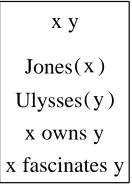
There is a wide range of diagram classes currently avail-able, ranging from an essentially complete treatment of the diagrams in Pollard and Sag (1994) (Figure 2), and in Kamp and Reyle (1993) (Figure 3), to small but useful classes for diagrams from particular areas of linguistics, such as metrical trees and categorial derivations. There are also a number of generic diagram classes such as trees with unlimited or fixed branching.
x y
Jones( )
x
Ulysses( )
y
x owns y
x fascinates y
Figure 3: A diagram based on Kamp and Reyle 1993
4
Interarbora
Interarbora7 is an internet based service allowing the construction and display of tree diagrams via Web browsers. The user supplies a tree specification as a la-belled bracketted string, which is then analysed to pro-duce a specification of a Thistle diagram for a simple diagram class. This information is then passed back to the Web browser, which computes a Thistle diagram for display.
The analyser for bracketted strings attempts to be quite liberal. One target format that we handle successfully is that of the Penn Treebank8. Figure 3 shows a sim-ple examsim-ple from Interarbora. As with the other dia-grams in this paper, this example is formatted here using Postscript generated by Interarbora. There is no discern-able difference between this presentation and that deliv-ered by a web browser. Interarbora is described in more detail by Calder (2000).
5
Current status
The system described above is fully implemented and is available at no charge for non-commercial purposes. As
7http://www.ltg.ed.ac.uk/˜jo/interarbora/
Comments: Hank chasing Frank
Figure 4: An example tree from Interarbora
our implementation platform is Java, there are relatively few portability issues.9 In addition to the mode of
op-eration described above, where a user selects a location in a diagram and chooses a type for that location, we have also investigated modes which are not strictly top-down. Such modes are essential in tasks such as annota-tion, where one has, for example, a given string or text to mark up. In this case, one is interested in adding to the (possibly minimal) existing structure, and this cannot be straightforwardly done under a pure top-down model. Consequently, we have added a range of operations over diagrams, including:
split a sequence of characters is replaced by two (or
more) of its subsequences with appropriate struc-tural adjustments
join the inverse of split
demote a diagram is adjoined into the diagram at the
current location
promote the diagram at the current location replaces its
mother.
There are a number of interesting points to these op-erations. First, the possibility of such operations is in general determined through grammatical inference. So it is not possible to split a sequence of characters in a lo-cation where only one such sequence is allowed by the grammar. Second, the demote operation is the exact ana-log of adjunction in Tree Adjoining Grammars (see e.g. Joshi et al, 1991). A demote operation is only allowed if the type of diagram at the current location is permit-ted within some other diagram type t and the type t is also permissible at the current location in structure. In general, having selected a location for a demote opera-tion, there may be several ways of executing the oper-ation. For example, the user may be asked to choose which daughter in a finite branching local tree should re-ceive the diagram at the currently selected location. Fi-nally, these operations are not grammar specific, so that 9Our implementation predates later versions of Java which provide
the same kinds of operations are available, whether one is dealing with corpus annotation tools or an editor for HPSG diagrams.
6
Current use and on-going and future
work
The system is in use in the support of teaching in a vari-ety of settings. Cox et al results about the effectiveness of Thistle in teaching concepts to do with phrase structure and category membership. Understanding of these con-cepts seems to have been improved simply by viewing a video capture of trees being editing. Interarbora is used at several institutions in junior level courses. We have used Thistle as a front end to a variety of rule formats, including those for the tokenization tool TTT (Grover et al 2000). The diagram player has been used for the visu-alization of the results of corpus searches inGSEARCH10
and of dialogue states, in concert with software devel-oped in theTRINDIproject11.
On-going support work includes changing the per-sistence format of diagrams from SGML to XML, and bringing diagram classes within the same format. There are a large number of minor improvements we intend to make, including generalizing the Web interfaces so that diagram classes and persistence formats may be supplied by the user.
Our current research has a number of aspects. The lim-itation to context free diagram classes simplifies many aspects of implementation, most notably in the area of layout. On the other hand, many diagram classes re-quire greater than context free power for their adequate description. Important classes include state transition di-agrams, systemic functional networks and autosegmental diagrams. We are looking at compromises which will al-low the construction and display of such diagrams while avoiding difficult layout problems.
Another area in which the context free assumption is being examined has to do with diagrams where con-straints such as equality are required to hold within a di-agram. An example of this is the notion of proper bind-ing in Discourse Representation Theory — a variable oc-curring as an argument must be appropriately introduced (and vice versa). A further example is the enforcement of appropriateness conditions within a typed feature frame-work. Strictly speaking, this case doesn’t violate our context free assumption, but encoding such conditions in a context free way is cumbersome. In these cases, we are interested in looking at ways of further constrain-ing the content of diagrams. One possibility, which sits happily enough with Thistle’s background of formal lan-guage theory, is to exploit the notion of path, a sequence of variable-type pairs. Any Thistle diagram corresponds to a set of such paths, and, because these are generated by a context free grammar, the language of such paths
10http://www.hcrc.ed.ac.uk/gsearch/
11http://www.ling.gu.se/research/projects/trindi/trindikit.html
is regular. We could enforce appropriateness in a typed feature setting, for example, by expressing further reg-ular constraints over paths. Using greater than regreg-ular power would result in diagrams whose structure was no longer context free.
Other possibilities include looking at logics to express constraints over diagrams. We can view the set of paths as a model of some logical theory. As our diagrams are necessarily finite, this means that logical frameworks of considerable power could be invoked.
One further element of our work examines ways of providing programmatic control of diagrams, with appli-cations in interactive diagram design, where a cooperat-ing program may fill in details which are logically im-plied, and debugging of complex representations.
7
Conclusions
We have seen above that Thistle provides a flexible, lightweight interface to a wide variety of diagram types. Furthermore, it can be used for the delivery of diagrams (and sequences of diagrams) in a variety of settings. The Interarbora service provides a way of allowing visualiza-tion of tree structures suitable for a wide variety of users.
References
Calder, J. (2000) Interarbora and Thistle: Delivering lin-guistic structure via the Internet, in Proceedings of the Second Language Resources and Evaluation Confer-ence, 31 May–2 June 2000, Athens, Greece.
Cox, R., McKendree, J., Tobin, R., Lee, J. & Mayes, T. (1999) Vicarious learning from dialogue and dis-course: A controlled comparison. Instructional Sci-ence 27, pp431–458.
Dybkjær, L., Møller, M. B., Bernsen, N. O., Grosse, M., Olsen, M. and Schiffrin, A. (2000) Annotating Com-munication Problems Using the MATE Workbench, in Proceedings of the Second Language Resources and Evaluation Conference, 31 May–2 June 2000, Athens, Greece.
Grover, C., Matheson, C., Mikheev, A. and Moens, M., (2000) LT TTT - A Flexible Tokenisation Tool, in Proceedings of the Second Language Resources and Evaluation Conference, 31 May–2 June 2000, Athens, Greece.
Joshi, A. K., Vijay-Shanker, K. and Weir, D. J. (1991) The convergence of mildly context-sensitive grammat-ical formalisms. In P. Sells, S. M. Shieber and T. Wa-sow (eds.) Foundational Issues in Natural Language Processing. MIT Press: Cambridge, MA.
Kamp, H & Reyle, U. (1993). From Discourse to Logic, Kluwer Academic: Dordrecht and London.