9
TO ENHANCE THE PERFORMANCE OF WIRELESS
NETWORK BY COMBINING PACKET SIZE AND
TRANSMISSION PROTOCOLS WITHOUT ANY
ADDITIONAL COST
Rajiv Mahajan
Ph.D Scholar Singania University, Rajasthan
ABSTRACT:
The rapid growth of the Internet together with the proliferation of mobile computing devices such as laptops, and Personal Digital Assistants (PDAs), has led to a brisk increase in the use of wireless technologies for the LAN environment. The quick access to the information involves not only new opportunities for the investors, but a challenge for the research community in order to provide suitable means for the communications to occur without restrictions. Performance of the wireless communication one the most important factor to study. In this paper we analysis the factor that effect the throughput of the system both with the UDP and TCP which may be used to enhance the speed and reliability of the wireless networking in an organization without any change in the infrastructure and also there is no need of any additional Cost thus make the system cheap to perform well.
Keyword: TCP, UDP, WinAODV, throughput, Packet Size, Cost Analysis, PDA
1. INTRODUCTION
Wireless networking has experienced fast development in the last few years. A large number of handhelds, portables, and mobile phones have become implanted with wireless communication capabilities [1]. As a result of this, very small computer devices with wireless communication capabilities will soon be embedded in almost every product. The mobility and the freedom offered by these wireless devices allow users to remain connected to their enterprise networks, while on the move [2]. Modern Wireless Local Area Networks (WLANs) with relatively high data rates have become an attractive technology for providing Internet connectivity for mobile users. Professional
Deployment of WLANs requires the capability to broaden the coverage without the need to deploy a costly infrastructure. Ad-hoc based wireless networks are an attractive solution for this problem. A wireless Ad-hoc network can be considered as a group of wireless devices with radio frequency connectivity that assists each other in transmission of data packets within the network. Data traffic flows over one or more paths between succeeding nodes to reach its destination, making wireless Ad-hoc networks similar to the structure of the Internet [3]. In a wireless Ad-hoc environment, a network can be seen as a collection of end systems that are free to move randomly while maintaining a reliable connection. This kind of network requires no centralized administration or fixed network infrastructure, and can be easily and inexpensively deployed as needed. Ad-hoc wireless networks have recently received a lot of attention. This is mainly due to their potential to support a variety of applications without the need for a fixed infrastructure. Some of the applications where such networks can be usefully deployed are military applications, emergency, search and rescue applications, university campuses, conferences, and hospitals. A key advantage of Ad-hoc networks over conventional WLAN configurations is that Ad-hoc networks have no single point of failure [5].
10
Secondly, wireless Ad-hoc networks allow the users to overcome geographical and location limitations. This is due to the fact that all nodes in the network can provide connectivity as opposed to a single access point. Scalability is also an advantage as Ad-hoc networks are robust and can be easily scaled up. Finally, wireless Ad-hoc networks offer a significant cost saving, as the existing environment does not have to be modified drastically to accommodate the addition of nodes to the existing and evolving network [4].
2. EXPERIMENTAL SETUP
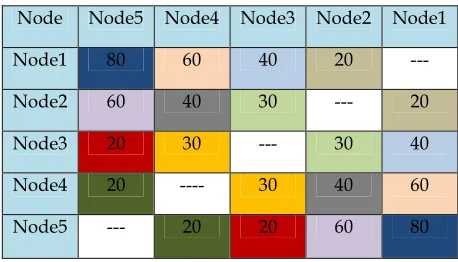
[image:2.595.249.366.351.427.2]The experimental Ad-hoc network consists of five network nodes deployed in the range of 100* 100 m in the Campus. The nodes are distributed at different Location. Figure 3-1 shows the locations of the nodes. The approximate distance in meters between each pair of nodes is shown in Table 3-1. The PCs called node1 to node5, are off the shelf Windows XP machines with 512 Mb of RAM. They are all equipped with IEEE 802.11b (DLink Air plus DWL-520) compatible wireless network cards. The physical layer used in this experiment is Direct Sequence Spread Spectrum (DSSS). All the System are Assigned IP address Manually. These IP address are 192.138.0.1-5 no subnetting is used. Node 1 and node 5 are directly connected with the Internet through Universal NIC. Internet is shared with the other computer through these two systems.
Fig 2: Layout of the network
Node Node5 Node4 Node3 Node2 Node1
Node1 80 60 40 20 ---
Node2 60 40 30 --- 20
Node3 20 30 --- 30 40
Node4 20 ---- 30 40 60
Node5 --- 20 20 60 80
Table 2 : Approximate (Meter) Distance between the different Nodes
2.1 ROUTING PROTOCOL
[image:2.595.196.425.467.598.2]11
[image:3.595.202.421.205.346.2]software is developed by researchers from Intel Corporation [9]. With this software, the IP address 192.138.0.254 is reserved for the gateways. Node 1 and Node 5 are set as Internet Gateways and node 2, node 3 and node 4 are set as Client and Internet Access. Each Node having its own routing table and having the information regarding the neighbouring nodes. Snapshot of WINADOV is shown below:
Fig 2.1 Snapshot of WinAODV
3. RESULTS AND ANALYSIS
3.1 PERFORMANCE MEASUREMENT AND MATRICES
Packet Size is one of the most important factors in order to optimize the performance in wireless communications. Large packets are mostly not acceptable as compare to the smaller packet due to bit errors. On the other hand small packet increase the complexity of the systems and thus they may increase the loss of data so it is very important to find the optimizes size of the packet where we can collect the maximum throughput of the wireless communication. In this section we tried to find the optimum size of the packet which can be use throughout the research.
12
Figure 3.1: Variation of average throughput with respect to change in packet Size
The graphs in this figure show that the throughput first attains a maximum at around 1470 bytes which corresponds to MTU of 1500 bytes,. Similarly to the physical experiments, it is noticeable that there is a sharp decrease in throughput once packet size reaches 1460 bytes. This can be explained by noting that MTU value for IEEE 802.11b is 1500 bytes. Once the packet size exceeds 1460 bytes the network layer starts to fragment the packets in order to optimize the performance. Packet fragmentation reduces system throughput due to the overhead in each packet
3.2 THROUGHPUT MEASUREMENT
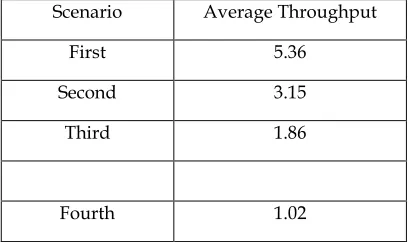
This section provides throughput measurements and outlines the analysis performed on the previously described scenarios. The average throughput at node2 for the first, second, third and forth scenarios. The TCP packet size is set to 1460 bytes. Summery of the analysis is shown in table below
Table 3.29(a): Average throughput Variation with respect to variation in packet Size (TCP)
Table 3.2(b): Average throughput Variation with respect to variation in packet Size (UDP) Scenario Average Throughput
First 5.36
Second 3.15
Third 1.86
Fourth 1.02
Scenario Average Throughput
Fifth 6.85
Six 4.55
Seven 3.69
[image:4.595.209.414.319.440.2]13
Figure 3: Comparison of TCP and UDP Average throughputBy comparing the values in Table 3-4 and Table 3-5, it is noticeable that when nodes use TCP protocol, the throughput is lower compared to when they use UDP. This is possibly due to a number of reasons:
• The UDP header is shorter by 12 bytes than the TCP header.
• TCP’s acknowledgments share the same shared medium as the data which introduces additional traffic. • TCP does not deal very well with lost packets in wireless environments.
Considering all these facts, it is not a surprise that UDP outperforms TCP by achieving a better maximum throughput.
4. SUMMERY
Performance of Wireless network depend upon many factor but packet size, throughput round delay are some of the important factor which studied in this paper. Further it is observed that with increase in packet size the through put of the system increases directly. It is further observed that UDP shows better performance as compared to the TCP but upto a limit i.e 1460 size then get get decreased it may be due the splitting or fragmentation of the packet. In future other factors may also be study to measured the performance of the networking like round delay or packet loss in order to find the overall performance of the networking.
References
1. I. F. Akyildiz, W. Su, Y. Sankarasubramaniam, and E. Cayirci, "Wireless sensor networks: a survey," Computer Networks, 2002, vol. 38, pp. 393-422.
2. I. F. Akyildiz, X. Wang, and W. Wang, "Wireless mesh networks: a survey," Computer Networks, 2005, vol. 47, pp. 445-487. 3. A. Al Hanbali, E. Altman, and P. Nain, "A Survey of TCP over Ad-hoc Networks," IEEECommunications Surveys & Tutorials 2005,
vol. 7, pp. 22-36.
4. E. Barka, "On The Impact of Security on the Performance of WLANs," Journal of Communications, 2007, vol. 2, pp. 1-11. 5. P. Barron, J. Dowling, and S. Weber, "WinAODV," University of Dublin,
.
6 N. Ben Salem, L. Buttyan, J. P. Hubaux, and M. Jakobsson, "Node Cooperation in Hybrid Ad-hoc Networks," IEEE Transactions on Mobile Computing 2006, vol. 5, pp. 365-376.
7. T. Bheemarjuna Reddy, I. Karthigeyan, B. S. Manoj, and C. Siva Ram Murthy, "Quality of Service Provisioning in Ad-hoc Wireless Networks: a Survey of Issues and Solutions," Ad-hoc Networks, 2006, vol. 4, pp. 83-124.
8. B. Bing, "Measured performance of the IEEE 802.11 wireless LAN," In Proc. Of the Local Computer Networks (LCN '99), 1999, pp. 34-42.
9. S. Chakrabarti and A. Mishra, "QoS issues in Ad-hoc wireless networks," Communications Magazine, IEEE, 2001, vol. 39, pp. 142-148.
10.C. Cheng, R. Riley, S. P. R. Kumar, and J. J. Garcia-Luna-Aceves, "A loop-free extended Bellman-Ford routing protocol without bouncing effect," In Proc. of the Symposium on Communications architectures & protocols (SIGCOMM '89), 1989, pp. 224-236. 11.I. Chlamtac, M. Conti, and J. J.-N. Liu, "Mobile Ad-hoc networking: imperatives and challenges," Ad-hoc Networks, 2003, vol. 1, pp.
13-64.
14
13. M. S. Corson and J. Macker, Mobile Ad-hoc Networking (MANET):Routing protocol Performance Issues and EvaluationConsiderations,
Request For Comments 2501, Internet Engineering Task Force (IETF), 1999.
14. D. De Couto, D. Aguayo, J. Bicket, and R. Morris, "A High Throughput Path Metric for Multi-hop Wireless Routing," In Proc. of the 9th ACM Int. Conf. Mobile Computing and Networking, 2003, pp. 134-146.
15. H. Deng, W. Li, and D. P. Agrawal, "Routing security in wireless Ad-hoc networks," Communications Magazine, IEEE, 2002, vol. 40, pp. 70-75.
16. T. Fowler, "Mesh Networks for Broadband Access," IEE Review, 2001, vol. 47, pp. 17-22.
17. J. Freebersyser and B. Leiner, "A DoD perspective on mobile Ad-hoc networks," Addison-Wesley Longman Publishing Co., Inc, 2001, pp. 29-51.
18 S. Garg and M. Kappes, "An experimental study of throughput for UDP and VoIP traffic in IEEE 802.11b networks," In Proc. of the IEEE Wireless Communications and Networking, WCNC, 2003, pp. 1748-1753.
19. S. R. Gatta, J.-P. Duplessis, S. Guven, and S. Manchester, "Simplified Creation and Termination of an Ad-hoc Wireless Network with Internet Connection Sharing," in United States: Microsoft Corporation, 2006.
20. J. Gomez, A. T. Campbell, M. Naghshineh, and C. Bisdikian, "Conserving transmission power in wireless Ad-hoc networks," In Proc. of the 9th Int. Conf. on Network Protocols, 2001, pp. 24-34.
21. V. Gupta, S. Krishnamurthy, and M. Faloutsos, "Denial of Service Attacks at the MAC Layer in Wireless Ad Hoc Networks," MILCOM, 2002, pp. 1118-1123.
22. Z. J. Haas and M. R. Pearlman, The Zone Routing Protocol (ZRP) for Ad-hoc Networks, Internet Engineering Task Force (IETF) Draft, 1997.
23. G. C. Hadjichristofi, W. J. Adams, and N. J. Davis IV, "A framework for key management in mobile Ad-hoc networks," In Proc. of the Int. Conf. on Information Technology: Coding and Computing, (ITCC 2005), 2005, pp. 568-573.
24. S. A. Jafar, "Too Much Mobility Limits the Capacity of Wireless Ad-hoc Networks," IEEE Transactions on Information Theory 2005, vol. 51, pp. 3954- 3964.
25. H. Ju-Lan and I. Rubin, "Performance Analysis of Directional CSMA/CA MAC Protocol in Mobile Ad-hoc Networks," In Proc. of the IEEE Int. Conf. on Communications (ICC '06), 2006, pp. 3657-3662.
26. J. Korhonen and Y. Wang, "Effect of Packet Size on Loss Rate and Delay in Wireless Links," In Proc. of the IEEE Wireless Communications and Networking Conference, 2005, pp. 1608-1613.
27. J. Lee, G. Kim, and S. Park, "Optimum UDP packet sizes in Ad-hoc networks," In Proc. of the Worrkshop Merging Optical and IP Technologies on High Performance Switching and Routing, 2002, pp. 214-218.
28. N. Meghanathan, "A Simulation Study on the Stability-oriented Routing Protocols for Mobile Ad-hoc Networks," In Proc. of the Int. Conf. on Wireless and Optical Communications Networks, 2006, pp. 1-5.