Dependency Forest for Statistical Machine Translation
Zhaopeng Tu† Yang Liu† Young-Sook Hwang‡ Qun Liu† Shouxun Lin†
†Key Lab. of Intelligent Info. Processing ‡HILab Convergence Technology Center
Institute of Computing Technology C&I Business
Chinese Academy of Sciences SKTelecom
{tuzhaopeng,yliu,liuqun,sxlin}@ict.ac.cn [email protected]
Abstract
We propose a structure called dependency forest for statistical machine translation. A dependency forest compactly represents multiple dependency trees. We develop new algorithms for extracting string-to-dependency rules and training depen-dency language models. Our forest-based string-to-dependency system obtains sig-nificant improvements ranging from 1.36 to 1.46 BLEU points over the tree-based baseline on the NIST 2004/2005/2006 Chinese-English test sets.
1 Introduction
Dependency grammars have become increasingly popular in syntax-based statistical machine trans-lation (SMT). One important advantage of depen-dency grammars is that they directly capture the dependencies between words, which are key to re-solving most parsing ambiguities. As a result, in-corporating dependency trees proves to be effec-tive in improving statistical machine translation (Quirk et al., 2005; Ding and Palmer, 2005; Shen et al., 2008).
However, most dependency-based translation systems suffer from a major drawback: they only use 1-best dependency trees for rule extraction, dependency language model training, and decod-ing, which potentially introduces translation mis-takes due to the propagation of parsing errors (Quirk and Corston-Oliver, 2006). While the treelet system (Quirk et al., 2005) takes a de-pendency tree as input, the string-to-dede-pendency system (Shen et al., 2008) decodes on a source-language string. However, as we will show, the string-to-dependency system still commits to us-ing degenerate rules and dependency language models learned from noisy 1-best trees.
To alleviate this problem, an obvious solu-tion is to offer more alternatives. Recent studies have shown that SMT systems can benefit from widening the annotation pipeline: using packed forests instead of 1-best trees (Mi and Huang, 2008), word lattices instead of 1-best segmenta-tions (Dyer et al., 2008), and weighted alignment matrices instead of 1-best alignments (Liu et al., 2009).
Along the same direction, we propose a struc-ture called dependency forest, which encodes ex-ponentially many dependency trees compactly, for dependency-based translation systems. In this pa-per, we develop two new algorithms for extracting string-to-dependency rules and for training depen-dency language models, respectively. We show that using the rules and dependency language models learned from dependency forests leads to consistent and significant improvements over that of using 1-best trees on the NIST 2004/2005/2006 Chinese-English test sets.
2 Background
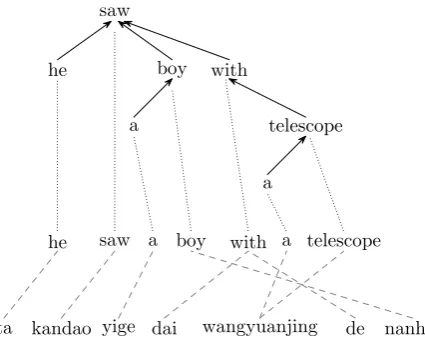
Figure 1 shows a dependency tree of an English sentence he saw a boy with a telescope. Arrows point from the child to the parent, which is often referred to as the head of the child. For example, in Figure 1, saw is the head of he. A dependency tree is more compact than its constituent counter-part because there is no need to build a large su-perstructure over a sentence.
saw
he boy with
a telescope
a
he saw a boy with a telescope
ta kandao yige dai wangyuanjing de nanhai
Figure 1: A training example for tree-based rule extraction.
dependency tree with all the children complete. Floating structures consist of sibling nodes of a common head, but the head itself is unspecified or floating. For example, Figure 2(a) and Figure 2(b) are two fixed structures while Figure 2(c) is a floating one.
Formally, for a given sentencew1:l=w1. . . wl, d1. . . dl represent the parent word IDs for each
word. Ifwiis a root, we definedi = 0.
Definition 1. A dependency structuredi..jis fixed
on head h, where h∈/ [i, j], or fixed for short, if and only if it meets the following conditions
• dh∈/ [i, j]
• ∀k∈[i, j]andk6=h, dk∈[i, j]
• ∀k /∈[i, j],dk=hordk∈/ [i, j]
Definition 2. A dependency structure di..j is
floating with children C, for a non-empty set C ⊆ {i, ..., j}, or floating for short, if and only if it meets the following conditions
• ∃h /∈[i, j], s.t.∀k∈C, dk=h
• ∀k∈[i, j]andk /∈C, dk ∈[i, j]
• ∀k /∈[i, j],dk∈/[i, j]
A dependency structure is well-formed if and only if it is either fixed or floating.
2.1 Tree-based Rule Extraction
Figure 1 shows a training example consisting of an English dependency tree, its Chinese translation,
boy
a
(a)
with
telescope
a
(b)
boy with
a telescope
a
(c)
Figure 2: Well-formed dependency structures cor-responding to Figure 1. (a) and (b) are fixed and (c) is floating.
and the word alignments between them. To facil-itate identifying the correspondence between the English and Chinese words, we also gives the En-glish sentence. Extracting string-to-dependency rules from aligned string-dependency pairs is sim-ilar to extracting SCFG (Chiang, 2007) except that the target side of a rule is a well-formed struc-ture. For example, we can first extract a string-to-dependency rule that is consistent with the word alignment (Och and Ney, 2004):
with ((a) telescope)→dai wangyuanjing de
Then a smaller rule
(a) telescope→wangyuanjing
can be subtracted to obtain a rule with one non-terminal:
with (X1)→daiX1de
whereXis a non-terminal and the subscript indi-cates the correspondence between non-terminals on the source and target sides.
saw0,7
he0,1 boy2,4with4,7
a2,3 telescope5,7
a5,6
(a)
saw0,7
he0,1 boy2,7
a2,3 with4,7
telescope5,7
a5,6
(b)
saw0,7
he0,1 boy2,4 boy2,7
with4,7
e1 e2
a2,3
e3 e4
telescope5,7
e5
a5,6
e6
(c)
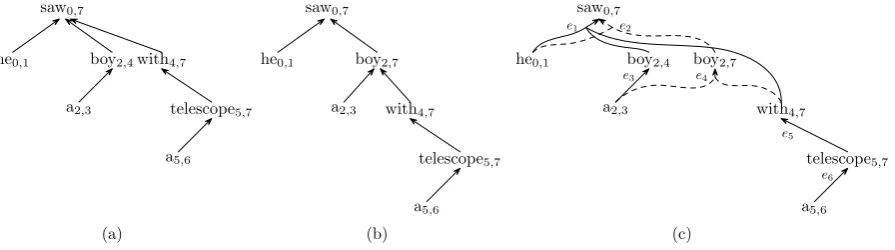
Figure 3: (a) the dependency tree in Figure 1, (b) another dependency tree for the same sentence, and (c) a dependency forest compactly represents the two trees.
be calculated as:
P rob = PT(saw)
×PL(he|saw-as-head)
×PR(boy|saw-as-head)
×PR(with|boy, saw-as-head)
×PL(a|boy-as-head)
×PR(telescope|with-as-head)
×PL(a|telescope-as-head)
where PT(x) is the probability of word x being
the root of a dependency tree. PLand PRare the
generative probabilities of left and right sides re-spectively.
As the string-to-tree system relies on 1-best trees for parameter estimation, the quality of rule table and dependency language model might be affected by parsing errors and therefore ultimately results in translation mistakes.
3 Dependency Forest
We propose to encode multiple dependency trees in a compact representation called dependency forest, which offers an elegant solution to the problem of parsing error propagation.
Figures 3(a) and 3(b) show two dependency trees for the example English sentence in Figure 1. The prepositional phrase with a telescope could either depend on saw or boy. Figure 3(c) is a dependency forest compactly represents the two trees by sharing common nodes and edges.
Each node in a dependency forest is a word. To distinguish among nodes, we attach a span to each node. For example, in Figure 1, the span of
the first a is(2,3) because it is the third word in the sentence. As the fourth word boy dominates the node a2,3, it can be referred to as boy2,4. Note
that the position of boy itself is taken into consid-eration. Similarly, the word boy in Figure 3(b) can be represented as boy2,7.
The nodes in a dependency forest are connected by hyperedges. While an edge in a dependency tree only points from a dependent to its head, a hyperedge groups all the dependants that have a common head. For example, in Figure 3(c), the hyperedge
e1:h(he0,1,boy2,4,with4,7),saw0,7i
denotes that he0,1, boy2,4, and with4,7 are
depen-dants (from left to right) of saw0,7.
More formally, a dependency forest is a pair hV, Ei, where V is a set of nodes, and E
is a set of hyperedges. For a given sentence
w1:l = w1. . . wl, each node v ∈ V is in the
form of wi,j, which denotes that w dominates
the substring from positions i through j (i.e.,
wi+1. . . wj). Each hyperedge e ∈ E is a pair
htails(e), head(e)i, where head(e) ∈ V is the head andtails(e)∈V are its dependants.
saw0,7
he saw a boy with a telescope
ta kandao yige dai wangyuanjing de nanhai
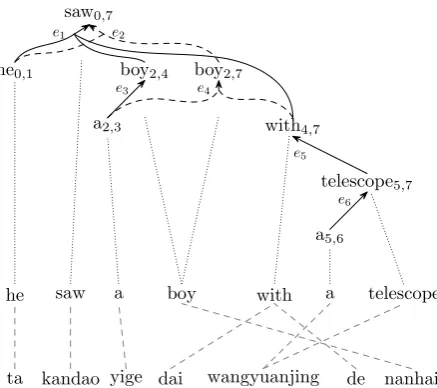
Figure 4: A training example for forest-based rule extraction.
dependency forest. For example, in Figure 3(a), the scores for the edges he → saw, boy → saw, and with→saw could be 13, 22, and -12, respec-tively.
To assign a probability to each hyperedge, we can first obtain a positive number for a hyperedge using the scores of the corresponding edges:1
c(e) =exp
wherec(e)is the count of a hyperedgee,head(e)
is a head, tails(e) is a set of dependants of the head,vis one dependant, ands(v, head(e))is the score of an edge fromvtohead(e). For example, the count of the hyperedgee1 in Figure 3(c) is
c(e1) =exp
13 + 22−12 3
!
(2)
Then, the probability of a hyperedge can be ob-tained by normalizing the count among all hyper-edges with the same head collected from a training corpus:
p(e) = P c(e)
e0:head(e0)=head(e)c(e0)
(3)
Therefore, we obtain a weighted dependency forest in which each hyperedge has a probability.
1
It is difficult to assign a probability to each hyperedge. The current method is arbitrary, and we will improve it in the future.
Algorithm 1 Forest-based Initial Phrase Extrac-tion
Input: a source sentenceψ, a forestF, an alignmenta,
andk
Output: minimal initial phrase setR
1: for each nodev∈V in a bottom-up order do
2: for each hyperedgee∈Eandhead(e) =vdo
3: W ← ∅
4: fixs←EnumFixed(v, modif iers(e))
5: floatings←EnumFloating(modif iers(e))
6: add structures fixs, floatings toW
7: for eachω∈W do
8: ifωis consistent withathen
9: generate a ruler
10: R.append(r)
11: keepk-best dependency structures forv
4 Forest-based Rule Extraction
In tree-based rule extraction, one just needs to first enumerate all bilingual phrases that are consis-tent with word alignment and then check whether the dependency structures over the target phrases are well-formed. However, this algorithm fails to work in the forest scenario because there are usu-ally exponentiusu-ally many well-formed structures over a target phrase.
The GHKM algorithm (Galley et al., 2004), which is originally developed for extracting tree-to-string rules from 1-best trees, has been suc-cessfully extended to packed forests recently (Mi and Huang, 2008). The algorithm distinguishes between minimal and composed rules. Although there are exponentially many composed rules, the number of minimal rules extracted from each node is rather limited (e.g., one or zero). Therefore, one can obtain promising composed rules by combin-ing minimal rules.
Unfortunately, the GHKM algorithm cannot be applied to extracting string-to-dependency rules from dependency forests. This is because the GHKM algorithm requires a complete subtree to exist in a rule while neither fixed nor floating de-pendency structures ensure that all dependants of a head are included. For example, the floating structure shown in Figure 2(c) actually contains two trees.
non-terminals from dependency forests. The algorithm maintains k-best well-formed structures for each node (line 11). The well-formed structures of a head can be constructed from those of its depen-dants. For example, in Figure 4, as the fixed struc-ture rooted at telescope5,7is
(a) telescope
we can obtain a fixed structure rooted for the node with4,7 by attaching the fixed structure of its
de-pendant to the node (EnumFixed in line 4). Figure 2(b) shows the resulting fixed structure.
Similarly, the floating structure for the node saw0,7can be obtained by concatenating the fixed
structures of its dependants boy2,4 and with4,7
(EnumFloating in line 5). Figure 2(c) shows the resulting fixed structure. The algorithm is similar to Wang et al. (2007), which binarize each con-stituent node to create some intermediate nodes that correspond to the floating structures.
Therefore, we can find k-best fixed and float-ing structures for a node in a dependency forest by manipulating the fixed structures of its depen-dants. Then we can extract string-to-dependency rules if the dependency structures are consistent with the word alignment.
How to judge a well-formed structure extracted from a node is better than others? We follow Mi and Huang (2008) to assign a fractional count to each well-formed structure. Given a tree fragment
t, we use the inside-outside algorithm to compute its posterior probability:
αβ(t) = α(root(t))×Y
e∈t p(e)
× Y
v∈leaves(t)
β(v) (4)
whereroot(t)is the root of the tree,eis an edge,
leaves(t)is a set of leaves of the tree,α(·)is out-side probability, andβ(·)is inside probability.
For example, the subtree rooted at boy2,7in Fig-ure 4 has the following posterior probability:
α(boy2,7)×p(e4)×p(e5)
×p(e6)×β(a2,3)×β(a5,6) (5)
Now the fractional count of the subtreetis
c(t) = αβ(t)
αβ(T OP) (6)
whereT OP denotes the root node of the forest. As a well-formed structure might be non-constituent, we approximate the fractional count by taking that of the minimal constituent tree frag-ment that contains the well-formed structure. Fi-nally, the fractional counts of well-formed struc-tures can be used to compute the relative frequen-cies of the rules having them on the target side (Mi and Huang, 2008):
φ(r|lhs(r)) = P c(r)
r0:lhs(r0)=lhs(r)c(r0)
(7)
φ(r|rhs(r)) = P c(r)
r0:rhs(r0)=rhs(r)c(r0)
(8)
Often, our approach extracts a large amount of rules from training corpus as we usually retain ex-ponentially many well-formed structures over a target phrase. To maintain a reasonable rule ta-ble size, we discard any rule that has a fractional count lower that a thresholdt.
5 Forest-based Dependency Language Model Training
Dependency language model plays an important role in string-to-dependency system. Shen et al. (2008) show that string-to-dependency system achieves 1.48 point improvement in BLEU along with dependency language model, while no im-provement without it. However, the string-to-dependency system still commits to using depen-dency language model from noisy 1-best trees. We now turn to dependency forest for it encodes multiple dependency trees.
To train a dependency language model from a dependency forest, we need to collect all heads and their dependants. This can be easily done by enumerating all hyperedges. Similarly, we use the inside-outside algorithm to compute the posterior probability of each hyperedgee,
αβ(e) = α(head(e))×p(e)
× Y
v∈tailes(e)
β(v) (9)
For example, the posterior probability of the hy-peredgee2 in Figure 4 is calculated as
αβ(e2) = α(saw0,7)×p(e2)
Rule DepLM NIST 2004 NIST 2005 NIST 2006 time
tree tree 33.97 30.21 30.73 19.6
tree forest 34.42∗ 31.06∗ 31.37∗ 24.1
forest tree 34.60∗ 31.16∗ 31.45∗ 21.7
forest forest 35.33∗∗ 31.57∗∗ 32.19∗∗ 28.5
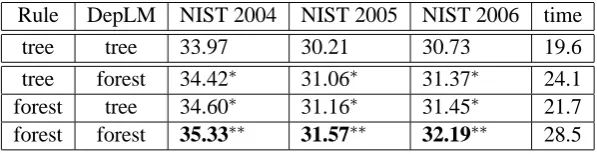
Table 1: BLEU scores and average decoding time (second/sentence) on the Chinese-English test sets. The baseline system (row 2) used the rule table and dependency language model learned both from 1-best dependency trees. We use “ *” and “**” to denote a result is better than baseline significantly at
p <0.05andp <0.01, respectively.
Then, we can obtain the fractional count of a hyperedgee,
c(e) = αβ(e)
αβ(T OP) (11)
Eachn-gram (e.g., “boy-as-heada”) is assigned the same fractional count of the hyperedge it be-longs to.
We also tried training dependency language model as in (Shen et al., 2008), which means all hyperedges were on equal footing without re-garding probabilities. However, the performance is about 0.8 point lower in BLEU. One possbile reason is that hyperedges with probabilities could distinguish high quality structures better.
6 Experiments
6.1 Results on the Chinese-English Task We used the FBIS corpus (6.9M Chinese words + 8.9M English words) as our bilingual train-ing corpus. We ran GIZA++ (Och and Ney, 2000) to obtain word alignments. We trained a 4-gram language model on the Xinhua portion of GIGAWORD corpus using the SRI Language Modeling Toolkit (Stolcke, 2002) with modi-fied Kneser-Ney smoothing (Kneser and Ney, 1995). We optimized feature weights using the minimum error rate training algorithm (Och and Ney, 2002) on the NIST 2002 test set. We evalu-ated the translation quality using case-insensitive BLEU metric (Papineni et al., 2002) on the NIST 2004/2005/2006 test sets.
To obtain dependency trees and forests, we parsed the English sentences of the FBIS corpus using a shift-reduce dependency parser that en-ables beam search (Huang et al., 2009). We only
Rules Size New Rules
tree 7.2M
-forest 7.6M 16.86%
Table 2: Statistics of rules. The last column shows the ratio of rules extracted from non 1-best parses being used in 1-best derivations.
retained the best well-formed structure for each node when extracting string-to-tree rules from de-pendency forests (i.e., k = 1). We trained two 3-gram depLMs (one from trees and another from forests) on English side of FBIS corpus plus 2M sentence pairs from other LDC corpus.
After extracting rules and training depLMs, we ran our replication of string-to-dependency sys-tem (Shen et al., 2008) to translate the develop-ment and test sets.
Table 1 shows the BLEU scores on the test sets. The first column “Rule” indicates where the string-to-dependency rules are learned from: 1-best dependency trees or dependency forests. Similarly, the second column “DepLM” also dis-tinguish between the two sources for training de-pendency language models. The baseline sys-tem used the rule table and dependency lan-guage model both learned from 1-best depen-dency trees. We find that adding the rule table and dependency language models obtained from de-pendency forests improves string-to-dede-pendency translation consistently and significantly, ranging from +1.3 to +1.4 BLEU points. In addition, us-ing the rule table and dependency language model trained from forest only increases decoding time insignificantly.
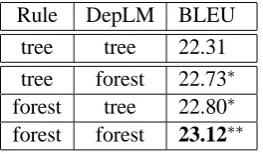
Rule DepLM BLEU tree tree 22.31 tree forest 22.73∗ forest tree 22.80∗ forest forest 23.12∗∗
Table 3: BLEU scores on the Korean-Chinese test set.
parses are used by the decoder? Table 2 shows the number of rules filtered on the test set. We observe that the rule table size hardly increases. One pos-sible reason is that we only keep the best depen-dency structure for each node. The last row shows that 16.86% of the rules used in 1-best deriva-tions are extracted from non 1-best parses in the forests, indicating that some useful rules cannot be extracted from 1-best parses.
6.2 Results on the Korean-Chinese Task To examine the efficacy of our approach on differ-ent language pairs, we carried out an experimdiffer-ent on Korean-Chinese translation. The training cor-pus contains about 8.2M Korean words and 7.3M Chinese words. The Chinese sentences were used to train a 5-gram language model as well as a 3-gram dependency language model. Both the de-velopment and test sets consist of 1,006 sentences with single reference. Table 3 shows the BLEU scores on the test set. Again, our forest-based ap-proach achieves significant improvement over the baseline (p <0.01).
6.3 Effect ofK-best
We investigated the effect of different k-best structures for each node on translation quality (BLEU scores on the NIST 2005 set) and the rule table size (filtered for the tuning and test sets), as shown in Figure 5. To save time, we extracted rules just from the first 30K sentence pairs of the FBIS corpus. We trained a language model and depLMs on the English sentences. We used 10 different k: 1, 2, 3, 4, 5, 6, 7, 8, 9 and 10. Ob-viously, the higher the k is, the more rules are extracted. Whenk=10, the number of rules used on the tuning and test sets was 1,299,290 and the BLEU score was 20.88. Generally, both the num-ber of rules and the BLEU score went up with
20.4
0.95 1.00 1.05 1.10 1.15 1.20 1.25 1.30 1.35
BLEU score
rule table size(M)
k=1,2,...,10
Figure 5: Effect of k-best on rule table size and translation quality.
0.98 1.00 1.02 1.04 1.06 1.08 1.10
BLEU score
rule table size(M)
t=1.0,0.9,...,0.1
Figure 6: Effect of pruning threshold on rule table size and translation quality.
the increase of k. However, this trend did not hold within the range [4,10]. We conjecture that when retaining more dependency structures for each node, low quality structures would be intro-duced, resulting in much rules of low quality.
An interesting finding is that the rule table grew rapidly whenkis in range [1,4], while gradually within the range [4,10]. One possible reason is that there are limited different dependency struc-tures in the spans with a maximal length of 10, which the target side of rules cover.
6.4 Effect of Pruning Threshold
pruning thresholds: 0.1, 0.2, 0.3, 0.4, 0.5, 0.6, 0.7, 0.8, 0.9 and 1.0. Intuitively, the higher the prun-ing threshold is, the less rules are extracted. When
t=0.1, the number of rules used on the tuning and test sets was 1,081,841 and the BLEU score was 20.68.
Lots of rules are pruned when the pruning threshold increases from 0.0 to 0.3 (around 20%). After pruning away these rules, we achieved 0.6 point improvement in BLEU. However, when we filtered more rules, the BLEU score went down.
Figures 5 and 6 show that using two parame-ters that have to be hand-tuned achieves a small improvement at the expense of an additional com-plexity. To simplify the approach, we only keep the best dependency structure for each node with-out pruning any rule.
7 Related Works
While Mi and Huang (2008) and we both use forests for rule extraction, there remain two ma-jor differences. Firstly, Mi and Huang (2008) use a packed forest, while we use a dependency forest. Packed forest is a natural weighted hypergraph (Klein and Manning, 2001; Huang and Chiang, 2005), for each hyperedge treats the correspond-ing PCFG rule probability as its weight. However, it is challenging to make dependency forest to be a weighted hypergraph because dependency parsers usually only output a score for each edge in a de-pendency tree rather than a hyperedge in a depen-dency forest. Secondly, The GHKM algorithm (Galley et al., 2004), which is originally devel-oped for extracting tree-to-string rules from 1-best trees, has been successfully extended to packed forests recently (Mi and Huang, 2008). Unfor-tunately, the GHKM algorithm cannot be applied to extracting string-to-dependency rules from de-pendency forests, because the GHKM algorithm requires a complete subtree to exist in a rule while neither fixed nor floating dependency structures ensure that all dependants of a head are included.
8 Conclusion and Future Work
In this paper, we have proposed to use dependency forests instead of 1-best parses to extract string-to-dependency tree rules and train string-to-dependency lan-guage models. Our experiments show that our
ap-proach improves translation quality significantly over a state-of-the-art string-to-dependency sys-tem on various language pairs and test sets. We believe that dependency forest can also be used to improve the dependency treelet system (Quirk et al., 2005) that takes 1-best trees as input.
Acknowledgement
The authors were supported by SK Telecom C&I Business, and National Natural Science Founda-tion of China, Contracts 60736014 and 60903138. We thank the anonymous reviewers for their in-sightful comments. We are also grateful to Wen-bin Jiang for his invaluable help in dependency forest.
References
Chiang, David. 2007. Hierarchical phrase-based
translation. Computational Linguistics, pages 201– 228.
Ding, Yuan and Martha Palmer. 2005. Machine trans-lation using probabilistic synchronous dependency insertion grammars. In Proceedings of ACL.
Dyer, Christopher, Smaranda Muresan, and Philip Resnik. 2008. Generalizing word lattice transla-tion. In Proceedings of ACL.
Galley, Michel, Mark Hopkins, Kevin Knight, and Daniel Marcu. 2004. What’s in a translation rule? In Proceedings of NAACL.
Huang, Liang and David Chiang. 2005. Better k-best parsing. In Proceedings of IWPT.
Huang, Liang, Wenbin Jiang, and Qun Liu. 2009.
Bilingually-constrained (monolingual) shift-reduce parsing. In Proceedings of EMNLP.
Klein, Dan and Christopher D. Manning. 2001. Pars-ing and hypergraphs. In ProceedPars-ings of IWPT.
Kneser, R. and H. Ney. 1995. Improved backing-off for m-gram language modeling. In Proceedings of
Acoustics, Speech, and Signal.
Liu, Yang, Tian Xia, Xinyan Xiao, and Qun Liu. 2009. Weighted alignment matrices for statistical machine translation. In Proceedings of EMNLP.
Mi, Haitao and Liang Huang. 2008. Forest-based
translation rule extraction. In Proceedings of
Och, Franz J. and Hermann Ney. 2000. Improved sta-tistical alignment models. In Proceedings of ACL.
Och, Franz J. and Hermann Ney. 2002. Discriminative training and maximum entropy models for statistical machine translation. In Proceedings of ACL.
Och, Franz J. and Hermann Ney. 2004. The alignment template approach to statistical machine translation.
Computational Linguistics, 30(4):417–449.
Papineni, Kishore, Salim Roukos, Todd Ward, and Wei-Jing Zhu. 2002. Bleu: a method for automatic evaluation of machine translation. In Proceedings
of ACL.
Quirk, Chris and Simon Corston-Oliver. 2006. The impact of parsing quality on syntactically-informed statistical machine translation. In Proceedings of
EMNLP.
Quirk, Chris, Arul Menezes, and Colin Cherry. 2005. Dependency treelet translation: syntactically in-formed phrasal smt. In Proceedings of ACL.
Shen, Libin, Jinxi Xu, and Ralph Weischedel. 2008. A new string-to-dependency machine translation algo-rithm with a target dependency language model. In
Proceedings of ACL.
Stolcke, Andreas. 2002. Srilm - an extensible lan-guage modeling toolkit. In Proceedings of ICSLP.
Wang, Wei, Kevin Knight, and Daniel Marcu. 2007. Binarizing syntax trees to improve syntax-based
machine translation accuracy. In Proceedings of