Controlling Listening-oriented Dialogue using Partially Observable
Markov Decision Processes
Toyomi Meguro†, Ryuichiro Higashinaka‡, Yasuhiro Minami†, Kohji Dohsaka†
†NTT Communication Science Laboratories, NTT Corporation
‡NTT Cyber Space Laboratories, NTT Corporation [email protected] [email protected]
{minami,dohsaka}@cslab.kecl.ntt.co.jp
Abstract
This paper investigates how to automat-ically create a dialogue control compo-nent of a listening agent to reduce the cur-rent high cost of manually creating such components. We collected a large number of listening-oriented dialogues with their user satisfaction ratings and used them to create a dialogue control component using partially observable Markov decision pro-cesses (POMDPs), which can learn a pol-icy to satisfy users by automatically find-ing a reasonable reward function. A parison between our POMDP-based com-ponent and other similarly motivated sys-tems using human subjects revealed that POMDPs can satisfactorily produce a dia-logue control component that can achieve reasonable subjective assessment.
1 Introduction
Although task-oriented dialogue systems have been actively researched (Hirshman, 1989; Fer-guson et al., 1996; Nakano et al., 1999; Walker et al., 2002), recently non-task-oriented functions are starting to attract attention, and systems with-out a specific task that deal with more casual di-alogues, such as chats, are being actively investi-gated from their social and entertainment aspects (Bickmore and Cassell, 2001; Higashinaka et al., 2008; Higuchi et al., 2008).
In the same vein, we have been working on listening-oriented dialogues in which one conver-sational participant attentively listens to the other (hereafter, listening-oriented dialogue). Our aim is to build listening agents that can implement such a listening process so that users can satisfy their desire to speak and be heard. Figure 1 shows
an excerpt from a typical listening-oriented dia-logue. In the literature, dialogue control compo-nents for less (or non-) task-oriented dialogue sys-tems, such as listening agents, have typically used hand-crafted rules for dialogue control, which can be problematic because completely covering all dialogue states by hand-crafted rules is diffi-cult when the dialogue has fewer task restrictions (Wallace, 2004; Isomura et al., 2009).
To solve this problem, this paper aims to auto-matically build a dialogue control component of a listening agent using partially observable Markov decision processes (POMDPs). POMDPs, which make it possible to learn a policy that can max-imize the averaged reward in partially observable environments (Pineau et al., 2003), have been suc-cessfully adopted in task-oriented dialogue sys-tems for learning a dialogue control module from data (Williams and Young, 2007). However, no work has attempted to use POMDPs for less (or non-) task-oriented dialogue systems, such as lis-tening agents, because user goals are not as well-defined as task-oriented ones, complicating the finding of a reasonable reward function.
Utterance Dialogue act
S: Good evening. GREETING
The topic is “food,” nice to
meet you. GREETING
L: Nice to meet you, too. GREETING
S: I had curry for dinner. S-DISC(sub: fact)
Do you like curry? QUESTION(sub: pref)
L: Yes, I do. SYMPATHY
S: Really? REPEAT
Me, too. SYMPATHY
L: Do you usually go out to eat? QUESTION(sub: habit)
S: No, I always cook at home. S-DISC(sub: habit)
I don’t use any special spices, but I sometimes cook noodles using soup and curry.
S-DISC(sub: habit)
L: That sounds good! S-DISC(sub: pref
[image:2.595.73.291.67.232.2](pos-itive))
Figure 1: Excerpt of a typical listening-oriented dialogue. Dialogue topic is “food.” Dialogue acts corresponding to utterances are shown in paren-theses (See Table 1 for meanings): S-DISCstands
for SELF-DISCLOSURE; PREF for PREFERENCE;
S for speaker; and L for listener. The dialogue was translated from Japanese by the authors.
The next section introduces related work. Sec-tion 3 describes our approach. SecSec-tion 4 de-scribes our collection of listening-oriented dia-logues. This is followed in Section 5 by an evalua-tion experiment that compared our POMDP-based dialogue control with other similarly motivated systems. The last section summarizes the main points and mentions future work.
2 Related work
With increased attention on social dialogues and senior peer counseling, work continues to emerge on listening-oriented dialogues. One early work is (Maatman et al., 2005), which showed that vir-tual agents can give users the sense of being heard using such gestures as nodding and head shak-ing. Recently, Meguro et al. (2009a) analyzed the characteristics of listening-oriented dialogues. They compared listening-oriented dialogues and casual conversations between humans, revealing that the two types of dialogues have significantly different flows and that listeners actively ques-tion with frequently inserted self-disclosures; the speaker utterances were mostly concerned with self-disclosure.
Shitaoka et al. (2010) also investigated the functions of listening agents, focusing on their response generation components. Their system takes the confidence score of speech recognition
into account and changes the system response ac-cordingly; it repeats the user utterance or makes an empathic utterance for high-confidence user ut-terances and makes a backchannel when the con-fidence is low. The system’s empathic utterances can be “I’m happy” or “That’s too bad,” depend-ing on whether a positive or negative expression is included in the user utterances. Their system’s response generation only uses the speech recogni-tion confidence and the polarity of user utterances as cues to choose its actions. Currently, it does not consider the utterance content or the user in-tention.
In order for listening agents to achieve high smoothness, a switching mechanism between the “active listening mode,” in which the system is a listener, and the “topic presenting mode,” in which the system is a speaker, has been proposed (Yokoyama et al., 2010; Kobayashi et al., 2010). Here, the system uses a heuristic function to main-tain a high user interest level and to keep the sys-tem in an active listening mode. Dialogue con-trol is done by hand-crafted rules. Our motivation bears some similarity to theirs in that we want to build a listening agent that gives users a sense of being heard; however, we want to automatically make such an agent from dialogue data.
POMDPs have been introduced for robot action control (Pineau et al., 2003). Here, the system learns to make suitable movements for complet-ing a certain task. Over the years, POMDPs have been actively studied for applications to spoken dialogue systems. Williams et al. (2007) suc-cessfully used a POMDP for dialogue control in a ticket-buying domain in which the objective was to fix the departure and arrival places for tickets. Recent work on POMDPs indicates that it is pos-sible to train a dialogue control module in task-oriented dialogues when the user goal is obvious. In contrast, in this paper, we aim to verify whether POMDPs can be applied to less task-oriented di-alogues (i.e., listening-oriented didi-alogues) where user goals are not as obvious.
train POMDPs for dialogue control in listening-oriented dialogues.
3 Approach
A typical dialogue system has utterance under-standing, dialogue control, and utterance gen-eration modules. The utterance understanding module comprehends user natural-language utter-ances, whose output (i.e., a user dialogue act) is passed to the dialogue control module. The dia-logue control module chooses the best system di-alogue act at every didi-alogue point using the user dialogue act as input. The utterance generation module generates natural-language utterances and says them to users by realizing the system dia-logue acts as surface forms.
This paper focuses on the dialogue control module of a listening agent. Since a listening-oriented dialogue has a characteristic conversation flow (Meguro et al., 2009a), focusing on this mod-ule is crucial because it deals with the dialogue flow. Our objective is to train from data a dialogue control module that achieves a smooth dialogue flow that makes users feel that they are being lis-tened to attentively.
3.1 Dialogue control using POMDPs
The purpose of our dialogue control is to simulta-neously create situations in which users feel lis-tened to (i.e., user satisfaction) and to generate smooth action sequences (i.e., smoothness). To do this, we automatically and statistically train the reward and the policy of the POMDP using a large amount of listening-oriented dialogue data. POMDP is a reinforcement learning framework that can learn a policy to select an action sequence that maximizes average future rewards. Setting a reward is crucial in POMDPs.
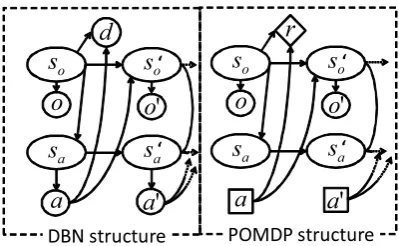
For our purpose, we introduce two different re-wards: one for user satisfaction and the other for smoothness. Before creating a POMDP structure, we used the dynamic Bayesian network (DBN) structure (Fig. 2) to obtain the statistical structure of the data and the two rewards.
The random values in the DBN are as follows:
so andsa are the dialogue state and action state, o is a speaker observation,a is a listener action, anddis a random variable for an evaluation score
that indicates the degree of the user being listened to. This evaluation score can be obtained by
ques-'
a
a
o
s
r
os
'
o
a
s
s
ao
‘
‘
a
a
'
o
s
d
o
s
'
o
a
s
s
ao
‘
‘
[image:3.595.310.510.68.191.2]DBN structure POMDP structure
Figure 2: DBN and POMDP structures employed in this paper. Note thatain the POMDP is isolated from other states because it is decided by a learned policy.
tionnaires, and the variable is used for calculat-ing a user satisfaction reward for the POMDP. The DBN arcs in Fig. 2 define the emission and transition probabilities. Pr(o|so)is the emission probability of o givenso. Pr(d|so) is the
emis-sion probability ofd givenso. Pr(so|so, a) is a transition probability from so toso givena. The
DBN is trained using the EM algorithm. Using the obtained variables, we calculate the two re-ward functions as follows:
(1) Reward for user satisfaction This reward is obtained from thedvariable by
r1((so,∗), a) = max
d=min
d×Pr(d|so, a),
where * is arbitrarysaandminandmaxare
min-imum and maxmin-imum evaluation scores.
(2) Reward for smoothness For smoothness, we maximize the action predictive probability given the history of actions and observations. The probability is calculated from listening-oriented dialogue data. sais introduced for estimating the
predictive probability of actionaand for selecting ato maximize the predictive probability.
We setPr(a|sa) = 1 whena = saso thatsa
corresponds one-on-one witha. Then, ifat =sa
at time t is given, we obtain Pr(at|o1, a1, . . . , at−1, ot)
=
sa
Pr(at|sa) Pr(sa|o1, a1, . . . , at−1, ot)
= Pr(sa|o1, a1, . . . , ot−1, at−1, ot)
set 1.0 to reward r2((∗, sa), a) whensa = a, the
POMDP will generate actions that maximize their predictive probabilities. We believe that this re-ward should increase the smoothness of a system action sequence since the sequence is generated according to the statistics of human-human dia-logues.
Converting a DBN into a POMDP The DBN is converted into a POMDP (Fig. 2), while main-taining the transition and output probabilities. We convertdtoras described above.
The system is in a partially observed state. Since the state is not known exactly, we use a dis-tribution called “belief state”btwith which we
ob-tain the average reward that will be gained in the future at time t by:
Vt=
∞
τ=0
γτ
s
bτ+t((so, sa))r((so, sa), aτ+t),
where τ is a discount factor; namely, the future reward is decreased byτ. A policy is learned by
value iteration so that the action that maximizes
Vtcan be chosen. We definer((so, sa), a)as
fol-lows:
r((so, sa), a) =r1((so,∗), a) +r2((∗, sa), a).
By balancing these two rewards, we can choose an action that satisfies both user satisfaction and smoothness.
4 Data collection
We collected listening-oriented dialogues using human subjects who consisted of ten listeners (five males and five females) and 37 speakers (18 males and 19 females). The listeners and speak-ers ranged from 20 to 60 years old and were all native Japanese speakers. Listeners and speakers were matched to form a listener-speaker pair and communicated over the Internet with our chat in-terface. They used only text; they were not al-lowed to use voice, video, or facial expressions. The speakers chose their own listener and freely participated in dialogues from 7:00 pm to mid-night for a period of 15 days. One conversation was restricted to about ten minutes. The subjects talked about a topic chosen by the speaker. There were 20 predefined topics: money, sports, TV and radio, news, fashion, pets, movies, music, house-work and childcare, family, health, house-work, hob-bies, food, human relationships, reading, shop-ping, beauty aids, travel, and miscellaneous. The
listeners were instructed to make it easy for the speakers to say what the speakers wanted to say. We collected 1260 listening-oriented dialogues. 4.1 Dialogue-act annotation
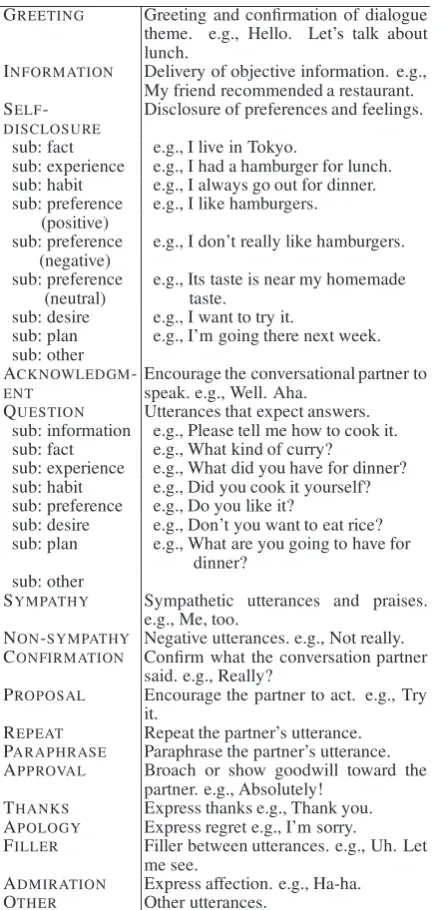
We labeled the collected dialogues using the dialogue-act tag set shown in Table 1. We made these tags by selecting, extending, and modifying those from previous studies that concerned human listening behaviors in some way (Meguro et al., 2009a; Jurafsky et al., 1997; Ivey and Ivey, 2002). In our tag set, only question and self-disclosure tags have sub-category tags. Two annotators (not the authors) labeled each sentence of our collected dialogues using these 32 tags. In dialogue-act an-notation, since there can be several sentences in one utterance, one annotator first split the utter-ances into sentences, and then both annotators la-beled each sentence with a single dialogue act.
4.2 Obtaining evaluation scores
POMDPs need evaluation scores (i.e., d) for
dia-logue acts (i.e.,a) for training a reward function.
Therefore, we asked a third-party participant, who was neither a listener nor a speaker in our dialogue data collection, to evaluate the user satisfaction levels of the collected dialogues. She rated each dialogue in terms of how she would have felt “be-ing heard” after the dialogue if she had been the speaker of the dialogue in question. She provided ratings on the 7-point Likert scale for each dia-logue. Since she rated the whole dialogue with a single rating, we set the evaluation score of each action within a dialogue using the evaluation score for that dialogue.
We used a third-person’s evaluation and not the original person’s to avoid the fact that the eval-uative criterion is too different between humans; identical evaluation scores from two people do not necessarily reflect identical user satisfaction levels. We highly valued the reliability and con-sistency of the third-person scores. This way, at least, we can train a policy that maximizes its av-erage reward function for the rater, which we need to verify first before considering adaptation to two or more individuals.
5 Experiment
5.1 Experimental setup
GREETING Greeting and confirmation of dialogue theme. e.g., Hello. Let’s talk about lunch.
INFORMATION Delivery of objective information. e.g.,
My friend recommended a restaurant. SELF
-DISCLOSURE
Disclosure of preferences and feelings.
sub: fact e.g., I live in Tokyo.
sub: experience e.g., I had a hamburger for lunch. sub: habit e.g., I always go out for dinner. sub: preference e.g., I like hamburgers.
(positive)
sub: preference e.g., I don’t really like hamburgers. (negative)
sub: preference e.g., Its taste is near my homemade (neutral) taste.
sub: desire e.g., I want to try it.
sub: plan e.g., I’m going there next week. sub: other
ACKNOWLEDGM -ENT
Encourage the conversational partner to speak. e.g., Well. Aha.
QUESTION Utterances that expect answers. sub: information e.g., Please tell me how to cook it. sub: fact e.g., What kind of curry?
sub: experience e.g., What did you have for dinner? sub: habit e.g., Did you cook it yourself? sub: preference e.g., Do you like it?
sub: desire e.g., Don’t you want to eat rice? sub: plan e.g., What are you going to have for
dinner? sub: other
SYMPATHY Sympathetic utterances and praises.
e.g., Me, too.
NON-SYMPATHY Negative utterances. e.g., Not really.
CONFIRMATION Confirm what the conversation partner said. e.g., Really?
PROPOSAL Encourage the partner to act. e.g., Try
it.
REPEAT Repeat the partner’s utterance.
PARAPHRASE Paraphrase the partner’s utterance. APPROVAL Broach or show goodwill toward the
partner. e.g., Absolutely! THANKS Express thanks e.g., Thank you.
APOLOGY Express regret e.g., I’m sorry.
FILLER Filler between utterances. e.g., Uh. Let
me see.
ADMIRATION Express affection. e.g., Ha-ha. OTHER Other utterances.
Table 1: Definition and example of dialogue acts
In the first step, we created our POMDP sys-tem using our approach (See Section 3.1). We also made five other systems for comparison that we describe in Section 5.2. Each system outputs dialogue-act tag sequences for evaluation. The dialogue theme was “food” because it was the most frequent theme and accounted for 20% of our data (See Table 2 for the statistics); we trained our POMDP using the “food” dialogues. We re-stricted the dialogue topic to verify that our ap-proach at least works with a small set. Since there is no established measure for automatically eval-uating a dialogue-act tag sequence, we evaluated
All Food (subset of All)
# dialogues 1260 250
# words 479881 94867
# utterances per dialogue 28.2 29.1
# dialogues per listener 126 25
# dialogues per speaker 34 6.8
# dialogue acts 67801 13376
inter-annotator agreement 0.57 0.55
Table 2: Statistics of collected dialogues and dialogue-act annotation. Inter-annotator agree-ment means agreeagree-ment of dialogue-act annotation using Cohen’sκ.
our dialogue control module using human subjec-tive evaluations. However, this is very difficult to do because dialogue control modules only output dialogue acts, not natural language utterances.
In the second step, we recruited participants who created natural language utterances from dialogue-act tag sequences. In their creating dia-logues, we provided them with situations to stim-ulate their imaginations. Table 3 shows the situ-ations, which were deemed common in everyday Japanese life; we let the participants create utter-ances that fit the situations. These situations were necessary because, without restrictions, the evalu-ation scores could be influenced by dialogue con-tent rather than by dialogue flow.
For this dialogue-imagining exercise, we re-cruited 16 participants (eight males and eight fe-males) who ranged from 19 to 39 years old. Each participant made twelve dialogues using two situ-ations. For assigning the situations, we first cre-ated four conditions: (1) a student and living with family, (2) working and living with family, (3) a student and living alone, and (4) working and liv-ing alone. Then the participants were categorized into one of these conditions on the basis of their actual lifestyle and assigned two of the situations matching the condition.
For each situation, each participant created six imaginary dialogues from the six dialogue-act se-quences output by the six systems: our POMDP and the other five systems for comparison. This process produced such dialogues as shown in Figs. 5 and 6. The dialogue in Fig. 5 was made from a dialogue-act tag sequence of a human-human conversation using No. 1 of Table 3. The dialogue in Fig. 6 was made from the sequence of our POMDP using No. 2 of Table 3.
[image:5.595.73.294.68.524.2] [image:5.595.307.516.69.149.2]evalu-ate the imagined 192 (16 × 2 × 6) dialogues. The judges were neither the participants who made dialogues nor those who rated the collected listening-oriented dialogues. Six dialogues made from one situation were randomly shown to the judges one-by-one, who then filled out question-naires to indicate their user satisfaction levels by answering this question on a 7-point Likert scale: “If you had been the speaker, would you have felt that you were listened to?”
5.2 Systems for comparison
We created our POMDP-based dialogue control and five other systems for comparison.
POMDP We learned a policy based on our ap-proach. We used “food” dialogues (See Section 4), and the evaluation scores were those described in Section 4.2. This system used the policy to generate sequences of dialogue-act tags by sim-ulation; user observations were generated based on emission probability, and system actions were generated based on the policy.
In this paper, the total number of observations and actions was 33 because we have 32 dialogue-act tags (See Table 1) plus a “skip” tag. In learning the policy, an observation and an action must indi-vidually take turns, but our data can include mul-tiple dialogue-act tags in one utterance. There-fore, if there is more than one dialogue-act tag in one utterance, a “skip” is inserted between the tags. The state numbers for So andSa were 16
and 33, respectively. In this experiment, we set 10 tor2((∗, sa), a).
EvenPOMDP We arranged a POMDP using only the smoothness reward (hereafter, Even-POMDP) by creating a POMDP system with a fixed evaluation score; hence user satisfaction is not incorporated in the reward. When using fixed (even) evaluation scores for all dialogues, the effect of the user satisfaction reward is de-nied, and the system only generates highly fre-quent sequences. We have EvenPOMDP to clarify whether user satisfaction is necessary. The other conditions are identical as in the POMDP system. HMM We modeled our dialogue-act tag se-quences using a Speaker HMM (SHMM) (Me-guro et al., 2009a), which has been utilized to model two-party listening-oriented dialogues. In a SHMM, half the states emit listener dialogue acts,
Listener:
GREETIN G
Speaker:
GREETIN G
Listener:
QUESTIO N
Speaker:
S-DISC
Listener:
S-DISC SYMPATH Yor
1
2
3
4
[image:6.595.312.509.72.122.2]5
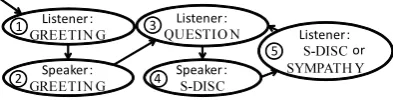
Figure 3: Structure of rule-based system
and the other half emit speaker dialogue acts. All states are connected to each other. We modeled the “food” dialogues using an SHMM, and made the model generate the most probable dialogue-act tag sequences. More specifically, first, a dialogue-act tag was generated randomly based on the ini-tial state. If the state was that of a listener, we generated a maximum likelihood action and the state was randomly transited based on the transi-tion probability. If the state was that of a speaker, we randomly generated an action based on the emission probability and the state was transited using the maximum likelihood transition proba-bility.
Rule-based system This system creates dialogue-act tag sequences using hand-crafted rules that are based on the findings in (Meguro et al., 2009a) and are realized as shown in Fig. 3. A sequence begins at state 1 in Fig. 3, and one dialogue act is generated at each state. At state
3
, a sub-category tag underQUESTION is chosen
randomly, and at state 4, a matched sub-category tag under SELF-DISCLOSURE is chosen. At
state 5, the listener’s SELF-DISCLOSURE or SYMPATHY is generated randomly.
Human dialogue sequence This system created dialogue-act tag sequences by randomly choosing dialogues between humans from the collected data and used their annotated tag sequences.
Random This system simply created dialogue-act tag sequences at random.
5.3 Experimental results
With whom What day What time What Where Who made
1 family weekday around 6:00 pm grilled salmon home mother
2 family weekend around 7:00 pm potato and meat home mother
3 co-workers weekday at noon boiled seaweed lunch box myself
..
. ... ... ... ... ... ...
[image:7.595.105.488.70.138.2]32 friend weekday at noon hamburger school cafeteria N/A
Table 3: Dialogue situations relating to everyday Japanese life We qualitatively analyzed the dialogues of each
system and observed the following characteristics: POMDP At a dialogue’s beginning, the system greets several times and shifts to a different phase in which listeners ask questions and self-disclose to encourage speakers to reciprocate.
Rule-based The output of this system seems very natural and easy to read. The dialogue-act tags followed reasonable rules, making it easier for the participants to create natural utterances from them.
Human conversation The dialogues between humans were obviously natural before they were changed to tags from the natural-language ut-terances. However, human dialogues have ran-domness, which makes it difficult for the partic-ipants to create natural-language utterances from the tags. Hence, the evaluation score for this sys-tem was lower than the “Rule-based.”
HMM, EvenPOMDP Since these systems con-tinually output the same action tags, their output was very unnatural. For example, greetings never stopped because GREETING is most frequently
followed by GREETING in the data. These
sys-tems have no mechanism to stop this loop. POMDP successfully avoided such continua-tion because its accontinua-tions have more varied rewards. For example, GREETING is repeated in
Even-POMDP because its smoothness reward is high; however, in POMDP, although the smoothness re-ward remains high, its user satisfaction rere-ward is not that high. This is because greetings appear in all dialogues and their user satisfaction reward converges to the average. Therefore, such actions as greetings do not get repeated in POMDP. In POMDP, some states have high user satisfaction rewards, and the POMDP policy generated actions to move to such states.
Random Since this system has more variety of tags than HMM, its evaluation scores out-performed HMM, but were outout-performed by POMDP, which learned statistically from the data.
Rule-based 6.07 dialogueHuman
5.22POMDP
(Proposed)
3.76 Random
2.67 HMM
1.17 Even POMDP
1.16
0 1 2 3 4 5 6 7
Av
er
ag
ed
E
va
lu
at
io
n
Sc
or
es
Figure 4: System scores. Except between POMDP and EvenPOMDP, significant differences exist among all systems (p<0.01).
From our qualitative analysis, we found that POMDP can generate more satisfying sequences than HMM/EvenPOMDP because it does not fall into the loop of frequent dialogue-act tag se-quences. This suggests the usefulness of incor-porating two kinds of rewards into the policy and that our approach for setting a reward is promis-ing.
However, with the proposed POMDP, unnatural sequences remain; for example, the system sud-denly output THANKS, as shown in Fig. 6. The
number of states may have been too small. We plan to investigate what caused this in the future.
In our qualitative analysis, we observed that randomness in dialogues might hold a clue for improving evaluation scores. Therefore, we measured the perplexity of each system output using dialogue-act trigrams and obtained 72.8 for “Random,” 27.4 for “Human dialogue,” 7.4 for “POMDP,” 3.2 for “HMM,” 2.5 for “Even-POMDP,” and 1.7 for “Rule-based.”
[image:7.595.306.512.170.282.2]Utterance Dialogue act
S: Hello. GREETING
L: Nice to meet you GREETING
S: I had dinner at home today. S-DISC(sub: fact)
Do you like grilled salmon? QUESTION,PREF
L: Yes, I think so. SYMPATHY
I sometimes want to have a
fancy meal. S-Dsire)ISC (sub:
de-S: Deluxe. REPEAT
Me too. SYMPATHY
L: Do you usually do your own
cooking? Qhabit)UESTION (sub:
S: No, I don’t. S-DISC,HABIT
I always buy my meals at the
convenience store. S-Dhabit)ISC (sub: L: I like the lunch boxes of
[image:8.595.75.289.68.233.2]conve-nience stores S-D(positive))ISC (sub: pref
Figure 5: Excerpt of listening-oriented dialogue that participant imagined from tag sequences of human conversations. Dialogue was translated from Japanese by the authors.
Utterance Dialogue act
L: Nice to meet you. GREETING
Where and who did you have
dinner with today? Qfact)UESTION (sub: S: I had “niku-jaga” (meat and
beef) with my family at home. S-DISC(sub: fact)
L: Oh. ADMIRATION
S: I think it is normal to eat with
your family at home. S-D(neutral))ISC (sub: pref
L: Thanks. THANKS
Do you have any brothers or
sis-ters? Qfact)UESTION (sub:
Soon, my brother and his wife
will visit my home. S-DISC(sub: plan)
S: I see. SYMPATHY
L: I want to use expensive meat in
my “niku-jaga.” S-Dsire)ISC (sub:
de-Oh. ADMIRATION
Please give me your recipe. QUESTION (sub:
information) S: My friends claim that my
“niku-jaga” is as good as a restaurant’s.
INFORMATION
L: I’d love to try it S-DISC (sub:
de-sire)
Figure 6: Excerpt of a listening-oriented dialogue made from tag sequences of POMDP
evaluation scores, we conclude that randomness is necessary in non-task-oriented dialogues and that some randomness can be included with our ap-proach. We do not discuss “Rule-based” here be-cause its tag sequence was meant to have small perplexity.
6 Conclusion and Future work
This paper investigated the possibility of automat-ically building a dialogue control module from
di-alogue data to create automated listening agents. With a POMDP as a learning framework, a dialogue control module was learned from the listening-oriented dialogues we collected and compared with five different systems. Our POMDP system showed higher performance in subjective evaluations than other statistically mo-tivated systems, such as an HMM-based one, that work by selecting the most likely subsequent ac-tion in the dialogue data. When we investigated the output sequences of our POMDP system, the system frequently chose to self-disclose and ques-tion, which corresponds to human listener be-havior, as revealed in the literature (Meguro et al., 2009a). This suggests that learning dialogue control by POMDPs is achievable for listening-oriented dialogues.
The main contribution of this paper is that we successfully showed that POMDPs can be used to train dialogue control policies for less task-oriented dialogue systems, such as listening agents, where the user goals are not as clear as task-oriented ones. We also revealed that the re-ward function can be learned effectively by our formulation that simultaneously maximizes user satisfaction and smoothness. Finding an appro-priate reward function is a real challenge for less task-oriented dialogue systems; this work has pre-sented the first workable solution.
[image:8.595.75.288.304.545.2]References
Bickmore, Timothy and Justine Cassell. 2001. Rela-tional agents: a model and implementation of build-ing user trust. In Proc. SIGCHI conference on human factors in computing systems (CHI), pages 396–403.
Ferguson, George, James F. Allen, and Brad Miller. 1996. TRAINS-95: towards a mixed-initiative plan-ning assistant. InProc. Third Artificial Intelligence Planning Systems Conference (AIPS), pages 70–77.
Higashinaka, Ryuichiro, Kohji Dohsaka, and Hideki Isozaki. 2008. Effects of self-disclosure and em-pathy in human-computer dialogue. InProc. IEEE Workshop on Spoken Language Technology (SLT), pages 108–112.
Higuchi, Shinsuke, Rafal Rzepka, and Kenji Araki. 2008. A casual conversation system using modal-ity and word associations retrieved from the web. In Proc. 2008 conference on Empirical Methods in Natural Language Processing (EMNLP), pages 382–390.
Hirshman, Lynette. 1989. Overview of the DARPA speech and natural language workshop. InProc. DARPA Speech and Natural Language Workshop 1989, pages 1–2.
Isomura, Naoki, Fujio Toriumi, and Kenichiro Ishii. 2009. Evaluation method of non-task-oriented di-alogue system using HMM.IEICE Transactions on Information and Systems, J92-D(4):542–551. Ivey, Allen E. and Mary Bradford Ivey. 2002.
In-tentional Interviewing and Counseling: Facilitat-ing Client Development in a Multicultural Society. Brooks/Cole Publishing Company.
Jurafsky, Dan, Elizabeth Shriberg, and Debra Bi-asca, 1997. Switchboard SWBD-DAMSL Shallow-Discourse-Function Annotation Coders Manual.
Kobayashi, Yuka, Daisuke Yamamoto, Toshiyuki Koga, Sachie Yokoyama, and Miwako Doi. 2010. Design targeting voice interface robot capable of active listening. In Proc. 5th ACM/IEEE inter-national conference on Human-robot interaction (HRI), pages 161–162,
Maatman, R. M., Jonathan Gratch, and Stacy Marsella. 2005. Natural behavior of a listening agent.Lecture Notes in Computer Science, 3661:25–36.
Meguro, Toyomi, Ryuichiro Higashinaka, Kohji Dohsaka, Yasuhiro Minami, and Hideki Isozaki. 2009a. Analysis of listening-oriented dialogue for building listening agents. InProc. 10th Annual SIG-DIAL Meeting on Discourse and Dialogue (SIG-DIAL), pages 124–127.
Meguro, Toyomi, Ryuichiro Higashinaka, Kohji Dohsaka, Yasuhiro Minami, and Hideki Isozaki. 2009b. Effects of personality traits on listening-oriented dialogue. InProc. International Workshop on Spoken Dialogue Systems Technology (IWSDS), pages 104–107.
Minami, Yasuhiro, Akira Mori, Toyomi Meguro, Ryuichiro Higashinaka, Kohji Dohsaka, and Eisaku Maeda. 2009. Dialogue control algorithm for ambient intelligence based on partially observable markov decision processes. InProc. International Workshop on Spoken Dialogue Systems Technology (IWSDS), pages 254–263.
Nakano, Mikio, Noboru Miyazaki, Jun ichi Hirasawa, Kohji Dohsaka, and Takeshi Kawabata. 1999. Un-derstanding unsegmented user utterances in real-time spoken dialogue systems. In Proc. 37th An-nual Meeting of the Association for Computational Linguistics (ACL), pages 200–207.
Pineau, Joelle., Geoff. Gordon, and Sebastian Thrun. 2003. Point-based value iteration: An anytime al-gorithm for POMDPs. InProc. International Joint Conference on Artificial Intelligence (IJCAI), pages 1025–1032.
Shitaoka, Kazuya, Ryoko Tokuhisa, Takayoshi Yoshimura, Hiroyuki Hoshino, and Narimasa Watanabe. 2010. Active listening system for dia-logue robot. InJSAI SIG-SLUD Technical Report, volume 58, pages 61–66. (in Japanese).
Walker, Marilyn, Alex Rudnicky, John Aberdeen, Eliz-abeth Owen Bratt, Rashmi Prasad, Salim Roukos, Greg S, and Seneff Dave Stallard. 2002. DARPA communicator evaluation: progress from 2000 to 2001. InProc. International Conference on Spoken Language Processing (ICSLP), pages 273–276.
Wallace, Richard S. 2004. The Anatomy of A.L.I.C.E.
A.L.I.C.E. Artificial Intelligence Foundation, Inc.
Williams, Jason D. and Steve Young. 2007. Par-tially observable markov decision processes for spo-ken dialog systems. Computer Speech & Language, 21(2):393–422.