A Block-Based Robust Dependency Parser for Unrestricted
Chinese Text,
Ming Zhou Microsoft Research China, Sigma Centre, 49#, Zhichun Road,
100080, Beijing, China [email protected]
Abstract
Although substantial efforts have been made to parse Chinese, very few have been practically used due to incapability of handling unrestricted texts. This paper realizes a practical system for Chinese parsing by using a hybrid model of phrase structure partial parsing and dependency
parsing. This system showed good
performance and high robustness in parsing unrestricted texts and has been applied in a successful machine translation product.
Introduction
Substantial efforts have been made to parse western languages such as English, and many powerful computational models have been proposed (Gazdar, et al, 1987, Tomita, M, 1986). However, very limited work has been done with Chinese. This is mainly due to the fact that the structure of the Chinese language is quite
different from English. Therefore the
computational model in processing English may not be directly applied to the Chinese language. Lin-Shan Lee et al (1991) proposed a Chinese natural language processing system with special consideration o f some typical phenomena of Chinese. Jinye Zhou et al (1986) presented a deterministic Chinese parsing methodology using formal semantics to combine syntactic and semantic analysis. However, most of the
proposed approaches were realized on
small-scale lexicon and rule base (usually thousands words and tens or hundreds rules). It
is still an open issue whether these models will
work on real texts containing various
ungrammatical phenomena. A parser capable of handling real text should have not only large lexicon and big rule base, but also high robustness in coping with different kinds of ungrammatical phenomena. Therefore, it is important to design a grammar scheme which not only is capable of representing the unique grammar structures which are different with
English, but also qualified of handling
unrestricted text.
Phrase structure scheme is usually used in English parsing models to represent sentence structures, but it is not convenient and not strong enough to express Chinese sentence by phrase structure in some occasions. For examples:
Sentence-1 ~ t ~ f f ] i ~ ~ .
Fig. 1 phrase structure
SOC
Fig.2 dependency structure
[image:1.596.343.538.482.678.2]Sentence-1 is a pivot sentence(~gd'f~3), i.e., "~1~" is not only the object of "i,W" butalso the subject of " Ik~" . But this phrase structure cannot indicate the relations clearly as shown in Fig.1. However, the grammar structure is clarified if it is represented in dependency structure (Fig. 2). Therefore, it is believed that dependency grammar sebeme is more suitable than phrase structure to represent Chinese structures (Zhou, Huang, 1994). However, traditional Dependency g a m m a r realizes the dependency relations between any of two specific words, then numerous word based dependency knowledge should be constructed, this is a time-consuming task. Fortunately, knowledge for phrase structure parsing has been accumulated for Chinese for many years and it should be re-used to compensate the lack of knowledge of word-based dependency parsing. Therefore, to combine the advantages of phrase structure parsing and dependency parsing, we
propose a new parsing strategy, called
"block-based dependency parsing".
A "block" means a basic component of sentence, for example, there are six blocks for sentence 1:
]
Another example:
Sentence 2: ~:~_12q::~IJ~Af]i~ ~ ~ ~ n ~
Blocks:[If~.J2q:] [~t~'ff]] [ ~ ] [ ~ l ~ : ~ : ~ t ~ : ]
]
A block represents an information unit in
communications. For example, in
Chinese-Japanese machine translation,
translations of the members within a block in a Chinese sentence usually are in a same blocks in the Japanese translation. Furthermore, it is clear to represent block with phrase structure, while it is rather complicated with dependency structure. This block-based dependency parsing process works like follows. For an input sentence, basic components of sentence, i.e., "blocks" are first identified by an ATN-like partial parsing procedure, which produces a clear skeleton of the sentence structure. In our phrase structure analysis, we don't try to deduce the whole sentence into root S, instead, we only try to get
the components, namely blocks. This partial parsing strategy guarantees high robustness. Then dependency parsing is applied in order to build dependency relations among blocks. The
dependency parsing skips ungrammatical
portions it encounters. This strategy confines ungrammatical portion and avoids errors to be • propagated globally. By partial parsing and skip
strategy, this parser can handle long,
complicated, or even faulty sentences. The experiments show that this parser is very robust and powerful. A parser constructed based on this approach has been developed, with 220,000 words, 5,000 part-of-speech tagging rules, over 1,000 block parsing rules and 300 dependency parsing rules. This parser has been applied in a Chinese-Japanese machine translation product (Zhou, 1999). To the author's knowledge, this parser is one of the largest scale Chinese parser ever implemented in the world.
The outline of this paper is as follows. In section 1, we present our special solution to part-of-speech tagging which significantly affects the Chinese parsing. Section 2 describes in details the block-based dependency parsing approach. We then explain the dependency parsing algorithm in section 3. The experiment and its analysis are given in section 4. The conclusion is given in section 5.
1 Rule-based part-of-speech tagging
The Chinese language has many special syntactic phenomena substantially different from English (Chao, 1981; Huang, 1982, Wu and Hou, 1982). One of the biggest problems is that there is no morphological change for a verb, whether the verb functions as the predicate, subject, object, or modifier of a noun. For instance:
vhv r,rl
([i igCN V] NP)
Chinese linguistics literature insists that those words are verbs, and should be marked as " V ' , regardless of what context they are in. In this sense, there will be phrase structure rules for noun phrase like:
NP->N+V
However, there must be some rules for VP, S like:
S->N+V VP->V+N
Therefore the Conflict of rules becomes very serious. It means that part-of-speech information in Chinese is too weak to support Chinese syntactical analysis. To solve this problem, we propose that in the part-of-speech tagging stage, the real grammar features of this kind of words are determined directly as N, instead of V. To do this, we describe all possible word category information for a word in the lexicon, for example:
~ V/N/F/A
//V: verb; N: noun; F: adverb; A: adjective A set of rules with comprehensive context constraints is designed to determine the specific part-of-speech of a word in a context. For example:
1. X(NIR~J3(VINIFIA) + X(V*)->~(F) + X(V)
2. ~+~(VINIFIA) + X ( ~ ) - > ~ + ~ f l q ) + X(N)
3. ~+~(VINIFIA ) + X(VFN)->~+~J(A ) + X(N)
4. iE~+~J3(VINIFIA) + X(~V)->iE:~+~J3(V)
X(NIR): a word X, whose word category may includes N,R, or others.
R: Pronoun;
* • any part-of-speeches; V* having V category; - V having no V category;
It is ideal if we have a large corpus which has been tagged with thins kind of word category information, so that we can obtain tagging rules or obtained n-gram model by training. However,
at present, we can't find a Chinese corpus tagged with this kind of part-of-speech information as the training data. We had to write the part-of-speech disambiguation rules manually. Currently, over 5,000 linguistics rules have been designed.
2 Block-based Chinese dependency analysis As indicated in Fig. 3, block-based dependency analysis consists of four modules, i.e., word segmentation, part-of-speech tagging, block
analysis and dependency analysis. A
bi-directional heuristic longest matching method is applied to decide the optimal word sequence. A set of manually compiled linguistic rules is applied to decide the optimal word category sequence. In a partial parsing process, first, local structures (such as duplication, prefix and suffix) are identified by a set of word formation rules, and proper names are identified by a set of construction rules. This kind of local structures are called meta-blocks. Then frame structures (DP), which have paired starting word and ending word, such as
"~'"'.
"I~", " ~ ' " ' ." q a " ete are identified, but its internal structure analysis is delayed. Then ATN network is used to identify the basic blocks, called level-1 blocks (these blocks don't contain IP, LP and DP). Then we use a set of heuristic rules to identify the boundaries of IP and LP. Then ATN network will use again to identify the complicated blocks, called level-2 blocks, which may contain LP, DP, IP as its components. Then a sequence of blocks obtained is then transported to dependency parser, which will generate dependency relations among blocks. ARer that, we will recursively parse the internal parts of IP,
Chinese
Sentences
lw°r
segment -ation
part-of- identifica-
speech tion
tagging
I T~gesging 1 [ ATN
J Dependency
~ depend- tree
ency parsing
[image:3.596.111.552.584.707.2]] [ Depe21deenCy ]
LP and DP to get its inner blocks and dependency relations.
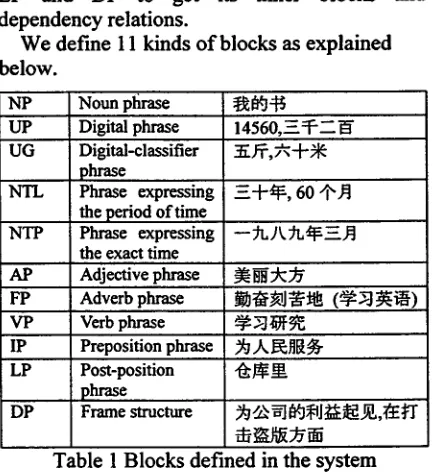
We define 11 kinds o f blocks as explained below.
NP UP UG
NTL
NTP
AP FP VP IP LP
DP
Noun phr~e ~ ¢ ~
Digital phrase 14560,.~_=P--_~" Digital-classifier .:~.~,~-.p~: phrase
Phrase expressing =.-[-~t~z, 60 ./x~ the period of time
Phrase expressing ~ ~}k ~1~.~_~ the exact time
Adjective phrase ~gk:~Y
Adverb phrase ~:~l:'~:J4~ ( ~ :~:i~)
Verb phrase -~-~ ] i ~ Preposition phrase ~ l ~ l / ~ - Post-position " l ~ r ~ phrase
Frame structure ~ ..6..~ ~ ~ ~lJ ~i~ Jl~ .~.,,:i~ ~q"
Table 1 Blocks defined in the system
Except PP, LP and DP, each kind o f block is defined by a set o f rules in the form o f phrase structure rule. All o f these rules combined with syntactic and semantic constraints are implemented as an ATN network (Allen, 1995).
We also define 17 kinds o f dependency relations for Chinese as shown in table 2.
1 !SUB Subject(LiB) 2 0 B J 1 Indireet-objeet~t~ ~ ) 3 O B J 2 Direct o b j e e t ( ~ i ~ ) 4 C O M P Complement(~b~) 4 NUM A m o u n t ( ~ 5 ~ )
5 TOP Topic(~J~)
6 ADV'N Near adverbs ( ~| ~:~o~i~)
7 ADVF Far adverbs (~'l"~.i~. ~'~.~i~. ~ ~ )
8 QT miscellaneous before verbs (~Ji*~:~_. ~-~I
~ ~ )
lO HT miscellaneous after verbs(Y~Ji,~..~l~J
11 P U N C Punctuation mark(~/~gj~-~) 12 P I V T P i v o t ( ~ )
13 SOC Pivot-complcment(~b~) 14 VAA Series of verbs after(~)~ ~-tJt~V~tJ/(l~) 15 VAB Series of verbs before(~J~-~ffL~.t~fl ~) 16 G ~ ~ ~JJ i~q ~t~ fJ~ ~Y~ ~JJ~
17 LOG Logical relation between sentences(tiE ~. I~:)
Table 2 Dependency relations used in the system
For an Input: S = w~, w2,---, w,,, the expected parse result includes two parts as described below:
(!) T : a set o f sub-trees, each sub-tree represents a block.
T={ Ti,T2,T3 ... In }
(~) D: a set of 3-tuple in the form of {governor, dependant, dependency-relation}, which represents dependency relations between blocks.
D = { < go~,de11,relq >,< g o v 2, dep2 , reIa 2 >,... < gov., dep., rela m >}
Algorithm 1: The block-based parsing algorithm
1) Identification DP by matching the starting word and ending word;
2)Identification o f meta-blocks by bottom-up analysis;
3) Identification of NP, UP, UG, NTL, NTP, AP, FP, VP of level 1 by bottom-up analysis;
4)Identification LP, PP by looking for left boundary for LP and right boundary for IP, by using a set of Chinese linguistic rules;
5) Identification o f NP, UP, UG, NTL, NTP, AP, FP, VP of level 2 by bottom-up analysis;
6) Dependency parsing with the blocks identified; 7) For blocks LP, DP and LP, recursively do 1
thorough 6.
In the following, we will illustrate the parsing process with an example.
Sentence 3: : ~ 5 1 q ~ Y ~ ; ~ J ' q a / J ~ J ~
(1)Word Segmentation & Part-of-speech tagging
/ ~
v / ~ F / ~ V/.ff~ N / ~ N/~ ~/q~,b
~-~ FI_i~ AJ. P~
(2) Meta-blocks identification [ / ~ v/:~ F / : ~ v/we
(3) Frame structure identification
_yz NIJt~~ L/]DP
(4) Block identification
[image:4.596.99.316.106.342.2]block2:[/~a N / ~ . ~ NONP
block3: [ ~ v ~ / J , A/~_.~ N / ~ N / ~ V/_~ ~N/,zJC-~ z N/~t~i~,q L/]DP
block4: [ ~ F / ~ A/lAP block5: [o P/]
(5)Predicate Identification
Block4 is determined as the predicate.
(6) Dependency parsing (block2, blockl, OBJ1) (block3, block4, ADVF) (block1, block4, SUB) (block5, bolck4, PUNC)
(7)Repeat the above parsing process to analyze the internal structure of DP, IP and L P
Analyze block3 recursively (The detailed process is omitted).
Lots of efforts have been made to parse languages into phrase structure, and many powerful computational models have been proposed (Gazdar, et al, 1987, Tomita, M, 1986). We build up an ATN like network to identifFy these blocks. Since the ATN approaches can be found in the literatures (Allen, 1995), we will not describe this algorithm in details here. In the next section, we will focus on a new efficient algorithm for Chinese dependency parsing.
3 Dependency analysis
Text For an Input: S = blockl, b l o c k 2 , . . . , b l o c k , , the dependency parsing will generate a set o f 3-tuple in the form of {governor, dependant,
dependency-relation}, which represents
dependency relations between blocks in the given sentence.
{ < g o v 1 , depl , rel% >,
< g o v 2 , dep2 , r e l a 2> .... < g o v . , d e p , , r e l a m >}
Algorithm 2: The dependency parsing
1) Count the number of block qualifying o f acting as a predicate, denoted as s. These kind of blocks are called "predicate candidates".
2) Decide the predicate from these s blocks, denoted as blockj
3) If s=0, return; //need not analysis;
4)For any case of S, S=1,2,... (S>0), dependency parsing respectively;
do
A sentence may contain s predicate candidates. For each case, we defined a detailed analysis algorithm. Up to now, the parser is designed to have ability to treat with sentences containing up to 7 predicate candidates. In case a sentence has more than 7 predicate candidates, it will be partitioned into two parts, and then doing analysis in turn.
Suppose the predicate block is b l o c k j , the number of "predicate candidates" is denoted as s. We explain the dependency parsing by the following two simple cases.
Case 1: s=l
• For all b l o c k k before b l o c k j , builds
dependency relations of
( b l o c k k , block~,suB),( b l o c k k , b l o c k i,ADv),
( b l o c k k , blocks ,G), ( b l o c k k , blockj ,TOP); • For all b l o c k k after blocks ,builds
dependency relations of
( b l o c k k , blocks ,COMP),( b l o c k k , b l o c k i ,OBJ l), ( b l o c k k , block~ ,OBJ2), etc.
Case 2: s=2, Let's say the another predicate candidate is b l o c k j
• For all b l o c k k before blockj ,builds
dependency relations o f
( b l o c k k , block~ ,suB), ( b l o c k k , blocks ,Ape), ( b l o c k k ,blockt,G), ( b l o c k k ,blockj ,TOP); For all b l o c k k after b l o c k j ,builds
dependency relations of
( b l o c k k , b l o c k j ,COMP),
( b l o c k k , b l o c k j ,osJD,
( b l o c k k , b l o c k j ,OBJ2), etc.
• For blocks between b l o c k i and b l o c k j , Conducts detailed analysis based on the verb categories o f b l o c k i and blocky
• Determines the dependency relation
4 Experiments
A parsing system was implemented and extensive experiments have been performed. The system is written in C and tested on Pentium PC. A total of over 1,000 phrase structure rules and over 3,00 dependency rules were used for block-based parsing. We built a large lexicon of 220,000 word entries, with word category information and necessary syntactical and semantic features. This approach has been incorporated as Chinese parsing model in a
successful commercial Chinese-Japanese
machine translation system J-Beijing (Zhou, 1999).
This system accepts Chinese text and output the parsing result for each sentence. Each input sentence is defined as a word string ending with period, comma, question mark, semicolon, exclamation mark.
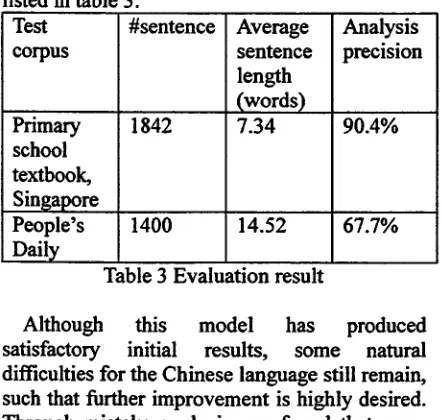
We evaluated the parsing result with two
corpus: (~) "primary school textbook of
S i n g a p o r e " ( ~ : ~ l ~ J ~ : J x ~ ) , a corpus consists of single sentences of modern Chinese, including 1842 sentences, which not only covers most Chinese sentence types, but also includes various of morphological phenomena, such as word duplication, affix, suffix, etc. (~)Some
news articles collected from People's
Daily(1998,1999,2000). The sentences are real text, so there are lots of unknown words (mainly proper nouns), long sentences, complicated sentences, ellipsis, etc. The evaluation results are listed in table 3.
Test corpus
Primary school textbook, Singapore People's Daily
#sentence
1842
Average sentence length
(words) 7.34
Analysis precision
90.4%
[image:6.596.96.317.493.703.2]1400 14.52 67.7%
Table 3 Evaluation result
Although this model has produced
satisfactory initial results, some natural
difficulties for the Chinese language still remain, such that further improvement is highly desired. Through mistake analysis, we found that some
o f main issues affecting the system performance seriously, as is listed below.
1) Word segmentation
/ ~ / , ~ f g J ~ / _ k ~ / o / / ~ . ~ , ~ / ~ / ~ / _ 1 = ~ / o /
" ~ l ~ " can not only function as single word, but also function as two words with totally different meaning.
2) Part-of-speech tagging
(1,~,R) (2,~,I) (3,/0IT,R) (4,~J,I) (5.J~.N) (6,~1~ ~'~.-~,N) (7,~)~,E) (8,fF,V) (9,I~J,E) (10,4~7~,F) (H, ~.7~.F) ( 1 2 , ~ , V , P ) ( 1 3 , ~ , N ) ( 1 4 , ~ , V , C ) (15. ,P)
3) Compound noun
Since compound nouns cannot exhaustively numerated, errors will be inevitable.
4) Identification of proper noun
(1,~TzI~J~],N) ( 2 , ~ , V , P ) C3,~.A) :4...-~.,N) (5,~i
~,v,c) (6,~,~ ( 7 , ~ , ~ (8,,~,~,~
5) Syntactical ambiguity
(l,~i~.,V,P) ( 2 , a n , N ) (3,]~I---~,N) (4,~{~;,N) (5. //~.V.C) (6jz-~.A.D) (6,'~)~,N) (7,~-~,A) (8,0(f.-~,N)
(9,~-~,A) ( I O , ~ , N ) (11,o ,P)
For pattern of "V+A+N', there are usually two kinds of reduction methods:
[[V+A]vp+~ ~ . A ~ / ~ [V+[A+N]np] ~ j ~ z ~
All of these problems need further improvements in the future.
Conclusion
ungrammatical or faulty, or complicated sentences, therefore making the system highly robust. Furthermore, our top-down strategy of identifying the Chinese special structures such as frame structures, preposition structures, post-preposition structures produces a simplified sentence skeleton, thereby improving the efficiency of parsing.
Although this model has shown satisfactory initial results, some natural difficulties for the Chinese language still remain, and further work will be needed. We currently determine the word category by a set of linguistics rules compiled by
human which limits the precision of
identification precision. Therefore, other
approaches such as statistical approach or some kind o f hybrid approach will be adopted in the future. In addition, new methods in handling ambiguous word segmentation, proper noun and compound noun identification, block analysis, predicate identification and dependency analysis will be studied.
Jingcun Wu, Xuechao Hou, Modem Chinese Syntactical Analysis, Beijing University Press,
1982.
Zhengsheng Luo, Changiian Sun, Cai Sun (1995), An Approach to the Recognition of predicated in the automatic analysis of Chinese sentence patterns, Advances and applications on Computational Linguistics, Tsinghua University Press
Chao, Y.R. 0968). A Grammar of Spoken Chinese, Berkeley, CA: University of California Press M. Zhou, C.N.Huang, (1994) An Efficient Syntactic
Tagging Toll for Corpora. Proc. COLING 94, Kyoto, pp. 945-955.
Huang, J. (1982). Logical relations in Chinese and the theory of grammar, Doctoral dissertation, Massachusetts Institute of Technology, Cambridge, MA.
Acknowledgements
Our thanks go to Dr. Kai-Fu Lee and Prof. Changning Huang of Microsoft Research China for their valuable suggestions. Also thanks all the members of Chinese-Japanese MT group of Kodensha for their great efforts in testing the parsing system and improving the dictionary.
References
Gazdar, G.,Franz.,A., Osborne, K., and Evans, R. (1987), Natural Language Processing in the
1980s.', CSLI, Stanford University.
Tomita, M. (1986). Efficient Parsing for Natural Language: A Fast Algorithm for Practical Systems, Boston: Kluwer.
Jinye Zhou, Shi-kuo Chang (1986), A Methodology for Deterministic Chinese Parsing, Computer Processing of Chinese & Oriental Languages, Vol. 2, No. 3 May 1986.
Lin-Shan Lee, Lee-Feng Chien, Longj-ji Lin, James Huang, K.-J. Chen (1991), An Efficient Natural Language Processing System Specially Designed for the Chinese Language, Computational Linguistics, Vol.17, No. 4, 1991