Available online at www.ijrat.org
©2018 Institute for Exploring Advances in Engineering
Multi-Image Enhancement Technique using
Morphological Haar Wavelet Transform
Sreekala K
Visvesvaraya Technological University. Belagavi, India [email protected]
Sateesh Kumar H C
Sai Vidya Institute of Technology Bengaluru, India [email protected]
K B Raja
Dept. of ECE
University Visvesvaraya College of Engineering
Bengaluru, India
ABSTRACT
Image enhancement is the process of improving the quality of a digitally stored image so that it is more suitable for certain applications. Here an image enhancement method is proposed which uses non-linear wavelets. Though wavelet transform is a linear operation, nonlinear extensions can be made combining it with mathematical morphology. Morphological Haar wavelet transform is a type of non-linear wavelet. Unlike the linear Haar wavelet, morphological Haar wavelet uses erosion or dilation instead of linear analysis filter. It is used to maintain the edge information of reconstructed image. Morphological Haar wavelet decomposes the image into low and high frequency components. High frequency component contains horizontal, vertical and diagonal components after decomposition. Low and high frequency coefficients undergo bilinear interpolation to get a group of extended coefficient sequence. These coefficients are combined by averaging the high frequency coefficients and it undergoes inverse transformation to produce a high resolution image. Morphological operations are performed using structuring elements. This method utilizes directional windows to perform non-linear operation. This method using Morphological Haar wavelet results in less mathematical calculations than other existing methods. Performance comparison parameters are calculated for the output image and it is compared with the parameters obtained from other techniques.
Keywords—Bilinear Interpolation, Image Enhancement, Morphological Haar Wavelet, SURF, MSE, PSNR
I. INTRODUCTION
A high quality image is formed from one or more low quality images by different image processing techniques. It is used in many of applications which include text image improvement, medical image processing, facial image improvement and so on. Linear and non-linear filter are two different type of filtering techniques. Linear filter uses linear operation on individual input image and then summing the output. They destroy the edge details of an image. Non-linear filter uses non-linear operation and it helps to preserve edge details. It is complex than the linear filters.
Discrete wavelet transform process only low frequency coefficient in each decomposition level. There the high frequency coefficients are not processed in further levels and the high frequency information in the image will be lost. The analysis filters used in linear wavelet decomposition method are linear lowpass filters and it smoothen the edges whereas the analysis filters in the morphological Haar wavelet transform are non-linear, and they help in preserving the edge information. These filters are constructed using the mathematical morphological operation such as erosion or dilation. Morphological operations are done on images based on shapes. It uses a structuring element on the input image and generates an output image of the same size.
Mathematical morphological operations together with wavelet transform maintain the high frequency and low frequency information in the image. In morphological wavelet transform (MWT), both the coefficients i.e., approximation coefficients and detailed coefficients of the former levels are decomposed in the succeeding levels. So the higher frequency coefficients are not lost. In this way MWT works well in reconstructing better quality image than the DWT. This method can be implemented in images and videos, for obtaining a good quality output. Non-linear class of wavelet is efficient and simpler than other wavelets. Here the objective is to apply morphological wavelet transform on 2D images to generate a high quality output image.
©2018 Institute for Exploring Advances in Engineering
the details of different papers referred. Section 3 describes the proposed enhancement technique, which includes image registration technique used, morphological haar wavelet decomposition, interpolation technique used, inverse transform and different performance comparison parameters that are used for checking the performance of the enhancement method. Section 4 discusses about the output and comparison of the parameters calculated using different methods. Section 5 is conclusion and future work.
II LITERATURE REVIEW
M. A. Farhan and S. S. K[1] speaks about a scheme used for micro grid protection which is based on mathematical morphology. Mathematical morphology can be used for the extraction of signal component more accurately. They have used morphological Haar wavelet for detection of faults. It is a non-linear scheme used for multi-resolution signal decomposition and analysis. Here the mapping of information at different levels of the pyramid is done using analysis and synthesis operators. Lifting scheme is used for the construction of new wavelet decomposition. Performance analysis was done for islanded and grid connected mode of operation in different network topologies.
Kumaki T et al.[2], proposes the idea of Adaptive multi-directional max-plus algebra-based morphological wavelet transform(AM-MMT). AM-MMT helps in extracting the directional structures in order to calculate the nonlinear transform. This gives the concept of selecting different sampling windows with reference to the direction of the contents in an image. An original image is decomposed into rectangular form, where each of them represent as macro block and each macro block pass through square sampling window. AM-MMT improves the efficiency of producing better quality images.
Liu W et al. [3] gives the concept of reconstructing super resolution image by multi-scale Undecimated morphological wavelet transforms which consists of filters that uses morphological mathematical operations. Undecimated morphological wavelet (UMW) is extended in two dimensions. These transforms are multi-directional and shift-invariant. Their design is much simpler and are capable of extracting the meaningful morphological on different directions. It also shows how the proposed method improves the image reconstruction quality and computation efficiency.
Jinal Patel and Ketki Pathak[4] speaks about an architecture for image compression applications which uses Discrete Wavelet Transform(DWT) and lifting scheme. DWT is very important in image and video compression applications as it performs multiresolution analysis of signals. The architecture implemented here using lifting scheme is very simple, which contains row processor, two column processor and a memory module. It is implemented in MATLAB and Xilinx.
Wen Z et al.[5] proposes a lifting morphological wavelet transform based detection scheme for power quality disturbances. Here the construction of prediction operator and update operator is done using a morphological extreme value operator. This highlights the disturbance feature and restrains the noise. Max-lifting and min-Max-lifting morphological wavelet transform deals with the disturbing signals and helps in obtaining the detail coefficient. Then finding out the transient disturbances of the power quality using maxima method.
Fadnavis S [6] speaks about the different image interpolation schemes which are based on multiresolution technique. Image interpolation is used to improve the quality of an image and to find out the values lying between two samples. The interpolation techniques discussed in this paper are nearest neighbor, bilinear interpolation, bicubic interpolation, basic-splines and lanczos interpolation.
Shi H et al.[7] discusses about the construction of morphological midpoint wavelet transform for the prefect reconstruction and the enhancement based on lifting scheme. The morphological wavelet comprises of signal analysis and detail analysis operators that relates to lowpass and highpass channel. Low pass filter give signal information that consists of basic as well as geometry information and high pass filter gives detail information together with noise information and this is discarded by threshold processing. Midpoint filter as a nonlinear filter calculates the average between the maximum as well as minimum values in the area incorporated. The detail analysis operator consists of vertical details, horizontal details and diagonal details. Here the wavelet lifting scheme preserve the edge details efficiently.
Shirai S et al.[8] discuss about different directional and non-directional sampling windows. Morphological wavelet transform on cellular automata processing (CAM2) gives high processing speed and the computation time depends on the number of sampling windows used. How to choose sampling window for the images is also described. Greater potency can be achieved by use of directional sampling windows
in multidirectional morphological wavelet transform.
©2018 Institute for Exploring Advances in Engineering
Implementation of higher level values is done by analysis operator, and the lower level implementation is done by synthesis operator. These two operations together give identity operator. The paper also gives an idea about the difference between single scale and multiscale decomposition methods.
J. Goutsias and H.J.A.M.Heijmans [10] speak about the nonlinear extensions of wavelet transform and the nonlinear extensions started becoming popular with the introduction of lifting scheme. The paper introduces wavelet based mathematical morphology like morphological haar wavelet. Lifting scheme gives an easy way for constructing morphological wavelets. It also discusses some examples which retain local maxima in the signal over a range of values.
H. J. A. M. Heijmans and J. Goutsias [11] speaks about pyramids and wavelets which are the different types of multiresolution image decomposition schemes. Wavelet decomposition always involves a pyramid transform and they have illustrated both with examples using quincunx scheme. They have also discussed a nonlinear wavelet transform which uses the lifting scheme.
Akansha Srivastava et al.[12] speaks about MRI images enhancement which uses approaches in frequency and spatial domain. They have done enhancement in wavelet domain and morphological filters for edge enhancement with some denoising techniques. They have also done the comparison analysis using Contrast improvement index (CII), peak signal to noise ratio (PSNR) and average signal to noise ratio (ASNR).
R.L. Claypoole et al.[13] speaks about the different characteristics of wavelet transform constructed with lifting schemes which helps in incorporating adaptivity and nonlinear operators. They have used "update first" technique to preserve the multiresolution properties of the transform. Within that there is an algorithm to avoid predicting across edges and represent edges efficiently. The adaptive lifting transform given in the paper can be used for lossy compression and helps in reducing edge artifacts and ringing.
Lin Zhuang, [14] proposes a morphological wavelet transform based digital watermarking algorithm which helps in copyright. it has a gray image watermark to alert the copyright owner and a binary image watermark to protect the copyright. It is a simple algorithm with less computational complexity.
Keyong Shao and Yun Zou,[15] proposes a wavelet transform and mathematical morphology based edge detection algorithm. Wavelet transform helps in removing the noise whereas mathematical morphology helps in extracting smooth edges. Low frequency edge extraction is done using morphological edge detection operator and for high frequency edges wavelet modulus maxima edge extraction is used.
Xiaoping J et al.[16] discuss about a set of flat structuring elements used morphological wavelet transform which is used for improving high frequency detail coefficients. Morphological wavelet transform is used for enhancement and filtering to obtain clear fingerprint image. Original image undergo multi-scale forward morphological transformation and then use flat-structuring elements to correct detail coefficients. Finally apply multi-scale morphological reconstruction to obtain an enhanced output image. Mathematical morphology helps in maintaining the image information and eliminates unwanted components.
Huang CP et al.[17] discusses about the image representation using fuzzy morphological wavelet. here the operations performed are similar to conventional mathematical morphology and can be executed much faster using parallel machines. In fuzzy mathematical morphology, the fitting is between the values zero and one. It transforms one fuzzy set to another.
Cha H and Chaparro LF [18] propose an adaptive technique to obtain signal representation using morphological operators and wavelets. In Morphological polynomial representation (MPR) and morphological wavelet representation (MWR) execution depend on minimum as well as maximum morphological operations. Non-linear morphological operation reduces computational complexity and makes fast parallel implementation.
Huynh-Thu Q. and Ghanbari M.[19]speaks about the importance of PSNR in assessing the quality of images and videos. PSNR is a valid quality measure when video content and the codec type are not changed. But if the content is changed, then PSNR cannot be a reliable method.
III PROPOSED METHOD
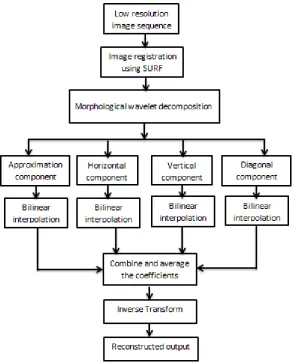
The proposed method to obtain an enhanced high resolution from a sequence of low resolution images is shown in the figure(1). First the images are registered using Speeded Up Robust (SURF) features. This registered image undergoes morphological Haar wavelet decomposition and produces four sub bands. The decomposed coefficients undergo bilinear interpolation. Finally take the inverse Morphological haar wavelet transform to get the enhanced image.
A. Image Registration
©2018 Institute for Exploring Advances in Engineering
[image:4.595.150.448.179.544.2]
the point matching is done using SURF[21][22]. The main concept behind SURF detector is that it is based on the approximated Hessian Matrix. It builds a stack without 2:1 down sampling for upper level in the pyramid. Resulting image will have the same resolution. For filtering the stack, SURF uses a box filter approximation of second order Gaussian partial derivatives and the nearest neighbor will be taken as the key point with minimum Euclidian distance for the invariant descriptor vector.
Figure 1: Proposed Method-flow diagram
B. Morphological Haar Wavelet Decomposition
Morphological haar wavelet transform (MHWT)[9][10] decomposes low resolution 2D image into approximate coefficients and detailed coefficients, vertical, horizontal and diagonal component, with the help of structuring element(B) or a window[2]. Morphological Haar wavelet is the simplest nonlinear wavelet and the structure is similar to linear Haar but it uses morphological operators. Compared to linear wavelets, this preserves the edge edge details.
Morphological Haar min wavelet decomposition is done using the equation[10][11]
(1)
(2)
This decomposes the signal into detail and approximate components. The dual morphological Haar max wavelet decomposition is done using the equations[10][11]
(3)
(4)
©2018 Institute for Exploring Advances in Engineering
C. Bi-linear Interpolation
Bi-linear Interpolation[6] is the resampling method used here. New pixel value is found using the distance weighted average of the four nearest pixel values. Here the two linear interpolations are performed in one direction and the other two linear interpolations are performed in perpendicular direction. The interpolation kernel is given as
[image:5.595.178.417.562.703.2]{ | |
| | | | (5)
where denote the distance between two interpolation points.
D. Inverse Morphological Haar Wavelet
Image reconstruction is done using inverse morphological Haar wavelet transform. The dual of equation used in section (3B) is used for reconstruction.
E. Performance Comparison parameters
Two parameters are used here to compare the effectiveness of the proposed enhancement technique with others. They are Mean Square Error (MSE) and Peak Signal to Noise Ratio (PSNR). MSE is the sum of square of difference between the original and reconstructed images divided by number of pixels in the image.
∑ [ ]
(6)
where is the intensity value of original image and is the intensity value of reconstructed image. is the total number of pixels in the image. PSNR helps in identifying the quality of reconstructed image. High PSNR results in the reconstruction of high quality image. It is expressed in dB (Decibel). t is defined as the square of peak value of image divided by mean square error.
(7)
for gray scale image.
4. RESULTS AND DISCUSSION
A. Results and Analysis
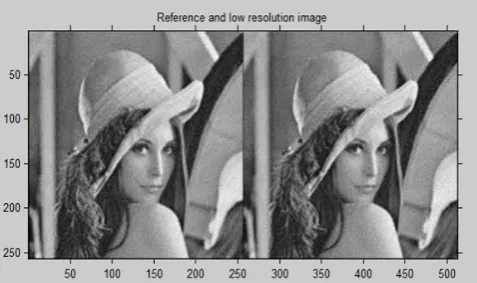
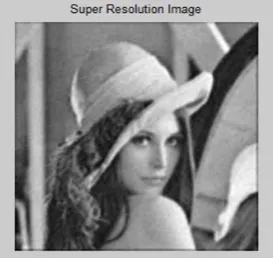
The low resolution Grayscale lena image is processed using the proposed method which consists of morphological haar wavelet and bilinear interpolation. Figutre(2) shows the reference image and a low resolution image to be registered. Figure(3) gives the approximate matching points in both reference and low resolution image. Figure(4) shows the matching points closer to reference image. Registered image is decomposed using morphological haar wavelet transform and results in approximated and detailed(horizontal, vertical and diagonal) components which are shown in figure(5). These coefficients undergo bilinear interpolation and then the average of the coefficients is found. After this take the inverse transform which results in a high quality output image, shown in figure (6)
©2018 Institute for Exploring Advances in Engineering
[image:6.595.151.458.103.443.2]
Figure 3 Putatively Matched Points Figure 4 Matching points
Figure 5 Decomposed components after applying Morphological Haar Wavelet transform
Figure 6 Reconstructed Image
B. Comparative Study
The experiment was done with Morphological Haar Wavelet for different images and parameters PSNR and MSE are calculated. The result is compared with the result obtained using undecimated morphological wavelet and the comparison is given in table(1) and (2). It is found that the proposed method with morphological Haar wavelet gives comparatively better image.
5. CONCLUSION AND FUTURE WORK
[image:6.595.228.365.469.598.2]©2018 Institute for Exploring Advances in Engineering
proposed method gives a better output image compared to undecimated morphological wavelet. The work can be extended for enhancing the video quality.
Table 1: Mean Square Error Images Morphological Haar
Wavelet
Undecimated Morphological Wavelet [3] Lena image
(512X512)
75.43647 90.5191
Pepper (512X512)
91.3356 91.9963
Cameraman (256X256)
156.8629 268.7326
Couple (256X256)
63.9352 183.7385
Barbara (512X512)
76.7857 242.7170
Table2: Peak Signal to Noise Ratio Images Morphological Haar
Wavelet
Undecimated Morphological Wavelet [3] Lena image
(512X512)
29.35499 28.5634
Pepper (512X512)
28.5244 28.4931
Cameraman (256X256)
26.1756 23.8376
Couple (256X256)
30.0734 25.4888
Barbara (512X512)
29.2871 24.2798
REFERENCES
[1] M. A. Farhan and S. S. K, " "Mathematical morphology-based islanding detection for distributed generation", in IET Generation, Transmission and Distribution, vol. 11, no. 14, pp. 3449-3457, 9 28. October 2017.
[2] Kumaki T, Tanito Y, Tokunaga T, Fujita T and Ogura T, “Adaptive multi-directional max-plus algebra-based morphological wavelet transform,” Journal of Signal Processing, vol. 20, no. 1, pp. 9-19, Jan 25, 2016. [3] Liu W, Liang YS, Chen ZB and Zhang JH, “An image super resolution reconstruction algorithm based on undecimated morphological wavelet”, IEEE International Conference on Digital Signal Processing (DSP), pp. 600-603, Jul 21, 2015.
[4] J.Patel and K. Pathak, “Implementation of the 5/3 Lifting 2D Discrete Wavelet Transform”, International Journal of Engineering Development and Research, vol.2, no. 3 , 2014.
[5] Wen Z, Ouyang S and Pei H, “An improved lifting morphological wavelet method and its application in power quality disturbances detection”, IEEE International Conference on Power and Energy Engineering, pp. 1-5, Mar 27, 2012 .
[6] Fadnavis S, “Image Interpolation Techniques in Digital Image Processing: An Overview”, International Journal of Engineering Research and Applications, vol.4, no. 10, pp. 70-3, Oct 4, 2014.
©2018 Institute for Exploring Advances in Engineering
[8] Shirai S, Nakai M, Kumaki T, Fujita T, Nakanishi M and Ogura T, “Morphological wavelet transform using multiple directional sampling windows on cellular hardware platform”, IEEE 9th International New Circuits and systems conference, pp.354-357, Jun 26, 2011.
[9] Goutsias J, Heijmans H J, “Nonlinear multiresolution signal decomposition schemes- I. Morphological pyramids”, IEEE Transactions on image processing, vol.9, no. 11, pp. 1862-76, Nov, 2000.
[10] Goutsias J, Heijmans H J, “Nonlinear multiresolution signal decomposition schemes-II. Morphological wavelets”, IEEE Transactions on Image Processing, vol. 9, no. 11, pp. 1897-913, Nov, 2000.
[11] Henk J. A. M. Heijmans, John Goutsias, "Morphological Pyramids and Wavelets Based on the Quincunx Lattice", Mathematical Morphology and its Applications to Image and Signal Processing, Springer US, pages-273-281, 2000.
[12] Akansha Srivastava, Alankrita, Abhishek Raj, Vikrant Bhateja, "Combination of Wavelet Transform and Morphological Filtering for Enhancement of Magnetic Resonance Images", Digital Information Processing and Communications, Springer Berlin Heidelberg, pages- 460-474, 2011.
[13] R. L. Claypoole and G. M. Davis and W. Sweldens and R. G. Baraniuk, "Nonlinear wavelet transforms for image coding via lifting", IEEE Transactions on Image Processing, volume-12, pages 1449-1459, 2003
[14] Zhuang L,“ Multipurpose digital watermarking algorithm based on morphological wavelet transform,” IEEE International Conference on Communications and Mobile Computing, vol. 3, pp. 396-400, Jan 6, 2009. [15] Keyong Shao, Yun Zou, "An Image Edge Detection Algorithm Based on Wavelet Transform and Mathematical Morphology", Foundations of Intelligent Systems, Springer Berlin Heidelberg, pages 485-495, 2014
[16] Xiaoping J, Shijun Y, Jing Z, Heping C and Naiqi L, “Research of morphological wavelet transformation in fingerprint image preprocessing,” IEEE 6th International Conference on Web Information Systems and Applications , pp. 41-44 , Sep 18, 2009.
[17] Huang CP, Image Representation Using Fuzzy Morphological Wavelet, INTECH Open Access Publisher, 2008.
[18] Cha H, Chaparro LF, “Adaptive morphological representation of signals: Polynomial and wavelet methods”, Multidimensional systems and signal processing, vol. 8, no. 3, pp. 249-71, Jul 1, 1997.
[19] Q. Huynh-Thu, M. Ghanbari, "Scope of validity of PSNR in image/video quality assessment," in Electronics Letters, vol. 44, no. 13, pp. 800-801, June 19 2008.
[20] K. Kipli et al., "Full reference image quality metrics and their performance," 2011 IEEE 7th International Colloquium on Signal Processing and its Applications, Penang, pp. 33-38, 2011.
[21] Bay H, Tuytelaars T, Van Gool L,“Surf: Speeded up robust features,”In European conference on computer
vision, Springer Berlin Heidelberg, pp. 404-417, May7, 2006.