Effective LSTMs for Target-Dependent Sentiment Classification
Duyu Tang, Bing Qin, Xiaocheng Feng, Ting Liu Harbin Institute of Technology, Harbin, China
{dytang, qinb, xcfeng, tliu}@ir.hit.edu.cn
Abstract
Target-dependent sentiment classification remains a challenge: modeling the semantic related-ness of a target with its context words in a sentence. Different context words have different influences on determining the sentiment polarity of a sentence towards the target. Therefore, it is desirable to integrate the connections between target word and context words when building a learning system. In this paper, we develop two target dependent long short-term memory (LSTM) models, where target information is automatically taken into account. We evaluate our methods on a benchmark dataset from Twitter. Empirical results show that modeling sentence represen-tation with standard LSTM does not perform well. Incorporating target information into LSTM can significantly boost the classification accuracy. The target-dependent LSTM models achieve state-of-the-art performances without using syntactic parser or external sentiment lexicons.1
1 Introduction
Sentiment analysis, also known as opinion mining (Pang and Lee, 2008; Liu, 2012), is a fundamental task in natural language processing and computational linguistics. Sentiment analysis is crucial to un-derstanding user generated text in social networks or product reviews, and has drawn a lot of attentions from both industry and academic communities. In this paper, we focus on target-dependent sentiment classification (Jiang et al., 2011; Dong et al., 2014; Vo and Zhang, 2015), which is a fundamental and extensively studied task in the field of sentiment analysis. Given a sentence and a target mention, the task calls for inferring the sentiment polarity (e.g. positive, negative, neutral) of the sentence towards the target. For example, let us consider the sentence: “I bought a new camera. The picture quality is amazing but the battery life is too short”. If the target string ispicture quality, the expected sentiment polarity is “positive” as the sentence expresses a positive opinion towardspicture quality. If we consider the target asbattery life, the correct sentiment polarity should be “negative”.
Target-dependent sentiment classification is typically regarded as a kind of text classification problem in literature. Majority of existing studies build sentiment classifiers with supervised machine learning approach, such as feature based Supported Vector Machine (Jiang et al., 2011) or neural network ap-proaches (Dong et al., 2014; Vo and Zhang, 2015). Despite the effectiveness of these apap-proaches, we argue that target-dependent sentiment classification remains a challenge: how to effectively model the semantic relatedness of a target word with its context words in a sentence. One straight forward way to address this problem is to manually design a set of target-dependent features, and integrate them into existing feature-based SVM. However, feature engineering is labor intensive and the “sparse” and “dis-crete” features are clumsy in encoding side information like target-context relatedness. In addition, a person asked to do this task will naturally “look at” parts of relevant context words which are helpful to determine the sentiment polarity of a sentence towards the target. These motivate us to develop a power-ful neural network approach, which is capable of learning continuous features (representations) without feature engineering and meanwhile capturing the intricate relatedness between target and context words.
1Codes are publicly available athttp://ir.hit.edu.cn/˜dytang.
This work is licensed under a Creative Commons Attribution 4.0 International License. License details: http:// creativecommons.org/licenses/by/4.0/
LSTM 𝑤1 LSTM 𝑤2 LSTM 𝑤𝑙 ……
ℎ1 ℎ2 ℎ𝑙
LSTM
𝑤𝑙+1
LSTM
𝑤𝑟−1
……
ℎ𝑙+1 ℎ𝑟−1
LSTM 𝑤𝑟 LSTM 𝑤𝑛−1 LSTM 𝑤𝑛 ……
ℎ𝑟 ℎ𝑛−1 ℎ𝑛
Softmax
target words
Long Short-Term Memory
LSTML
𝑤1
LSTML
𝑤𝑙
……
ℎ1 ℎ𝑙
LSTML
𝑤𝑙+1
LSTML
𝑤𝑟−1
……
ℎ𝑟−1 ℎ𝑙+1
LSTMR 𝑤𝑙+1 LSTMR 𝑤𝑟−1 …… ℎ𝑟 LSTMR 𝑤𝑟 LSTMR 𝑤𝑛 …… ℎ𝑛
target words target words
ℎ𝑟−1
ℎ𝑙+1
Softmax
[image:2.595.83.514.61.301.2]Target-Dependent Long Short-Term Memory
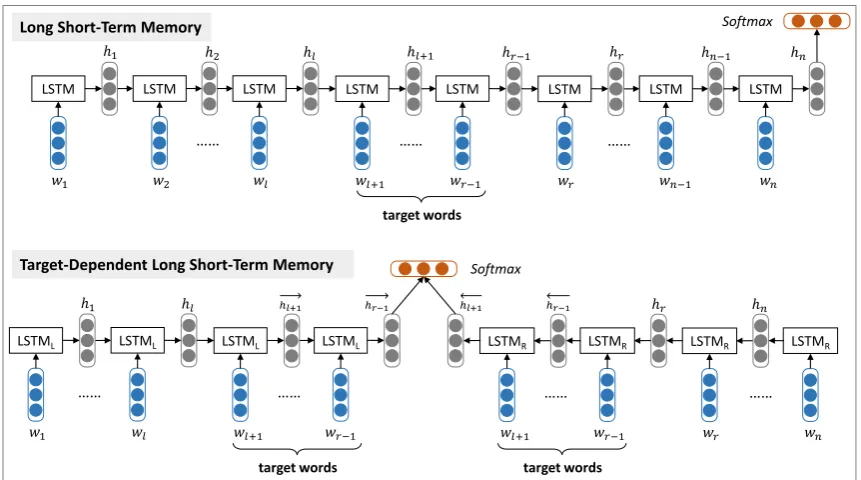
Figure 1: The basic long short-term memory (LSTM) approach and its target-dependent extension TD-LSTM for target-dependent sentiment classification.wstands for word in a sentence whose length isn,
{wl+1,wl+2, ...,wr−1}are target words,{w1,w2, ...,wl}are preceding context words,{wr, ...,wn−1, wn}are following context words.
In this paper, we present neural network models to deal with target-dependent sentiment classification. The approach is an extension on long short-term memory (LSTM) (Hochreiter and Schmidhuber, 1997) by incorporating target information. Such target-dependent LSTM approach models the relatedness of a target word with its context words, and selects the relevant parts of contexts to infer the sentiment polarity towards the target. The model could be trained in an end-to-end way with standard backpropagation, where the loss function is cross-entropy error of supervised sentiment classification.
We apply the neural model to target-dependent sentiment classification on a benchmark dataset (Dong et al., 2014). We compare with feature-based SVM (Jiang et al., 2011), adaptive recursive neural network (Dong et al., 2014) and lexicon-enhanced neural network (Vo and Zhang, 2015). Empirical results show that the proposed approach without using syntactic parser or external sentiment lexicon obtains state-of-the-art classification accuracy. In addition, we find that modeling sentence with standard LSTM does not perform well on this target-dependent task. Integrating target information into LSTM could significantly improve the classification accuracy.
2 The Approach
We describe the proposed approach for target-dependent sentiment classification in this section. We first present a basic long short-term memory (LSTM) approach, which models the semantic representation of a sentence without considering the target word being evaluated. Afterwards, we extend LSTM by considering the target word, obtaining the Target-Dependent Long Short-Term Memory (TD-LSTM) model. Finally, we extend TD-LSTM with target connection, where the semantic relatedness of target with its context words are incorporated.
2.1 Long Short-Term Memory (LSTM)
In this part, we describe a long short-term memory (LSTM) model for target-dependent sentiment clas-sification. It is a basic version of our approach. In this setting, the target to be evaluated is ignored so that the task is considered in a target independent way.
LSTML
𝑤1
LSTML
𝑤𝑙
……
ℎ1 ℎ𝑙
LSTML
𝑤𝑙+1
LSTML
𝑤𝑟−1
……
ℎ𝑟−1 ℎ𝑙+1
LSTMR
𝑤𝑙+1
LSTMR
𝑤𝑟−1
……
ℎ𝑟
LSTMR
𝑤𝑟
LSTMR
𝑤𝑛
……
ℎ𝑛 ℎ𝑟−1
ℎ𝑙+1
Softmax
Target-Connection Long Short-Term Memory
[image:3.595.82.514.62.184.2]𝑣𝑡𝑎𝑟𝑔𝑒𝑡
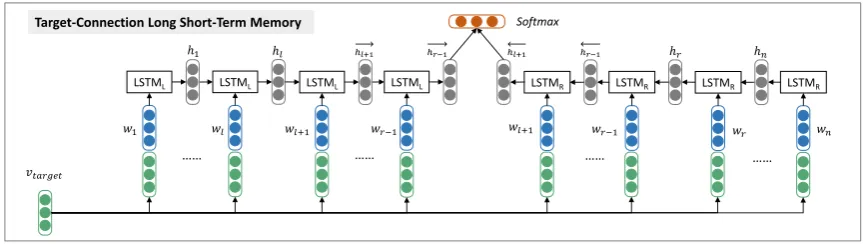
Figure 2: The target-connection long short-term memory (TC-LSTM) model for target-dependent sen-timent classification, wherewstands for word in a sentence whose length isn,{wl+1,wl+2, ...,wr−1}
are target words,vtargetis target representation,{w1,w2, ...,wl}are preceding context words,{wr, ..., wn−1,wn}are following context words.
analysis (Li et al., 2015a; Tang et al., 2015). It is capable of computing the representation of a longer expression (e.g. a sentence) from the representation of its children with multi levels of abstraction. The sentence representation can be naturally considered as the feature to predict the sentiment polarity of sentence.
Specifically, each word is represented as a low dimensional, continuous and real-valued vector, also known as word embedding (Bengio et al., 2003; Mikolov et al., 2013; Pennington et al., 2014; Tang et al., 2014). All the word vectors are stacked in a word embedding matrixLw ∈ Rd×|V|, wheredis
the dimension of word vector and|V|is vocabulary size. In this work, we pre-train the values of word vectors from text corpus with embedding learning algorithms (Pennington et al., 2014; Tang et al., 2014) to make better use of semantic and grammatical associations of words.
We use LSTM to compute the vector of a sentence from the vectors of words it contains, an illustration of the model is shown in Figure 1. LSTM is a kind of recurrent neural network (RNN), which is capable of mapping vectors of words with variable length to a fixed-length vector by recursively transforming current word vector wt with the output vector of the previous step ht−1. The transition function of
standard RNN is a linear layer followed by a pointwise non-linear layer such as hyperbolic tangent function (tanh).
ht=tanh(W ·[ht−1;wt] +b) (1)
whereW ∈ Rd×2d,b ∈ Rd,dis dimension of word vector. However, standard RNN suffers the
prob-lem of gradient vanishing or exploding (Bengio et al., 1994; Hochreiter and Schmidhuber, 1997), where gradients may grow or decay exponentially over long sequences. Many researchers use a more sophisti-cated and powerful LSTM cell as the transition function, so that long-distance semantic correlations in a sequence could be better modeled. Compared with standard RNN, LSTM cell contains three additional neural gates: an input gate, a forget gate and an output gate. These gates adaptively remember input vector, forget previous history and generate output vector (Hochreiter and Schmidhuber, 1997). LSTM cell is calculated as follows.
it=σ(Wi·[ht−1;wt] +bi) (2)
ft=σ(Wf ·[ht−1;wt] +bf) (3)
ot=σ(Wo·[ht−1;wt] +bo) (4)
gt=tanh(Wr·[ht−1;wt] +br) (5)
ct=itgt+ftct−1 (6)
ht=ottanh(ct) (7)
wherestands for element-wise multiplication,σ is sigmoid function,Wi,bi,Wf,bf,Wo,boare the
After calculating the hidden vector of each position, we regard the last hidden vector as the sentence representation (Li et al., 2015a; Tang et al., 2015). We feed it to a linear layer whose output length is class number, and add asoftmaxlayer to output the probability of classifying the sentence as positive, negative or neutral. Softmax function is calculated as follows, where C is the number of sentiment categories.
softmaxi = PCexp(xi)
i0=1exp(xi0) (8)
2.2 Target-Dependent LSTM (TD-LSTM)
The aforementioned LSTM model solves dependent sentiment classification in a target-independent way. That is to say, the feature representation used for sentiment classification remains the same without considering the target words. Let us again take “I bought a new camera. The picture quality is amazing but the battery life is too short” as an example. The representations of this sentence with regard topicture qualityandbattery lifeare identical. This is evidently problematic as the sentiment polarity labels towards these two targets are different.
To take into account of the target information, we make a slight modification on the aforementioned LSTM model and introduce a target-dependent LSTM (TD-LSTM) in this subsection. The basic idea is to model the preceding and following contexts surrounding the target string, so that contexts in both directions could be used as feature representations for sentiment classification. We believe that capturing such target-dependent context information could improve the accuracy of target-dependent sentiment classification.
Specifically, we use two LSTM neural networks, a left one LSTMLand a right one LSTMR, to model
the preceding and following contexts respectively. An illustration of the model is shown in Figure 1. The input of LSTMLis the preceding contexts plus target string, and the input of LSTMRis the following
contexts plus target string. We run LSTMLfrom left to right, and run LSTMRfrom right to left. We favor
this strategy as we believe that regarding target string as the last unit could better utilize the semantics of target string when using the composed representation for sentiment classification. Afterwards, we concatenate the last hidden vectors of LSTMLand LSTMR, and feed them to asoftmaxlayer to classify
the sentiment polarity label. One could also try averaging or summing the last hidden vectors of LSTML
and LSTMRas alternatives.
2.3 Target-Connection LSTM (TC-LSTM)
Compared with LSTM model, target-dependent LSTM (TD-LSTM) could make better use of the target information. However, we think TD-LSTM is still not good enough because it does not capture the interactions between target word and its contexts. Furthermore, a person asked to do target-dependent sentiment classification will select the relevant context words which are helpful to determine the senti-ment polarity of a sentence towards the target.
Based on the consideration mentioned above, we go one step further and develop a target-connection long short-term memory (TC-LSTM). This model extends TD-LSTM by incorporating an target con-nection component, which explicitly utilizes the concon-nections between target word and each context word when composing the representation of a sentence.
An overview of TC-LSTM is illustrated in Figure 2. The input of TC-LSTM is a sentence consist-ing of n words{w1, w2, ...wn} and a target stringt occurs in the sentence. We represent target t as {wl+1, wl+2...wr−1}because a target could be a word sequence of variable length, such as “google” or
“harry potter”. When processing a sentence, we split it into three components: target words, preceding context words and following context words. We obtain target vectorvtarget by averaging the vectors
the embedding of current word. We believe that TC-LSTM could make better use of the connection between target and each context word when building the representation of a sentence.
2.4 Model Training
We train LSTM, TD-LSTM and TC-LSTM in an end-to-end way in a supervised learning framework. The loss function is the cross-entropy error of sentiment classification.
loss=−X
s∈S C X
c=1 Pg
c(s)·log(Pc(s)) (9)
whereSis the training data,C is the number of sentiment categories,smeans a sentence,Pc(s)is the
probability of predicting sas classc given by the softmaxlayer, Pcg(s) indicates whether class cis
the correct sentiment category, whose value is 1 or 0. We take the derivative of loss function through back-propagation with respect to all parameters, and update parameters with stochastic gradient descent. 3 Experiment
We apply the proposed method to target-dependent sentiment classification to evaluate its effectiveness. We describe experimental setting and empirical results in this section.
3.1 Experimental Settings
We conduct experiment in a supervised setting on a benchmark dataset (Dong et al., 2014). Each instance in the training/test set has a manually labeled sentiment polarity. Training set contains 6,248 sentences and test set has 692 sentences. The percentages of positive, negative and neutral in training and test sets are both 25%, 25%, 50%. We train the model on training set, and evaluate the performance on test set. Evaluation metrics are accuracy and macro-F1 score over positive, negative and neutral categories (Manning and Sch¨utze, 1999; Jurafsky and Martin, 2000).
3.2 Comparison to Other Methods
We compare with several baseline methods, including:
In SVM-indep, SVM classifier is built with target-independent features, such as unigram, bigram, punctuations, emoticons, hashtags, the numbers of positive or negative words in General Inquirer senti-ment lexicon. InSVM-dep, target-dependent features (Jiang et al., 2011) are also concatenated as the feature representation.
In Recursive NN, standard Recursive neural network is used for feature learning over a transfered target-dependent dependency tree (Dong et al., 2014). AdaRNN-w/oE,AdaRNN-w/Eand AdaRNN-combare different variations of adaptive recursive neural network (Dong et al., 2014), whose composi-tion funccomposi-tions are adaptively selected according to the inputs.
InTarget-dep, SVM classifier is built based on rich target-independent and target-dependent features (Vo and Zhang, 2015). InTarget-dep+, sentiment lexicon features are further incorporated.
The neural models developed in this paper are abbreviated as LSTM, TD-LSTM and TC-LSTM, which are described in the previous section. We use 100-dimensional Glove vectors learned from Twitter, randomize the parameters with uniform distribution U(−0.003,0.003), set the clipping threshold of softmax layer as 200 and set learning rate as 0.01.
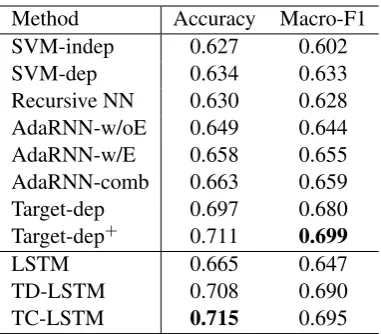
Experimental results of baseline models and our methods are given in Table 1. Comparing between SVM-indep and SVM-dep, we can find that incorporating target information can improve the classifica-tion accuracy of a basic SVM classifier. AdaRNN performs better than feature based SVM by making use of dependency parsing information and tree-structured semantic composition. We can find that target-dep is a strong performer even without using lexicon features. It benefits from rich automatic features generated from word embeddings.
Method Accuracy Macro-F1 SVM-indep 0.627 0.602 SVM-dep 0.634 0.633 Recursive NN 0.630 0.628 AdaRNN-w/oE 0.649 0.644 AdaRNN-w/E 0.658 0.655 AdaRNN-comb 0.663 0.659 Target-dep 0.697 0.680 Target-dep+ 0.711 0.699
LSTM 0.665 0.647
[image:6.595.204.395.60.227.2]TD-LSTM 0.708 0.690 TC-LSTM 0.715 0.695
Table 1: Comparison of different methods on target-dependent sentiment classification. Evaluation met-rics are accuracy and macro-F1. Best scores are in bold.
targets in a sentence. TD-LSTM obtains a big improvement over LSTM when target signals are taken into consideration. This result demonstrates the importance of target information for target-dependent sentiment classification. By incorporating target-connection mechanism, TC-LSTM obtains the best performances and outperforms all baseline methods in term of classification accuracy.
Comparing between Target-dep+and Target-dep, we find that sentiment lexicon feature could further
improve the classification accuracy. Our final model TC-LSTM without using sentiment lexicon infor-mation performs comparably with Target-dep+. We believe that incorporation lexicon information in
TC-LSTM could get further improvement. We leave this as a potential future work.
3.3 Effects of Word Embeddings
It is well accepted that a good word embedding is crucial to composing a powerful text representa-tion at higher level. We therefore study the effects of different word embeddings on LSTM, TD-LSTM and TC-LSTM in this part. Since the benchmark dataset from (Dong et al., 2014) comes from Twitter, we compare between sentiment-specific word embedding (SSWE)2(Tang et al., 2014) and Glove vec-tors3 (Pennington et al., 2014). All these word vectors are 50-dimensional and learned from Twitter. SSWEh, SSWEr and SSWEu are different embedding learning algorithms introduced in (Tang et al.,
2014). SSWEhand SSWErlearn word embeddings by only using sentiment of sentences. SSWEutakes
into account of sentiment of sentences and contexts of words simultaneously.
LSTM TD−LSTM TC−LSTM
0.6 0.62 0.64 0.66 0.68 0.7 0.72
SSWE−h SSWE−r SSWE−u Glove.twitter.50d Glove.twitter.100d Glove.twitter.200d
Figure 3: Classification accuracy of LSTM, TD-LSTM and TC-LSTM with different word embeddings. We compare between SSWEh, SSWEr, SSWEuand Glove vectors.
2SSWE vectors are publicly available athttp://ir.hit.edu.cn/˜dytang
[image:6.595.159.440.540.698.2]From Figure 3, we can find that SSWEhand SSWErperform worse than SSWEu, which is consistent
with the results reported on target-independent sentiment classification of tweets (Tang et al., 2014). This shows the importance of context information for word embedding learning as both SSWEh and
SSWErdo not encode any word contexts. Glove and SSWEu perform comparably, which indicates the
importance of global context for estimating a good word representation. In addition, the target connection model TC-LSTM performs best when considering a specific word embedding.
50dms 100dms 200dms
LSTM 27 95 329
LSTM-TD 20 93 274
LSTM-TC 65 280 1,165
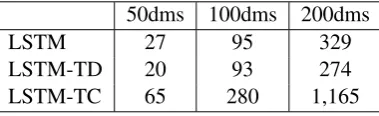
Table 2: Time cost of each model with 50dms, 100dms and 200dms Glove vectors. Each value means how many seconds cost in each training iteration.
We compare between Glove vectors with different dimensions (50/100/200). Classification accuracy and time cost are given in Figure 3 and Table 2, respectively. We can find that 100-dimensional word vectors perform better than 50-dimensional word vectors, while 200-dimensional word vectors do not show significant improvements. Furthermore, LSTM and LSTM have similar time cost, while TD-LSTM gets higher classification accuracy as target information is incorporated. TC-TD-LSTM performs slightly better than TD-LSTM while at the cost of longer training time because the parameter number of TC-LSTM is larger.
3.4 Case Study
In this section, we explore to what extent the target-dependent LSTM models including TD-LSTM and TC-LSTM improve the performance of a basic LSTM model.
Example gold LSTM
i hate myipodlook at my last tweet before the argh one that ’s for you -1 0
okay soooo ... ummmmm .... what is going on with lindsay lohan’ s face?
boring day at the office = perez and tomorrow overload. not good 0 -1 i heard ShannonBrown did his thing in thelakersgame!! got ta love him 0 1
Heygoogle, thanks for all these great Labs features on Chromium, but how
[image:7.595.204.394.159.217.2]about ” Create Application Shortcut”?! 1 0
Table 3: Examples drawn from the test set whose polarity labels are incorrectly inferred by LSTM but correctly predicted by both TD-LSTM and TC-LSTM. For each example, target words are in bold, “gold” is the ground truth and “LSTM” means the predicted sentiment label from LSTM model.
In Table 3, we list some examples whose polarity labels are incorrectly inferred by LSTM but correctly predicted by both TD-LSTM and TC-LSTM. We observe that LSTM model prefers to assigning the polarity of the entire sentence while ignoring the target to be evaluated. TD-LSTM and TC-LSTM could take into account of target information to some extend. For example, in the 2nd example the opinion holder expresses a negative opinion about his work, but holds a neutral sentiment towards the target “lindsay lohan”. In the last example, the whole sentence expresses a neutral sentiment while it holds a positive opinion towards “google”.
3.5 Discussion
In order to capture the semantic relatedness between target and context words, we extend TD-LSTM by adding a target connection component. One could also try other extensions to capture the connection between target and context words. For example, we also tried an attention-based LSTM model, which is inspired by the recent success of attention-based neural network in machine translation (Bahdanau et al., 2015) and document encoding (Li et al., 2015b). We implement the soft-attention mechanism (Bah-danau et al., 2015) to enhance TD-LSTM. We incorporate two attention layers for preceding LSTM and following LSTM, respectively. The output vector for each attention layer is the weighted average among hidden vectors of LSTM, where the weight of each hidden vector is calculated with a feedforward neural network. The outputs of preceding and following attention models are concatenated and fed tosoftmax
for sentiment classification. However, we cannot obtain better result with such an attention model. The accuracy of this attention model is slightly lower than the standard LSTM model (around 65%), which means that the attention component has a negative impact on the model. A potential reason might be that the attention based LSTM has larger number of parameters, which cannot be easily optimized with the small number of corpus.
4 Related Work
We briefly review existing studies on target-dependent sentiment classification and neural network ap-proaches for sentiment classification in this section.
4.1 Target-Dependent Sentiment Classification
Target-dependent sentiment classification is typically regarded as a kind of text classification problem in literature. Therefore, standard text classification approach such as feature-based Supported Vector Machine (Pang et al., 2002; Jiang et al., 2011) can be naturally employed to build a sentiment classi-fier. Despite the effectiveness of feature engineering, it is labor intensive and unable to discover the discriminative or explanatory factors of data. To handle this problem, some recent studies (Dong et al., 2014; Vo and Zhang, 2015) use neural network methods and encode each sentence in continuous and low-dimensional vector space without feature engineering. Dong et al. (2014) transfer a dependency tree of a sentence into a target-specific recursive structure, and get higher level representation based on that structure. Vo and Zhang (2015) use rich features including sentiment-specific word embedding and sentiment lexicons. Different from previous studies, the LSTM models developed in this work are purely data-driven, and do not rely on dependency parsing results or external sentiment lexicons.
4.2 Neural Network for Sentiment Classification
Neural network approaches have shown promising results on many sentence/document-level sentimen-t classificasentimen-tion (Socher esentimen-t al., 2013b; Tang esentimen-t al., 2015). The power of neural model lies in isentimen-ts a-bility in learning continuous text representation from data without any feature engineering. For sen-tence/document level sentiment classification, previous studies mostly have two steps. They first learn continuous word vector embeddings from data (Bengio et al., 2003; Mikolov et al., 2013; Pennington et al., 2014). Afterwards, semantic compositional approaches are used to compute the vector of a sen-tence/document from the vectors of its constituents based on the principle of compositionality (Frege, 1892). Representative compositional approaches to learn sentence representation include recursive neu-ral networks (Socher et al., 2013b; Irsoy and Cardie, 2014), convolutional neuneu-ral network (Kalchbrenner et al., 2014; Kim, 2014), long short-term memory (Li et al., 2015a) and tree-structured LSTM (Tai et al., 2015; Zhu et al., 2015). There also exists some studies focusing on learning continuous representation of documents (Le and Mikolov, 2014; Tang et al., 2015; Bhatia et al., 2015; Yang et al., 2016).
5 Conclusion
incorporating target information could boost the performance of a long short-term memory model. The target-dependent LSTM model obtains state-of-the-art classification accuracy.
Acknowledgements
We greatly thank Yaming Sun for tremendously helpful discussions. This work was supported by the National High Technology Development 863 Program of China (No. 2015AA015407), National Natural Science Foundation of China (No. 61632011 and No.61273321). According to the meaning given to this role by Harbin Institute of Technology, the contact author of this paper is Bing Qin.
References
Dzmitry Bahdanau, Kyunghyun Cho, and Yoshua Bengio. 2015. Neural machine translation by jointly learning to
align and translate. ICLR.
Yoshua Bengio, Patrice Simard, and Paolo Frasconi. 1994. Learning long-term dependencies with gradient descent
is difficult. Neural Networks, IEEE Transactions on, 5(2):157–166.
Yoshua Bengio, R´ejean Ducharme, Pascal Vincent, and Christian Janvin. 2003. A neural probabilistic language
model. Journal of Machine Learning Research, 3:1137–1155.
Parminder Bhatia, Yangfeng Ji, and Jacob Eisenstein. 2015. Better document-level sentiment analysis from rst
discourse parsing. InEMNLP, pages 2212–2218.
Li Dong, Furu Wei, Chuanqi Tan, Duyu Tang, Ming Zhou, and Ke Xu. 2014. Adaptive recursive neural network
for target-dependent twitter sentiment classification. InACL, pages 49–54.
Gottlob Frege. 1892. On sense and reference.Ludlow (1997), pages 563–584.
Sepp Hochreiter and J¨urgen Schmidhuber. 1997. Long short-term memory. Neural computation, 9(8):1735–1780.
Ozan Irsoy and Claire Cardie. 2014. Deep recursive neural networks for compositionality in language. InNIPS,
pages 2096–2104.
Long Jiang, Mo Yu, Ming Zhou, Xiaohua Liu, and Tiejun Zhao. 2011. Target-dependent twitter sentiment
classi-fication.ACL, 1:151–160.
Dan Jurafsky and James H Martin. 2000. Speech & language processing. Pearson Education India.
Nal Kalchbrenner, Edward Grefenstette, and Phil Blunsom. 2014. A convolutional neural network for modelling
sentences. InACL, pages 655–665.
Yoon Kim. 2014. Convolutional neural networks for sentence classification. InEMNLP, pages 1746–1751.
Quoc V. Le and Tomas Mikolov. 2014. Distributed representations of sentences and documents. InICML, pages
1188–1196.
Jiwei Li, Dan Jurafsky, and Eudard Hovy. 2015a. When are tree structures necessary for deep learning of
repre-sentations? EMNLP.
Jiwei Li, Minh-Thang Luong, and Dan Jurafsky. 2015b. A hierarchical neural autoencoder for paragraphs and
documents. ACL.
Bing Liu. 2012. Sentiment analysis and opinion mining. Synthesis Lectures on Human Language Technologies,
5(1):1–167.
Christopher D Manning and Hinrich Sch¨utze. 1999. Foundations of statistical natural language processing. MIT
press.
Tomas Mikolov, Ilya Sutskever, Kai Chen, Greg S Corrado, and Jeff Dean. 2013. Distributed representations of
words and phrases and their compositionality. InNIPS, pages 3111–3119.
Bo Pang and Lillian Lee. 2008. Opinion mining and sentiment analysis. Foundations and trends in information
Bo Pang, Lillian Lee, and Shivakumar Vaithyanathan. 2002. Thumbs up?: sentiment classification using machine
learning techniques. InEMNLP, pages 79–86.
Jeffrey Pennington, Richard Socher, and Christopher D Manning. 2014. Glove: Global vectors for word
represen-tation. InEMNLP, pages 1532–1543.
Richard Socher, Danqi Chen, Christopher D Manning, and Andrew Y Ng. 2013a. Reasoning with neural tensor
networks for knowledge base completion.NIPS.
Richard Socher, Alex Perelygin, Jean Wu, Jason Chuang, Christopher D. Manning, Andrew Ng, and Christopher
Potts. 2013b. Recursive deep models for semantic compositionality over a sentiment treebank. In EMNLP,
pages 1631–1642.
Yaming Sun, Lei Lin, Duyu Tang, Nan Yang, Zhenzhou Ji, and Xiaolong Wang. 2015. Modeling mention, context
and entity with neural networks for entity disambiguation.IJCAI.
Kai Sheng Tai, Richard Socher, and Christopher D Manning. 2015. Improved semantic representations from
tree-structured long short-term memory networks. InACL.
Duyu Tang, Furu Wei, Nan Yang, Ming Zhou, Ting Liu, and Bing Qin. 2014. Learning sentiment-specific word
embedding for twitter sentiment classification. InACL, pages 1555–1565.
Duyu Tang, Bing Qin, and Ting Liu. 2015. Document modeling with gated recurrent neural network for sentiment
classification. EMNLP, pages 1422–1432.
Duy-Tin Vo and Yue Zhang. 2015. Target-dependent twitter sentiment classification with rich automatic features.
IJCAI.
Zichao Yang, Diyi Yang, Chris Dyer, Xiaodong He, Alex Smola, and Eduard Hovy. 2016. Hierarchical attention
networks for document classification. InProceedings of the 2016 Conference of the North American Chapter
of the Association for Computational Linguistics: Human Language Technologies.