
Learning Question Classifiers
Xin Li Dan Roth
Department of Computer Science University of Illinois at Urbana-Champaign
fxli1,[email protected]
Abstract
In order to respond correctly to a free form factual ques-tion given a large collecques-tion of texts, one needs to un-derstand the question to a level that allows determining some of the constraints the question imposes on a pos-sible answer. These constraints may include a semantic classification of the sought after answer and may even suggest using different strategies when looking for and verifying a candidate answer.
This paper presents a machine learning approach to question classification. We learn a hierarchical classi-fier that is guided by a layered semantic hierarchy of an-swer types, and eventually classifies questions into fine-grained classes. We show accurate results on a large col-lection of free-form questions used in TREC 10.
1 Introduction
Open-domain question answering (Lehnert, 1986; Harabagiu et al., 2001; Light et al., 2001) and story comprehension (Hirschman et al., 1999) have be-come important directions in natural language pro-cessing. Question answering is a retrieval task more challenging than common search engine tasks be-cause its purpose is to find an accurate and concise answer to a question rather than a relevant docu-ment. The difficulty is more acute in tasks such as story comprehension in which the target text is less likely to overlap with the text in the questions. For this reason, advanced natural language techniques rather than simple key term extraction are needed. One of the important stages in this process is analyz-ing the question to a degree that allows determinanalyz-ing the “type” of the sought after answer. In the TREC competition (Voorhees, 2000), participants are re-quested to build a system which, given a set of En-glish questions, can automatically extract answers (a short phrase) of no more than 50 bytes from a 5-gigabyte document library. Participants have
Research supported by NSF grants 9801638 and ITR IIS-0085836 and an ONR MURI Award.
alized that locating an answer accurately hinges on first filtering out a wide range of candidates (Hovy et al., 2001; Ittycheriah et al., 2001) based on some categorization of answer types.
This work develops a machine learning approach to question classification (QC) (Harabagiu et al., 2001; Hermjakob, 2001). Our goal is to categorize questions into different semantic classes that impose constraints on potential answers, so that they can be utilized in later stages of the question answering process. For example, when considering the ques-tion Q: What Canadian city has the largest
popula-tion?, the hope is to classify this question as having
answer type city, implying that only candidate an-swers that are cities need consideration.
Based on the SNoW learning architecture, we de-velop a hierarchical classifier that is guided by a lay-ered semantic hierarchy of answer types and is able to classify questions into fine-grained classes. We suggest that it is useful to consider this classifica-tion task as a multi-label classificaclassifica-tion and find that it is possible to achieve good classification results (over 90%) despite the fact that the number of dif-ferent labels used is fairly large,50. We observe that local features are not sufficient to support this accu-racy, and that inducing semantic features is crucial for good performance.
The paper is organized as follows: Sec. 2 presents the question classification problem; Sec. 3 discusses the learning issues involved in QC and presents our learning approach; Sec. 4 describes our experimen-tal study.
2 Question Classification
We define Question Classification(QC) here to be the task that, given a question, maps it to one of
k classes, which provide a semantic constraint on the sought-after answer1. The intension is that this
1We do not address questions like “Do you have a light?”,
classification, potentially with other constraints on the answer, will be used by a downstream process which selects a correct answer from among several candidates.
A question classification module in a question an-swering system has two main requirements. First, it provides constraints on the answer types that allow further processing to precisely locate and verify the answer. Second, it provides information that down-stream processes may use in determining answer se-lection strategies that may be answer type specific, rather than uniform. For example, given the ques-tion “Who was the first woman killed in the Vietnam
War?” we do not want to test every noun phrase
in a document to see whether it provides an answer. At the very least, we would like to know that the target of this question is a person, thereby reducing the space of possible answers significantly. The fol-lowing examples, taken from the TREC 10 question collection, exhibit several aspects of this point. Q: What is a prism? Identifying that the target of this
question is a definition, strategies that are specific for
definitions (e.g., using predefined templates) may be
use-ful. Similarly, in:
Q: Why is the sun yellow? Identifying that this question
asks for a reason, may lead to using a specific strategy for reasons.
The above examples indicate that, given that dif-ferent answer types may be searched using difdif-ferent strategies, a good classification module may help the question answering task. Moreover, determin-ing the specific semantic type of the answer could also be beneficial in locating the answer and veri-fying it. For example, in the next two questions, knowing that the targets are a city or country will be more useful than just knowing that they are loca-tions.
Q: What Canadian city has the largest population? Q: Which country gave New York the Statue of Liberty?
However, confined by the huge amount of man-ual work needed for constructing a classifier for a complicated taxonomy of questions, most question answering systems can only perform a coarse clas-sification for no more than 20 classes. As a result, existing approaches, as in (Singhal et al., 2000), have adopted a small set of simple answer entity types, which consisted of the classes: Person,
Loca-tion, OrganizaLoca-tion, Date, Quantity, DuraLoca-tion, Lin-ear Measure. The rules used in the classification
were of the following forms:
– If a query starts with Who or Whom: type Person.
– If a query starts with Where: type Location.
– If a query contains Which or What, the head noun phrase determines the class, as for What X questions.
While the rules used have large coverage and rea-sonable accuracy, they are not sufficient to support fine-grained classification. One difficulty in sup-porting fine-grained classification is the need to ex-tract from the questions finer features that require syntactic and semantic analysis of questions, and possibly, many of them. The approach we adopted is a multi-level learning approach: some of our fea-tures rely on finer analysis of the questions that are outcomes of learned classifiers; the QC module then applies learning with these as input features.
2.1 Classification Standard
Earlier works have suggested various standards of classifying questions. Wendy Lehnert’s conceptual taxonomy (Lehnert, 1986), for example, proposes about 13 conceptual classes including causal
an-tecedent, goal orientation, enablement, causal con-sequent, verification, disjunctive, and so on.
How-ever, in the context of factual questions that are of interest to us here, conceptual categories do not seem to be helpful; instead, our goal is to
se-mantically classify questions, as in earlier work on
TREC (Singhal et al., 2000; Hovy et al., 2001; Harabagiu et al., 2001; Ittycheriah et al., 2001). The key difference, though, is that we attempt to do that with a significantly finer taxonomy of swer types; the hope is that with the semantic an-swer types as input, one can easily locate anan-swer candidates, given a reasonably accurate named en-tity recognizer for documents.
2.2 Question Hierarchy
Class # Class #
ABBREV. 9 description 7
abb 1 manner 2
exp 8 reason 6
ENTITY 94 HUMAN 65
animal 16 group 6
body 2 individual 55
color 10 title 1
creative 0 description 3
currency 6 LOCATION 81
dis.med. 2 city 18
event 2 country 3
food 4 mountain 3
instrument 1 other 50
lang 2 state 7
letter 0 NUMERIC 113
other 12 code 0
plant 5 count 9
product 4 date 47
religion 0 distance 16
sport 1 money 3
substance 15 order 0
symbol 0 other 12
technique 1 period 8
term 7 percent 3
vehicle 4 speed 6
word 0 temp 5
DESCRIPTION 138 size 0
definition 123 weight 4
Table 1: The distribution of 500 TREC 10 questions over the question hierarchy. Coarse classes (in bold) are followed by their fine class refinements.
2.3 The Ambiguity Problem
One difficulty in the question classification task is that there is no completely clear boundary between classes. Therefore, the classification of a specific question can be quite ambiguous. Consider
1. What is bipolar disorder?
2. What do bats eat?
3. What is the PH scale?
Question 1 could belong to definition or dis-ease medicine; Question 2 could belong to food, plant or animal; And Question 3 could be a nu-meric value or a definition. It is hard to catego-rize those questions into one single class and it is likely that mistakes will be introduced in the down-stream process if we do so. To avoid this problem, we allow our classifiers to assign multiple class la-bels for a single question. This method is better than only allowing one label because we can apply all the classes in the later precessing steps without any loss.
3 Learning a Question Classifier
Using machine learning methods for question clas-sification is advantageous over manual methods for several reasons. The construction of a manual clas-sifier for questions is a tedious task that requires the analysis of a large number of questions. More-over, mapping questions into fine classes requires the use of lexical items (specific words) and there-fore an explicit representation of the mapping may
be very large. On the other hand, in our learning approach one can define only a small number of “types” of features, which are then expanded in a data-driven way to a potentially large number of fea-tures (Cumby and Roth, 2000), relying on the abil-ity of the learning process to handle it. It is hard to imagine writing explicitly a classifier that depends on thousands or more features. Finally, a learned classifier is more flexible to reconstruct than a man-ual one because it can be trained on a new taxonomy in a very short time.
One way to exhibit the difficulty in manually con-structing a classifier is to consider reformulations of a question:
What tourist attractions are there in Reims?
What are the names of the tourist attractions in Reims? What do most tourists visit in Reims?
What attracts tourists to Reims? What is worth seeing in Reims?
All these reformulations target the same answer type Location. However, different words and syn-tactic structures make it difficult for a manual clas-sifier based on a small set of rules to generalize well and map all these to the same answer type. Good learning methods with appropriate features, on the other hand, may not suffer from the fact that the number of potential features (derived from words and syntactic structures) is so large and would gen-eralize and classify these cases correctly.
3.1 A Hierarchical Classifier
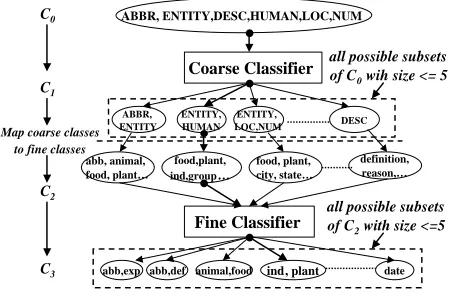
Question classification is a multi-class classifica-tion. A question can be mapped to one of 50 pos-sible classes (We call the set of all pospos-sible class labels for a given question a confusion set (Golding and Roth, 1999)). Our learned classifier is based on the SNoW learning architecture (Carlson et al., 1999; Roth, 1998)2 where, in order to allow the classifier to output more than one class label, we map the classifier’s output activation into a condi-tional probability of the class labels and threshold it.
The question classifier makes use of a sequence of two simple classifiers (Even-Zohar and Roth, 2001), each utilizing the Winnow algorithm within SNoW. The first classifies questions into coarse classes (Coarse Classifier) and the second into fine classes (Fine Classifier). A feature extractor auto-matically extracts the same features for each clas-sifier. The second classifier depends on the first in
2Freely available at http://L2R.cs.uiuc.edu/
ABBR, ENTITY,DESC,HUMAN,LOC,NUM
abb,exp ind, plant date
abb, animal,
Map coarse classes to fine classes
C0
C1
C2
C3 abb,def animal,food
all possible subsets of C0wih size <= 5
all possible subsets of C2with size <=5
Figure 1: The hierarchical classifier
that its candidate labels are generated by expanding the set of retained coarse classes from the first into a set of fine classes; this set is then treated as the confusion set for the second classifier.
Figure 1 shows the basic structure of the hierar-chical classifier. During either the training or the testing stage, a question is processed along one path top-down to get classified.
The initial confusion set of any question isC 0
g, the set of all the coarse classes. The coarse classifier determines a set of preferred labels, C
1 is expanded to a fixed set of fine classes determined by the class hierarchy. That is, sup-pose the coarse class c
i is mapped into the set c
gof fine classes, thenC 2
= S
ci2C1 c
i. The fine classifier determines a set of preferred labels, C
3
= Fine Classifier(C 2 timate outputs from the whole classifier which are used in our evaluation.
3.2 Feature Space
Each question is analyzed and represented as a list of features to be treated as a training or test exam-ple for learning. We use several types of features and investigate below their contribution to the QC accuracy.
The primitive feature types extracted for each question include words, pos tags, chunks (non-overlapping phrases) (Abney, 1991), named entities,
head chunks (e.g., the first noun chunk in a
sen-tence) and semantically related words (words that often occur with a specific question class).
Over these primitive features (which we call “sensors”) we use a set of operators to compose
more complex features, such as conjunctive (n-grams) and relational features, as in (Cumby and Roth, 2000; Roth and Yih, 2001). A simple script that describes the “types” of features used, (e.g., conjunction of two consecutive words and their pos tags) is written and the features themselves are ex-tracted in a data driven way. Only “active” features are listed in our representation so that despite the large number of potential features, the size of each example is small.
Among the 6 primitive feature types, pos tags, chunks and head chunks are syntactic features while named entities and semantically related words are semantic features. Pos tags are extracted using a SNoW-based pos tagger (Even-Zohar and Roth, 2001). Chunks are extracted using a previously learned classifier (Punyakanok and Roth, 2001; Li and Roth, 2001). The named entity classifier is also learned and makes use of the same technol-ogy developed for the chunker (Roth et al., 2002). The ‘related word’ sensors were constructed semi-automatically.
Most question classes have a semantically related word list. Features will be extracted for this class if a word in a question belongs to the list. For exam-ple, when “away”, which belongs to a list of words semantically related to the class distance, occurs in the sentence, the sensor Rel(distance) will be ac-tive. We note that the features from these sensors are different from those achieved using named entity since they support more general “semantic catego-rization” and include nouns, verbs, adjectives rather than just named entities.
For the sake of the experimental comparison, we define six feature sets, each of which is an incre-mental combination of the primitive feature types. That is, Feature set 1 (denoted by Word) contains word features; Feature set 2 (Pos) contains features composed of words and pos tags and so on; The fi-nal feature set, Feature set 6 (RelWord) contains all the feature types and is the only one that contains the related words lists. The classifiers will be exper-imented with different feature sets to test the influ-ence of different features. Overall, there are about
200;000 features in the feature space of RelWord due to the generation of complex features over sim-ple feature types. For each question, up to a cousim-ple of hundreds of them are active.
3.3 Decision Model
a question. Given a confusion set and a question, SNoW outputs a density over the classes derived from the activation of each class. After ranking the classes in the decreasing order of density values, we have the possible class labelsC =fc
1 with their densities P = fp
1 cussed earlier, for each question we output the first
k classes (1 k 5),c the probability that a question belongs to Class i, the decision model yields a reasonable probabilistic interpretation. We useT =0:95in the experiments.
4 Experimental Study
We designed two experiments to test the accuracy of our classifier on TREC questions. The first experi-ment evaluates the contribution of different feature types to the quality of the classification. Our hi-erarchical classifier is trained and tested using one of the six feature sets defined in Sect. 3.2 (we re-peated the experiments on several different training and test sets). In the second experiment, we evalu-ate the advantage we get from the hierarchical clas-sifier. We construct a multi-class classifier only for fine classes. This flat classifier takes all fine classes as its initial confusion set and classifies a question into fine classes directly. Its parameters and deci-sion model are the same as those of the hierarchical one. By comparing this flat classifier with our hi-erarchical classifier in classifying fine classes, we hope to know whether the hierarchical classifier has any advantage in performance, in addition to the ad-vantages it might have in downstream processing and comprehensibility.
4.1 Data
Data are collected from four sources: 4,500 English questions published by USC (Hovy et al., 2001), about 500 manually constructed questions for a few rare classes, 894 TREC 8 and TREC 9 questions, and also 500 questions from TREC 10 which serves as our test set3.
These questions were manually labeled accord-ing to our question hierarchy. Although we allow multiple labels for one question in our classifiers, in our labeling, for simplicity, we assigned exactly
3The annotated data and experimental results are available
fromhttp://L2R.cs.uiuc.edu/cogcomp/
one label to each question. Our annotators were re-quested to choose the most suitable class accord-ing to their own understandaccord-ing. This methodology might cause slight problems in training, when the labels are ambiguous, since some questions are not treated as positive examples for possible classes as they should be. In training, we divide the 5,500 questions from the first three sources randomly into 5 training sets of 1,000, 2,000, 3,000, 4,000 and 5,500 questions. All 500 TREC 10 questions are used as the test set.
4.2 Evaluation
In this paper, we count the number of correctly clas-sified questions by two different precision standards P1and P5. Suppose
k
i labels are output for the i -th question (k
i
5) and are ranked in a decreasing order according to their density values. We define
I ij
=f
1; ifthecorrectlabeloftheith questionisoutputinrankj; 0; otherwise:
=mwhere m is the total number of test examples. P
1 corresponds to the usual defini-tion of precision which allows only one label for each question, while P
5 allows multiple labels. P
5 reflects the accuracy of our classifier with re-spect to later stages in a question answering sys-tem. As the results below show, although question classes are still ambiguous, few mistakes are intro-duced by our classifier in this step.
4.3 Experimental Results
Performance of the hierarchical classifier Table 2 shows the P
5 precision of the hierarchi-cal classifier when trained on 5,500 examples and tested on the 500 TREC 10 questions. The re-sults are quite encouraging; question classification is shown to be solved effectively using machine learning techniques. It also shows the contribution of the feature sets we defined. Overall, we get a 98.80% precision for coarse classes with all the fea-tures and 95% for the fine classes.
P<=5 Word Pos Chunk NE Head RelWord
Coarse 92.00 96.60 97.00 97.00 97.80 98.80
Fine 86.00 86.60 87.60 88.60 89.40 95.00
Inspecting the data carefully, we can observe the significant contribution of the features constructed based on semantically related words sensors. It is interesting to observe that this improvement is even more significant for fine classes.
No. Train Test P
1 P
<=5
1 1000 500 83.80 95.60
2 2000 500 84.80 96.40
3 3000 500 91.00 98.00
4 4000 500 90.80 98.00
5 5500 500 91.00 98.80
Table 3: Classification accuracy for coarse classes on different training sets using the feature set RelWord. Re-sults are evaluated usingP
1and P
5.
No. Train Test P
1 P
<=5
1 1000 500 71.00 83.80
2 2000 500 77.80 88.20
3 3000 500 79.80 90.60
4 4000 500 80.00 91.20
5 5500 500 84.20 95.00
Table 4: Classification accuracy for fine classes on dif-ferent training sets using the feature set RelWord. Re-sults are evaluated usingP
1and P
5. Tables 3 and 4 show the P
1 and P
5 accuracy of the hierarchical classifier on training sets of dif-ferent sizes and exhibit the learning curve for this problem.
We note that the average numbers of labels out-put by the coarse and fine classifiers are 1.54 and 2.05 resp., (using the feature set RelWord and 5,500 training examples), which shows the decision model is accurate as well as efficient.
Comparison of the hierarchical and the flat classifier
The flat classifier consists of one classifier which is almost the same as the fine classifier in the hierar-chical case, except that its initial confusion set is the whole set of fine classes. Our original hope was that the hierarchical classifier would have a better performance, given that its fine classifier only needs to deal with a smaller confusion set. However, it turns out that there is a tradeoff between this factor and the inaccuracy, albeit small, of the coarse level prediction. As the results show, there is no perfor-mance advantage for using a level of coarse classes, and the semantically appealing coarse classes do not contribute to better performance.
Figure 2 give some more intuition on the flat vs. hierarchical issue. We define the tendency of Class
ito be confused with Classjas follows:
D ij
=Err ij
2=(N i
+N j
); (3)
where (when using P 1),
Err
ij is the number of questions in Class i that are misclassified as
belong-P
1 Word Pos Chunk NE Head RelWord
h 77.60 78.20 77.40 78.80 78.80 84.20
f 52.40 77.20 77.00 78.40 76.80 84.00
P
<=5 Word Pos Chunk NE Head RelWord
h 86.00 86.60 87.60 88.60 89.40 95.00
f 83.20 86.80 86.60 88.40 89.80 95.60
Table 5:Comparing accuracy of the hierarchical (h) and flat (f) classifiers on 500 TREC 10 question; training is done on 5,500 questions. Results are shown for different feature sets usingP
1and P
5.
Fine Classes 1−50
Fine Classes 1−50
2 24 28 32 37 50
2 24 28 32 37 50
Figure 2:The gray–scale map of the matrix D[n,n]. The color of the small box in position (i,j) denotesD
ij. The
largerD
ij is, the darker the color is. The dotted lines
separate the 6 coarse classes.
ing to Class j, andN i
;N
j are the numbers of ques-tions in Class i and j resp.
Figure 2 is a gray-scale map of the matrix D[n,n]. D[n,n] is so sparse that most parts of the graph are blank. We can see that there is no good cluster-ing of fine classes mistakes within a coarse class, which explains intuitively why the hierarchical clas-sifier with an additional level coarse classes does not work much better.
4.4 Discussion and Examples
We have shown that the overall accuracy of our clas-sifier is satisfactory. Indeed, all the reformulation questions that we exemplified in Sec. 3 have been correctly classified. Nevertheless, it is constructive to consider some cases in which the classifier fails. Below are some examples misclassified by the hier-archical classifier.
What French ruler was defeated at the battle of Water-loo?
The correct label is individual, but the classifier, failing to relate the word “ruler” to a person, since it was not in any semantic list, outputs event.
What is the speed hummingbirds fly ?
animal. Our feature sensors fail to determine that the focus of the question is ‘speed’. This example illustrates the necessity of identifying the question focus by analyzing syntactic structures.
What do you call a professional map drawer ?
The classifier returns other entities instead of equivalent term. In this case, both classes are ac-ceptable. The ambiguity causes the classifier not to output equivalent term as the first choice.
5 Conclusion
This paper presents a machine learning approach to question classification. We developed a hierarchical classifier that is guided by a layered semantic hier-archy of answers types, and used it to classify ques-tions into fine-grained classes. Our experimental re-sults prove that the question classification problem can be solved quite accurately using a learning ap-proach, and exhibit the benefits of features based on semantic analysis.
In future work we plan to investigate further the application of deeper semantic analysis (including better named entity and semantic categorization) to feature extraction, automate the generation of the semantic features and develop a better understand-ing to some of the learnunderstand-ing issues involved in the difference between a flat and a hierarchical classi-fier.
References
S. P. Abney. 1991. Parsing by chunks. In S. P. Abney R. C. Berwick and C. Tenny, editors, Principle-based
parsing: Computation and Psycholinguistics, pages
257–278. Kluwer, Dordrecht.
A. Carlson, C. Cumby, J. Rosen, and D. Roth. 1999. The SNoW learning architecture. Technical Report UIUCDCS-R-99-2101, UIUC Computer Science De-partment, May.
C. Cumby and D. Roth. 2000. Relational representations that facilitate learning. In Proc. of the International
Conference on the Principles of Knowledge Represen-tation and Reasoning, pages 425–434.
Y. Even-Zohar and D. Roth. 2001. A sequential model for multi class classification. In EMNLP-2001, the
SIGDAT Conference on Empirical Methods in Natu-ral Language Processing, pages 10–19.
A. R. Golding and D. Roth. 1999. A Winnow based ap-proach to context-sensitive spelling correction.
Ma-chine Learning, 34(1-3):107–130.
S. Harabagiu, D. Moldovan, M. Pasca, R. Mihalcea, M. Surdeanu, R. Bunescu, R. Girju, V. Rus, and P. Morarescu. 2001. Falcon: Boosting knowledge for answer engines. In Proceedings of the 9th Text
Re-trieval Conference, NIST.
U. Hermjakob. 2001. Parsing and question classification for question answering. In ACL-2001 Workshop on
Open-Domain Question Answering.
L. Hirschman, M. Light, E. Breck, and J. Burger. 1999. Deep read: A reading comprehension system. In
Pro-ceedings of the 37th Annual Meeting of the Associa-tion for ComputaAssocia-tional Linguistics.
E. Hovy, L. Gerber, U. Hermjakob, C. Lin, and D. Ravichandran. 2001. Toward semantics-based an-swer pinpointing. In Proceedings of the DARPA
Hu-man Language Technology conference (HLT). San Diego, CA.
A. Ittycheriah, M. Franz, W-J Zhu, A. Ratnaparkhi, and R.J. Mammone. 2001. IBM’s statistical question an-swering system. In Proceedings of the 9th Text
Re-trieval Conference, NIST.
W. G. Lehnert. 1986. A conceptual theory of question answering. In B. J. Grosz, K. Sparck Jones, and B. L. Webber, editors, Natural Language Processing, pages 651–657. Kaufmann, Los Altos, CA.
X. Li and D. Roth. 2001. Exploring evidence for shal-low parsing. In Proc. of the Annual Conference on
Computational Natural Language Learning.
M. Light, G. Mann, E. Riloff, and E. Breck. 2001. Analyses for Elucidating Current Question Answering Technology. Journal for Natural Language
Engineer-ing. forthcomEngineer-ing.
V. Punyakanok and D. Roth. 2001. The use of classi-fiers in sequential inference. In NIPS-13; The 2000
Conference on Advances in Neural Information Pro-cessing Systems, pages 995–1001. MIT Press.
D. Roth and W. Yih. 2001. Relational learning via propositional algorithms: An information extraction case study. In Proc. of the International Joint
Confer-ence on Artificial IntelligConfer-ence, pages 1257–1263.
D. Roth, G. Kao, X. Li, R. Nagarajan, V. Punyakanok, N. Rizzolo, W. Yih, C. O. Alm, and L. G. Moran. 2002. Learning components for a question answering system. In TREC-2001.
D. Roth. 1998. Learning to resolve natural language am-biguities: A unified approach. In Proc. of the
Ameri-can Association of Artificial Intelligence, pages 806–
813.
A. Singhal, S. Abney, M. Bacchiani, M. Collins, D. Hin-dle, and F. Pereira. 2000. AT&T at TREC-8. In
Pro-ceedings of the 8th Text Retrieval Conference, NIST.
E. Voorhees. 2000. Overview of the TREC-9 question answering track. In The Ninth Text Retrieval


![Figure 2: The gray–scale map of the matrix D[n,n]. Thecolor of the small box in position (i,j) denotesDij](https://thumb-us.123doks.com/thumbv2/123dok_us/788076.1091852/6.595.329.528.70.117/figure-gray-scale-matrix-thecolor-small-position-denotesdij.webp)
