Efficient Unsupervised Recursive Word Segmentation Using Minimum
Description Length
Shlomo ARGAMONa Navot AKIVAb Amihood AMIRb Oren KAPAHb
aIllinois Institute of Technology, Dept. of Computer Science, Chicago, IL 60616, USA
bBar-Ilan University, Dept. of Computer Science, Ramat Gan 52900, ISRAEL
{navot,amir,kapaho}@cs.biu.ac.il
Abstract
Automatic word segmentation is a basic re-quirement for unsupervised learning in morpho-logical analysis. In this paper, we formulate a novel recursive method for minimum descrip-tion length (MDL) word segmentadescrip-tion, whose basic operation is resegmenting the corpus on a prefix (equivalently, a suffix). We derive a local expression for the change in description length under resegmentation, i.e., one which de-pends only on properties of the specific prefix (not on the rest of the corpus). Such a formula-tion permits use of a new and efficient algorithm for greedy morphological segmentation of the corpus in a recursive manner. In particular, our method does not restrict words to be segmented only once, into a stem+affix form, as do many extant techniques. Early results for English and Turkish corpora are promising.
1 Introduction
Although computational morphological analyzers have existed for many years for a number of lan-guages, there are still many languages for which no such analyzer exists, but for which there is an abun-dance of electronically-available text. Developing a morphological analyzer for a new language by hand can be costly and time-consuming, requiring a great deal of effort by highly-specialized experts. Supervised learning methods, on the other hand, re-quire annotated data, which is often scarce or non-existent, and is also costly to develop. For this reason, there is increasing interest in unsupervised learning of morphology, in which unannotated text is analysed to find morphological structures. Even approximate unsupervised morphological analysis can be useful, as an aid to human annotators.
This paper addresses a key task for unsuper-vised morphological analysis: word segmentation, segmenting words into their most basic meaning-ful constituents (substrings), called morphs (ortho-graphic realizations of morphemes). We adopt the minimum description length (MDL) approach to word segmentation, which has been shown to be
ef-fective in recent work (notably (Goldsmith, 2001) and (Brent et al., 1995)). The minimum descrip-tion length principle (Barron et al., 1998) is an information-theoretic criterion to prefer that model for observed data which gives a minimal length cod-ing of the observed data set (given the model) to-gether with the model itself.
1.1 Our approach
Our approach in this paper is to better clarify the use of MDL for morphological segmentation by en-abling direct use of a variety of MDL coding criteria in a general and efficient search algorithm. Issues of computational efficiency have been a bottleneck in work on unsupervised morphological analysis, lead-ing to various approximations and heuristics belead-ing used. Our key contribution is to show how a lo-cal formulation of description length (DL) for word segmentation enables an efficient algorithm (based on pattern-matching methods) for greedy morpho-logical segmentation of the corpus. We thus provide a search framework method which avoids some re-strictions needed in previous work for efficiency. In particular, our method segments words in the cor-pus recursively, enabling multiple morphs to be ex-tracted from a single word, rather than just allow-ing a sallow-ingle stem+affix pair for a given word, as in many previous approaches. For example, we might find the segmentationinter+nation+al+ist, whereas a single-boundary method would segment the word on just one of those boundaries.
1.2 Related work
Several systems for unsupervised learning of mor-phology have been developed over the last decade or so. D´ejean (1998), extending ideas in Harris (1955), describes a system for finding the most frequent af-fixes in a language and identifying possible mor-pheme boundaries by frequency bounds on the num-ber of possible characters following a given char-acter sequence. Brent et al. (1995) give an in-formation theoretic method for discovering mean-ingful affixes, which was later extended to enable a novel search algorithm based on a probabilistic word-generation model (Snover et al., 2002). Gold-smith (2001) gives a comprehensive heuristic al-gorithm for unsupervised morphological analysis, which uses an MDL criterion to segment words and find morphological paradigms (called signa-tures). Similarly, Creutz and Lagus (2002) use an MDL formulation for word segmentation. All of these approaches assume a stem+affix morpholog-ical paradigm.
Further, the above approaches only consider in-formation in words’ character sequences for im-prove morphological segmentation, and do not con-sider syntactic or semantic context. Schone and Ju-rafsky (2000) extend this by using latent semantic analysis (Dumais et al., 1988) to require that a pro-posed stem+affix split is sufficiently semantically similar to the stem before the split is accepted. A conceptually similar approach is taken by Baroni et al. (2002) who combine use of edit distance to mea-sure orthographic similarity and mutual information to measure semantic similarity, to determine mor-phologically related word pairs.
2 Overview of the Approach
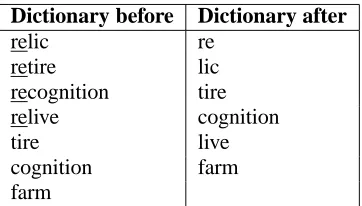
In this section we provide an overview of our ap-proach to greedy construction of a set of morphs (a dictionary), using a minimal description length (MDL) criterion (Barron et al., 1998) (we present three alternative MDL-type criteria below, of vary-ing levels of sophistication). The idea is to initialize a dictionary of morphs to the set of all word types in the corpus, and incrementally refine it by resegment-ing affixes (either prefixes or suffixes) from the cor-pus. Resegmenting on a prefixp (depicted in Fig-ure 1) means adding the prefix as a new morph, and removing it from all words where it occurs as a pre-fix. Some of the morphs thus created may already exist in the corpus (e.g., “cognition” in Fig. 1). We denote the set of morphs starting withp asVp, and
the set of continuations that follow p by Sp (i.e., Vp =pSp). The number of occurrences of a morph min the corpus (as currently segmented) is denoted
Dictionary before Dictionary after
relic re
retire lic recognition tire relive cognition
tire live
cognition farm farm
Figure 1:Illustration of resegmenting on the prefixre-. Note thatVre ={relic, retire, recognition, relive}, and
Sre={lic, tire, cognition, live}.
by C(m), and the number of tokens in the corpus with prefixpis denotedB(p) =P
vk∈VpC(vk).
The algorithm examines all prefixes of current morphs in the dictionary as resegmentation candi-dates. The candidatep∗that would give the greatest decrease in description length upon resegmentation is chosen, and the corpus is then resegmented onp∗. This is repeated until no candidate can decrease de-scription length.
Key to this process is efficient resegmentation of the corpus, which entails incremental update of the description length change that each prefix p will give upon resegmentation, denoted ∆CODEp (the
change in the coding cost CODE(M,Data) for the corpus plus the model M). This is achieved in two ways. First, we develop (Sec. 3) expressions for
∆CODEp which depend only on simple properties
ofp,Vp, andSp, and their occurrences in the corpus.
This locality property obviates the need to exam-ine most of the corpus to determexam-ine∆CODEp.
Sec-ond, we use a novel word/suffix indexing data struc-ture which permits efficient resegmentation and up-date of the statistics on which ∆CODEp depends
(Sec. 4). Initial experimental results for the different models using our algorithm are given in Section 5.
3 Local Description Length Models
As we show below, the key to efficiency is deriving local expressions for the change in coding length that will be caused by resegmentation on a partic-ular prefix p. That is, this coding length change,
∆CODEp, should depend only on direct properties
ofp, those morphsVp ={vk=psk}for which it is
a prefix, and those stringsSp ={sk|psk ∈Vp}(p’s
continuations). This enables us to efficiently main-tain the necessary data about the corpus and to up-date it on resegmentation, avoiding costly scanning of the entire corpus on each iteration.
description length via two simple models, and then give a derivation of a local expression for descrip-tion length change for a more realistic descripdescrip-tion length measure.
3.1 Model 1: Dictionary count
Perhaps the simplest possible model is to find a seg-mentation which minimizes the number of morphs in the dictionary CODE1(M,Data) = |M|. Al-though the global minimum will almost always be the trivial solution where each morph is an individ-ual letter, this trivial solution may be avoided by enforcing a minimal morph length (of 2, say). Fur-thermore, when implemented via a greedy prefix (or suffix) resegmenting algorithm, this measure gives surprisingly good results, as we show below.
Locality in this model is easily shown, as
∆CODE1p(M) = 1 +|Sp−M| − |Vp| = 1− |Sp∩M|
since p is added to M as are all its continuations not currently inM, while each morphvk∈Vpis
re-moved (being resegmented as the 2-morph sequence psk).
3.2 Model 1a: Adjusted count
We also found a heuristic modification of Model 1 to work well, based on the intuition that an af-fix with more continuations that are current morphs will be better, while to a lesser extent more contin-uations that are not current morphs indicates lower quality. This gives the local heuristic formula:
∆CODE1pa(M) = 1 +|Sp−M| −α|Sp∩M|
whereαis a tunable parameter determining the rel-ative weights of the two factors.
3.3 Model 2: MDL
A more theoretically motivated model seeks to min-imize the combined coding cost of the corpus and the dictionary (Barron et al., 1998):
CODE2(Data|M) +CODE2(M)
where we assume a minimal length code for the cor-pus based on the morphs in the dictionary1.
The coding cost of the dictionaryM is:
CODE2(M) = CODE2(M) = bP
m∈Mlen(m)
1
As is well known, MDL model estimation is equivalent to MAP estimation for appropriately chosen prior and conditional data distribution (Barron et al., 1998).
wherebis the number of bits needed to represent a character and len(m)is the length ofm in charac-ters.
The coding cost CODE(Data|M) of the corpus given the dictionary is simply the total number of bits to encode the data usingM’s code:
CODE2(Data|M)
=CODE(M(Data) =M1...N) =−PN
i=1logP(mi) =−P|M|
j=1C(mj) logP(mj)
=−P|M|
j=1C(mj)(logC(mj)−logN)
whereM(Data)is the corpus segmented according toM,N is the number of morph tokens in the seg-mented corpus, mi is the ith morph token in that
segmentation, P(m) is the probability of morph m in the corpus estimated as P(m) = C(m)/N, C(m) is the number of times morphm appears in the corpus,|M|is the total number of morph types inM, andmj is thejth morph type in theM.
Now suppose we wish to add a new morph toM by resegmenting on a prefixpfrom all morphs shar-ing that prefix, as above. First, consider the total change in cost for the dictionary. Note that the ad-dition of the new morphpwill cause an increase of blen(p)bits to the total dictionary size. At the same time, each new morph s ∈ Sp −M will add its
coding cost blen(s), while each preexisting morph s′ ∈Sp∩Mwill not change the dictionary length at
all. Finally, eachvkis removed from the dictionary,
giving a change of−blen(vk). The total change in
coding cost for the dictionary by resegmenting onp is thus:
∆CODE2p(M) =b (len(p) +P
sk∈(Sp−M)len(sk) −P
klen(vk))
Now consider the change in coding cost for the corpus after resegmentation. First, consider each preexisting morph type m 6∈ Vp, with the same
count after resegmentation (since it does not con-tain p). The coding cost of each occurrence ofm, however, will change, since the total number of to-kens in the corpus will change. Thus the total cost change for such anmis:
∆CODE2p(Data|m6∈Vp)
=C(m)(logP(m)−log ˆP(m))
=C(m)(logC(m)−logN−logC(m) + log ˆN) =C(m)(log ˆN−logN)
=C(m)(log(N+B(p))−logN)
depends only onN andB(p):
∆CODE2p(Data|M−Vp)
=P
m∈M−VpC(m)(log(N+B(p))−logN)
= (P
m∈M−VpC(m))(log(N+B(p))−logN)
= (N−P
vkC(vk))(log(N+B(p))−logN)
= (N−B(p))(log(N+B(p))−logN)
Now, consider explicitly each morph vk ∈ Vp
which will be split after resegmentation. First, remove the code for each occurrence of vk from
the corpus coding: C(vk) logP(vk). Next, add a
code for each occurrence of the new morph cre-ated by the prefix:−C(vk) log ˆP(p), wherePˆ(p) = B(p)/(N + B(p)) is the probability of morph p in the resegmented corpus. Finally, code the con-tinuations sk: −C(vk) log ˆP(sk) (where Pˆ(sk) =
ˆ C(sk)
ˆ
N =
C(vk)+C(sk) ˆ
N is the probability of the ‘new’
morphsk). Putting this together, we have the
cor-pus coding cost change forVp (noting thatB(p) =
P
vkC(vk)):
∆CODE2p(Data|Vp)
=P
vkC(vk)[ logP(vk)−log ˆP(p)−log ˆP(sk) ]
=P
vkC(vk) (logC(vk)−logN
+ log ˆN−logB(p) + log ˆN−log ˆC(sk))
= P
vkC(vk)(logC(vk)−log ˆC(sk))
+B(p)(2 log ˆN−logN) −B(p) logB(p)
Thus the cost change for resegmenting onpis:
∆CODE2p(M,Data)
= ∆CODE2p(M) + ∆CODE 2
p(Data|M)
= ∆CODE2p(M) + ∆CODE 2
p(Data|M−Vp)
+∆CODE2p(Data|Vp)
= bhlen(p) +P
sk∈(Sp−M)len(sk)−Pvklen(vk) i
+ (N−B(p)) (log(N+B(p))−logN) + P
vkC(vk)(logC(vk)−log ˆC(sk))
+B(p)(2 log ˆN−logN) −B(p) logB(p)
Note that all terms are local to the prefixp, its in-cluding morphs Vp and its continuations Sp. This
will enable an efficient incremental algorithm for greedy segmentation of all words in the corpus, as described in the next section.
4 Efficient Greedy Prefix Search
The straightforward greedy algorithm schema for finding an approximately minimal cost dictio-nary is to repeatedly find the best prefix p∗ = arg minp∆CODEp(M,Data) and resegment the
corpus on p∗, until no p∗ exists with negative
∆CODE. However, the expense of passing over the
entire corpus repeatedly would be prohibitive. Due to lack of space, we sketch here our method for caching corpus statistics in a pair of tries, in such a way that∆CODEpcan be easily computed for any
prefixp, and such that the data structures can be ef-ficiently updated when resegmenting on a prefix p. (A heap is also used for efficiently finding the best prefix.)
The main data structures consist of two tries. The first, which we term the main suffix trie (MST), is a suffix trie (Gusfield, 1997) for all the words in the corpus. Each node in the MST represents either the prefix of a current morph (initially, a word in the corpus), or the prefix of a potential morph (in case its preceding prefix gets segmented). Each such node is labeled with various statistics of its prefixp (denoted by the path to it from the root) and its suf-fixes, such as its prefix length len(p), its countB(p), the number of its continuations |Sp|, and the
col-lective length of its continuations P
sk∈Splen(sk),
as well as the current value of ∆CODEp(M,Data)
(computed from these statistics). Also, each node representing the end of an actual word in the corpus is marked as such.
The second trie, the reversed prefix trie (RPT), contains all the words in the corpus in reverse. Hence each node in the RPT corresponds to the suf-fix of a word in the corpus. We maintain a list of pointers at each node in the RPT to each node in the MST which has an identical suffix. This allows ef-ficient access to all prefixes of a given string. Also, those nodes corresponding to a complete word in the corpus are marked.
Initial construction of the data structures can be done in time linear in the size of the corpus, us-ing straightforward extensions of known suffix trie construction techniques (Gusfield, 1997). Finding the best prefix p∗ can be done efficiently by stor-ing pointers to all the prefixes in a heap, keyed by
∆CODEp. To then remove all words prefixed byp∗
and add all its continuations as new morphs (as well asp∗itself), proceed as follows, for each continua-tionsk:
1. If sk is marked in RPT, then it is a complete
word, and only its count needs to be updated.
2. Otherwise
(a) Mark sk’s node in MST as a complete
word, and update its statistics
(b) AddsR
k to RPT and mark the
correspond-ing nodes in MST as acceptcorrespond-ing stems.
Prefixes
Figure 2: The first 20 English prefix and suffix morphs extracted from Reuters-21578 corpus using Model 1. Meaningless morphs are marked by ’*’; nonminimal meaningful morphs by ’?’.
Prefixes Suffixes
Figure 3: The first 20 English prefix and suffix morphs extracted using Model 1a, as above.
The complexity for resegmenting onpis
O(len(p) + X sk∈Sp
len(sk) +NSUF(Sp) log(|M|))
whereNSUF(Sp)is the number of different morphs
in the previous dictionary that have a suffix in Sp
(which need to be updated in the heap).
5 Experimental Results
In this section we give initial results for the above algorithm in English and Turkish, showing how meaningful morphs are extracted using different greedy MDL criteria. Recall that the models and algorithm described in this paper are intended as parts of a more comprehensive morphological anal-ysis system, as we describe below in future work.
5.1 English
For evaluation in English, we used the standard Reuters-21578 corpus of news articles (comprising 1.7M word tokens and 32,811 unique words). For each of the 3 models described above, we extracted morphs either by resegmenting on prefixes or on suffixes (looking at the words reversed). When seg-menting according to Models 1 and 2, a minimum prefix length of 2 was enforced, to improve morph quality (though not for suffixes, since in English there are some one-letter suffixes such as -s).
First, consider morphs found by Model 1 (Fig. 2). The prefix morphs found are surprisingly good for this simple model, with only one wrong in the first 15 extracted. That erroneous morph ister-, which is part of inter-, however in- was extracted first; this kind of error could be ameliorated by a merging postprocessing step. The suffixes are similarly good, although oddly the system did not find -s, which caused it to find several compos-ite morphs, such as -ersand -ions, which can get resegmented into their components (-er+sand -ion+s) later.
Model 1a also performs extremely well, for dif-ferent values of α(we show justα = 1andα = 2
in Fig. 3, for lack of space). Note that the morphs found by this model differ qualitatively from those found by Model 1, in that we get longer morphs more related to agglutination than to regular inflec-tion patterns. This suggests that multiple statistical models should be used together to extract different facets of a language’s morphological composition.
Finally, morphs from the more complex Model 2 are given in Fig. 4. As in Model 1a, Model 2 gives more agglutinative morphs than inflective morphs, and has a greater tendency to segment com-plex morphs (such as-ification-), which pre-sumably will later be resegmented into their com-ponent parts (e.g., -if+ic+at+ion). This may enable construction of hierarchical models of mor-phological composition in the future.
5.2 Turkish
Prefixes
Figure 4: The first 20 English prefix and suffix morphs extracted using Model 2, as above, withb= 8.
p Meaning
birbirlerin- one to another
s
¸efin- your chief
tedbirler- precautions
birin- somebody
h¨uk¨umlerin- your opinions
¨
ulkesin- his country
elimiz- our hand
d¨uzenlemelerin- your arrangements
yerin- your place
kendin- yourself
devletler- governments
bic¸imin- your style
istedi˘gim- (thing) that I want
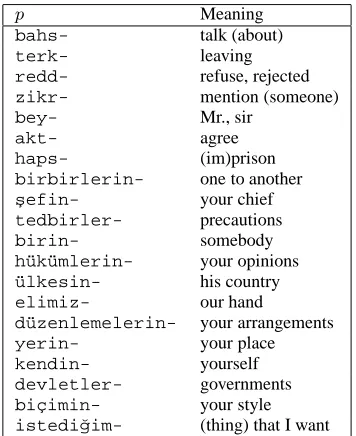
Figure 5: Turkish morphs segmented as prefixes using Model 1.
morphs were found using all models, with Model 2 finding longer morphs, as in English. We do note some issues with boundary letters for Model 2 pre-fixes, however.
6 Conclusions
We have given a firmer foundation for the use of minimal description length (MDL) criteria for mor-phological analysis by giving a novel local formula-tion of the change in descripformula-tion length (DL) upon resegmentation of the corpus on a prefix (or suffix),
p Meaning
-ların your (pl.) (things)
-lerine to your (pl.) (things)
-ya to
-lara to (pl.)
-dir is
Figure 6: Turkish morphs segmented as suffixes using Model 1.
Figure 7: Turkish morphs segmented as prefixes using Model 2. Turkish letters in parentheses are not in the segmented morphs, though a better segmentation would have included them.
which enables an efficient algorithm for greedy con-struction of a morph dictionary using an MDL cri-terion. The algorithm we have devised is generic, in that it may easily be applied to any local description length model. Early results of our method, as evalu-ated by examination of the morphs it extracts, show high accuracy in finding meaningful morphs based solely on orthographic considerations; in fact, we find that Model 1, which depends only on the num-ber of morphs in the dictionary (and not on frequen-cies in the corpus at all) gives surprisingly good re-sults, though Model 2 may generally be preferable (more experiments on varied and larger corpora still remain to be run).
p Meaning -isine toward (someone)
-nlerininof their (things)
-taki which at
-isini from, towards
-yeti to
-iyorsa if (pres.)
-ili with
-likte at (the place of)
-’in of
-imizden from our
p Meaning
-ilerine to (pl.)
-lemektedirit does
*-tik
-ilemez cannot do
-lerimizi our things
-mun from my
-mlar (plural)
-tmak to
-unca while
-lu with
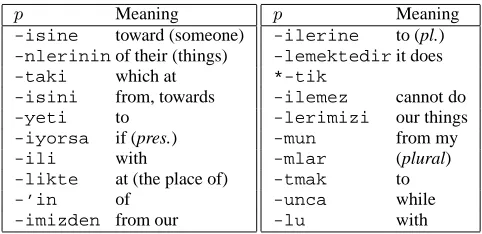
Figure 8: Turkish morphs segmented as suffixes using Model 2; tables as in Figure 5.
efficient beam-search algorithm (avoiding copying the entire data structure), which may improve accu-racy over the current greedy search method. In ad-dition, we will investigate the use of more sophisti-cated DL models, including, for example, semantic similarity between candidate affixes and stems, us-ing the probability of occurrence of individual char-acters for coding, or usingn-gram probabilities for coding the corpus as a sequence of morphs (instead of the unigram coding model used here and previ-ously).
The second direction involves integrating the cur-rent algorithm into a larger system for more compre-hensive morphological analysis. As noted above, due to the greedy nature of the search, a recombi-nation step may be needed to ’glue’ morphs that got incorrectly separated (such asun-and-der-). More fundamentally, we intend to use the algorithm presented here (with the above extensions) as a sub-routine in a paradigm construction system along the lines of Goldsmith (2001). It seems likely that effi-cient and accurate MDL segmentation as we present here will enable more effective search through the space of possible morphological signatures.
Acknowledgements
Thanks to Moshe Fresko and Kagan Agun for help with the Turkish translations, as well as the anony-mous reviewers for their comments.
References
M. Baroni, J. Matiasek, and H. Trost. 2002. Unsu-pervised discovery of morphologically related words based on orthographic and semantic similarity. In Proceedings of the Workshop on Morphological and Phonological Learning of ACL/SIGPHON-2002, pages 48–57.
Andrew Barron, Jorma Rissanen, and Bin Yu. 1998. The minimum description length principle in coding and modeling. IEEE Transactions on Information Theory, 44(6):2743–2760, October.
Michael R. Brent, Sreerama K. Murthy, and Andrew Lundberg. 1995. Discovering morphemic suffixes: A
case study in minimum description length induction. In Proceedings of the Fifth International Workshop on Artificial Intelligence and Statistics, Ft. Lauderdale, FL.
Mathias Creutz and Krista Lagus. 2002. Unsupervised discovery of morphemes. In Proceedings of the Work-shop on Morphological and Phonological Learning of ACL-02, pages 21–30, Philadelphia.
Herv´e D´ejean. 1998. Morphemes as necessary concept for structures discovery from untagged corpora. In Workshop on Paradigms and Grounding in Natural Language Learning, pages 295–299, Adelaide. S. T. Dumais, G. W. Furnas, T. K. Landauer, S.
Deer-wester, and R. Harshman. 1988. Using latent seman-tic analysis to improve access to textual information. In Proceedings of the SIGCHI conference on Human factors in computing systems, pages 281–285. ACM Press.
John Goldsmith. 2001. Unsupervised learning of the morphology of a natural language. Computational Linguistics, 27:153–198.
Dan Gusfield. 1997. Algorithms on Strings, Trees, and Sequences - Computer Science and Computational Bi-ology. Cambridge University Press.
Zellig Harris. 1955. From phoneme to morpheme. Lan-guage, 31:190–222.
Kemal Oflazer. 2001. English Turkish aligned parallel corpora. Turkish Natural Language Processing Initiative, Bilkent University.
http://www.nlp.cs.bilkent.edu.tr/Turklang/ corpus/par-corpus/.
Patrick Schone and Daniel Jurafsky. 2000. Knowledge free induction of morphology using latent semantic analysis. In Proceedings of CoNLL-2000 and LLL-2000, pages 67–72, Lisbon.