Efficient Support Vector Classifiers
for Named Entity Recognition
Hideki Isozaki and Hideto Kazawa
NTT Communication Science Laboratories Nippon Telegraph and Telephone Corporation
2-4 Hikari-dai, Seika-cho, Soraku-gun, Kyoto, 619-0237, Japan
isozaki,kazawa @cslab.kecl.ntt.co.jp
Abstract
Named Entity (NE) recognition is a task in which proper nouns and numerical information are ex-tracted from documents and are classified into cat-egories such as person, organization, and date. It is a key technology of Information Extraction and Open-Domain Question Answering. First, we show that an NE recognizer based on Support Vector Ma-chines (SVMs) gives better scores than conventional systems. However, off-the-shelf SVM classifiers are too inefficient for this task. Therefore, we present a method that makes the system substantially faster. This approach can also be applied to other simi-lar tasks such as chunking and part-of-speech tag-ging. We also present an SVM-based feature selec-tion method and an efficient training method.
1 Introduction
Named Entity (NE) recognition is a task in which proper nouns and numerical information in a docu-ment are detected and classified into categories such as person, organization, and date. It is a key technol-ogy of Information Extraction and Open-Domain Question Answering (Voorhees and Harman, 2000). We are building a trainable Open-Domain Question Answering System called SAIQA-II. In this paper, we show that an NE recognizer based on Support Vector Machines (SVMs) gives better scores than conventional systems. SVMs have given high per-formance in various classification tasks (Joachims, 1998; Kudo and Matsumoto, 2001).
However, it turned out that off-the-shelf SVM classifiers are too inefficient for NE recognition. The recognizer runs at a rate of only 85 bytes/sec on an Athlon 1.3 GHz Linux PC, while rule-based systems (e.g., Isozaki, (2001)) can process several kilobytes in a second. The major reason is the inefficiency of SVM classifiers. There are other reports on the slowness of SVM classifiers. An-other SVM-based NE recognizer (Yamada and
Mat-sumoto, 2001) is 0.8 sentences/sec on a Pentium III 933 MHz PC. An SVM-based part-of-speech (POS) tagger (Nakagawa et al., 2001) is 20 tokens/sec on an Alpha 21164A 500 MHz processor. It is difficult to use such slow systems in practical applications.
In this paper, we present a method that makes the NE system substantially faster. This method can also be applied to other tasks in natural language processing such as chunking and POS tagging. An-other problem with SVMs is its incomprehensibil-ity. It is not clear which features are important or how they work. The above method is also useful for finding useless features. We also mention a method to reduce training time.
1.1 Support Vector Machines
Suppose we have a set of training data for a two-class problem: , where
is a feature vector of the -th sample in the
training data and "!$#%&#"' is the label for
the sample. The goal is to find a decision func-tion that accurately predicts for unseen . A
non-linear SVM classifier gives a decision function
(
)* sign,+-) for an input vector where
+-).*
/
0
21)3
546879:!6;
Here,
(
)<*=!$# means is a member of a
cer-tain class and
(
)$* &# means is not a
mem-ber. 7 s are called support vectors and are
repre-sentatives of training examples. > is the number
of support vectors. Therefore, computational com-plexity of+?) is proportional to> . Support vectors
and other constants are determined by solving a cer-tain quadratic programming problem. 4687@ is a
kernel that implicitly maps vectors into a higher di-mensional space. Typical kernels use dot products:
4687@A*CBED7@ . A polynomial kernel of degree
F
vari-M
M
M
M
N
M
M
M
M
M
M
M
M
M
O
O
O
O
O
N
O
O
O
O
O
O
O
O
O
O
O
O
M
: positive example,O
: negative example
N
M
,N
O
[image:2.595.94.277.73.176.2]: support vectors
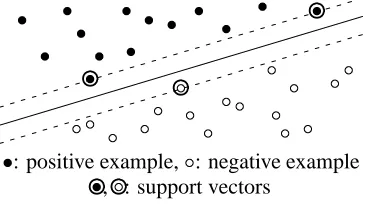
Figure 1: Support Vector Machine
ous kernels, and the design of an appropriate kernel for a particular application is an important research issue.
Figure 1 shows a linearly separable case. The de-cision hyperplane defined by +-)P*RQ separates
positive and negative examples by the largest mar-gin. The solid line indicates the decision hyperplane and two parallel dotted lines indicate the margin be-tween positive and negative examples. Since such a separating hyperplane may not exist, a positive pa-rameterS is introduced to allow misclassifications.
See Vapnik (1995).
1.2 SVM-based NE recognition
As far as we know, the first SVM-based NE system was proposed by Yamada et al. (2001) for Japanese. His system is an extension of Kudo’s chunking sys-tem (Kudo and Matsumoto, 2001) that gave the best performance at CoNLL-2000 shared tasks. In their system, every word in a sentence is classified se-quentially from the beginning or the end of a sen-tence. However, since Yamada has not compared it with other methods under the same conditions, it is not clear whether his NE system is better or not. Here, we show that our SVM-based NE system is more accurate than conventional systems. Our sys-tem uses the Viterbi search (Allen, 1995) instead of sequential determination.
For training, we use ‘CRL data’, which was pre-pared for IREX (Information Retrieval and Extrac-tion Exercise1, Sekine and Eriguchi (2000)). It has about 19,000 NEs in 1,174 articles. We also use additional data by Isozaki (2001). Both datasets are based on Mainichi Newspaper’s 1994 and 1995 CD-ROMs. We use IREX’s formal test data called GENERAL that has 1,510 named entities in 71 ar-ticles from Mainichi Newspaper of 1999. Systems are compared in terms of GENERAL’s F-measure
1
http://cs.nyu.edu/cs/projects/proteus/irex
which is the harmonic mean of ‘recall’ and ‘preci-sion’ and is defined as follows.
Recall = M/(the number of correct NEs),
Precision = M/(the number of NEs extracted by a system),
where M is the number of NEs correctly extracted and classified by the system.
We developed an SVM-based NE system by fol-lowing our NE system based on maximum en-tropy (ME) modeling (Isozaki, 2001). We sim-ply replaced the ME model with SVM classifiers. The above datasets are processed by a morpholog-ical analyzer ChaSen 2.2.12. It tokenizes a sen-tence into words and adds POS tags. ChaSen uses about 90 POS tags such as common-noun and
location-name. Since most unknown words are proper nouns, ChaSen’s parameters for unknown words are modified for better results. Then, a char-acter type tag is added to each word. It uses 17 character types such as all-kanjiand small-integer. See Isozaki (2001) for details.
Now, Japanese NE recognition is solved by the classification of words (Sekine et al., 1998; Borth-wick, 1999; Uchimoto et al., 2000). For instance, the words in “President George Herbert Bush said Clinton is . . . ” are classified as follows: “Presi-dent” =OTHER, “George” =PERSON-BEGIN, “Her-bert” = PERSON-MIDDLE, “Bush” =PERSON-END, “said” =OTHER, “Clinton” =PERSON-SINGLE, “is” = OTHER. In this way, the first word of a person’s name is labeled asPERSON-BEGIN. The last word is labeled asPERSON-END. Other words in the name are PERSON-MIDDLE. If a person’s name is ex-pressed by a single word, it is labeled as PERSON-SINGLE. If a word does not belong to any named entities, it is labeled as OTHER. Since IREX de-fines eight NE classes, words are classified into 33 (*UTWVEX!K# ) categories.
Each sample is represented by 15 features be-cause each word has three features (part-of-speech tag, character type, and the word itself), and two preceding words and two succeeding words are also used for context dependence. Although infrequent features are usually removed to prevent overfitting, we use all features because SVMs are robust. Each sample is represented by a long binary vector, i.e., a sequence of 0 (false) and 1 (true). For instance, “Bush” in the above example is represented by a
2
vectorP*YG[Z\#^]_"G[Z`a] described below. Only
15 elements are 1.
bdcfe8ghji
// Current word is not ‘Alice’
bdcklghme
// Current word is ‘Bush’
bdcnghji
// Current word is not ‘Charlie’
:
bdcfe^opi"kpqpghme
// Current POS is a proper noun
bdcfe^opinipghji
// Current POS is not a verb
:
bdcnqre^sreghji
// Previous word is not ‘Henry’
bdcnqre^skghme
// Previous word is ‘Herbert’
:
Here, we have to consider the following lems. First, SVMs can solve only a two-class prob-lem. Therefore, we have to reduce the above multi-class problem to a group of two-multi-class problems. Second, we have to consider consistency among word classes in a sentence. For instance, a word classified as PERSON-BEGIN should be followed by PERSON-MIDDLE or PERSON-END. It implies that the system has to determine the best combina-tions of word classes from numerous possibilities. Here, we solve these problems by combining exist-ing methods.
There are a few approaches to extend SVMs to covert -class problems. Here, we employ the “one
class versus all others” approach. That is, each clas-sifier (%u
) is trained to distinguish members of a
classv from non-members. In this method, two or
more classifiers may give !$# to an unseen vector
or no classifier may give!$# . One common way to
avoid such situations is to compare+
u
) values and
to choose the class indexv of the largest+
u
) .
The consistency problem is solved by the Viterbi search. Since SVMs do not output probabilities, we use the SVM+sigmoid method (Platt, 2000). That is, we use a sigmoid function wxG?J*y#zI#{! |l}~
&{G to map+
u
) to a probability-like value.
The output of the Viterbi search is adjusted by a postprocessor for wrong word boundaries. The adjustment rules are also statistically determined (Isozaki, 2001).
1.3 Comparison of NE recognizers
We use a fixed value * #Q9Q . F-measures are
not very sensitive to unless is too small. When
we used 1,038,986 training vectors, GENERAL’s F-measure was 89.64% for *Q# and 90.03% for
6*#Q9Q . We employ the quadratic kernel (
F
*Y )
because it gives the best results. Polynomial kernels of degree 1, 2, and 3 resulted in 83.03%, 88.31%,
F-measure (%)
RG+DT
ME
SVM
0 20 40 60 80 100 120 CRL
data
E^:
76 78 80 82 84 86 88 90
Number of NEs in training data (^
[image:3.595.315.540.79.225.2])
Figure 2: F-measures of NE systems
and 87.04% respectively when we used 569,994 training vectors.
Figure 2 compares NE recognizers in terms of GENERAL’s F-measures. ‘SVM’ in the figure in-dicates F-measures of our system trained by Kudo’s TinySVM-0.073 withS*Q# . It attained 85.04%
when we used only CRL data. ‘ME’ indicates our ME system and ‘RG+DT’ indicates a rule-based machine learning system (Isozaki, 2001). Accord-ing to this graph, ‘SVM’ is better than the other sys-tems.
However, SVM classifiers are too slow. Fa-mous SVM-Light 3.50 (Joachims, 1999) took 1.2 days to classify 569,994 vectors derived from 2 MB documents. That is, it runs at only 19 bytes/sec. TinySVM’s classifier seems best optimized among publicly available SVM toolkits, but it still works at only 92 bytes/sec.
2 Efficient Classifiers
In this section, we investigate the cause of this in-efficiency and propose a solution. All experiments are conducted for training data of 569,994 vectors. The total size of the original news articles was 2 MB and the number of NEs was 39,022. According to the definition of +-), a classifier has to process >
support vectors for each . Table 1 shows> s for
dif-ferent word classes. According to this table, classi-fication of one word requires ’s dot products with
228,306 support vectors in 33 classifiers. Therefore, the classifiers are very slow. We have never seen such large> s in SVM literature on pattern
recogni-tion. The reason for the large> s is word features. In
other domains such as character recognition,
dimen-3
sion` is usually fixed. However, in the NE task,`
increases monotonically with respect to the size of the training data. Since SVMs learn combinations of features,> tends to be very large. This tendency
will hold for other tasks of natural language pro-cessing, too.
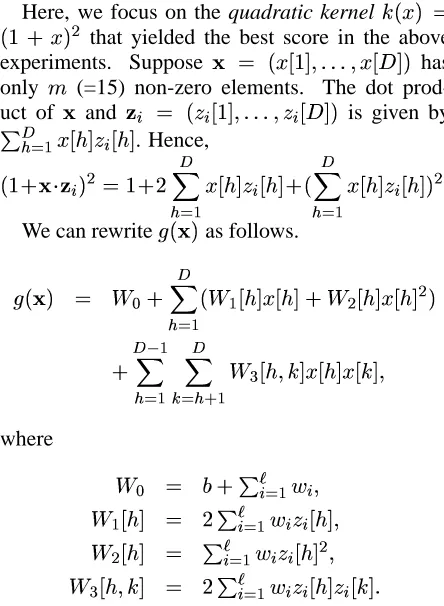
Here, we focus on the quadratic kernel BG<*
I#!G that yielded the best score in the above
experiments. Suppose * G[Z\#^]_"G[Z`a] has
only (=15) non-zero elements. The dot
prod-uct of and 7 * 5 Z\#^]_" Z`<] is given by
1)
G[Z], Z]. Hence,
I#!D7 * #!W 0 1)
G¡Z], Z¢]!£
0
1)
G¡Z], Z¢]
We can rewrite+-) as follows.
+-)¤* ¥§¦¨!
0
1)
_¥ Z]G[Z¢]¢!m¥
Z¢]G[Z¢] ! .© 0 1) 0 ª 1 « ¥§¬rZB@]G[Z]G¡ZB@]_ where ¥ ¦ * ;¡! / 1) 3 ® ¥¯Z]°* / 1) 3 5Z]_ ¥ Z]°* / 1) 3 ±p8Z]²% ¥P¬rZB@]°* / 1) 3
Z], ZB@]_
For binary vectors, it can be simplified as
+-).*¥ ¦ ! 0 ³,´9µl¶ 1) _¥C· Z¢]! 0
ª-³,ª¸¹%º´9µª¶ 1)
¥ ¬ ZB@]
where
¥ ·
Z¢]°* ¥ Z¢]!m¥
Z¢]Y* » 0 ³¼½5µl¶ 1) 3 ¥§¬9ZB@]¾* 0 ³,¼®½_µl¶ 1 ¼®½±µª¶ 1) 3
Now, +?) can be given by summing up ¥
·
Z¢]
for every non-zero element G¡Z] and ¥ ¬ ZB@] for
every non-zero pairG¡Z]G[ZB@]. Accordingly, we only
need to add #W! ¿! jR&À#z% (=121)
con-stants to get +-) . Therefore, we can expect this
[image:4.595.72.294.149.452.2]method to be much faster than a na¨ıve implementa-tion that computes tens of thousands of dot products at run time. We call this method ‘XQK’ (eXpand the Quadratic Kernel).
Table 1 compares TinySVM and XQK in terms of CPU time taken to apply 33 classifiers to process the training data. Classes are sorted by > . Small
numbers in parentheses indicate the initialization time for reading support vectors 7 ' and
allocat-ing memory. XQK requires a longer initialization time in order to prepare¥
· and
¥§¬ . For instance,
TinySVM took 11,490.26 seconds (3.2 hours) in to-tal for applyingOTHER’s classifier to all vectors in the training data. Its initialization phase took 2.13 seconds and all vectors in the training data were classified in 11,488.13 (*=#9#%XÁ%QÂ 9ÃÄ& x#p» )
sec-onds. On the other hand, XQK took 225.28 seconds in total and its initialization phase took 174.17 sec-onds. Therefore, 569,994 vectors were classified in 51.11 seconds. The initialization time can be disre-garded because we can reuse the above coefficents. Consequently, XQK is 224.8 (=11,488.13/51.11) times faster than TinySVM for OTHER. TinySVM took 6 hours to process all the word classes, whereas XQK took only 17 minutes. XQK is 102 times faster than SVM-Light 3.50 which took 1.2 days.
3 Removal of useless features
XQK makes the classifiers faster, but mem-ory requirement increases from Å<
/ 1) to Å< / 1)
!#z% r where (=15) is the
num-ber of non-zero elements in7 . Therefore, removal
of useless features would be beneficial. Conven-tional SVMs do not tell us how an individual feature works because weights are given not to features but to 4687 . However, the above weights (¥
·
and ¥§¬ ) clarify how a feature or a feature pair works.
We can use this fact for feature selection after the training.
We simplify
(
) by removing all features that satisfy Æ<Ç
} 8È¥ · Z]ÈfÀÆ<Ç } ª È¥§¬rZB@]Èf Æ<Ç } ª
È¥P¬rZB-]ÈKÉËÊ . The largest Ê that does
not change the number of misclassifications for the training data is found by using the binary search for each word class. We call this method ‘XQK-FS’ (XQK with Feature Selection). This approx-imation slightly degraded GENERAL’s F-measure from 88.31% to 88.03%.
Table 1: Reduction of CPU time (in seconds) by XQK
word class > TinySVM(init) XQK(init) speed up SVM-Light
OTHER 64,970 11,488.13(2.13) 51.11(174.17) 224.8 29,986.52 ARTIFACT-MIDDLE 14,171 1,372.85(0.51) 41.32 (14.98) 33.2 6,666.26 LOCATION-SINGLE 13,019 1,209.29(0.47) 38.24 (11.41) 31.6 6,100.54 ORGANIZ..-MIDDLE 12,050 987.39(0.44) 37.93 (11.70) 26.0 5,570.82
: : : : : :
TOTAL 228,306 21,754.23(9.83) 1,019.20(281.28) 21.3 104,466.31
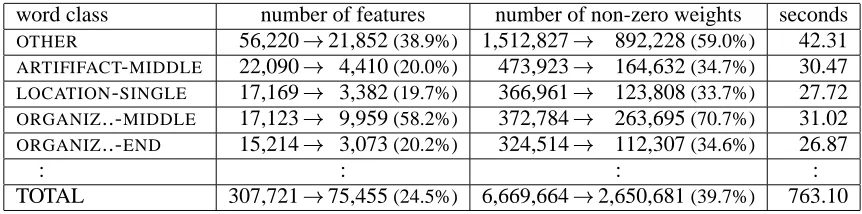
Table 2: Reduction of features by XQK-FS
word class number of features number of non-zero weights seconds OTHER 56,220Î 21,852(38.9%) 1,512,827Î 892,228(59.0%) 42.31
ARTIFIFACT-MIDDLE 22,090Î 4,410(20.0%) 473,923Î 164,632(34.7%) 30.47
LOCATION-SINGLE 17,169Î 3,382(19.7%) 366,961Î 123,808(33.7%) 27.72
ORGANIZ..-MIDDLE 17,123Î 9,959(58.2%) 372,784Î 263,695(70.7%) 31.02
ORGANIZ..-END 15,214Î 3,073(20.2%) 324,514Î 112,307(34.6%) 26.87
: : : :
TOTAL 307,721Î 75,455(24.5%) 6,669,664Î 2,650,681(39.7%) 763.10
The total number of features was reduced by 75% and that of weights was reduced by 60%. The ta-ble also shows CPU time for classification by the selected features. XQK-FS is 28.5 (=21754.23/ 763.10) times faster than TinySVM. Although the reduction of features is significant, the reduction of CPU time is moderate, because most of the reduced features are infrequent ones. However, simple re-duction of infrequent features without considering weights damages the system’s performance. For in-stance, when we removed 5,066 features that ap-peared four times or less in the training data, the modified classifier for ORGANIZATION-END mis-classified 103 training examples, whereas the origi-nal classifier misclassified only 19 examples. On the other hand, XQK-FS removed 12,141 features with-out an increase in misclassifications for the training data.
XQK can be easily extended to a more general quadratic kernel BG?£*¤±vl¦Ï!v G and to
non-binary sparse vectors. XQK-FS can be used to se-lect useful features before training by other kernels. As mentioned above, we conducted an experiment for the cubic kernel (F
*л ) by using all features.
When we trained the cubic kernel classifiers by us-ing only features selected by XQK-FS, TinySVM’s classification time was reduced by 40% because >
was reduced by 38%. GENERAL’s F-measure was slightly improved from 87.04% to 87.10%. On the other hand, when we trained the cubic ker-nel classifiers by using only features that appeared three times or more (without considering weights), TinySVM’s classification time was reduced by only 14% and the F-measure was slightly degraded to 86.85%. Therefore, we expect XQK-FS to be use-ful as a feature selection method for other kernels when such kernels give much better results than the quadratic kernel.
4 Reduction of training time
Since training of 33 classifiers also takes a long time, it is difficult to try various combinations of pa-rameters and features. Here, we present a solution for this problem. In the training time, calculation of
BÑDr BÑ$Dr
BÑD@ for various Ñ s is dominant. Conventional systems save time
by caching the results. By analyzing TinySVM’s classifier, we found that they can be calculated more efficiently.
For sparse vectors, most SVM classifiers (e.g., SVM-Light) use a sparse dot product algorithm (Platt, 1999) that compares non-zero elements of
and those of7 to getBED7 in+-) . However,
[image:5.595.90.521.249.356.2]7
/
. Therefore, we can implement a faster classifier
that calculates them concurrently. TinySVM’s clas-sifier prepares a listfi2siZ] that contains all7 s
whose -th coordinates are not zero. In addition,
counters forÓD%7 pÔD%7
/
are prepared because dot products of binary vectors are integers. Then, for each non-zeroG[Z], the counters are incremented
for all7
fi2siZ¢]. By checking only members
offi2siZ] for non-zeroG[Z], the classifier is not
bothered by fruitless cases: G¡Z]Õ*Q8Z¢]×Ö*YQ or
G[Z¢]WÖ*ØQÙZ¢]Ú*yQ . Therefore, TinySVM’s
clas-sifier is faster than other clasclas-sifiers. This method is applicable to any kernels based on dot products.
For the training phase, we can build fi2si· Z¢]
that contains all s whose -th coordinates are not
zero. Then,BÑD BÑÚD can be
effi-ciently calculated becauseÑ is common. This
im-provement is effective especially when the cache is small and/or the training data is large. When we used a 200 MB cache, the improved system took only 13 hours for training by the CRL data, while TinySVM and SVM-Light took 30 hours and 46 hours respectively for the same cache size. Al-though we have examined other SVM toolkits, we could not find any system that uses this approach in the training phase.
5 Discussion
The above methods can also be applied to other tasks in natural language processing such as chunk-ing and POS taggchunk-ing because the quadratic kernels give good results.
Utsuro et al. (2001) report that a combination of two NE recognizers attained F = 84.07%, but wrong word boundary cases are excluded. Our sys-tem attained 85.04% and word boundaries are auto-matically adjusted. Yamada (Yamada et al., 2001) also reports that F
* is best. Although his
sys-tem attained F = 83.7% for 5-fold cross-validation of the CRL data (Yamada and Matsumoto, 2001), our system attained 86.8%. Since we followed Isozaki’s implementation (Isozaki, 2001), our sys-tem is different from Yamada’s syssys-tem in the fol-lowing points: 1) adjustment of word boundaries, 2) ChaSen’s parameters for unknown words, 3) char-acter types, 4) use of the Viterbi search.
For efficient classification, Burges and Sch¨olkopf (1997) propose an approximation method that uses “reduced set vectors” instead of support vectors. Since the size of the reduced set vectors is smaller than > , classifiers become more efficient, but the
computational cost to determine the vectors is very large. Osuna and Girosi (1999) propose two meth-ods. The first method approximates+-) by support
vector regression, but this method is applicable only whenS is large enough. The second method
refor-mulates the training phase. Our approach is sim-pler than these methods. Downs et al. (Downs et al., 2001) try to reduce the number of support vectors by using linear dependence.
We can also reduce the run-time complexity of a multi-class problem by cascading SVMs in the form of a binary tree (Schwenker, 2001) or a direct acyclic graph (Platt et al., 2000). Yamada and Mat-sumoto (2001) applied such a method to their NE system and reduced its CPU time by 39%. This ap-proach can be combined with our SVM classifers.
NE recognition can be regarded as a variable-length multi-class problem. For this kind of prob-lem, probability-based kernels are studied for more theoretically well-founded methods (Jaakkola and Haussler, 1998; Tsuda et al., 2001; Shimodaira et al., 2001).
6 Conclusions
Our SVM-based NE recognizer attained F = 90.03%. This is the best score, as far as we know. Since it was too slow, we made SVMs faster. The improved classifier is 21 times faster than TinySVM and 102 times faster than SVM-Light. The im-proved training program is 2.3 times faster than TinySVM and 3.5 times faster than SVM-Light. We also presented an SVM-based feature selection method that removed 75% of features. These meth-ods can also be applied to other tasks such as chunk-ing and POS taggchunk-ing.
Acknowledgment
We would like to thank Yutaka Sasaki for the train-ing data. We thank members of Knowledge Pro-cessing Research Group for valuable comments and discussion. We also thank Shigeru Katagiri and Ken-ichiro Ishii for their support.
References
James Allen. 1995. Natural Language Understand-ing 2nd. Ed. Benjamin CummUnderstand-ings.
Andrew Borthwick. 1999. A Maximum Entropy Approach to Named Entity Recognition. Ph.D. thesis, New York University.
learning machines. In Advances in Neural Infor-mation Processing Systems 9, pages 375–381. Tom Downs, Kevin E. Gates, and Annette Masters.
2001. Exact simplification of support vector so-lutions. Journal of Machine Learning Research, 2:293–297.
Hideki Isozaki. 2001. Japanese named entity recognition based on a simple rule generator and decision tree learning. In Proceedings of Associ-ation for ComputAssoci-ational Linguistics, pages 306– 313.
Tommi S. Jaakkola and David Haussler. 1998. Ex-ploiting generative models in discriminative clas-sifiers. In M. S. Kearns, S. A. Solla, and D. A. Cohn, editors, Advances in Neural Information Processing Systems 11. MIT Press.
Thorsten Joachims. 1998. Text categorization with support vector machines: Learning with many relevant features. In Proceedings of the European Conference on Machine Learning.
Thorsten Joachims. 1999. Making large-scale support vector machine learning practical. In B. Sch¨olkopf, C. J. C. Burges, and A. J. Smola, editors, Advances in Kernel Methods, chapter 16, pages 170–184. MIT Press.
Taku Kudo and Yuji Matsumoto. 2001. Chunking with support vector machines. In Proceedings of NAACL, pages 192–199.
Tetsuji Nakagawa, Taku Kudoh, and Yuji Mat-sumoto. 2001. Unknown word guessing and part-of-speech tagging using support vector ma-chines. In Proceedings of the Sixth Natural Lan-guage Processing Pacific Rim Symposium, pages 325–331.
Edgar E. Osuna and Federico Girosi. 1999. Re-ducing the run-time complexity in support vector machines. In B. Sch¨olkopf, C. J. C. Burges, and A. J. Smola, editors, Advances in Kernel Meth-ods, chapter 16, pages 271–283. MIT Press. John C. Platt, Nello Cristiani, and John
Shawe-Taylor. 2000. Large margin DAGs for multiclass classification. In Advances in Neural Informa-tion Processing Systems 12, pages 547–553. MIT Press.
John C. Platt. 1999. Fast training of support vector machines using sequential minimal optimization. In B. Sch¨olkopf, C. J. C. Burges, and A. J. Smola, editors, Advances in Kernel Methods, chapter 12, pages 185–208. MIT Press.
John C. Platt. 2000. Probabilities for SV machines. In A. J. Smola, P. L. Bartlett, B. Sch¨olkopf,
and D. Schuurmans, editors, Advances in Large Margin Classifiers, chapter 5, pages 61–71. MIT Press.
Friedhelm Schwenker. 2001. Solving multi-class pattern recognition problems with tree-structured support vector machines. In B. Radig and S. Flor-czyk, editors, Pattern Recognition, Proceedings of the 23rd Symposium, number 2191 in LNCS, pages 283–290. Springer.
Satoshi Sekine and Yoshio Eriguchi. 2000. Japanese named entity extraction evaluation — analysis of results —. In Proceedings of 18th International Conference on Computational Lin-guistics, pages 1106–1110.
Satoshi Sekine, Ralph Grishman, and Hiroyuki Shinnou. 1998. A decision tree method for find-ing and classifyfind-ing names in Japanese texts. In Proceedings of the Sixth Workshop on Very Large Corpora.
Hiroshi Shimodaira, Ken-ichi Noma, Mitsuru Naka, and Shigeki Sagayama. 2001. Support vec-tor machine with dynamic time-alignment ker-nel for speech recognition. In Proceedings of Eu-rospeech, pages 1841–1844.
Koji Tsuda, M. Kawanabe, G. R¨atsch, S. Sonnen-burg, and K. M¨uller. 2001. A new discriminative kernel from probabilistic models. In Advances in Newral Information Processing Systems 14. Kiyotaka Uchimoto, Qing Ma, Masaki Murata,
Hi-romi Ozaku, Masao Utiyama, and Hitoshi Isa-hara. 2000. Named entity extraction based on a maximum entropy model and transformation rules (in Japanese). Journal of Natural Language Processing, 7(2):63–90.
Takehito Utsuro, Manabu Sassano, and Kiyotaka Uchimoto. 2001. Learning to combine outputs of multiple Japanese named entity extractors (in Japanese). In IPSJ SIG notes NL-144-5.
Vladimir N. Vapnik. 1995. The Nature of Statisti-cal Learning Theory. Springer.
E. M. Voorhees and D. K. Harman, editors. 2000. Proceedings of the 9th Text Retrieval Conference. Hiroyasu Yamada and Yuji Matsumoto. 2001. Ap-plying support vector machine to multi-class clas-sification problems (in Japanese). In IPSJ SIG Notes NL-146-6.