Using Text Reviews for Product Entity Completion
Mrinmaya Sachan Tanveer Faruquie L. V. Subramaniam Mukesh K. Mohania IBM Research India
New Delhi, India
{mrsachan, ftanveer, lvsubram, mkmukesh}@in.ibm.com
Abstract
In this paper we address the problem of obtaining structured information about products in the form of attribute-value pairs by leveraging a combination of enter-prise internal product descriptions and ex-ternal data. Product descriptions are short text strings used internally within enter-prises to describe a product. These strings usually comprise of the Brand name, name of the product, and its attributes like size, color, etc. Existing product data quality solutions provide us the capability to stan-dardize and segment these descriptions into their composing attributes using do-main specific rulesets. We provide tech-niques that can leverage the supervision provided by these existing rulesets for ex-tracting missing values from other exter-nal text data sources accurately. We use a large real life data collection to demon-strate the effectiveness of our approach.
1 Introduction
Enterprises usually store information of its prod-ucts in the form of unstructured text strings. Such product descriptions contain the name of the prod-uct and its specific attributes. These prodprod-uct de-scriptions are usually written by multiple people and could contain overlapping information or even the same information written differently. For ex-ample, a superstore may source the same product from many different vendors and each vendor may give varying descriptions of the same product. In-formation could be scattered through various de-partments and held by certain employees or sys-tems instead of being available centrally. This re-sults into varying standards and vocabulary.
Consider the following product descriptions ob-tained from an enterprise selling cameras. They
are provided by different vendors supplying the cameras to the enterprise:
Nikon D90 4288×2848 703 g Digicam F/1.8 Nikon Digital 90 Cam 12.3MP 1.8 F-Len(1.55lb) Nikon D-90 Camera with Nikkor 50mm 1.8D
Expert knowledge specific to the domain (that D90, D-90 and Digital 90, 4288×2848 and 12.3 MP, F-number 1.8 and 1.8 D focal length, and 703 g and 1.55lbs are same) is required to conclude that the entries above are the same product. Cou-pled with data entry errors, the problem of identi-fying a standard representation of the product be-comes even harder.
The problem of obtaining a structured represen-tation of such product descriptions is similar to the ‘Attribute-Value pair’ mining problem. Attribute represents an aspect of the product. It could be anything from a manufacturing detail like model number to information like color, size and weight. Due to its practical applications, the problem has drawn interest from the research community as well as the industry. There are many products which provide solutions for standardizing, match-ing, merging and validating such descriptions. Popular ones include Oracle middleware, Silver-creek, Ethoscontent product-copy, Trilliumsoft-ware and IBM Data Stage-Quality Stage. Since rules are easy to understand, manage and give good accuracies in practice, they are widely used by these solutions. Overall, the product data cleansing solution is achieved by a collection of rule sets, each tackling a given product vertical. A ruleset scales to descriptions within its vertical.
Often, the product descriptions are very brief and do not convey the entire information about the product. Critical information about the prod-uct could be missing. Because of this, an enter-prise does not have a complete view of its products and services. Suppose an enterprise wants to have manufacturer wise information about its products for making important demand-supply decisions. If
the manufacturer information is erroneously cap-tured or missing, it wouldn’t be possible. This lack of information makes it difficult for a poten-tial customer to compare products and make an in-formed decision about it. At the same time, low data quality impedes business. An enterprise may loose its competitive edge due to poor customer service and advertising resulting from incorrect re-porting and incomplete view of its products and services. Having a standard and complete struc-tured representation of a product can help in con-solidation and is useful in various business intelli-gence applications. Given the purchasing history of its customers, a better view of enterprise prod-ucts would result into a host of benefits like better targeted advertising, better recommender systems and reduced maintenance effort.
At the same time, as more and more people are beginning to write reviews, blogs and opin-ions about their experiences in using products, it is possible to obtain a lot of information about the products on the web. Popular merchant sites like Ebay and Amazon contain a large number of prod-uct reviews from its customers. These reviews not only contain reviewer sentiments but also contain key information which can be used to create an enriched view of the products. Our goal is to ob-tain a complete view of the products by extracting attribute values from such sources.
Here we note that existing rulesets used by data cleansing solutions can give us critically important supervision to drive the attribute-value extraction. This would not only help us in achieving greater accuracy but also allow us to extract true product values. Infact, a key differentiator that puts this work apart from its peers is that the supervision provided by the rules allows us to extract attribute ‘values’ in the real sense and not merely sentiment words as in most previous works.
Overall, the task of creating a complete view of the products comprises of standardization of appropriate features present in the product de-scriptions along with enrichment using web data. We carry out product description segmentation by writing handcrafted rules on top of a domain spe-cific dictionary. Then, we show that the same rules can be reused on web data to fill-in missing val-ues for many of the product attributes. Our pa-per is organized as follows. Section 2 gives us the necessary background and describes related work. Then, Section 3 describes our approach in detail.
In Section 4, we report experimental results on real datasets. Finally, Section 5 concludes.
2 Related Work and Background
There has been significant work in information ex-traction from text data for products. In particular the extraction of product attributes and user sen-timents has received wide attention. One of the methods (Hu and Liu, 2004) is to use frequent item sets of nouns along with the opinion words to mine infrequent product attributes. This method is fur-ther improved (Zhuang et al., 2006) by using do-main knowledge along with noun phrases for at-tribute extraction. Another refinement (Qiu et al., 2009) uses extraction rules based on different rela-tions existing between opinion words and attribute words. These relations are syntactic and are prop-agated in an iterative manner.
Some approaches detect product attributes along with opinion extraction. (Liu et al., 2005) first detects attributes by using a rule miner to find noun phrases. Further, it finds polarity descrip-tors for these noun phrases. (Popescu and Etzioni, 2005) computes the point wise mutual information between noun phrases and product class specific discriminators to determine whether a noun phrase is a product attribute. It finds part-whole patterns by querying the web and uses a part-whole pattern for attribute mining. It further finds the sentiments of these attributes. In contrast, our work finds ac-tual values for the attributes and not merely senti-ments expressed by users.
proba-Table 1: Sample Segmented Product Descriptions
Description BrandName ProductName Product Lens Resolution Price
Fujifilm Quick Snap Single Use Camera Fujifilm Quick Snap Camera NULL NULL NULL
$25 cannon EF f/2.8 USM Lens Canon EF Lens f/2.8 USM NULL $ 25
Sony DSCP 8 3.2 MP Camra Sony DSCP 8 Camera NULL 3.2 MP NULL
bility of belonging to a group giving it the abil-ity to find multigram attribute terms. However, these methods concentrate on detecting product at-tributes and do not find associated values.
Among machine learning approaches CRF (Peng and McCallum, 2006) (Stoyanov and Cardie, 2008) has been effective if we have train-ing data and want to extract template attributes and values. However, we do not always have a pre-defined list of explicit attributes and values which have to be extracted and populated. The method in (Ghani et al., 2006) finds attributes and values together using a naive bayes algorithm combined with EM. This method requires labeled training data which is often difficult and expensive to pro-duce. Also, since both the attribute and value extraction is automatic, the accuracy is low and hence, not useful for most business applications. Our method differs from it as we propose an auto-matic approach to detect potential attributes and a combination of rules and semi-supervised learning to extract values. Our method also has the flexibil-ity to detect values of pre-defined attributes.
3 Our Approach
We pose the problem of Product Entity Comple-tion as two sub-problems: Product descripComple-tion segmentation and Enrichment. The segmentation problem simulates the product data standardiza-tion done in the industry. It constructs a stan-dard attribute value representation using product descriptions found in the enterprise database. A set of attributes{A1. . . An}is decided by apply-ing some initial domain knowledge. We are given a set of product descriptions comprising of values for one or more attributes. Our task is to segment these descriptions and put each segment into one of thenattribute bins. Since the descriptions are incomplete, large number of attribute values are null after the segmentation step. Enrichment task leverages the supervision provided by the rules to extract unknown or missing values from external web data.
3.1 Product Description Segmentation
Enterprise descriptions of products are short strings containing information about one or more attributes like “Brand Name”, “Product Name”, “Model Number”, “Manufacturer” and few other product specific attributes. To attain a standard view of products and to conform to organization-wide specifications, product data cleansing solu-tions are used to segment the descripsolu-tions into these product attributes. Non-standard represen-tations are converted to standard forms and mis-spellings, etc are corrected. Some typical exam-ples of product descriptions and their correspond-ing standardized forms are shown in Table 1.
To begin with, the enterprise or a domain expert ascertains the attributes comprising the descrip-tions. To perform the task of moving free-form de-scriptions into these pre-determined fixed attribute columns, a dictionary classification for generic to-kens like involved brand names and product names is maintained from various intellectual property organizations like UNSPSC1 and WIPO2, and common metric units and currency symbols from common knowledge. This dictionary of standards is often stored in the form of rich taxonomies and is fixed. Each token is assigned a classification symbol depending on its type. To account for all misspellings (“Camera”, “Camcorder” and “Cam-recorder”), difference in vocabularies(“Oz” and “Ounces”), classifications, synonyms and abbrevi-ations, and other non-standard representabbrevi-ations, the native forms(like Camrecorder) are mapped to a standard form (Camcorder) using signature clus-tering techniques as described in (Prasad et al., 2011). This is conveniently achieved by popu-lar string simipopu-larity measures and by looking at context of these native forms in the input de-scriptions. Such data driven context mining ap-proaches to find various ways in which similar words (which often have the same classification entry) like “Camera”, “Camcorder” and “Cam-recorder”, and “LCD”, “CFD” and “TFT” help re-duce the manual effort in rule writing and
dictio-1
http://www.unspsc.org/
nary building. Despite this, suitable additions to these dictionaries are sometimes needed from do-main experts. Example classification for our run-ning example is given in Table 2.
Table 2: Classification Entries
NativeForm StandardForm Classification Symbol
Canon CANON Brand B
Cannon CANON Brand B
Sony SONY Brand B
Fujifilm FUJIFILM Brand B
Quick Snap QUICK SNAP Product Name N
Camera CAMERA Product P
Camra CAMERA Product P
USM USM Lens Property L
$ $ Currency C
MP MEGAPIXEL Metric M
F F Alphabet A
Also, we generate symbols for each number or unknown word to help us make use of the context to write rules. The classifications lead to a pattern of symbols for every product description entry.
For the following product description,
“Canon Powershot SD1200IS 10 MPIXEL Digital Camf /3.5−6.3 8′′LCD Screen$123”
[image:4.595.73.570.71.281.2]the corresponding pattern would be: “B+ @#M+P A/#−##M+ +C#” Here, B is a brand name and P is a product name recognized from one of the catalogues lying with the enterprise or some intellectual property database. M is a metric unit andC is a currency symbol lying in the dictionary of metric standards and currencies, respectively. Other symbols in-clude + for an unknown word, # for a number and@for an alphanumeric. Finally, a domain ex-pert writes rules to move entries into appropriate database columns and complete the standardiza-tion. Rules are written to process important sub-patterns from the left or the right and capture at-tribute values in one pass. Table 3 lists some hand crafted segmentation rules to capture Resolution, Focal Length and Price. People invest a great amount of time, effort and money in building and maintaining these rules for extracting information from product descriptions. The output of these rules are used to populate Data Warehouses and Product Information Management (PIM) systems. However, these rules are applied only to short product descriptions which do not lead to a com-plete view of the product. In the subsequent step, we provides techniques that employ these rules to discover missing values of existing attributes. Do-ing so reuses the time and effort spent in buildDo-ing
Table 3: Rules for Segmentation Process
Subpattern Rulea
#|M=“MP” COPY [1][2] “Resolution”;
A=“F”|/|#|-|# COPY [1][2][3][4][5] “FocalLength”; C|# COPY [1] “Currency”;
COPY [2] “Price”;
a
[N] represents theNthtoken in the subpattern
“Resolution”, “FocalLength” and “Price” are Attribute columns |represents a token separator
the rules on external content which otherwise is very expensive and time consuming to build.
3.2 Missing Value Filling
We observe that the product descriptions after standardization have missing values for many pre-defined attributes (Nambiar et al., 2011). Next, to obtaining a complete view of the product we ex-tract these values from the product reviews avail-able on the web. Our approach is general and can be extended to other data sources like Sales and Marketing data, Product Catalogs, Website Prod-uct Listings and so on. Unlike many previous at-tempts, we extract meaningful ‘values’ of interest-ing attributes such as the shape, size and manufac-turer’s name and not merely use sentiments. We make use of the supervision provided by already existing rulesets frequently used for standardiza-tion to get a handle of such values. However as the reviews are verbose and noisy, these values too contain a lot of noise. Hence some text processing heuristics are used to choose most appropriate val-ues.
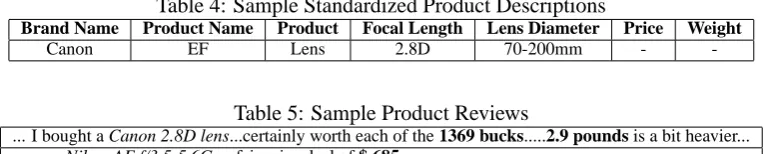
Table 4: Sample Standardized Product Descriptions
Brand Name Product Name Product Focal Length Lens Diameter Price Weight
Canon EF Lens 2.8D 70-200mm -
-Table 5: Sample Product Reviews
... I bought a Canon 2.8D lens...certainly worth each of the 1369 bucks...2.9 pounds is a bit heavier... ... new Nikon AF f/3.5-5.6G ... fair price deal of $ 685 ...
We compute the affinity for a candidate by look-ing at the appearances of known attribute val-ues(values obtained by segmentation of the prod-uct description strings) of the prodprod-uct in its con-text. The ‘known attribute values’ are assigned certain weights and the confidence score for the candidate is computed using the weights carried by the ‘known attribute values’ in its context. As-suming all weights to be equal, the following ex-ample explains the idea in detail:
Consider the product description “Canon EF 70-200mm f/2.8D Lens” and its corresponding seg-mented output in table 4. Here - represents the missing values to be filled using the reviews. Con-sider the two reviews given in table 5. Out of the candidates “1369 bucks ” and “$ 685” for the price attribute, “1369 bucks” is chosen as it con-tains more known attribute values (Canon, 2.8D, lens) in its context in review 1. On the other hand as “$ 685” has many competing attribute values (which do not match the known values) in its con-text (Nikon, AF, f/3.5-5.6G), it is rejected. Sim-ilarly, “2.9 pounds” being the only candidate for the weight attribute is accepted due to the presence of many matching known values in its context.
In the above example, we simply counted the number of known attribute values in each candi-date’s context to compute its confidence score. All the known values carried equal weights.
However, certain values occur much more rarely than others in free text. Hence, matching a rarer value in a candidate’s context should give us more confidence that the review author is talking about the same product (as in the product description string) than one which occurs more frequently. For example, matching a value Focal length ’18-55 mm’ (which occurs rarely) instills more confidence than if the value color ’black’ (a value which should occurs very frequently) is matched. We quantify this idea by assigning an ‘importance’ measure to all known values. The importance I(v) of a known value v can be decided by the proportion of distinct product
entities in the database(output of the standardiza-tion phase) that contain the value v. Since we wish to weigh rarer values more as they signify more importance, we use the inverse document frequency(IDF) formulation popularly used in previous text mining works to define:
I(v) =
(
log(nN(v)) if n(v)>0
0 otherwise
where, N is the total number of distinct entities for the attribute in the database, and n(v) is the number of distinct product entities that contain the valuev.
We also note that matching the value for a cer-tain attribute can signify greater confidence than others. For instance, if the “Product:Camera” or “Brand:Nikon” matches we still cannot be very sure because the author can be comparing two dif-ferent cameras or two Nikon products. However if a value mentioning weight or lens of the camera matches, we can be more certain as it is unlikely to have two cameras with exactly the same weight or the same lens.
With this intuition in mind, we also give dif-ferent weights to each ‘attribute’ in the standard-ization schema for matching. These weights in-tuitively signify our confidence on a value of the given attribute towards matching. In our running example, intuitively we should give more weight to ‘Weight’ or ‘Lens’ attributes than ‘Product’ and‘Brand’. Weight of the attributes can be ex-pressed by the domain expert during the schema decision process. Please note that this schema de-cision and weight assignment needs to be done only once per product vertical. For the matching to be effective, all real numbers were morphed to a common representation ‘#’ and misspellings were corrected for terms known in the dictionary.
confi-dence of a candidate dies off with its distance from the candidate. A formal description of the idea is given below.
Given: Attribute schemaA={A1. . . AN}, set of productsP and set of reviewsRpfor eachp∈P,
R= [
p∈P
Rp
Let Ai(p) be the value of attribute Ai for the product p ∈ P from the segmentation step. Let
Ip(Ai, r) be the set of index positions at which
Ai(p)occurs in the reviewr∈Rp. Define:
Bp(Ai) =
(
1 ifAi(p)is known 0 otherwise
Let attribute valueAjbe missing for some product
p after the segmentation step i.e. Bp(Aj) = 0 for somej ∈ {1. . . n}. Given a set of candidates
Cp(Aj, r) (obtained by applying rules on a prod-uct reviewr∈Rp) for attributeAjand productp, we define:
Qp(c, r) = n
X
x=1
Bp(Ax)W(Ax)
X
i∈Ip(Ax,r)
I(i)dr(i, c)
∀c∈Cp(Aj, r)
wheredris a distance metric defined over every pair of words in a given reviewr.
In similar lines to the idea presented so far, occurrence of a value that contests a value already known from the standardization stage(segmentation output of the product descrip-tion) can be used as an indicator that the author is talking of some other product or attribute. Hence, we have a case to reject candidates in its vicin-ity. Also, often people compare two products or brands while writing a review. Use of comparative adjective forms or coordinating conjunctions like “but, whereas, while, although, etc.” that express a contrast mark such cases. To incorporate both of the above ideas, we can easily extend the objec-tive function Qp to account for these contingen-cies by adding terms to the summation that reduce the score of a candidate if conflicting attribute val-ues and active comparison is found in its vicinity. Consider the following review:
I love the Point and Shoot mode in my new camera X. I was bored of using the same auto mode in my old cam Y. Though it lacks the auto-program fea-ture, still it’s worth its price in gold. While auto mode in Camera Y was a sham, night mode was
a cool addition. A f/1.8 lens , preferably brand Z would just be the icing on the cake.
Here the author compares his old camera with the one he just purchased and finally talks about buy-ing a different product (a lens). A naive extraction scheme will extract features for each of cameras X and Y, and lens Z. The problem could be further compounded if the author swings back and forth comparing two products leading us to the deep wa-ters of Pronoun Resolution and Attribute Corefer-ence Resolution. However, we easily find a way around them with the assumption that the switch will not happen too frequently in most reviews.
Finally, as the descriptions are often sparse, we do not have all representative values for an at-tribute. A better ‘importance’ measure for a value (I(v)) can be obtained from the reviews. Also, in the above description,Qpvalues can be arbitrarily large or small. Hence, we translate this idea in the probabilistic sense to a scale between 0 and 1. In an informal manner, the affinity of each candidate with the product can be treated as a confidence measure (represented by P(c) instead of discrete
Qpvalues) in a scale of 0 to 1.
We also give a linear time algorithm based on the above idea. The algorithm iterates over all the can-didates, modifying their affinity and dispersing the change to all other candidates in the review.
Given:- A set of products P and a set of re-viewsRpfor every productp∈P. LetCp,rbe the set of candidates for productpin reviewr. LetA
be the set of attributes. Wsim(Ak)andWdif f(Ak) are the weights of the attributeAkfor a matching value and a competing value, respectively. Weight
Wcomp penalizes a comparative sentence in the affinity calculation. dr(c, c′) is some distance metric defined on all candidate pairs in a review
r. We set the distance between two candidates as the number of words between their occurrence in the review in our simulations.
for eachp∈P:
for eachr∈Rp:
forc∈Cp,r:
Compute:I(c)
Initialize:P(c) = 1 2
Init value=P(c) fork∈1. . . n: ifc=Ak(p):
P(c) := Wsim(Ak) ∗ P(c) + (1 −
end if
else ifc=Ak(p′), p′∈P, p′! =p:
P(c) :=Wdif f(A(k))∗P(c)
end elseif
end for
if c lies in a comparative sentence:
P(c) :=Wcomp∗P(c)
end if
Change(c)=P(c)-Init value forc′∈Cp,r, c′! =c:
P(c)+ =Change(c′)×I(c′)×e−dr(c′,c) end for
NormalizeP
end for end for end for
Selection:- Finally for each product p and attribute Aj that misses a value forp, we choose the candidate with maximum affinity(P(c)) i.e. choosec∗p,Aj such that,
c∗p,Aj = argmax c′∈Cp(Aj,r),r∈Rp
P(c′, r).
Finally, c∗p,Aj is filled in as a value for Aj if
P(c∗p,Aj, r))(r is the review containing cp,Aj) is
above a certain threshold. The algorithm runs with a complexity ofO(N+C2)whereNis the size of
the reviews(number of words) andCis the number of candidates generated by applying rules on them. SinceCis generally small, this is effectively linear with respect to size.
4 Evaluation
4.1 Dataset
The algorithms were tested on a real life dataset crawled from ‘Amazon’. It contains reviews and short descriptions of 996 products in the Camera and Accessories space (Cameras, lenses, filters, etc). The total number of reviews was 23,337 lead-ing to reviews per product ratio of about 24. Av-erage number of words per review was around 40. Each product has a minimum of 20 reviews.
4.2 Experimental Setup
4.2.1 Product Description Segmentation
The experiments were carried out by first iden-tifying the appropriate schema and 12 attributes were identified for description segmentation. They are given in Table 6. Rules (as described in Sec-tion 4.1) were used to standardize the
descrip-tions into the composing attributes. The dictionary augmentation and rule writing together took nine man-hours. This is much lower than usual since we used Intellectual Property datasets on Brands and Products and clustering used to detect mis-spellings and varying vocabulary.
Table 6: Attributes guessed by the Rule Writer
Attribute Value Attribute Value
Brand Nikon Product Type Digital
Zoom True Color Black
Lens F/2.8 D Retail Price $ 250 Model D 90 Product Camera
Filter UV Size Compact
Resolution 12MP Features Point&Shoot
4.2.2 Missing Value Filling
It was observed that around 60% of the attributes after the segmentation stage were null. So we used the reviews to fill in these missing values. Reusing the rules on the reviews led to a whopping 8434 candidates for the 12 attribute places in 969 prod-ucts, which on using the confidence score based pruning scheme reduced to 5321. We set 0.5 as the weights for Brand Name, Product Name, Product Type and Color; and 1 for the remaining attributes. Recall that this is in-line with our arguments that there can be many products with the same Brand name, Product name, type and color but it is less likely for two products to have the same value for other attributes (say Retail Price or Weight). This choice of weights is done once and can be done at the time of the initial schema selection. Finally to select or reject candidates, we use a threshold. We used 0.4 times the mean(of the candidate con-fidence values) as the threshold for selection in our experiments. The threshold can be chosen based on the general confidence that the enterprise has on the correctness of the reviews. As the thresh-old is decreased, the number of values filled in increases but the precision-recall (and thereby F-Score) decreases.
4.3 Results
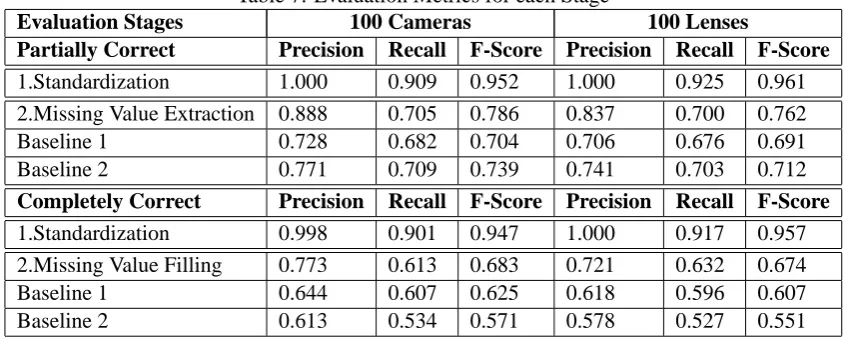
Table 7: Evaluation Metrics for each Stage
Evaluation Stages 100 Cameras 100 Lenses
Partially Correct Precision Recall F-Score Precision Recall F-Score
1.Standardization 1.000 0.909 0.952 1.000 0.925 0.961 2.Missing Value Extraction 0.888 0.705 0.786 0.837 0.700 0.762 Baseline 1 0.728 0.682 0.704 0.706 0.676 0.691 Baseline 2 0.771 0.709 0.739 0.741 0.703 0.712
Completely Correct Precision Recall F-Score Precision Recall F-Score
1.Standardization 0.998 0.901 0.947 1.000 0.917 0.957 2.Missing Value Filling 0.773 0.613 0.683 0.721 0.632 0.674 Baseline 1 0.644 0.607 0.625 0.618 0.596 0.607 Baseline 2 0.613 0.534 0.571 0.578 0.527 0.551
Hence, we evaluate results for both cases (when the values match perfectly or only partially).
4.3.1 Product Description Segmentation
As the Standardization stage is rule based, with time, close to perfect precision and recall can be achieved. In nine man-hours of effort, we achieved very high precision and recall as shown in Table 7.
4.3.2 Missing Value Filling
In Table 7, we give the precision and recall for the Enrichment phase. Here, we also draw two base-line comparisons for our work.
Baseline 1 is drawn by using the values ex-tracted by the standardization stage from a train-ing set (remaintrain-ing 886 cameras) as seeds to train a CRF. The value extraction task is treated as a multi-class classification problem where each word is to be classified as a value to one of the attributes (A1. . . An) or as a “not a value” class.
To generate a training set, every word is repre-sented as a feature vector ofn+ 20features. First
nfeatures are boolean entries and represent if the word matches an already known attribute value of the product. If the word matches with a value for
Aj, then jth feature is set to true and the rest to false. 10 words in the context of that word and their POS tags are remaining 20 features. The seeds are used to assign class labels to the train-ing set. State of the art CRF is used for value extraction in a 10-fold setting. Please note that drawing the seeds from the standardization stage (which was rule based) gives this baseline the su-pervision provided by the rules. This is done to make a comparison with our approach fair. Recall that our technique for missing value Assignment leverages the supervision of existing rules to come
up with meaningful values for the attributes. (Ghani et al., 2006) laid down an inge-nious technique to automatically extract candidate attribute-value seeds. They considered all pair of consecutive words(wi, wi+1) wherewi is a can-didate value for the attribute wi+1. Next, they
computed the mutual information between all such candidate attribute-value pairs to prune down to fewer but cleaner seeds. Baseline 2 generates seeds by their technique and filters them for the at-tributes{A1. . . An}. Again, CRF is trained with the same feature space.
It can further be observed that due to rule based cues, our techniques do well even when com-pletely correct values are expected. However, Baseline 2 (projection of (Ghani et al., 2006) on the attribute set) falls apart as most extracted val-ues are incomplete and partial.
The entire experiment is also carried out on a similar dataset of 100 lenses to prove the general-ization ability of our technique within the product domain(Photography). Results on the lens dataset (shown in Table 7) are very close to the camera dataset, and occasionally better.
5 Conclusion
References
Rayid Ghani, Katharina Probst, Yan Liu, Marko Krema, and Andrew Fano. 2006. Text mining for product attribute extraction. SIGKDD Explorations
Newsletter, 8(1):41–48.
Minqing Hu and Bing Liu. 2004. Mining and summa-rizing customer reviews. In Proceedings of the
In-ternational Conference on Knowledge discovery and data mining, pages 168–177.
Nozomi Kobayashi, Kentaro Inui, and Yuji Matsumoto. 2007. Extracting aspect-evaluation and aspect-of
re-lations in opinion mining. In Proceedings of the
Joint Conference on Empirical Methods in Natural Language Processing and Computational Natural Language Learning.
Bing Liu, Minqing Hu, and Junsheng Cheng. 2005. Opinion observer: analyzing and comparing opin-ions on the web. In Proceedings of the International
Conference on World Wide Web, pages 342–351.
U. Nambiar, A. Faruquie, K. H. Prasad, L. V. Subra-maniam, and M. K. Mohania. 2011. Data augmen-tation as a service for single view creation. In
Pro-ceedings of IEEE International Conference on Ser-vices Computing (SCC).
Fuchun Peng and Andrew McCallum. 2006. Infor-mation extraction from research papers using condi-tional random fields. Information Processing
Man-agement, 42(4):963–979.
Ana-Maria Popescu and Oren Etzioni. 2005. Extract-ing product features and opinions from reviews. In
Proceedings of the conference on Human Language Technology and Empirical Methods in Natural Lan-guage Processing, pages 339–346.
K. H. Prasad, T.A. Faruquie, S. Joshi, S. Chaturvedi,
L. V. Subramaniam, and M. K. Mohania. 2011.
Data cleansing techniques for large enterprise datasets. In Proceedings of SRII Global Conference
(SRII).
Guang Qiu, Bing Liu, Jiajun Bu, and Chun Chen. 2009. Expanding domain sentiment lexicon through
double propagation. In Proceedings of the
Inter-national joint Conference on Artifical intelligence,
pages 1199–1204.
Veselin Stoyanov and Claire Cardie. 2008. Topic iden-tification for fine-grained opinion analysis. In
Pro-ceedings of International Conference on Computa-tional Linguistics, pages 817–824, Morristown, NJ,
USA.
B. Wang and H. Wang. 2008. Bootstrapping Both Product Features and Opinion Words from Chinese Customer Reviews with Cross-Inducing.
Proceed-ings of International Joint Conference on Natural Language Processing.
Zhongwu Zhai, Bing Liu, Hua Xu, and Peifa Jia. 2010. Grouping product features using semi-supervised learning with soft-constraints.
Li Zhuang, Feng Jing, and Xiao-Yan Zhu. 2006.
Movie review mining and summarization. In
![Table 3: Rules for Segmentation ProcessRuleaCOPY [1][2] “Resolution”;](https://thumb-us.123doks.com/thumbv2/123dok_us/803176.1094652/4.595.73.570.71.281/table-rules-for-segmentation-processruleacopy-resolution.webp)