Stance Classification of Ideological Debates:
Data, Models, Features, and Constraints
Kazi Saidul Hasan and Vincent Ng
Human Language Technology Research Institute University of Texas at Dallas
Richardson, TX 75083-0688
{saidul,vince}@hlt.utdallas.edu
Abstract
Determining the stance expressed in a post written for a two-sided debate in an on-line debate forum is a relatively new and challenging problem in opinion mining. We seek to gain a better understanding of how to improve machine learning ap-proaches to stance classification of ideo-logical debates, specifically by examining how the performance of a learning-based stance classification system varies with the amount and quality of the training data, the complexity of the underlying model, the richness of the feature set, as well as the application of extra-linguistic constraints.
1 Introduction
Determining the stance expressed in a post written for a two-sided debate in an online debate forum is a relatively new task in opinion mining. Given a post written for a two-sided topic discussed in an online debate forum (e.g., “Should abortion be
banned?”), the goal of debate stance classifica-tion is to determine which of the two sides (i.e., for and against) its author is taking.
Previous approaches to debate stance classifica-tion have focused on three debate settings, namely congressional floor debates (e.g., Thomas et al. (2006), Bansal et al. (2008), Balahur et al. (2009), Yessenalina et al. (2010), Burfoot et al. (2011)), company-internal discussions (e.g., Agrawal et al. (2003), Murakami and Raymond (2010)), and on-line social, political, and ideological debates in public forums (e.g., Somasundaran and Wiebe (2010), Wang and Ros´e (2010), Anand et al. (2011), Biran and Rambow (2011), Hasan and Ng (2012)). As Walker et al. (2012) point out, debates in public forums differ from congressional debates and company-internal discussions in terms of lan-guage use. Specifically, online debaters use color-ful and emotional language to express their points,
which may involve sarcasm, insults, and question-ing another debater’s assumptions and evidence. These properties could make stance classification of online debates more challenging than that of the other two types of debates.
Our goal in this paper is to gain a better under-standing of how to improve machine learning ap-proaches to stance classification of online debates by examining the following questions, which can be broadly categorized along four dimensions:
Data. Can we improve the performance of a
stance classification system simply by increasing the number of stance-annotated debate posts avail-able for training? Note, however, that the num-ber of stance-annotated posts that can be down-loaded from debate forums for a given debate do-main (e.g., Abortion) is fairly limited. A natural question is: given a debate domain, can we iden-tify from different data sources a large number of documents where authors express viewpoints rele-vant to the domain (e.g., blog posts, news articles) and then stance-label them heuristically, with the goal of employing these noisily labeled documents as additional data for training a stance classifier?
Features. The simplest kind of features one can
think of is probably n-grams. Nevertheless, a stance classifier trained on unigrams is a relatively strong baseline (Somasundaran and Wiebe, 2010). Anand et al. (2011) augment an n-gram feature set with four types of features: document statistics, punctuations, syntactic dependencies, and, if ap-plicable, the set of features computed for the im-mediately preceding post in the discussion thread (see Section 3 for details). How effective are Anand et al.’s features in improving an n-gram-based stance classifier? Will adding semantic fea-tures improve performance further?
Models. The simplest stance classification
model is probably one that assigns a stance label to each debate post independently of the other posts. Can we get better performance by
exploiting the linear structure inherent in a post sequence? Since a post may contain materials irrelevant to stance classification, can we train a better model by learning only from the stance-related sentences without relying on sentences manually annotated with stance labels?
Constraints. Extra-linguistic inter-post
con-straints, such as author constraints (see Section 3), have been shown to be effective in improving stance classification performance by postpro-cessing the output of a stance classifier. Will the effectiveness of these constraints be dependent on the underlying debate domain? Will it be dependent on the accuracy of the stance classifier to which they are applied?
By examining these questions, we can poten-tially determine how the performance of a stance classification system varies with the amount and quality of the training data, the complexity of the underlying model, the richness of the feature set, as well as the application of extra-linguistic con-straints. In our evaluation, we focus on stance classification of ideological debates.
2 Datasets
For our experiments, we collect debate posts from four popular domains, Abortion (ABO), Gay Rights (GAY), Obama (OBA), and Mari-juana (MAR). Each post should receive one of two domain labels, for and against, depending on whether the author of the post supports or opposes abortion, gay rights, Obama, and the legalization of marijuana, respectively. To see how we obtain these domain labels, let us first describe the data collection process in more detail.
We collect our debate posts for the four domains from an online debate forum1. In each domain, there are several two-sided debates. Each debate has a subject (e.g., “Abortion should be banned”) for which a number of posts were written by dif-ferent authors. Each post is manually tagged with its author’s stance (i.e., yes or no) on the debate subject. Since the label of each post represents the subject stance but not the domain stance, we need to automatically convert the former to the latter. For example, for the subject “Abortion should be banned”, the subject stance yes implies that the au-thor opposes to abortion, and hence the domain la-bel for the corresponding lala-bel should be against.
1
http://www.createdebate.com/
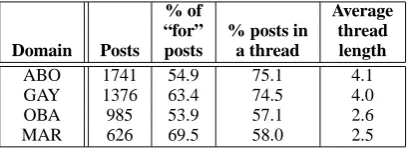
% of Average
“for” % posts in thread Domain Posts posts a thread length
ABO 1741 54.9 75.1 4.1
GAY 1376 63.4 74.5 4.0
OBA 985 53.9 57.1 2.6
MAR 626 69.5 58.0 2.5
Table 1: Statistics of the four datasets.
We construct one dataset for each domain. Statistics of these datasets are shown in Table 1.
3 Experimental Setup
In this section, we describe the experimental setup behind our investigation of the issues along the four dimensions of learning-based stance classifi-cation: models, features, data, and constraints.
3.1 Models
We seek to examine how model complexity im-pacts stance classification performance. We con-sider three types of models.
The first type of models is a binary classifier that assigns a stance label to each debate post indepen-dently of the other posts. We employ a generative model (Naive Bayes (NB) with add-one smooth-ing) and a discriminative model (Support Vector Machines (SVMs), as implemented in SVMlight (Joachims, 1999)) in our investigation. This en-ables us to determine whether the relative per-formance of generative models and discriminative models changes with the amount of training data (Ng and Jordan, 2002), and whether generative models can handle complex, possibly overlapping features as well as discriminative models.
The second type of models, sequence models, is motivated by an observation: since a post in a post sequence is a reply to its parent post, its label should be determined in dependent relation to that of its parent. Consequently, these models assume as input a post sequence and output a sequence of stance labels, one for each post in the input se-quence. As before, we employ two sequence la-belers, one generative (first-order Hidden Markov Models (HMMs) with add-one smoothing) and one discriminative (linear-chain Conditional Ran-dom Fields (CRFs) (Lafferty et al., 2001), as im-plemented in Mallet (McCallum, 2002)).
stances could improve document stance classifi-cation performance: for example, features com-puted from sentences with a neutral stance should not play any role in determining the document stance. To avoid the cost of hand-annotating sen-tences with stance labels for training a sentence-stance classifier, we determine sentence sentence-stances in our model in an unsupervised manner. More-over, while it is possible to implement fine-grained models based on NB, SVM, HMM, and CRF, we will focus exclusively on those based on NB and HMM. The reason is that they are easier to imple-ment because we employ our own impleimple-mentation of NB and HMM in these experiments.
The generative story. To generate a document
di, we first pick a document stancec with
prob-ability P(c). Given c, we generate each sentence in di independently of each other. To generate a
sentenceem, we first pick a sentence stanceswith
probability P(s|c), and then generatefn, the value
of thenth feature representing em, with
probabil-ity P(fn|s, c).
A few points deserve mention. First, fine-grained NB and fine-fine-grained HMM both employ this document generative story, differing only in terms of whether the document stance is generated independently (NB) or in dependent relation to that of the preceding post (HMM). Second, while a document stance can have one of two possible val-ues (for and against), a sentence stance can have one of three possible values (for, against, and
neu-tral). Note that the stance of a sentence can be
ex-pressed by someone other than the author of the post; for example, a sentence may restate an op-posing opinion by a different author.
Training the fine-grained models. As noted
above, we need to estimate P(c), P(s|c), and P(fn|s, c). P(c) can be estimated from the
stance-labeled training documents.2 However, since sen-tence stances are hidden, we estimate P(s|c) and P(fn|s, c) using the Expectation-Maximization
(EM) algorithm (Dempster et al., 1977).
To employ EM, we begin by heuristically label-ing each sentence with a stance as follows. First, for each document stancec, we identify the list of informative unigrams, which consists of the open-class words that appear at least 10 times in the training data and is associated withcat least 70%
2In the case of HMMs, we need to additionally estimate
the document transition probabilities, which can be done in a supervised manner.
of the times. Then, given a sentenceem, its stance
label is determined by taking a simple majority vote using the stance labels associated with the in-formative unigrams appearing inem. In case of a
tie,emis labeled as neutral.3
After heuristic labeling, we begin with the M-step, where we estimate model parameters P(s|c) and P(fn|c, s) from the training data. Since the
data is now stance-labeled at both the document and sentence level, we can estimate these parame-ters using maximum likelihood estimation.
Next, we proceed to the E-step, where the goal is to estimate P(s|em, di, c), the probability that
a sentence expresses a sentence stance given the document stance. From the above generative story,
P(s|em, di, c)∝P(s|c)P(em, di|s, c)
=P(s|c) |F|
Y
n=1
P(fn|s, c)
(1)
whereF is the set of features in sentenceem. We
run EM until convergence.
Applying the fine-grained models. After
train-ing, we can apply the fine-grained models to clas-sify each test post di. For fine-grained NB, we
employ the following equation:
P(c|di)∝P(c)P(di|c)
=P(c) |S(di)|
Y
m=1
P(smax|em, di, c)
(2)
where S(di) is the set of sentences in test post
di, and smax is the sentence stance with the
maximum conditional probability (obtained using Equation 1) for sentenceemindi.
For fine-grained HMM, we employ Viterbi to decode a post sequence, using P(di|c) as the
“out-put probability” of a test post given stancec.
3.2 Features
We seek to examine how the features used to train the stance classification system impact its perfor-mance. We consider three feature sets.
N-gram features. The first feature set consists
of unigrams and bigrams collected from the train-ing posts. We encode them as binary features that indicate their presence or absence in a given post.
3Intuitively, sentences containing an equal number of for
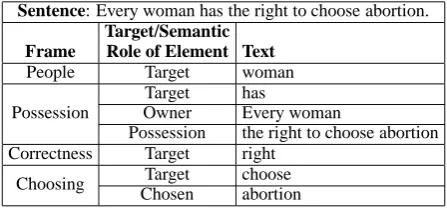
Sentence: Every woman has the right to choose abortion. Target/Semantic
Frame Role of Element Text
People Target woman
Possession
Target has
Owner Every woman
Possession the right to choose abortion
Correctness Target right
Choosing Target choose
Chosen abortion
Table 2: Sample frame-semantic parse.
Anand et al.’s (2011) features. The second
fea-ture set, proposed by Anand et al., consists of five types of features: n-grams, document statistics, punctuations, syntactic dependencies, and, if ap-plicable, the set of features computed for the im-mediately preceding post in its thread. Their n-gram features include both the unin-grams and grams in a post, as well as its first unigram, first bi-gram, and first trigram. The features based on doc-ument statistics include the post length, the num-ber of words per sentence, the percentage of words with more than six letters, and the percentage of words as pronouns and sentiment words. The punctuation features are composed of the repeated punctuation symbols in a post. The dependency-based features have three variants. In the first vari-ant, the pair of arguments involved in each depen-dency relation extracted by a dependepen-dency parser is used as a feature. The second variant is the same as the first except that the head (i.e., the first argument in a relation) is replaced by its part-of-speech (POS) tag. The features in the third variant, the topic-opinion features, are created by replacing each feature from the first two types that contains a sentiment word with the corresponding polarity label (i.e.,+or−).
Adding frame-semantic features. To provide
semantic generalizations, we create features com-puted using FrameNet semantic frames (Baker et al., 1998). More specifically, we first apply SE-MAFOR (Das et al., 2010) to create a frame-semantic parse for each sentence in a given de-bate post. Then, for each frame that a sentence contains, we create three types of frame-semantic features, as described below.
A frame-word interaction feature is a binary feature composed of (1) the name of the frame
f from which it is created, and (2) an unordered word pair in which the words are taken from two frame elements off. Specifically, for each pair of frame elementsf e1andf e2of a framef, we
cre-ate one frame-word interaction feature from each unordered word pair composed of one word from
f e1and one word fromf e2. Consider the frame-semantic parse of the sentence Every woman has
the right to choose abortion shown in Table 2.
Given the frame Possession and its frame elements
Every woman and the right to choose abortion, we
can generate frame-word interaction features such as Possession-right-woman,
Possession-choose-woman, Possession-abortion-woman.
A frame-pair feature is a binary feature com-posed of a word pair corresponding to the names of two frames, in which the target of the first is present in a frame element of the second. Specif-ically, for each frame element f e of a frame
f, if a substring of f e is the target of a frame
f2, we create a frame-pair feature composed of the ordered pair (f2, f). Consider the exam-ple in Table 2 again. Given the frame
Posses-sion and its frame elements Every woman and the right to choose abortion, we can create three
frame-pair features, People:Possession,
Choos-ing:Possession, and Correctness:Possession, since woman, choose, and right are the targets of frames People, Choosing, and Correctness, respectively.
A frame n-gram feature is the frame-based ver-sion of a word n-gram feature. Given a word un-igram or bun-igram in which each word is an open-class word, we create all possible frame n-gram features from it by replacing one or more of its words with its frame name (if the word is a frame target) or its frame semantic role (if the word is present in a frame element). For instance, in the word bigram woman+has from the sentence in Table 2, both woman and has are open-class words and are targets of People and Possession, respectively. Hence, we create for woman+has three frame n-gram features: woman+Possession,
People+has, and People+Possession. In addition,
since woman plays the role of Owner in
Posses-sion, we create two more frame n-gram features, Owner+Possession and Owner+has.
Using the frame-semantic features. One way
to use the frame-semantic features is to incorpo-rate them into Anand et al.’s (2011) feature set and train a stance classifier on the augmented fea-ture set.4 We employ a different way of using the frame-semantic features, however. We train two
4Preliminary results indicate that training a stance
Abortion Gay Rights
For Against For Against
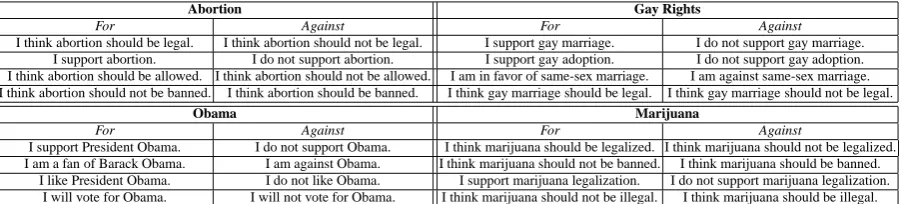
I think abortion should be legal. I think abortion should not be legal. I support gay marriage. I do not support gay marriage. I support abortion. I do not support abortion. I support gay adoption. I do not support gay adoption. I think abortion should be allowed. I think abortion should not be allowed. I am in favor of same-sex marriage. I am against same-sex marriage. I think abortion should not be banned. I think abortion should be banned. I think gay marriage should be legal. I think gay marriage should not be legal.
Obama Marijuana
For Against For Against
I support President Obama. I do not support Obama. I think marijuana should be legalized. I think marijuana should not be legalized. I am a fan of Barack Obama. I am against Obama. I think marijuana should not be banned. I think marijuana should be banned.
I like President Obama. I do not like Obama. I support marijuana legalization. I do not support marijuana legalization. I will vote for Obama. I will not vote for Obama. I think marijuana should not be illegal. I think marijuana should be illegal.
Table 3: Sample search queries.
stance classifiers,CAandCF S. CAis trained
us-ing Anand et al.’s (2011) features, whereas CF S
is trained using only the frame-semantic features. After training, we use the classifiers to predict the stance for a post x in the test set as follows. We first apply them independently to classify x, and then predict the stance forxby linearly interpolat-ing the resultinterpolat-ing classification values. The value of the interpolation constant is tuned to maximize performance on development data.5
3.3 Data
We seek to examine how the amount and quality of the training data impact stance classification per-formance.
To determine how classification performance varies with the amount of training data, we will plot learning curves in our evaluation.
As far as training data quality is concerned, our goal is to collect documents discussing viewpoints relevant to the debate domain of interest from dif-ferent sources (e.g., blogs, news websites), stance-label them heuristically, and determine how these noisily labeled documents can be used in combina-tion with the stance-annotated debate posts to train a stance classification system. Below we describe how we collect and utilize these documents.
Collecting noisily labeled documents. To
col-lect noisily labeled documents, we employ a two-step procedure. We (1) create using commonsense knowledge a list of phrases that are reliable indi-cators of both stances for each domain; and then (2) use each phrase as an exact search query to re-trieve noisily labeled documents from the Web.
Sample phrases that we create for each stance of each domain are shown in Table 3.6 For in-stance, for the Abortion domain, the phrase I
sup-port abortion indicates the author’s supsup-port for
5
We tried values from 0.0 to 1.0 in steps of 0.001.
6The complete set of phrases is available at http://
www.hlt.utdallas.edu/˜saidul/stance.html.
abortion. In contrast, I think abortion should be
banned is indicative of the author’s stance against
abortion. Since we use each phrase as a search query in the second step, we manually paraphrase each of them in hope to increase the number of retrieved documents. For instance, we create for
abortion should be banned paraphrases such as abortion should be prohibited, abortion should be illegal, and abortion should not be allowed.
Some paraphrases are created simply by employ-ing different forms of a proper noun (e.g., Obama,
Barack Obama, and President Obama). Table 4
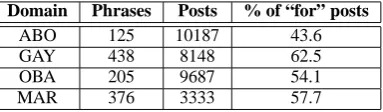
shows the statistics of the noisily labeled docu-ments. It took us less than two person-days to cre-ate the phrases and their paraphrases for each do-main. Roughly the same number of phrases were created for the two stances in a domain.
As noted above, we use each phrase created in the first step as an exact search query to retrieve documents from the Web using Bing’s Search API.7 A closer inspection of the retrieved docu-ments reveals that many of them contain materials irrelevant to the search query. One of them, for in-stance, is a blog article discussing different facets of women rights, followed by comments from sev-eral readers. The search query that retrieved the document appeared in one of the readers’ com-ments. In this case, it makes sense to delete ev-erything but this reader’s comment from the docu-ment before using it as noisily labeled data. For this reason, we heuristically extract the portion of each retrieved document that is relevant to the search query. More specifically, we define the rel-evant portion of a document as the smallest string that contains the search query string and is delim-ited by HTML tags. Note that we discard docu-ments that contain less than 10 words (in order to avoid documents with no useful content) or are re-trieved fromwww.createdebate.com(in
or-7https://datamarket.azure.com/dataset/
Domain Phrases Posts % of “for” posts
ABO 125 10187 43.6
GAY 438 8148 62.5
OBA 205 9687 54.1
MAR 376 3333 57.7
Table 4: Noisy data statistics.
der to avoid overlaps with our evaluation datasets).
Training with noisily labeled documents.
Given these noisily labeled documents, how can they be used in combination with the (cleanly labeled) debate posts in the training set for train-ing stance classifiers? Motivated by Nguyen and Moschitti (2011), we train two stance classifiers,
Cc and Cc+n. Cc is trained on only the debate
posts in the training set. Cc+n, on the other hand,
is trained on both the debate posts and the noisily labeled documents.8 Both of them use the same set of features.
After training, we use these classifiers to predict the stance for a postxin the test set as follows. We first apply them independently to classify x, and then predict the stance forxby linearly interpolat-ing the resultinterpolat-ing classification values. The value of the interpolation constant is tuned to maximize performance on development data.9
3.4 Constraints
Previous work on stance classification of congres-sional debates has found that enforcing author constraints (ACs) can improve classification per-formance (e.g., Thomas et al. (2006)). ACs are a type of inter-post constraints that specify that two posts written by the same author for the same de-bate domain should have the same stance, and are typically used to postprocess the output of a stance classifier. We seek to determine how ACs impact the performance of a system for stance-classifying ideological debate posts, and whether their effec-tiveness depends on the debate domain.
In our experiments, we enforce ACs as follows. We first use a stance classifier to classify the test posts. Note that the classification value of a post can be thought of as a probabilistic vote that a post can cast on the stance labels. Then, given a set of
8We treat the noisily labeled documents as sequences of
length one when using them to train HMMs and CRFs.
9We tried values from 0.0 to 1.0 in steps of 0.001. Note
that when both frame-semantic features and noisily labeled documents are used, there are two interpolation constants to be tuned. In that case, we tune the constant associated with the frame-semantic features before tuning the one associated with the noisily labeled documents.
test posts written by the same author for the same debate domain, we sum up the probabilistic votes cast by these posts, and assign to each of them the stance that receives the larger number of votes.
4 Evaluation
In the previous section, we described the experi-mental setup for investigating the issues pertaining to the four dimensions of learning-based stance classification. In this section, we begin by describ-ing the general experimental setup and then report on and discuss the evaluation results.
4.1 General Experimental Setup
Results are expressed in terms of accuracy ob-tained via 5-fold cross validation, where accuracy is the percentage of test instances correctly classi-fied. Since all experiments require the use of de-velopment data for parameter tuning, we use three folds for model training, one fold for development, and one fold for testing in each fold experiment. All SVM and CRF learning parameters are set to their default values in SVMlight and Mallet, re-spectively.
Learning curves are generated for all the experi-ments. Each point on a learning curve is computed by averaging the results of five independent runs corresponding to five different randomly selected training sets of the required size. To ensure a fair comparison of different learning models, the same five randomly selected training sets of the required size are used to train the models. Since the mod-els based on HMMs and CRFs need to be trained on post sequences, we assemble a training set of a given size as follows: whenever a post is sampled for inclusion into the training set, we incorporate all the posts in the same post sequence into the training set.
4.2 Results
Configuration 300 600 1000
SVM NB NBF HMM HMMF CRF SVM NB NBF HMM HMMF CRF SVM NB NBF HMM HMMF CRF
W 57.1 57.6∗ 59.1‡ 59.2∗ 60.1‡ 60.2 59.2 60.1∗ 60.0 60.9∗ 61.9‡ 62.7 61.1 61.7∗ 62.9‡ 63.1∗ 64.3‡ 65.3 A 57.5† 57.9 59.6†‡ 59.7†∗ 60.5†‡ 60.4 59.5† 60.3∗ 60.0 61.0∗ 61.9‡ 62.9†∗61.3† 61.8†∗ 63.1‡ 63.2∗ 64.4‡ 65.9†∗
A+FS 59.8† 59.9† 61.7†‡ 61.8†∗ 63.6†‡ 61.5 62.1† 61.9† 62.1† 63.4†∗64.4†‡ 65.1† 63.1† 62.7 64.2†‡ 64.7†∗65.3 64.9 A+FS+N 62.6† 61.8† 63.4†‡ 64.2†∗ 65.0†‡ 63.4†∗ 63.9† 63.5† 63.9† 65.5†∗66.6†‡ 66.0† 64.6† 64.3† 65.2†‡ 66.7†∗67.5†‡ 67.5†
A+FS+N+AC 70.0† 69.7† 70.3† 71.7†∗ 72.5†‡ 70.6†∗ 71.0† 70.9† 71.4† 71.9†∗73.6†‡ 71.5†∗73.5† 73.3† 74.1†‡ 74.0†∗75.1†‡ 74.7†
(a) Abortion
Configuration 300 600 1000
SVM NB NBF HMM HMMF CRF SVM NB NBF HMM HMMF CRF SVM NB NBF HMM HMMF CRF W 58.3 58.3 59.5‡ 60.0∗ 61.3‡ 63.4∗ 61.1 60.7 62.4‡ 62.7∗ 63.6 65.1∗ 62.5 62.1 63.6‡ 63.2∗ 64.5‡ 65.6∗
A 59.0† 59.2† 59.7‡ 60.2∗ 61.7†‡ 63.2∗ 61.8† 61.4† 62.6‡ 62.4∗ 63.7‡ 65.3∗ 62.6 62.4† 63.5‡ 63.8†∗64.9†‡ 65.8∗
A+FS 60.8† 60.6† 61.6†‡ 62.4†∗ 63.5†‡ 64.8†∗ 63.1† 62.8† 64.2†‡ 64.1†∗64.9†‡ 66.2†∗ 64.0† 64.1† 64.8† 65.0†∗66.3†‡ 66.8†
A+FS+N 63.2† 63.2† 64.8†‡ 64.7†∗ 66.0†‡ 65.9† 64.5† 64.8† 65.8†‡ 66.2†∗67.5†‡ 66.7 64.9† 65.2† 65.9† 66.8†∗68.2†‡ 67.6†
A+FS+N+AC 65.4† 65.3† 66.7†‡ 66.5†∗ 68.6†‡ 67.5†∗ 66.0† 66.2† 67.2†‡ 67.8†∗69.5†‡ 68.5†∗ 66.9† 67.0† 67.9†‡ 68.9†∗71.1†‡ 69.9†∗
(b) Gay Rights
Configuration 200 400 700
SVM NB NBF HMM HMMF CRF SVM NB NBF HMM HMMF CRF SVM NB NBF HMM HMMF CRF
W 56.2 56.3 58.3‡ 58.1∗ 60.2‡ 58.6∗ 57.3 57.7 59.2‡ 59.5∗ 61.4‡ 61.2 57.9 58.1 60.3‡ 60.2∗ 62.0‡ 62.9 A 56.6† 56.7† 58.1‡ 58.0∗ 60.1‡ 59.0†∗57.4 57.8 59.5‡ 59.7∗ 61.7‡ 61.2 58.1 58.2 60.6‡ 60.1∗ 62.2‡ 63.2†∗
A+FS 58.7† 58.9† 60.6†‡60.2†∗62.4†‡ 61.1†∗59.3† 59.7† 61.9†‡ 61.8†∗ 63.6†‡ 63.2† 60.0† 60.2† 62.7†‡ 62.1†∗ 64.3†‡ 64.2†
A+FS+N 61.7† 62.0† 63.9†‡63.6†∗65.7†‡ 64.6†∗62.5† 62.5† 65.1†‡ 64.9†∗ 67.1†‡ 66.1†∗63.4† 63.5† 65.8†‡ 65.5†∗ 68.0†‡ 67.1†∗
A+FS+N+AC 64.6† 64.7† 67.3†‡67.3†∗69.8†‡ 68.7†∗65.6† 65.5† 68.6†‡ 69.2†∗ 70.7†‡ 70.3† 66.6† 67.0†∗ 69.1†‡ 70.0†∗ 71.9†‡ 71.1†∗
(c) Obama
Configuration 100 300 500
SVM NB NBF HMM HMMF CRF SVM NB NBF HMM HMMF CRF SVM NB NBF HMM HMMF CRF W 63.5 63.9 64.7 65.5∗ 67.0‡ 66.4 64.3 64.5 65.8‡ 67.0∗ 68.3‡ 68.7 66.0 65.9 67.1‡ 68.5∗ 69.8‡ 70.5 A 64.1† 64.2 65.1†‡ 66.1†∗67.2‡ 66.7 65.5† 65.6† 66.4† 67.3∗ 68.6‡ 69.0 66.9† 66.8† 67.3 69.0†∗70.1‡ 70.8 A+FS 66.2† 66.4† 67.2†‡ 68.3†∗69.1†‡ 68.5† 67.7† 67.9† 68.6† 70.0†∗ 71.0†‡ 71.1† 69.0† 69.3† 69.2† 71.6†∗72.0† 72.6†
A+FS+N 68.4† 68.6† 69.8†‡ 70.5†∗71.8†‡ 70.6†∗ 69.9† 70.1† 71.0†‡ 72.5†∗ 73.3†‡ 73.1† 71.3† 71.1† 72.0†‡ 73.7†∗74.6†‡ 74.7†
A+FS+N+AC 69.3† 69.5† 70.9†‡ 71.4†∗72.7†‡ 71.6†∗ 71.0† 71.1† 71.9 73.7†∗ 74.2† 74.2† 72.2† 72.4† 73.4†‡ 74.9†∗75.7†‡ 75.4†
(d) Marijuana
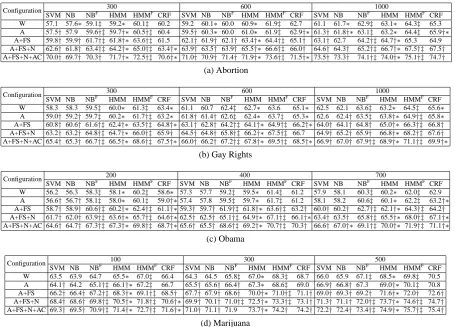
Table 5: Five-fold cross-validation accuracies for the four domains.
superscript ‘F’. There are five rows in each sub-table. The ‘W’ row shows the results when only n-gram features are used. The ‘A’ row shows the results when Anand et al.’s (2011) features are used. The ‘A+FS’ row shows the results when both Anand et al.’s features and frame-semantic features are used. The last two rows show the re-sults when noisily labeled documents and author constraints are added incrementally to A+FS.
To determine statistical significance, we con-duct pairedt-tests (p <0.05). These significance tests can be divided into three groups. The first group aims to determine whether the performance difference between the two systems shown in con-secutive rows in a given column is statistically significant. If a number is marked with a tagger (†), it means that the performance difference be-tween the corresponding system and the one in the previous row is statistically significant. The second group aims to determine whether the per-formance difference between two learning models are significant. We tested significance for three pairs of learning models: (1) SVM and NB; (2) NB and HMM; and (3) HMMF and CRF. If a number is marked with an asterisk (∗), it means
that the performance difference between the corre-sponding learning model and the one in the same pair is statistically significant.10 The third group aims to determine whether the performance dif-ference between NB/HMM and the corresponding fine-grained version of the model is statistically significant. If a number for a fine-grained model (NBF, HMMF) is marked with a double dagger (‡), it means that the performance difference between the model and its corresponding coarse-grained version (NB, HMM) is significant.
4.3 Discussion
Q: Can we improve performance by increasing the number of stance-labeled posts in the training set? A: Yes. Keeping other factors constant, as we increase the number of (cleanly labeled) training posts from 100 to 500, we see significant improve-ments on all four domains: accuracies increase by 1.5, 2.4, 2.0, and 3.1 points for ABO, GAY, OBA, and MAR, respectively. As we further increase the number of training posts from 500 to 1000, we see
10If a number under the NB column is marked with an
another significant rise in performance: accuracies improve by 2.7 and 1.3 points for ABO and GAY, respectively. For ABO, GAY, and OBA, increas-ing the trainincreas-ing set size seems to have a more pos-itive impact on systems employing a simple fea-ture set (W) than on those employing richer feafea-ture sets. Other than that, the degree of improvement does not seem to be dependent on the complexity of the model and the richness of the feature set.
Q: Which model is better, NB or SVM?
A: There is no clear winner. Other factors being equal, SVM beats NB significantly in 17% of the cases, NB beats SVM significantly in 27% of the cases, and the two are statistically indistinguish-able in the remaining cases. Neither generative models nor discriminative models seem to have an advantage over the other for this task.
Q: Are the sequence models better than their non-sequence counterparts?
A: Yes. Comparing NB and HMM, we see that HMM consistently outperforms NB significantly, with improvements ranging from 1.6 to 2.2 points for the four domains. Now, comparing HMM and CRF, we see that while CRF does not always per-form significantly better than HMM, in no case does it perform significantly worse.11 Taken to-gether, both sequence learners perform signifi-cantly better than NB. Since NB and SVM per-form at the same level, we can conclude that se-quence models indeed offer better performance.
Q: Are the fine-grained models better than their coarse-grained counterparts?
A: Considering HMM and HMMF, the answer is
yes: HMMFbeats HMM significantly by 1.1 to 2.1 points for the four domains. Considering NB and NBF, the answer is mostly yes: NBFbeats NB sig-nificantly by 1.2 to 2.3 points for GAY and OBA respectively. For the remaining domains, NBF per-forms significantly better than NB in most cases, especially when the n-gram feature set and the Anand et al.’s feature set are used.
Q: Which is the best model?
A: HMMF and CRF achieve the best results, but
there is no clear winner between them. Other fac-tors being equal, CRF beats HMMF significantly
in 26% of the cases, HMMF beats CRF signifi-cantly in 21% of the cases, and the two are statis-tically indistinguishable in the remaining cases.
11Significance test results between HMM and CRF are not
shown in Table 5 due to space limitations.
Q: Is Anand et al.’s feature set (A) stronger than the n-gram feature set (W)?
A: Although the A systems generally yield small improvements (<1%) over the corresponding W systems, only 42% of those cases represent signifi-cant improvements. On the other hand, the W sys-tems beat the corresponding A syssys-tems less than 15% of the times, and less than 10% of those cases represent significant improvements.
Q: Are frame-semantic features (FS) useful? A: Yes. Apart from a few cases in ABO, the A+FS systems significantly outperform the correspond-ing A systems by 1.5–2.2 accuracy points for the four domains.
Q: Does using noisily labeled documents help im-prove performance?
A: Yes. Comparing A+FS and A+FS+N, we see that employing noisily labeled documents con-sistently yields a significant improvement of 1.8 to 3.3 points for the four domains, regardless of which learning model is used. For ABO and GAY, the improvement that we obtain out of the noisy data decreases as we increase the number of (cleanly labeled) debate posts. However, for OBA and MAR, we do not see such diminishing returns. This could be explained by the difference in the quality of the noisily labeled documents ac-quired for the different domains, but additional ex-periments are needed to determine the reason.
Q: Do ACs have different degrees of impact in dif-ferent domains? If so, why?
A: Yes, ACs do seem to have different degrees of impact in different domains: on average, the ad-dition of ACs yields a 7% improvement in ABO, a 2-3% improvement in GAY, a 4% improvement in OBA, and a<1% improvement on MAR. We hypothesize that this difference has to do with the percentage of test posts to which ACs can be ap-plied successfully (i.e., an incorrect stance predic-tion will be turned into a correct one after applying ACs). To test this hypothesis, we take a closer look at two runs, an ABO run where HMMFis trained
58
The eight graphs above are the learning curves for HMM and HMMFfor the four domains. The five curves in each graph correspond to the configura-tions in the five rows of each sub-table in Table 5. In each graph, the best-performing configuration is A+FS+N+AC, which is followed by A+FS+N and then A+FS. There is no clear winner between W and A, but the latter tends to outperform the former as the amount of training data increases.
References
R. Agrawal, S. Rajagopalan, R. Srikant, and Y. Xu. 2003. Mining newsgroups using networks arising from social behavior. WWW.
P. Anand, M. Walker, R. Abbott, J. E. Fox Tree, R. Bowmani, and M. Minor. 2011. Cats rule and dogs drool!: Classifying stance in online debate.
WASSA.
C. F. Baker, C. J. Fillmore, and J. B. Lowe. 1998. The Berkeley FrameNet project. COLING/ACL.
A. Balahur, Z. Kozareva, and A. Montoyo. 2009. De-termining the polarity and source of opinions ex-pressed in political debates. CICLing.
M. Bansal, C. Cardie, and L. Lee. 2008. The power of negative thinking: Exploiting label disagreement in the min-cut classification framework. COLING
2008: Posters.
O. Biran and O. Rambow. 2011. Identifying justifica-tions in written dialogs. ICSC.
C. Burfoot, S. Bird, and T. Baldwin. 2011. Collec-tive classification of congressional floor-debate tran-scripts. ACL-HLT.
D. Das, N. Schneider, D. Chen, and N. A. Smith. 2010.
SEMAFOR 1.0: A probabilistic frame-semantic
parser. Carnegie Mellon University Technical Re-port CMU-LTI-10-001.
A. P. Dempster, N. M. Laird, and D. B. Rubin. 1977. Maximum likelihood from incomplete data via the EM algorithm. Journal of the Royal Statistical
So-ciety. Series B (Methodological), 39:1–38.
K. S. Hasan and V. Ng. 2012. Predicting stance in ideological debate with rich linguistic knowledge.
COLING 2012: Posters.
T. Joachims. 1999. Making large-scale SVM learning practical. In Advances in Kernel Methods - Support
Vector Learning. MIT Press.
J. D. Lafferty, A. McCallum, and F. C. N. Pereira.
2001. Conditional random fields: Probabilistic
models for segmenting and labeling sequence data.
ICML.
A. K. McCallum. 2002. Mallet: A machine learning for language toolkit.
A. Murakami and R. Raymond. 2010. Support or op-pose? Classifying positions in online debates from reply activities and opinion expressions. COLING
2010: Posters.
A. Y. Ng and M. I. Jordan. 2002. On discriminative vs. generative classifiers: A comparison of logistic regression and naive Bayes. NIPS.
T.-V. T. Nguyen and A. Moschitti. 2011. Joint distant and direct supervision for relation extraction.
IJC-NLP.
S. Somasundaran and J. Wiebe. 2010. Recognizing stances in ideological on-line debates. CAAGET. M. Thomas, B. Pang, and L. Lee. 2006. Get out the
vote: Determining support or opposition from Con-gressional floor-debate transcripts. EMNLP. M. Walker, P. Anand, R. Abbott, and R. Grant. 2012.
Stance classification using dialogic properties of persuasion. NAACL-HLT.
Y.-C. Wang and C. P. Ros´e. 2010. Making conversa-tional structure explicit: Identification of initiation-response pairs within online discussions.
NAACL-HLT.