A Self-learning Template Approach for Recognizing Named Entities from
Web Text
Qian Liu†‡, Bingyang Liu†‡, Dayong Wu‡, Yue Liu‡, Xueqi Cheng‡
†University of Chinese Academy of Sciences, Beijing, China
‡Institute of Computing Technology, Chinese Academy of Sciences, Beijing, China
{liuqian, liubingyang}@software.ict.ac.cn
{wudayong, liuyue, cxq}@ict.ac.cn
Abstract
Recognizing Chinese Named entities from the Web is challenging, due to the lack of labeled data and differences between Chi-nese and English. We propose a semi-supervised approach which leverages seed entities and the large unlabeled data to learn templates. Some high-quality tem-plates are generated iteratively to extrac-t new named enextrac-tiextrac-ties based on extrac-the model of quality metrics. Experimental results show that our approach significantly out-performs the baseline method and it is ro-bust against the changes of the Web.
1 Introduction
Compared to English Named Entity Recognition (NER), Chinese NER is more difficult. For exam-ple, although capitalization plays an very impor-tant role in English NER, this language-specific feature is useless in Chinese NER. Moreover, the lack of space between words in Chinese often makes the work based on word segmentation (Sun et al., 2002) failure. Especially, there are a lot of new words and ambiguous words in the Web tex-t, which increase the error of word segmentation. The loss of precision propagates to NER.
Currently, NER is mainly based on supervised models. Such models perform well in single do-main (Wang, 2009; Du et al., 2010). Unfortunate-ly, the data of the Web is open-domain and always changing. The performance of them degrades bad-ly, since the distribution of the Web data is differ-ent from that of the training data. For instance, the average F1 score of the Stanford NER, which is trained on the CoNLL03 shared task data set and achieves state-of-the-art performance on that task, drops from 90.8% to 45.8% on tweets (Liu et al., 2011). Despite a high-quality training data set, which has the same distribution as the Web data
and covers all kinds of domains, can improve the performance of NER, as far as we know, there are no such labeled data. Furthermore, named entities change over the time, especially person names and company names. (Tsuchiya et al., 2009) shows that 20%∼30% of named entity types are replaced with new ones every year in Mainichi Newspaper articles. Such change is even more obvious in the Web data and leads to the unreliable labeled data. Constantly annotating new data is time-consuming and expensive.
In this paper, we propose a semi-supervised ap-proach that uses self-learning templates to solve above problems. Instead of annotating a massive amount of data, we leverage a small number of named entities and the large unlabeled data to dis-cover new named entities that can not be identified using the training data. Experiments show that our approach raises the F1 from 75.9% to 88.6% on the Chinese Web data without retraining the exist-ing model, and it is robust against the changes of the data. Since no language-specific knowledge is used, our approach can easily be extended to other languages.
2 Related Work
There have been many approaches proposed to solve the problem of the lack of annotated da-ta. (Wu et al., 2009; Chiticariu et al., 2010) fo-cus on domain adaptation, which aims to reuse the knowledge among different domains. (Ling and Weld, 2012; R¨ud et al., 2011; Han and Zhao, 2010) leverage information from external knowl-edge sources, such as Wikipedia, WordNet and search engine, to compensate for the insufficien-t insufficien-training dainsufficien-ta. Some work builds crowdsourc-ing services to label data by human. For exam-ple, Amazon Mechanical Turk1provides a platfor-m to obtain data in various doplatfor-mains such as eplatfor-mail
1https://www.mturk.com/mturk/welcome
(Lawson et al., 2010), medicine (Yetisgen-Yildiz et al., 2010) and Twitter (Finin et al., 2010).
The work based on context templates is more closely related to our approach. (Etzioni et al., 2005) extracts named entities via domain-specific templates, which are learned from predefined tem-plates. (Whitelaw et al., 2008) builds training data utilizing templates generated by millions of seeds. Although context templates are used to im-prove the perform of NER in our approach, they are learned automatically from the unlabeled data and we only use several seed entities.
3 Approach based on self-learning Templates
3.1 Overall Framework of Our Approach
The main idea of our approach is that learning the high-quality templates in the bootstrapping pro-cess.
The details are shown in Algorithm 1, where the pair ⟨name, type⟩ represents an entity, named name, in class type. # denotes a placeholder for entity. The substring, like ts−2ts−1names(i)ts+1ts+2, denotes the ith NE in
the set of seed entities and its context of four to-kens long. First, for each entityeinEseed, we find
sentences containingeand create a temporary set of templates. Second, for each candidate template, we relocate all possible named entities Etemp in
Ccorpus. Third, computing the quality of templates
and adding the high-scoring ones into template set T Stemplate. Lastly, we compute the confidence of
candidate entities that are generated in above pro-cess, and remove the entities whose confidence are below the threshold from the set of entities. The value of threshold will be discussed in Section 4.
3.2 Features of Template
Given a candidate template, we define three statis-tical features to measure the quality of it.
effectiveness (f1):This feature reflects whether
a candidate template is prone to mistakes. We as-sume that tokens outside of Eseed are not named
entities. It is a reasonable assumption in practice, because the loss caused by assumption will be-come lower and lower with the increase ofEseed.
The effectiveness is calculated as
f1(T , c) =p(e|Tc)·p(Tc) =
#(correct e|Tc)
∑
i
#(e|Tc(i))
(1)
Algorithm 1Framework of Templates Learning
Input: a set of NEs:Eseed={< name, type >}; unlabeled web pages:
Corpus
Output:Eseed;T Stemplate
1: InitializeCcorpus:ϕ
2: InitializeT Scandidate:ϕ
3: InitializeT Stemplate:ϕ
4: whileEseedkeep growing (or below the predefined number of loops)do
5: foreachentity(i)=< name(i), type(i)>∈E
seeddo
6: Add all sentences containingname(i)toCcorpus
7: Create templates< t−2t−1#t+1t+2, type >when the
sub-stringts−2ts−1names(i)ts+1ts+2belongs to some sentence
inCcorpusand add them toT Scandidate
8: end for
9: foreach candidate template
T(i)=< t(i)
−2t (i)
−1#t (i) +1t
(i)
+2, type >∈T Scandidatedo
10: Extract all matching tokens < token, type > while the substring t(−i)2t−(i1)tokent(+1i)t(+2i) belongs to some sentence in
Ccorpusand add them toEtemp
11: end for
12: foreach templateT(i)∈T S
candidatedo
13: Calculate the score(T(i), score)
=evaluation(T Scandidate|Ccorpus, Eseed, Etemp,)
14: ifscore> δthen
15: AddT(i)toT Stemplate
16: end if 17: end for
18: Find new candidate NEsEcandidateusingT Stemplatefrom the
remaining unlabeled data 19: Select high-quality NEs:
E′seed=f ilter(Ecandidate|T Stemplate)
20: Update:Eseed=Eseed∪E′seed
21:end while
where#(e|Tc(i))denotes the number of correct
en-tities extracted by theithtemplate in classc.
discrimination (f2): This feature is used for
measuring how close a candidate template is re-lated to a class. The value is computed as
f2(T , c) =tf(T , c)·
(
1 + log #C 1 + #cj
)
(2)
wheretf(T, c) denotes the normalized frequency of template, that is divided by the maximum fre-quency,#Cis the number of classes inEseed, and
#cj is the number of classes that templateT
ap-pears.
diversity (f3): The more different and correct
NEs in a class extracted by templateT, the more likely other good NEs within the same class will be extracted by it. This feature is computed as
f3(T , c) =
#{(correct e|Tc)∧(dif f erent e|Tc)}
#(correct e|Tc)
(3)
3.3 Quality Metrics Model of Templates
Formally, given a set of candidate templates T Scandidate = {T(1), T(2), ..., T(n)} ⊂ Rm , let
fk:T Scandidate→Rdenote the ranking function
on thekthfeature, where fk ∈ F ={f1, f2, f3}.
Our goal is to combine all features to produce ranking list that are better than any individual fea-ture and then return the templates with high rank-ing scores.
Following the traditional manifold ranking pro-cess (Zhou et al., 2004) with one ranking function. 1) Defining the similarity matrix W on the template set T Scandidate: Wij =
similarity(T(i), T(j)). 2) Symmetrically normal-izing W by S = D−1/2W D−1/2 in which D is the diagonal matrix with (i, i)-element equal to the sum of the ith row of W. 3) Iterating F(t+ 1) =αSF(t) + (1−α)F(0)until a glob-al stable state, where α is trade-off parameter in
(0,1),F(0)denotes the initial ranking results and F(t)denotes the ranking results of thetthround.
For two ranking functionsf1 andf2, the
rank-ing score of f1 will be changed after combining
the ranking score of f2. Considering the cost of
consistency both the ranking results in initial f1
and the feedback fromf2, we define the cost
func-tion caused by refiningf1 withf2in the(t+ 1)th
round iteration as
φ(f1|f2) =
1 2
∑n
i,j=1 Wij
1 √
Dii
f1(t+1)(T(i))−√1
Djj
f2(t)(T(i))
2
+µ
n
∑
i=1
f1(t+1)(T(i))−f1(0)(T(i))2 )
(4)
wheref1(0)denotes the initial ranking scores off1.
Let the best refined ranking score isf∗, we have
∂ ∂f1
φ(f1|f2)f1 =f∗ =f∗−S·f
(t)
2 +u(f1∗−f (0)
1 ) = 0 (5)
f∗= 1 1 +µ·S·f
(t) 2 +
µ
1 +µ·f (0)
1 (6)
Letα= 1+1µ, then we have
f∗=α·S·f2(t)+ (1−α)·f1(0) (7)
Therefore, we can iteratively compute the rank-ing scores in the(t+ 1)th round to find the best f∗ shown as follows, which is proven to be con-vergent (Wei et al., 2010).
f1(t+1)=α·S·f2(t)+ (1−α)·f1(0) (8)
In our case, due to the templates with low rank-ing scores onf2 are helpless to refine the results
ranked on f1. We omit the templates in f2 that
fall below the threshold and feedback the rest tem-plates, signaled byT op f2, tof1. Then, the
nor-malized matrixScan be simplified as a block
ma-trix
(
ST op f2 0
0 0
)
. The equation above can be
rewritten as
f1(t+1)(T op f2) =α·ST op f2·f2(t)(T op f2)+(1−α)·f1(0)(T op f2)
(9)
Moreover, if we only improve the identical tem-plates, the similarity matrixWT op f2 and normal-ized matrixST op f2 degrade to identity matrices, the final iteration equation is
f1(t+1)(T op f2) =α·f2(t)(T op f2) + (1−α)·f1(0)(T op f2) (10)
3.4 Confidence of Candidate NEs
There may be still noisy in the set of candidate NEs despite using the high-quality templates to find new entities. Therefore, we also need to fil-ter out the non-NEs for the further processing to insure the high accuracy. This section correspond-s to the line 19 of Algorithm 1. We utilize the pointwise mutual information (PMI) (Etzioni et al., 2005) to measure the closeness between ex-tracted NEs and templates.
Given an extracted named entity e and a tem-plateT, the PMI score is computed as
P M I(e, T) = Hits(e+T)
Hits(e) (11)
where Hits(·) denotes the number of sentences searched in the whole unlabeled corpus.
The confidence of e extracted by template Tc
belonging to classccan be expressed as
conf idence(entity, c) = 1 #Tc
∑
i
P M I(entity, Tc(i)) (12)
where #Tc denotes the number of templates in
classc.
4 Experiments
4.1 Data Set
We conducted experiments on a real data set col-lected from the Web, which is from August 1th
2012 to August 31th 20122. The details of the data set are given in Table 1. Two fine-grained categories of Person are considered: Singer and
Athlete. Note that the NER on fine-grained cate-gories is more difficult than that on coarse-grained
2During the preprocessing step, HTML tags and ads are
categories such as Person, Location and Organi-zation. We randomly selected 8,955 sentences and manually labeled them as test data, which contain-s 232 contain-singercontain-s and 1,807 athletecontain-s. The labeled data is further split into two parts: one for training the baseline system and the other for testing. The test data set includes 65 singers and 406 athletes. We trained a linear CRF model (Lafferty et al., 2001) as the baseline using the BILOU scheme (Ratinov and Roth, 2009).
News Forum Microblog Number 1,087,926 420,278 49,037,301
Table 1: The composition of the data set.
[image:4.595.316.518.146.201.2]4.2 Experimental Analysis
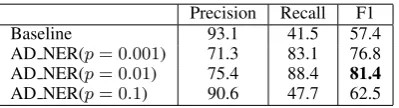
Table 2 gives some examples of learned templates. Using the learned templates and extracted named entities, an additional recognizer can be built very easily. It can discover some new named entities that are left out by models trained on labeled da-ta. We performed experiments to make compar-ison between baseline system and AD NER sys-tem, which integrates additional recognizer into the CRF model. The results are shown in Table 3∼5, wherepis the threshold of confidence score of candidate entity.
Template Q score Num. of NEs
Singer
欢、#、庾(Huan, #, Geng) 0.9000 60
#演唱(sing) 0.8109 279
天后#,(diva) 0.6620 319
听着#的歌(listen to the song) 0.6120 9
演唱#的歌(sing a song) 0.5820 16 Athlete
冠军#,(champion) 0.9059 2340
名将#,(famous athlete) 0.8711 481
选手#,(player) 0.8382 2440
战胜#夺冠(win) 0.7724 123
[image:4.595.71.293.462.599.2]选手#在比(in a competition) 0.6423 274
Table 2: Examples of templates and their quali-ties (Q score) and the number of extracted named entities.
Precision Recall F1
Baseline 93.1 41.5 57.4
AD NER(p= 0.001) 71.3 83.1 76.8 AD NER(p= 0.01) 75.4 88.4 81.4 AD NER(p= 0.1) 90.6 47.7 62.5
Table 3: Results onSinger.
Precision Recall F1
Baseline 97.8 65.9 78.8
AD NER(p= 0.001) 79.9 91.5 85.3 AD NER(p= 0.01) 92.8 88.3 90.5 AD NER(p= 0.1) 93.9 71.4 81.1
Table 4: Results onAthlete.
Precision Recall F1
Baseline 97.3 62.3 75.9
AD NER(p= 0.001) 76.2 90.0 82.5 AD NER(p= 0.01) 91.3 86.1 88.6 AD NER(p= 0.1) 93.2 67.8 78.5
Table 5: Overall experimental results.
From Table 3 and Table 4, we find the best per-formance of baseline on Singeris 57.4%, 21.4% lower than that onAthlete. This can be explained as the scale of labeled data impacts the perfor-mance of supervised method, because, in Table 1, the instances ofSingeris not as sufficient as Ath-lete. However, the performance of our approach in the two categories remains stable. This illustrates that the large-scale unlabeled data is useful in the case of a lack of training data.
As shown in Table 5, the best F1 of AD NER is 88.6%, which is 12.7% higher than F1 of baseline. Although there is a somewhat loss of precision, we obtain a large number of named entities. More-over, the cost of our approach is lower than auto-matic annotation, since we do not need to retrain the supervised model. It is more effective when la-beled data is complex and hard to construct while unlabeled data is abundant and easy to access. In the practice, our proposed approach can easily re-main up-to-date and extend the well-trained super-vised model without fine-tuning or any human in-tervention.
We further find that the overall precision of AD NER with threshold at 0.1 is only 1.9% high-er than that with threshold at 0.01, but the loss of recall is 18.3%. For this reason, the threshold can be set to 0.01.
5 Conclusion
[image:4.595.83.283.672.726.2]References
Laura Chiticariu, Rajasekar Krishnamurthy, Yunyao Li, Frederick Reiss, and Shivakumar Vaithyanathan. 2010. Domain adaptation of rule-based annotators
for named-entity recognition tasks. InProceedings
of the 2010 Conference on Empirical Methods in Natural Language Processing, pages 1002–1012.
Junwu Du, Zhimin Zhang, Jun Yan, Yan Cui, and Zheng Chen. 2010. Using search session context for
named entity recognition in query. InProceedings
of the 33rd international ACM SIGIR conference on Research and development in information retrieval, pages 765–766.
Oren Etzioni, Michael Cafarella, Doug Downey, Ana-Maria Popescu, Tal Shaked, Stephen Soderland, Daniel S. Weld, and Alexander Yates. 2005. Un-supervised named-entity extraction from the we-b: An experimental study. Artificial Intelligence, 165(1):91–134.
Tim Finin, Will Murnane, Anand Karandikar, Nicholas Keller, Justin Martineau, and Mark Dredze. 2010. Annotating named entities in twitter data with
crowdsourcing. InProceedings of the NAACL HLT
2010 Workshop on Creating Speech and Language Data with Amazon’s Mechanical Turk, pages 80–88.
Xianpei Han and Jun Zhao. 2010. Structural semantic relatedness: a knowledge-based method to named
entity disambiguation. In Proceedings of the 48th
Annual Meeting of the Association for Computation-al Linguistics, pages 50–59.
John Lafferty, Andrew McCallum, and Fernando CN Pereira. 2001. Conditional random fields: Prob-abilistic models for segmenting and labeling se-quence data. Proceedings of the Eighteenth Interna-tional Conference on Machine Learning, pages 282– 289.
Nolan Lawson, Kevin Eustice, Mike Perkowitz, and Meliha Yetisgen-Yildiz. 2010. Annotating large e-mail datasets for named entity recognition with
me-chanical turk. In Proceedings of the NAACL HLT
2010 Workshop on Creating Speech and Language Data with Amazon’s Mechanical Turk, pages 71–79.
Xiao Ling and Daniel S Weld. 2012. Fine-grained en-tity recognition. InProceedings of the 26th Confer-ence on Artificial IntelligConfer-ence.
Xiaohua Liu, Shaodian Zhang, Furu Wei, and Ming Zhou. 2011. Recognizing named entities in tweet-s. InProceedings of the 49th Annual Meeting of the Association for Computational Linguistics: Human Language Technologies, pages 359–367.
Lev Ratinov and Dan Roth. 2009. Design challenges and misconceptions in named entity recognition. In
Proceedings of the Thirteenth Conference on Com-putational Natural Language Learning, pages 147– 155.
Stefan R¨ud, Massimiliano Ciaramita, Jens M¨uller, and Hinrich Sch¨utze. 2011. Piggyback: Using search engines for robust cross-domain named entity recog-nition. InProceedings of the 49th Annual Meeting of the Association for Computational Linguistics: Hu-man Language Technologies, pages 965–975.
Jian Sun, Jianfeng Gao, Lei Zhang, Ming Zhou, and Changning Huang. 2002. Chinese named entity i-dentification using class-based language model. In
Proceedings of the 19th international conference on Computational linguistics, pages 1–7.
Masatoshi Tsuchiya, Shoko Endo, and Seiichi
Nak-agawa. 2009. Analysis and robust extraction of
changing named entities. InProceedings of the 2009 Named Entities Workshop: Shared Task on Translit-eration, pages 161–167.
Yefeng Wang. 2009. Annotating and recognising
named entities in clinical notes. In Proceedings of the ACL-IJCNLP 2009 Student Research Workshop, pages 18–26.
Furu Wei, Wenjie Li, and Shixia Liu. 2010. irank: A rank-learn-combine framework for unsupervised en-semble ranking. Journal of the American Society for Information Science and Technology, 61(6):1232– 1243.
Casey Whitelaw, Alex Kehlenbeck, Nemanja Petrovic,
and Lyle Ungar. 2008. Web-scale named entity
recognition. In Proceedings of the 17th ACM
con-ference on Information and knowledge management, pages 123–132.
Dan Wu, Wee Sun Lee, Nan Ye, and Hai Leong Chieu. 2009. Domain adaptive bootstrapping for named
en-tity recognition. In Proceedings of the 2009
Con-ference on Empirical Methods in Natural Language Processing, pages 1523–1532.
Meliha Yetisgen-Yildiz, Imre Solti, Fei Xia, and Scot-t Russell Halgrim. 2010. Preliminary experience with amazon’s mechanical turk for annotating
med-ical named entities. InProceedings of the NAACL
HLT 2010 Workshop on Creating Speech and Lan-guage Data with Amazon’s Mechanical Turk, pages 180–183.
Dengyong Zhou, Olivier Bousquet, Thomas Navin Lal,
Jason Weston, and Bernhard Sch¨olkopf. 2004.
Learning with local and global consistency.