Web-based frequency dictionaries for medium density languages
Andr´as Kornai MetaCarta Inc. 350 Massachusetts Avenue
Cambridge MA 02139 [email protected]
P´eter Hal´acsy
Media Research and Education Center Stoczek u. 2
H-1111 Budapest [email protected]
Viktor Nagy Institute of Linguistics
Bencz´ur u 33 H-1399 Budapest [email protected]
Csaba Oravecz Institute of Linguistics
Bencz´ur u 33 H-1399 Budapest [email protected]
Viktor Tr´on U of Edinburgh 2 Buccleuch Place EH8 9LW Edinburgh [email protected]
D´aniel Varga
Media Research and Education Center Stoczek u. 2
H-1111 Budapest [email protected]
Abstract
Frequency dictionaries play an important role both in psycholinguistic experiment design and in language technology. The paper describes a new, freely available, web-based frequency dictionary of Hun-garian that is being used for both purposes, and the language-independent techniques used for creating it.
0 Introduction
In theoretical linguistics introspective grammati-cality judgments are often seen as having method-ological primacy over conclusions based on what is empirically found in corpora. No doubt the main reason for this is that linguistics often studies phenomena that are not well exemplified in data. For example, in the entire corpus of written En-glish there seems to be only one attested example, not coming from semantics papers, of Bach-Peters sentences, yet the grammaticality (and the pre-ferred reading) of these constructions seems be-yond reproach. But from the point of view of the theoretician who claims that quantifier meanings can be computed by repeat substitution, even this one example is one too many, since no such theory can account for the clearly relevant (though barely attested) facts.
In this paper we argue that ordinary corpus size has grown to the point that in some areas of theoretical linguistics, in particular for is-sues of inflectional morphology, the dichotomy between introspective judgments and empirical observations need no longer be maintained: in this area at least, it is now nearly possible to make the leap from zero observed frequency to zero theoretical probability i.e. ungrammaticality.
In many other areas, most notably syntax, this is still untrue, and here we argue that facts of derivational morphology are not yet entirely within the reach of empirical methods. Both for inflectional and derivational morphology we base our conclusions on recent work with a gigaword web-based corpus of Hungarian (Hal´acsy et al 2004) which goes some way towards fulfilling the goals of the WaCky project (http://wacky.sslmit.unibo.it, see also L¨udeling et al 2005) inasmuch as the infras-tructure used in creating it is applicable to other medium-density languages as well. Section 1 describes the creation of the WFDH Web-based Frequency Dictionary of Hungarian from the raw corpus. The critical disambiguation step required for lemmatization is discussed in Section 2, and the theoretical implications are presented in Section 3. The rest of this Introduction is devoted to some terminological clarification and the presentation of the elementary probabilistic model used for psycholinguistic experiment design.
0.1 The range of data
perspec-tive medium range. Finally, alarge-rangecorpus is one that displays a variety of text types, gen-res, and styles that approximates that of overall language usage – the Brown corpus at 1m words has considerably larger range than e.g. the Reuters corpus at 100m words.
The fact that psycholinguistic experiments need to control for word frequency has been known at least since Thorndike (1941) and frequency ef-fects also play a key role in grammaticization (By-bee, 2003). Since the principal source of variabil-ity in word (n-gram) frequencies is the choice of topic, we can subsume overall considerations of genre under the selection of topics, especially as the former typically dictates the latter – for ex-ample, we rarely see literary prose or poetry deal-ing with undersea sedimentation rates. We assume a fixed inventory of topics T1, T2, . . . , Tk, with
k on the order 104, similar in granularity to the Northern Light topic hierarchy (Kornai et al 2003) and reserveT0 to topicless texts or “General Lan-guage”. Assuming that these topics appear in the language with frequencyq1, q2, . . . , qk, summing
to1−q0 ≤1, the “average” topic is expected to have frequency about1/k(and clearly,q0is on the same order, as it is very hard to find entirely topi-cless texts).
As is well known, the salience of different nouns and noun phrases appearing in the same structural position is greatly impacted not just by frequency (generally, less frequent words are more memorable) but also by stylistic value. For ex-ample, taboo words are more salient than neutral words of the same overall frequency. But style is also closely associated with topic, and if we match frequency profiles across topics we are therefore controlling for genre and style as well. Present-ing psycholPresent-inguistical experiments is beyond the scope of this paper: here we put the emphasis on creating the computational resource, the frequency dictionary, that allows for detail matching of fre-quency profiles.
Defining the range r of a corpus C simply as P
jqj where the sum is taken over all topics
touched by documents in C, single-author cor-pora typically have r < 0.1even for encyclope-dic writers, and web corpora haver > 0.9. Note that r just measures the range, it does not mea-sure how representative a corpus is for some lan-guage community. Here we discuss results con-cerning all three ranges. For small range, we use
the Hungarian translation of Orwell’s1984– 98k words including punctuation tokens, (Dimitrova et al., 1998). For mid-range, we consider four topi-cally segregated subcorpora of the Hungarian side of our Hungarian-English parallel corpus – 34m words, (Varga et al., 2005). For large-range we use our webcorpus – 700m words, (Hal´acsy et al., 2004).
1 Collecting and presenting the data
Hungarian lags behind “high density” languages like English and German but is hugely ahead of minority languages that have no significant ma-chine readable material. Varga et al (2005) es-timated there to be about 500 languages that fit in the same “medium density” category, together accounting for over 55% of the world’s speakers. Halacsy et al (2004) described how a set of open source tools can be exploited to rapidly clean the results of web crawls to yield high quality mono-lingual corpora: the main steps are summarized below.
Raw data, preprocessing The raw dataset comes from crawling the top-level domain, e.g. .hu, .cz, .hr, .pl etc. Pages that con-tain no usable text are filtered out, and all text is converted to a uniform character encoding. Iden-tical texts are dropped by checksum compari-son of page bodies (a method that can handle near-identical pages, usually automatically gener-ated, which differ only in their headers, datelines, menus, etc.)
Stratification A spellchecker is used to stratify pages by recognition error rates. For each page we measure the proportion of unrecognized (either in-correctly spelled or out of the vocabulary of the spellchecker) words. To filter out non-Hungarian (non-Czech, non-Croatian, non-Polish, etc.) docu-ments, the threshold is set at 40%. If we lower the threshold to 8%, we also filter outflatnative texts that employ Latin (7-bit) characters to denote their accented (8 bit) variants (these are still quite com-mon due to the ubiquity of US keyboards). Finally, below the 4% threshold, webpages typically con-tain fewer typos than average printed documents, making the results comparable to older frequency counts based on traditional (printed) materials.
same stem: we follow the usual lexicographic practice of treating inflected, but not derived, forms of a stem as belonging to the same lemma. Inflectional stems are computed by a morphologi-cal analyzer (MA), the choice between alternative morphological analyses is resolved using the out-put of a POS tagger (see Section 2 below). When there are several analyses that match the output of the tagger, we choose one with the least number of identified morphemes. For now, words outside the vocabulary of the MA are not lemmatized at all – this decision will be revisited once the planned ex-tension of the MA to a morphological guesser is complete.
Topic classification Kornai et al (2003) pre-sented a fully automated system for the classifica-tion of webpages according to topic. Combining this method with the methods described above en-ables the automatic creation of topic-specific fre-quency dictionaries and further, the creation of a per-topic frequency distribution for each lemma. This enables much finer control of word selection in psycholinguistic experiments than was hitherto possible.
1.1 How to present the data?
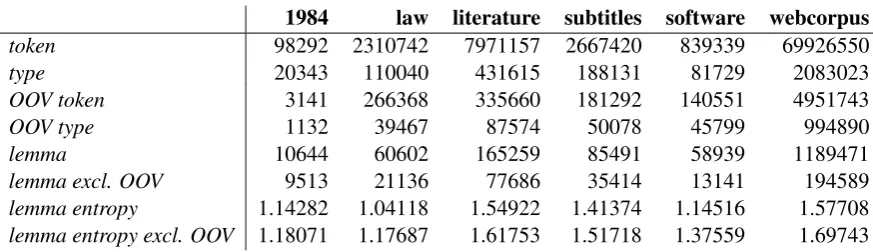
For Hungarian, the highest quality (4% thresh-old) stratum of the corpus contains 1.22m unique pages for a total of 699m tokens, already exceed-ing the 500m predicted in (Kilgarriff and Grefen-stette, 2003). Since the web has grown consid-erably since the crawl (which took place in 2003), their estimate was clearly on the conservative side. Of the 699m tokens some 4.95m were outside the vocabulary of the MA (7% OOV in this mode, but less than 3% if numerals are excluded and the analysis of compounds is turned on). The remain-ing 649.7m tokens fall in 195k lemmas with an average 54 form types per lemma. If all stems are considered, the ratio is considerably lower, 33.6, but the average entropy of the inflectional distri-butions goes down only from 1.70 to 1.58 bits.
As far as the summary frequency list (which is less than a megabyte compressed) is concerned, this can be published trivially. Clearly, the avail-ability of large-range gigaword corpora is in the best interest of all workers in language technology, and equally clearly, only open (freely download-able) materials allow for replicability of experi-ments. While it is possible to exploit search engine queries for various NLP tasks (Lapata and Keller,
2004), for applications which use corpora as unsu-pervised training material downloadable base data is essential.
Therefore, a compiled webcorpus should con-tain actual texts. We believe all “cover your be-hind” efforts such as publishing only URLs to be fundamentally misguided. First, URLs age very rapidly: in any given year more than 10% be-come stale (Cho and Garcia-Molina, 2000), which makes any experiment conducted on such a ba-sis effectively irreproducible. Second, by present-ing a quality-filtered and characterset-normalized corpus the collectors actually perform a service to those who are less interested in such mundane is-sues. If everybody has to start their work from the ground up, many projects will exhaust their fund-ing resources and allotted time before anythfund-ing in-teresting could be done with the data. In contrast, the Free and Open Source Software (FOSS) model actively encourages researchers to reuse data.
In this regard, it is worth mentioning that dur-ing the crawls we always respectedrobots.txt and in the two years since the publication of the gi-gaword Hungarian web corpus, there has not been a single request by copyright holders to remove material. We do not advocate piracy: to the con-trary, it is our intended policy to comply with re-moval requests from copyright holders, analogous to Google cache removal requests. Finally, even with copyright material, there are easy methods for preserving interesting linguistic data (say un-igram and bun-igram models) without violating the interests of businesses involved in selling the run-ning texts.1
2 The disambiguation of morphological analyses
In any morphologically complex language, the MA component will often return more than one possible analysis. In order to create a lemma-tized frequency dictionary it is necessary to de-cide which MA alternative is the correct one, and in the vast majority of cases the context provides sufficient information for this. This morphologi-cal disambiguation task is closely related to, but not identical with, part of speech (POS) tagging, a term we reserve here for finding the major parts
1
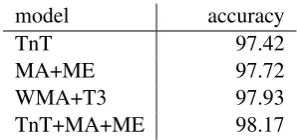
of speech (N, V, A, etc). A full tag contains both POS information and morphological annotation: in highly inflecting languages the latter can lead to tagsets of high cardinality (Tufis¸ et al., 2000). Hungarian is particularly challenging in this re-gard, both because the number of ambiguous to-kens is high (reaching 50% in the Szeged Cor-pus according to (Csendes et al., 2004) who use a different MA), and because the ratio of tokens that are not seen during training (unseen) can be as much as four times higher than in comparable size English corpora. But if larger training corpora are available, significant disambiguation is possi-ble: with a 1 m word training corpus (Csendes et al., 2004) the TnT (Brants, 2000) architecture can achieve 97.42% overall precision.
The ratio of ambiguous tokens is usually cal-culated based on alternatives offered by a mor-phological lexicon (either built during the training process or furnished by an external application; see below). If the lexicon offers alternative anal-yses, the token is taken as ambiguous irrespective of the probability of the alternatives. If an exter-nal resource is used in the form of a morphological analyzer (MA), this will almost always overgener-ate, yielding false ambiguity. But even if the MA is tight, a considerable proportion of ambiguous tokens will come from legitimate but rare analyses of frequent types (Church, 1988). For example the word nem, can mean both ’not’ and ’gender’, so bothADVandNOUNare valid analyses, but the ad-verbial reading is about five orders of magnitude more frequent than the noun reading, (12596 vs. 4 tokens in the 1 m word manually annotated Szeged Korpusz (Csendes et al., 2004)).
Thus the difficulty of the task is better mea-sured by the average information required for dis-ambiguating a token. If word w is assigned the labelTi with probability P(Ti|w) (estimated
as C(Ti, w)/C(w) from a labeled corpus) then
the label entropy for a word can be calculated as H(w) = −P
iP(Ti|w) logP(Ti|w), and the
difficulty of the labeling task as a whole is the weighted average of these entropies with respect to the frequencies of words w: P
wP(w)H(w).
As we shall see in Section 3, according to this measure the disambiguation task is not as difficult as generally assumed.
A more persistent problem is that the ratio of unseen items has very significant influence on the performance of the disambiguation system. The
problem is more significant with smaller corpora: in general, if the training corpus hasN tokens and the test corpus is a constant fraction of this, say N/10, we expect the proportion of new words to be cNq−1, where q is the reciprocal of the Zipf constant (Kornai, 1999). But if the test/train ra-tio is not kept constant because the training corpus is limited (manual tagging is expensive), the num-ber of tokens that are not seen during training can grow very large. Using the 1.2 m words of Szeged Corpus for training, in the 699 m word webcor-pus over 4% of the non-numeric tokens will be un-seen. Given that TnT performs rather dismally on unseen items (Oravecz and Dienes, 2002) it was clear from the outset that for lemmatizing the we-bcorpus we needed something more elaborate.
The standard solution to constrain the prob-abilistic tagging model for some of the unseen items is the application of MA (Hakkani-T¨ur et al., 2000; Hajiˇc et al., 2001; Smith et al., 2005). Here a distinction must be made between those items that are not found in the training corpus (these we have calledunseen tokens) and those that are not known to the MA – we call these out of vocabulary (OOV). As we shall see shortly, the key to the best tagging architecture we found was to follow dif-ferent strategies in the lemmatization and morpho-logical disambiguation of OOV and known (in-vocabulary) tokens.
The first step in tagging is the annotation of inflectional features, with lemmatization being postponed to later processing as in (Erjavec and Dˇzeroski, 2004). This differs from the method of (Hakkani-T¨ur et al., 2000), where all syntactically relevant features (including the stem or lemma) of word forms are determined in one pass. In our ex-perience, the choice of stem depends so heavily on the type of linguistic information that later pro-cessing will need that it cannot be resolved in full generality at the morphosyntactic level.
MA-ME model achieves 97.72% correct POS tag-ging and morphological analysis on the test corpus (not used in training).
Maximum entropy or other discriminative Markov models (McCallum et al., 2000) suffer from the label bias problem (Lafferty et al., 2001), while generative models (most notably HMMs) need strict independence assumptions to make the task of sequential data labeling tractable. Con-sequently, long distance dependencies and non-independent features cannot be handled. To cope with these problems we designed a hybrid archi-tecture, in which a trigram HMM is combined with the MA in such a way that for tokens known to the MA only the set of possible analyses are allowed as states in the HMM whereas for OOVs all states are possible. Lexical probabilities P(wi|ti) for
seen words are estimated from the training corpus, while for unseen tokens they are provided by the the above MA-ME model. This yields a trigram HMM where emission probabilities are estimated by a weighted MA, hence the model is called WMA-T3. This improves the score to 97.93%.
Finally, it is possible to define another archi-tecture, somewhat similar to Maximum Entropy Markov Models, (McCallum et al., 2000), using the above components. Here states are also the set of analyses the MA allows for known tokens and all analyses for OOVs, while emission prob-abilities are estimated by the MA-ME model. In the first pass TnT is run with default settings over the data sequence, and in the second pass the ME receives as features the TnT label of the preced-ing/following token as well as the one to be ana-lyzed. This combined system (TnT-MA-ME) in-corporates the benefits of all the submodules and reaches an accuracy of 98.17% on the Szeged Cor-pus. The results are summarized in Table 1.
model accuracy
TnT 97.42
MA+ME 97.72
WMA+T3 97.93
[image:5.595.106.255.587.657.2]TnT+MA+ME 98.17
Table 1: accuracy of morphological disambiguation
We do not consider these results to be final: clearly, further enhancements are possible e.g. by a Viterbi search on alternative sentence taggings using the T3 trigram tag model or by handling OOVs on a par with known unseen words using
the guesser function of our MA. But, as we dis-cuss in more detail in Halacsy et al 2005, we are already ahead of the results published elsewhere, especially as these tend to rely on idealized MA systems that have their morphological resources extended so as to have no OOV on the test set.
3 Conclusions
Once the disambiguation of morphological anal-yses is under control, lemmatization itself is a mechanical task which we perform in a database framework. This has the advantage that it sup-ports a rich set of query primitives, so that we can easily find e.g. nouns with back vowels that show stem vowel elision and have approximately the same frequency as the stem orvos ‘doctor’. Such a database has obvious applications both in psycholinguistic experiments (which was one of the design goals) and in settling questions of the-oretical morphology. But there are always nag-ging doubts about the closed world assumption be-hind databases, famously exposed in linguistics by Chomsky’s example colorless green ideas sleep furiously:how do we distinguish this from*green sleep colorless furiously ideasif the observed fre-quency is zero for both?
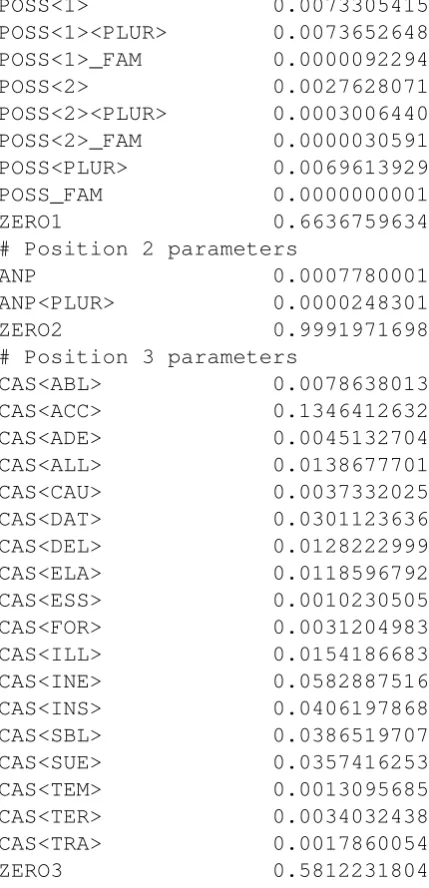
Clearly, a naive empirical model that assigns zero probability to each unseen word form makes the wrong predictions. Better estimates can be achieved if unseen words which are known to be possible morphologically complex forms of seen lemmas are assigned positive probability. This can be done if the probability of a complex form is in some way predictable from the probabilities of its component parts. A simple variant of this model is the positional independence hypothesis which takes the probabilities of morphemes in separate positional classes to be independent of each other. Here we follow Antal (1961) and Kornai (1992) in establishing three positional classes in the inflec-tional paradigm of Hungarian nouns.
# Position 1 parameters
FAM 0.0001038986
PLUR 0.1372398793
PLUR_POSS 0.0210927964
PLUR_POSS<1> 0.0011609442 PLUR_POSS<1><PLUR> 0.0028751247 PLUR_POSS<2> 0.0004958278 PLUR_POSS<2><PLUR> 0.0000740203 PLUR_POSS<PLUR> 0.0023850120
POSS<1> 0.0073305415 POSS<1><PLUR> 0.0073652648 POSS<1>_FAM 0.0000092294
POSS<2> 0.0027628071
POSS<2><PLUR> 0.0003006440 POSS<2>_FAM 0.0000030591
POSS<PLUR> 0.0069613929
POSS_FAM 0.0000000001
ZERO1 0.6636759634
# Position 2 parameters
ANP 0.0007780001
ANP<PLUR> 0.0000248301
ZERO2 0.9991971698
# Position 3 parameters
CAS<ABL> 0.0078638013
CAS<ACC> 0.1346412632
CAS<ADE> 0.0045132704
CAS<ALL> 0.0138677701
CAS<CAU> 0.0037332025
CAS<DAT> 0.0301123636
CAS<DEL> 0.0128222999
CAS<ELA> 0.0118596792
CAS<ESS> 0.0010230505
CAS<FOR> 0.0031204983
CAS<ILL> 0.0154186683
CAS<INE> 0.0582887516
CAS<INS> 0.0406197868
CAS<SBL> 0.0386519707
CAS<SUE> 0.0357416253
CAS<TEM> 0.0013095685
CAS<TER> 0.0034032438
CAS<TRA> 0.0017860054
[image:6.595.73.288.68.513.2]ZERO3 0.5812231804
Table 3: marginal probabilities in noun inflection
The innermost class is used for number and pos-sessive, with a total of 18 choices including the zero morpheme (no possessor and singular). The second positional class is for anaphoric posses-sives with a total of three choices including the zero morpheme, and the third (outermost) class is for case endings with a total of 19 choices including the zero morpheme (nominative) for a total of 1026 paradigmatic forms. The parame-ters were obtained by downhill simplex minimiza-tion of absolute errors. The average absolute er-ror is of the values computed by the independece hypothesis from the observed values is 0.000099 (mean squared error is9.18·10−7), including the 209 paradigmatic slots for which no forms were found in the webcorpus at all (but the indepen-dence model will assign positive probability to any
of them as the product of the component probabil-ities). When checking the independence hypoth-esis withΦ statistics in the webcorpus for every nominal inflectional morpheme pair the members of which are from different dimensions, theΦ co-efficient remained less than 0.1 for each pair but 3. For these 3 the coefficient is under 0.2 (which means that the shared variance of these pairs is be-tween 1% and 2%) so we have no reason to discard the independence hypothesis. If we run the same test on the 150 million words Hungarian National Corpus, which was analyzed and tagged by differ-ent tools, we also get the same result (Nagy, 2005).
It is very easy to construct low probability com-binations using this model. Taking a less frequent possessive ending such as the 2nd singular poses-sor familiar plural-od´ek, the anaphoric plural-´ei, and a rarer case ending such as the formalis-k´ent we obtain combinations such as bar´atod´ek´eik´ent “as the objects owned by your friends’ company”. The model predicts we need a corpus with about 4.2·1012noun tokens to see this suffix combina-tion (not necessarily with the stembar´at“friend”) or about ten trillion tokens. While the current cor-pus falls short by four orders of magnitude, this is about the contribution of the anaphoric plural (which we expect to see only once in about 40k noun tokens) so for any two of the three position classes combined the prediction that valid inflec-tional combinations will actually be attested is al-ready testable.
1984 law literature subtitles software webcorpus
token 98292 2310742 7971157 2667420 839339 69926550
type 20343 110040 431615 188131 81729 2083023
OOV token 3141 266368 335660 181292 140551 4951743
OOV type 1132 39467 87574 50078 45799 994890
lemma 10644 60602 165259 85491 58939 1189471
lemma excl. OOV 9513 21136 77686 35414 13141 194589
[image:7.595.79.516.60.186.2]lemma entropy 1.14282 1.04118 1.54922 1.41374 1.14516 1.57708 lemma entropy excl. OOV 1.18071 1.17687 1.61753 1.51718 1.37559 1.69743
Table 3:inflectional entropy of Hungarian computed on a variety of frequency dictionaries
Our overall conclusion is that for many pur-poses a web-based corpus has significant advan-tages over more traditional corpora. First, it is cheap to collect. Second, it is sufficiently hetero-geneous to ensure that language models based on it generalize better on new texts of arbitrary topics than models built on (balanced) manual corpora. As we have shown, automatically tagged and lem-matized webcorpora can be used to obtain large coverage stem and wordform frequency dictionar-ies. While there is a significant portion of OOV entries (about 3% for our current MA), in the de-sign of psycholinguistic experiments it is gener-ally sufficient to consider stems already known to the MA, and the variety of these (over three times the stem lexicon of the standard Hungarian fre-quency dictionary) enables many controlled exper-iments hitherto impossible.
References
L´aszl´o Antal. 1961. A magyar esetrendszer. Nyelvtu-dom´anyi ´Ertekez´esek, 29.
Jason Baldridge, Thomas Morton, and Gann Bierner. 2001. The opennlp maximum entropy package.
http://maxent.sourceforge.net.
Thorsten Brants. 2000. TnT – a statistical part-of-speech tagger. InProceedings of the Sixth Applied Natural Language Processing Conference (ANLP-2000), Seattle, WA.
Joan Bybee. 2003. Mechanisms of change in gram-maticization: the role of frequency. In Brian Joseph and Richard Janda, editors,Handbook of Historical Linguistics, pages 602–623. Blackwell.
Junghoo Cho and Hector Garcia-Molina. 2000. The evolution of the web and implications for an incre-mental crawler. In VLDB ’00: Proceedings of the 26th International Conference on Very Large Data
Bases, pages 200–209, San Francisco, CA, USA.
Morgan Kaufmann Publishers Inc.
Kenneth Ward Church. 1988. A stochastic parts pro-gram and noun phrase parser for unrestricted text.
InProceedings of the second conference on Applied
natural language processing, pages 136–143,
Mor-ristown, NJ, USA. Association for Computational Linguistics.
D´ora Csendes, J´an´os Csirik, and Tibor Gyim´othy. 2004. The Szeged Corpus: A POS tagged and syn-tactically annotated Hungarian natural language cor-pus. In Karel Pala Petr Sojka, Ivan Kopecek, editor,
Text, Speech and Dialogue: 7th International Con-ference, TSD, pages 41–47.
Ludmila Dimitrova, Tomaz Erjavec, Nancy Ide, Heiki Jaan Kaalep, Vladimir Petkevic, and Dan Tufis¸. 1998. Multext-east: Parallel and comparable corpora and lexicons for six central and eastern euro-pean languages. In Christian Boitet and Pete White-lock, editors,Proceedings of the Thirty-Sixth Annual Meeting of the Association for Computational Lin-guistics and Seventeenth International Conference
on Computational Linguistics, pages 315–319, San
Francisco, California. Morgan Kaufmann Publish-ers.
Tomaˇz Erjavec and Saˇso Dˇzeroski. 2004. Machine learning of morphosyntactic structure: Lemmatizing unknown Slovene words. Applied Artificial Intelli-gence, 18(1):17–41.
Jan Hajiˇc, Pavel Krbec, Karel Oliva, Pavel Kvˇetoˇn, and Vladim´ır Petkeviˇc. 2001. Serial combination of rules and statistics: A case study in Czech tag-ging. In Proceedings of the 39th Association of
Computational Linguistics Conference, pages 260–
267, Toulouse, France.
Dilek Z. Hakkani-T¨ur, Kemal Oflazer, and G¨okhan T¨ur. 2000. Statistical morphological disambigua-tion for agglutinative languages. InProceedings of
the 18th conference on Computational linguistics,
pages 285–291, Morristown, NJ, USA. Association for Computational Linguistics.
P´eter Hal´acsy, Andr´as Kornai, L´aszl´o N´emeth, Andr´as Rung, Istv´an Szakad´at, and Viktor Tr´on. 2004. Cre-ating open language resources for Hungarian. In
Proceedings of Language Resources and
Evalua-tion Conference (LREC04). European Language
P´eter Hal´acsy, Andr´as Kornai, and D´aniel Varga. 2005. Morfol´ogiai egy´ertelm˝us´ıt´es maximum entr´opia m´odszerrel (morphological disambiguation with the maxent method). In Proc. 3rd
Hungar-ian Computational Linguistics Conf. Szegedi
Tu-dom´anyegyetem.
Adam Kilgarriff and Gregory Grefenstette. 2003. In-troduction to the special issue on the web as corpus.
Computational Linguistics, 29(3):333–348.
Andr´as Kornai, Marc Krellenstein, Michael Mulligan, David Twomey, Fruzsina Veress, and Alec Wysoker. 2003. Classifying the hungarian web. In A. Copes-take and J. Hajic, editors,Proc. EACL, pages 203– 210.
Andr´as Kornai. 1992. Frequency in morphology. In I. Kenesei, editor, Approaches to Hungarian, vol-ume IV, pages 246–268.
Andr´as Kornai. 1999. Zipf’s law outside the middle range. In J. Rogers, editor,Proc. Sixth Meeting on
Mathematics of Language, pages 347–356.
Univer-sity of Central Florida.
John Lafferty, Andrew McCallum, and Fernando Pereira. 2001. Conditional random fields: Prob-abilistic models for segmenting and labeling se-quence data. In Proceedings of the 18th
Interna-tional Conference on Machine Learning, pages 282–
289. Morgan Kaufmann, San Francisco, CA.
Mirella Lapata and Frank Keller. 2004. The web as a baseline: Evaluating the performance of un-supervised web-based models for a range of NLP tasks. In Daniel Marcu Susan Dumais and Salim Roukos, editors,HLT-NAACL 2004: Main Proceed-ings, pages 121–128, Boston, Massachusetts, USA, May 2 - May 7. Association for Computational Lin-guistics.
Anke Luedeling, Stefan Evert, and Marco Baroni. 2005. Using web data for linguistic purposes. In Marianne Hundt, Caroline Biewer, and Nadjia Nes-selhauf, editors, Corpus linguistics and the Web. Rodopi.
Andrew McCallum, Dayne Freitag, and Fernando Pereira. 2000. Maximum entropy Markov mod-els for information extraction and segmentation. In
Proceedings of the 17th International Conference on
Machine Learning, pages 591–598. Morgan
Kauf-mann, San Francisco, CA.
Viktor Nagy. 2005. A magyar f˝on´evi inflexi´o statisztikai modellje (statistical model of nominal inflection in hungarian. In Proc. Kodol´anyi-ELTE Conf.
Csaba Oravecz and P´eter Dienes. 2002. Effi-cient stochastic part-of-speech tagging for
Hungar-ian. In Proceedings of the Third International
Conference on Language Resources and Evaluation
(LREC2002), pages 710–717.
Adwait Ratnaparkhi. 1996. A maximum entropy model for part-of-speech tagging. In Karel Pala Petr Sojka, Ivan Kopecek, editor, Proceedings of the Conference on Empirical Methods in Natural
Language Processing, pages 133–142, University of
Pennsylvania.
Noah A. Smith, David A. Smith, and Roy W. Tromble. 2005. Context-based morphological disambiguation with random fields. InProceedings of the Confer-ence on Human Language Technology and
Empiri-cal Methods in Natural Language Processing,
Van-couver.
Edward L. Thorndike. 1941. The Teaching of English Suffixes. Teachers College, Columbia University.
Viktor Tr´on, Gy¨orgy Gyepesi, P´eter Hal´acsy, Andr´as Kornai, L´aszl´o N´emeth, and D´aniel Varga. 2005. Hunmorph: open source word analysis. In
Proceed-ing of the ACL 2005 Workshop on Software.
Dan Tufis¸, P´eter Dienes, Csaba Oravecz, and Tam´as V´aradi. 2000. Principled hidden tagset design for tiered tagging of Hungarian. InProceedings of the Second International Conference on Language Re-sources and Evaluation.
D´aniel Varga, L´aszl´o N´emeth, P´eter Hal´acsy, Andr´as Kornai, Viktor Tr´on, and Viktor Nagy. 2005. Paral-lel corpora for medium density languages. In Pro-ceedings of the Recent Advances in Natural
Lan-guage Processing 2005 Conference, pages 590–596,