A Class-oriented Approach to Building a Paraphrase Corpus
Atsushi Fujita
Graduate School of Informatics, Kyoto University
Kentaro Inui
Graduate School of Information Science, Nara Institute of Science and Technology
Abstract
Towards deep analysis of composi-tional classes of paraphrases, we have examined a class-oriented framework for collecting paraphrase examples, in which sentential paraphrases are col-lected for each paraphrase class sep-arately by means of automatic can-didate generation and manual judge-ment. Our preliminary experiments on building a paraphrase corpus have so far been producing promising results, which we have evaluated according to cost-efficiency, exhaustiveness, and re-liability.
1 Introduction
Paraphrases are alternative ways of conveying the same content. The technology for paraphrase generation and recognition has drawn the atten-tion of an increasing number of researchers be-cause of its potential contribution to a broad range of natural language applications.
Paraphrases can be viewed as monolingual translations. From this viewpoint, research on paraphrasing has adapted techniques fostered in the literature of machine translation (MT), such as transformation algorithms (Lavoie et al., 2000; Takahashi et al., 2001), corpus-based techniques for paraphrase pattern acquisition (Barzilay and McKeown, 2001; Shinyama and Sekine, 2003; Quirk et al., 2004), and fluency measurements (Lapata, 2001; Fujita et al., 2004).
One thing the paraphrasing community is still lacking is shared collections of paraphrase
ex-amples that could be used to analyze problems underlying the tasks and to evaluate the perfor-mance of systems under development. To our best knowledge, the paraphrase corpus developed by Dolan et al. (2004) is one of the very few collec-tions available for free1. Development of para-phrase corpora raises several issues: what sorts of paraphrases should be collected, where para-phrase examples can be obtained from, how the coverage and quality of the corpus can be ensured, how manual annotation cost can be effectively re-duced, and how collected examples should be or-ganized and annotated.
Obviously these issues should be discussed with the purpose of each individual corpus taken into account. In this paper, we address the is-sues of building a gold-standard corpus that is to be used to evaluate paraphrase generation models and report on our preliminary experiences taking Japanese as a target language. Our approach is characterized by the following:
• We define a set of paraphrase classes based on the syntactic features of transformation patterns.
• We separately collect paraphrase examples for each paraphrase class that are considered to be linguistically explainable.
• We use a paraphrase generation system to exhaustively collect candidate paraphrases from a given text collection, which are then manually labeled.
15801 sentence pairs from their comparable corpus have been judged manually and available from
2 Goal
Paraphrases exhibit a wide variety of patterns ranging from lexical paraphrases to syntactic transformations and their combinations. Some of them are highly inferential or idiomatic and do not seem easy to generate only with syntactic and semantic knowledge. Such groups of para-phrases require us to pursue corpus-based acquisi-tion methods such as those described in Secacquisi-tion 3. More importantly, however, we can also find quite a few patterns of paraphrases that exhibit a degree of regularity. Those groups of paraphrases have a potential to be compositionally explained by combining syntactic and semantic properties of their constituent words. For instance, the fol-lowing paraphrases2in Japanese are considered to be of these groups.
(1) s. eiga-ni shigeki-o uke-ta.
film-DAT inspiration-ACC to receive-PAST I received an inspiration from thefilm. t. eiga-ni shigeki-s-are-ta.
film-DAT to inspire-PASS-PAST I was inspired by thefilm.
(2) s. sentakumono-ga soyokaze-ni yureru. laundry-NOM breeze-DAT to sway-PRES The laundry sways in the breeze.
t. soyokaze-ga sentakumono-o yurasu. breeze-NOM laundry-ACC to sway-PRES The breeze makes the laundry sways.
(3) s. glass-ni mizu-o mitashi-ta. glass-DAT water-ACC tofill-PAST Ifilled water into the glass. t. glass-o mizu-de mitashi-ta.
glass-ACC water-IMP tofill-PAST Ifilled the glass with water.
(4) s. kare-wa kikai-sousa-ga jouzu-da. he-TOP machine operation-NOM be good-PRES He is good at machine operation.
t. kare-wa kikai-o jouzu-ni sousa-suru. he-TOP machine-ACC well-ADV to operate-PRES He operates machines well.
(5) s. heya-wa mou atatamat-teiru. room-TOP already to be warmed-PERF The room has already been warmed up. t. heya-wa mou atatakai.
room-TOP already be warm-PRES The room is warm.
2For each example, “s” and “t” denote an original sen-tence and its paraphrase, respectively.
In example (1), a verb phrase, “shigeki-o uke-ta(to receive an inspiration),” is paraphrased into a verbalized form of the noun, “shigeki-s-are-ta
(to be inspired).” We canfind a number of para-phrases that exhibit a similar pattern of syntactic transformation in the same language and group such paraphrases into a single class, which is possibly labeled “paraphrasing of light-verb con-struction.” Likewise, paraphrases exemplified by (2) constitute another class, so-called transitiv-ity alternation. Example (3) is of the locative alternationclass and example (4) the compound noun decompositionclass. In example (5), a verb “atatamaru (to be warmed)” is paraphrased into its adjective form, “atatakai (be warm).” Para-phrases involving such a lexical derivation are also in our concern.
One can learn the existence of such groups of paraphrases and the regularity each group ex-hibits from the linguistic literature (Mel’cuk andˇ Polgu`ere, 1987; Jackendoff, 1990; Kageyama, 2001). According to Jackendoff and Kageyama, for instance, both transitivity alternation and loca-tive alternation can be explained in terms of the syntactic and semantic properties of the verb in-volved, which are represented by what they call
Lexical Conceptual Structure. The systematicity underlying such linguistic accounts is intriguing also from the engineering point of view as it could enable us to take a more theoretically motivated but still practical approach to paraphrase genera-tion.
Aiming at this goal leads us to consider build-ing a paraphrase corpus which enables us to eval-uate paraphrase generation systems and conduct error analysis for each paraphrase class sepa-rately. Our paraphrase corpus should therefore be organized according to paraphrase classes. More specifically, we consider a paraphrase corpus such that:
• The corpus consists of a set of subcorpora. • Each subcorpus is a collection of paraphrase
sentence pairs of a paraphrase class.
• Paraphrases collected in a subcorpus suffi -ciently reflect the distribution of the occur-rences in the real world.
as exhaustively as possible from the text collec-tion at aminimal human labor cost. The resultant corpus should also bereliable.
3 Related work
Previous work on building paraphrase corpus (collecting paraphrase examples) can be classified into two directions: manual production of para-phrases and automatic paraphrase acquisition.
3.1 Manual production of paraphrases
Manual production of paraphrase examples has been carried out in MT studies.
For example, Shirai et al. (2001) and Kinjo et al. (2003) use collections of Japanese-English translation sentence pairs. Given translation pairs, annotators are asked to produce new translations for each side of the languages. Sentences that have an identical translation are collected as equivalents, i.e., paraphrases. Shimohata (2004), on the other hand, takes a simpler approach in which he asks annotators to produce paraphrases of a given set of English sentences.
Obviously, if we simply asked human annota-tors to produce paraphrases of a given set of sen-tences, the labor cost would be expensive while the coverage not guaranteed. Previous work, however, has averted their eyes from evaluating the cost-efficiency of the method and the cover-age of the collected paraphrases supposedly be-cause their primary concern was to enhance MT systems.
3.2 Automatic paraphrase acquisition
Recently, paraphrase examples have been auto-matically collected as a source of acquiring para-phrase knowledge, such as pairs of synonymous phrases and syntactic transformation templates.
Some studies exploit topically related articles derived from multiple news sources (Barzilay and Lee, 2003; Shinyama and Sekine, 2003; Quirk et al., 2004; Dolan et al., 2004). Sentence pairs that are likely to be paraphrases are automatically col-lected from the parallel or comparable corpora, using such clues as overlaps of content words and named entities, syntactic similarity, and reference description, such as date of the article and posi-tions of sentences in the articles.
Automatic acquisition from parallel or compa-rable corpora, possibly in combination with man-ual correction, could be more cost-efficient than manual production. However, it would not ensure coverage and quality, because sentence pairing al-gorithms virtually limit the range of obtainable paraphrases and products tend to be noisy.
Nevertheless, automatic methods are useful to discover a variety of paraphrases that need further exploration. We hope that our approach to corpus construction, which we present below, will work complementary to those directions of research.
4 Proposed method
Recall that we require a corpus that reflects the distribution of the occurrences of potential para-phrases of each class because we aim to use it for linguistic analysis and quantitative evaluation of paraphrase generation models.
Since the issues we address here are highly em-pirical, we need to empirically examine a range of possible methods to gain useful methodologi-cal insights. As an initial attempt, we have so far examined a simple method which falls in the mid-dle of the aforementioned two approaches. The method makes use of an existing paraphrase gen-eration system to reduce human labor cost as well as to ensure coverage and quality:
Step 1. For a given paraphrase class, develop a set of morpho-syntactic paraphrasing pat-ternsand lexical resources.
Step 2. Apply the patterns to a given text collec-tion using the paraphrasing system to gener-ate a set ofcandidate paraphrases.
Step 3. Annotate each candidate paraphrase with information of the appropriateness accord-ing to a set ofjudgement criteria.
We use morpho-syntactic paraphrasing patterns derived from paraphrase samples in an analogous way to previous methods such as (Dras, 1999). For instance, from example (1), we derive a para-phrasing pattern for parapara-phrasing of light-verb constructions:
(6) s. N-o(⇒V) V N-ACC V
t. V(N)
V(N)
(e) confirmed (revised) paraphrase (e) confirmed (revised)
paraphrase (c) annotator’s judge
(correct / incorrect) (c) annotator’s judge
(correct / incorrect)
(d) error tags (d) error tags (a) source sentence
(a) source sentence
(b) automatically generated paraphrase (b) automatically
generated paraphrase
(c) second opinion (correct / incorrect) (c) second opinion (correct / incorrect)
Given
Obligatory
Obligatory
Optional
(f) free comments (f) free comments
[image:4.595.103.494.67.272.2]Optional
Figure 1: Annotation schema.
N, and the subscripted arrow in (6s) indicates that N-odepends onV.
To exhaustively collect paraphrase examples from a given text collection, we should not exces-sively constrain paraphrasing patterns. To avoid overly generating anomalies, on the other hand, we make use of several lexical resources. For in-stance, pairs of a deverbal noun and its transitive form are used to constrainNandV(N)in pattern (6). This way, we combine syntactic transforma-tion patterns with lexical constraints to specify a paraphrase class. This approach is practical given the recent advances ofshallow parsers.
For the judgement on appropriateness in Step 3, we create a set of criteria separately for each para-phrase class. When the parapara-phrase class in focus is specified, the range of potential errors in candi-date generation tends to be predictable. We there-fore specify judgement criteria in terms of a ty-pology of potential errors (Fujita and Inui, 2003); namely, we provide annotators with a set of con-ditions for ruling out inappropriate paraphrases.
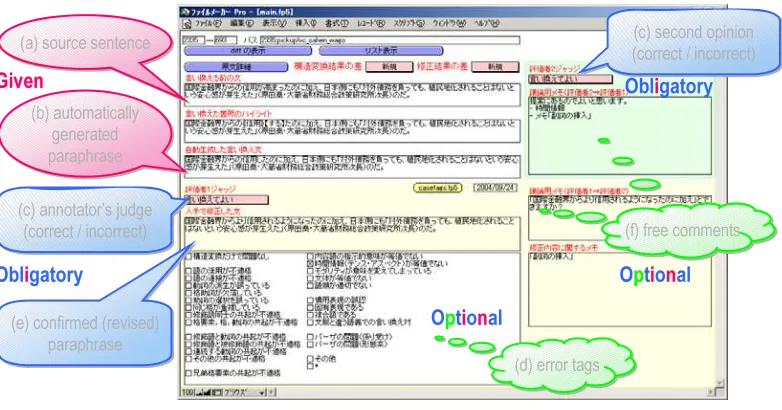
Annotators judge each candidate paraphrase with a view of an RDB-based annotation tool (Figure 1). Given (a) a source sentence and (b) an automatically generated candidate para-phrase, human annotators are asked to (c) judge the appropriateness of it and, if it is inappropri-ate, they are also asked to (d) classify the un-derlying errors into a predefined taxonomy, and make (e) appropriate revisions (if possible) and (f) format-free comments.
5 Preliminary trials
To examine how the proposed method actually work regarding the issues, we conducted prelim-inary trials, taking two classes of Japanese para-phrases: paraphrasing of light-verb constructions
and transitivity alternation. This section de-scribes the settings for each paraphrase class.
We sampled a collection of source sentences from one year worth of newspaper articles: Ni-hon Keizai Shinbun3, 2000, where the average sentence length was 25.3 words. The reason why we selected newspaper articles as a sample source was that most of the publicly available shallow parsers for Japanese were trained on a tree-bank sampled from newspaper articles, and a newspaper corpus was available in a considerably large scale. We used for candidate generation the morphological analyzer ChaSen4, the dependency
structure analyzer CaboCha5, and the paraphrase generation system KURA6.
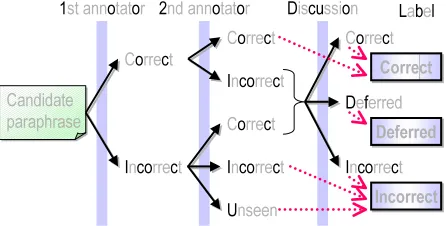
Two native speakers of Japanese, adults grad-uated from university, were employed as annota-tors. The process of judging each candidate para-phrase is illustrated in Figure 2. Thefirst annota-tor was asked to make judgements on each candi-date paraphrase. The second annotator inspected all the candidates judged correct by the first
an-3
http://sub.nikkeish.co.jp/gengo/zenbun.htm 4
http://chasen.naist.jp/ 5
Candidate paraphrase Candidate paraphrase
Correct
Incorrect
1st annotator 2nd annotator Correct
Incorrect
Correct
Incorrect
Correct
Deferred
Incorrect Discussion
Unseen
Deferred Deferred Correct Correct
[image:5.595.75.298.71.184.2]Incorrect Incorrect Label
Figure 2: Judgement procedure.
notator. To reduce the labor cost, only a small subset of candidates that thefirst annotator judged incorrect were checked by the second annotator, leaving the rest labeled incorrect. Once in sev-eral days, the annotators discussed cases on which they disagreed, and if possible revised the anno-tation criteria. When the discussion did not reach a consensus, the judgement was deferred.
5.1 Paraphrasing of light-verb constructions (LVC)
An example of this class is given in (1). A light-verb construction consists of a delight-verbal noun (“shigeki(inspiration)” in example (1)) governed by a light-verb (“ukeru (to receive)”). A para-phrase of this class is a pair of a light-verb con-struction and its unmarked form, which consists of the verbalized form of the deverbal noun where the light-verb is removed.
LetN, V be a deverbal noun and a verb, and V(N)be the verbalized form ofN. Paraphrases of this class can be represented by the following paraphrasing pattern:
(7) s. N-{ga, o, ni}(⇒V) V
N-{NOM,ACC,DAT} V
t. V(N)
V(N)
In the experiment, we used three more patterns to gain the coverage.
We then extracted 20,155 pairs of deverbal noun and its verbalized form (e.g. “shigeki (in-spiration)” and “shigeki-suru(to inspire)”) from the Japanese word dictionary, IPADIC (version 2.6.3)3. This set was used as a restriction on nouns that can match with N in a paraphrasing pattern. On the other hand, we made no restric-tion on V, because we had no exhaustive list of light-verbs. The patterns were automatically
compiled into pairs of dependency trees with uninstantiated components, and were applied to source sentences with the paraphrase generation system, which carried out dependency structure-based pattern matching. 2,566 candidate para-phrases were generated from 10,000 source sen-tences.
In the judgement phase, the annotators were also asked to revise erroneous candidates if pos-sible. The following revision operations were al-lowed for LVC:
• Change of conjugations • Change of case markers • Insert adverbs
• Append verbal suffixes, such as voice, as-pect, or mood devices
When pattern (7) is applied to sentence (1s), for instance, we need to add a voice device, “are (pas-sive),” to correctly produce (1t). In example (8), on the other hand, an aspectual device, “dasu (in-choative),” is appended, and a case marker, “no
(GEN),” is replaced with “o(ACC).”
(8) s. concert-no ticket-no hanbai-o hajime-ta. concert-GEN ticket-GEN sale-ACC to start-PAST We started to sale tickets for concerts.
t. concert-no ticket-o hanbai-shi-dashi-ta. concert-GEN ticket-ACC to sell-INCHOATIVE-PAST We started selling tickets for concerts.
So far, 1,114 candidates have been judged7 with agreements on 1,067 candidates, and 591 para-phrase examples have been collected.
5.2 Transitivity alternation (TransAlt)
This class of paraphrases requires a collection of pairs of intransitive and transitive verbs, such as “yureru(to sway)” and “yurasu(to sway)” in ex-ample (2). Since there was no available resource of such knowledge, we newly created a mini-mal set of intransitive-transitive pairs that were required to cover all the verbs appearing in the source sentence set (25,000 sentences). Wefirst retrieved all the verbs from the source sentences using a set of extraction patterns implemented in the same manner as paraphrasing patterns. Ex-ample (9) is one of the patterns used, where Nx matches with a noun, andV a verb.
7983 candidates for the
(9) s. N1-ga(⇒V) N2-ni(⇒V) V N1-NOM N2-DAT V
t. no change.
We then manually examined the transitivity of each of 800 verbs that matched withV, and col-lected 212 pairs of intransitive verbviand its tran-sitive formvt. Using them as constraints, we im-plemented eight paraphrasing patterns as in (10). (10) s. N1-ga(⇒Vi) N2-ni(⇒Vi) Vi
N1-NOM N2-DAT Vi
t. N2-ga(⇒Vt(Vi)) N1-o(⇒Vt(Vi)) Vt(Vi)
N2-NOM N1-ACC Vt(Vi)
whereViandVt(Vi)are variables that match with vi andvt, respectively. By applying the patterns
to the same set of source sentences, we obtained 985 candidate paraphrases.
We created a set of criteria for judging ap-propriateness (an example will be given in Section 6.4) and revision examples for the follow-ing operations allowed for this trial:
• Change of conjugations • Change of case markers • Change of voices
964 candidates have gained an agreement, and 484 paraphrase examples have been collected.
6 Results and discussion
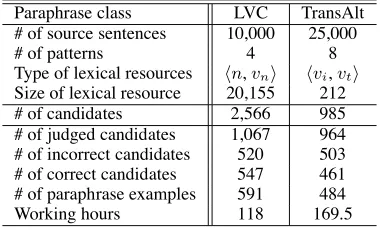
Table 1 gives some statistics of the resultant para-phrase corpora. Figures 3 and 4 show the number of candidate paraphrases, where the horizontal axes denote the total working hours of two anno-tators, and the vertical axes the number of candi-date paraphrases. The numbers of judged, correct, incorrect, and deferred candidates are shown.
6.1 Efficiency
2,031 candidate paraphrases have so far been judged in total and 1,075 paraphrase examples have been collected in 287.5 hours. The judge-ment was performed at a constant pace: 7.1 can-didates (3.7 examples) in one hour. It is hard to compare these results with other work because no previous study quantitatively evaluate the effi -ciency in terms of manual annotation cost. How-ever, we feel that the results have so far been sat-isfiable.
[image:6.595.319.510.85.200.2]For each candidate paraphrase judged incor-rect, the annotators were asked to classify the un-derlying errors into the fixed error types ((d) in
Table 1: Statistics of the resultant corpora.
Paraphrase class LVC TransAlt
# of source sentences 10,000 25,000
# of patterns 4 8
Type of lexical resources n,vn vi,vt
Size of lexical resource 20,155 212
# of candidates 2,566 985
# of judged candidates 1,067 964
# of incorrect candidates 520 503
# of correct candidates 547 461
# of paraphrase examples 591 484
Working hours 118 169.5
Figure 1). This error classification consumed ex-tra time because it required linguistic expertise which the annotators were not familiar with.
TransAlt was 1.75 times more time-consuming than LVC because the definition of TransAlt in-volved several delicate issues, which made the judgement process complicated. We return to this issue in Section 6.4.
6.2 Exhaustiveness
To estimate how exhaustively the proposed method collected paraphrase examples, we ran-domly sampled 750 sentences from the 4,500 sentences that were used in the trial for LVC, and manually checked whether the LVC para-phrasing could apply to each of them. As a re-sult, 206 examples were obtained, 158 of which were those already collected by the proposed method. Thus, the estimated exhaustiveness was 77% (158 / 206). Our manual investigation into the missed examples has revealed that 47 misses could have been automatically generated by en-hancing paraphrasing patterns and dictionaries, while only one example was missed due to an er-ror in shallow parsing. 34 cases of the 48 misses could have been collected by adding a couple of paraphrasing patterns. For example, pattern (11) verbalizes a noun followed by a nominalizing suf-fix, “ka(-ize),” as in (12).
(11) s. N-ka-{ga, o, ni}(⇒V) V N-ize-{NOM,ACC,DAT} V
t. V(N-ka)
V(N-ize)
(12) s. kore-wa kin’yu-shijo-no kassei-ka-ni this-TOP financial market-GEN activation-DAT
0 200 400 600 800 1000 1200
0 20 40 60 80 100 120
# of judged candidates
working hours Judged
[image:7.595.78.292.72.222.2]Correct Incorrect Deferred
Figure 3: # of judged candidates (LVC).
0 200 400 600 800 1000
0 20 40 60 80 100 120 140 160 180
# of judged candidates
working hours Judged
[image:7.595.307.518.73.221.2]Correct Incorrect Deferred
Figure 4: # of judged candidates (TransAlt).
t. kore-wa kin’yu-shijo-o this-TOP financial market-ACC
kassei-ka-suru kisei-kanwa-saku-da. to activate-PRES deregulation plan-COP This is a deregulation plan which activates financial market.
We cannot know if we have adequate para-phrasing patterns and resources before trials. Therefore, manual examination is necessary to re-fine them to bridge gap between the range of para-phrases that can be automatically generated and those of the specific class we consider.
6.3 Reliability
Ideally, more annotators should be employed to ensure the reliability of the products, which, how-ever, leads to a matter of balancing the trade-off. Instead, we specified the detailed judgement cri-teria for each paraphrase class, and asked the an-notators to reconsider marginal cases several days later and to make a discussion when judgements disagreed. The agreement ratio for correct candi-dates between two annotators increased as they became used to the task. In the trial for LVC, for example, the agreement ratio for each day changed from 74% (day 3) to 77% (day 6), 88% (day 9), and 93% (day 11). This indicates that the judgement criteria were effectively refined based on the feedback from inter-annotator discussions on marginal and disagreed cases. To evaluate the reliability of our judgement procedure more pre-cisely, we are planing to employ the third annota-tor who will be asked to judge all the cases inde-pendently of the others.
6.4 How we define paraphrase classes
One of the motivations behind our class-based ap-proach is an expectation that specifying the target classes of paraphrases would simplify the awk-ward problem of defining the boundary between paraphrases an non-paraphrases. Our trials for the two paraphrase classes, however, have revealed that it can still be difficult to create a clear cri-terion for judgement even when the paraphrase class in focus is specified.
As one of the criteria for TransAlt, we tested the agentivity of the nominative case of intransi-tive verbs. The test used an adverb, “muzukara
(by itself),” and classified a candidate paraphrase as incorrect if the adverb could be inserted im-mediately before the intransitive verb. For ex-ample, we considered example (13) as a correct paraphrase of the TransAlt class whereas (14) in-correct because the agentivity exhibited by (14s) did not remain in (14t).
(13) s. kare-ga soup-o atatame-ta. he-NOM soup-ACC to warm up-PAST He warmed the soup up.
t. soup-ga atatamat-ta. (correct) soup-NOM to be warmed up-PAST The soup was warmed up (by somebody).
(14) s. kare-ga koori-o tokashi-ta. he-NOM ice-ACC to melt (vt)-PAST He melted the ice.
t. koori-ga toke-ta. (incorrect) ice-NOM to melt (vi)-PAST The ice melted (by itself).
dropped in the target in both cases. Thus, the problem still remains. Nevertheless, our approach will provide us with a considerable amounts of concrete data, which we hope will lead us to bet-ter understanding of the issue.
7 Conclusion
Towards deep analysis of compositional classes of paraphrases, we have examined a class-oriented framework for collecting paraphrase examples, in which sentential paraphrases are collected for each paraphrase class separately by means of au-tomatic candidate generation and manual judge-ment. Our preliminary experiments on building a paraphrase corpus have so far been producing promising results, which we have evaluated ac-cording to cost-efficiency, exhaustiveness, and re-liability. The resultant corpus and resources will be available for free shortly. Our next step is di-rected to targeting a wider range of paraphrase classes.
References
Regina Barzilay and Kathleen R. McKeown. 2001. Extracting paraphrases from a parallel corpus. In
Proceedings of the 39th Annual Meeting of the Association for Computational Linguistics(ACL), pages 50–57.
Regina Barzilay and Lillian Lee. 2003.
Learn-ing to paraphrase: an unsupervised approach us-ing multiple-sequence alignment. InProceedings of the 2003 Human Language Technology Confer-ence and the North American Chapter of the Associ-ation for ComputAssoci-ational Linguistics(HLT-NAACL), pages 16–23.
Bill Dolan, Chris Quirk, and Chris Brockett. 2004. Unsupervised construction of large paraphrase cor-pora: exploiting massively parallel news sources. In Proceedings of the 20th International Con-ference on Computational Linguistics (COLING), pages 350–356.
Mark Dras. 1999.Tree adjoining grammar and the re-luctant paraphrasing of text. Ph.D. thesis, Division of Information and Communication Science, Mac-quarie University.
Atsushi Fujita and Kentaro Inui. 2003.
Explor-ing transfer errors in lexical and structural para-phrasing. IPSJ Journal, 44(11):2826–2838. (in Japanese).
Atsushi Fujita, Kentaro Inui, and Yuji Matsumoto. 2004. Detection of incorrect case assignments in automatically generated paraphrases of Japanese sentences. InProceedings of the 1st International
Joint Conference on Natural Language Processing
(IJCNLP), pages 14–21.
Ray Jackendoff. 1990.Semantic structures. The MIT Press.
Taro Kageyama, editor. 2001. Semantics and syntax of verb: comparable study between Japanese and English. Taishukan Shoten. (in Japanese).
Yumiko Kinjo, Kunio Aono, Keishi Yasuda, Toshiyuki
Takezawa, and Genichiro Kikui. 2003.
Collec-tion of Japanese paraphrases of basic expressions on travel conversation. InProceedings of the 9th Annual Meeting of the Association for Natural Lan-guage Processing, pages 101–104. (in Japanese). Maria Lapata. 2001. A corpus-based account of
reg-ular polysemy: the case of context-sensitive ad-jectives. In Proceedings of the 2nd Meeting of the North American Chapter of the Association for Computational Linguistics(NAACL), pages 63–70. Benoit Lavoie, Richard Kittredge, Tanya Korelsky, and Owen Rambow. 2000. A framework for MT and multilingual NLG systems based on uniform lexico-structural processing. InProceedings of the 6th Applied Natural Language Processing Confer-ence and the 1st Meeting of the North American Chapter of the Association for Computational Lin-guistics(ANLP-NAACL), pages 60–67.
Igor Mel’cuk and Alain Polgu`ere. 1987. A formalˇ lexicon in meaning-text theory (or how to do lex-ica with words). Computational Linguistics, 13(3-4):261–275.
Chris Quirk, Chris Brockett, and William Dolan. 2004. Monolingual machine translation for para-phrase generation. InProceedings of the 2004 Con-ference on Empirical Methods in Natural Language Processing(EMNLP), pages 142–149.
Mitsuo Shimohata. 2004. Acquiring paraphrases
from corpora and its application to machine trans-lation. Ph.D. thesis, Graduate School of Informa-tion Science, Nara Institute of Science and Tech-nology.
Yusuke Shinyama and Satoshi Sekine. 2003. Para-phrase acquisition for information extraction. In
Proceedings of the 2nd International Workshop on Paraphrasing: Paraphrase Acquisition and Appli-cations(IWP), pages 65–71.
Satoshi Shirai, Kazuhide Yamamoto, and Francis Bond. 2001. Japanese-English paraphrase corpus. In Proceedings of the 6th Natural Language Pro-cessing Pacific Rim Symposium(NLPRS)Workshop on Language Resources in Asia, pages 23–30. Tetsuro Takahashi, Tomoya Iwakura, Ryu Iida,