Representations for category disambiguation
Markus Dickinson Indiana University Bloomington, IN 47405
Abstract
As it serves as a basis for POS tagging, cat-egory induction, and human catcat-egory ac-quisition, we investigate the information needed to disambiguate a word in a lo-cal context, when using corpus categories. Specifically, we increase the recall of an error detection method by abstracting the word to be disambiguated to a represen-tation containing information about some of its inherent properties, namely the set of categories it can potentially have. This work thus provides insights into the rela-tion of corpus categories to categories de-rived from local contexts.
1 Introduction and Motivation
Category induction techniques generally rely on local contexts, i.e., surrounding words, to cluster word types together (e.g., Clark, 2003; Sch¨utze, 1995), using information of a kind also found in human category acquisition tasks (e.g., Mintz, 2002, 2003). Such information is also at the core of standard part-of-speech (POS) tagging, or disambiguation, methods (see, e.g., Manning and Sch¨utze, 1999, ch. 10), with the contexts generally abstracted to POS tags. The contextual informa-tion is similar in both tasks because inducinforma-tion is founded in part upon the notion that local contexts are useful for disambiguation: one morphosyntac-tically clusters words which should have the same category in the same contexts. But which contexts count as being the “same”? And to what extent do categories based on context distributions resemble
c
2008. Licensed under the Creative Commons Attribution-Noncommercial-Share Alike 3.0 Unported li-cense (http://creativecommons.org/licenses/by-nc-sa/3.0/). Some rights reserved.
corpus annotation categories? Since disambigua-tion is in some sense more primary, to begin to answer these questions we investigate which rep-resentations are effective for category disambigua-tion.
Disambiguating a word’s category in context has of course been explored in other situations, especially POS tagging. Rarely, however, has it been shown as to which information is the most accurate at disambiguation and which information is absolutely necessary, without mixing these is-sues with other tagging isis-sues, such as smoothing and unknown word tagging. We need techniques which isolate disambiguation, placing less empha-sis on generalizing contexts to new data. To de-termine the essential information needed for accu-rate disambiguation, we start with a precise model and generalize it. Changing the model in small ways and evaluating the resulting precision will in-dicate how particular aspects of the representation are contributing to successful disambiguation.
The central question of this paper is: which representation (of a word and its context) indi-cates that two situations should be categorized the same? In this context, POS annotation error detec-tion provides an ideal setting to explore represen-tations for disambiguation. Error detection relies on the assumption that words should be annotated consistently—in other words, contexts are grouped which accurately identify the category of a word as being consistent—and it does this with an empha-sis on high precision. In essence, error detection already investigates where disambiguation can be done, often using local contexts (e.g., Dickinson, 2005). With an emphasis on high precision, how-ever, many corpus instances are essentially uncat-egorized and are thus in need of generalization.
To get at the central question of an appropriate
representation for disambiguation, then, our task is to generalize error detection and increase the recall of errors found in a corpus by exploiting more gen-eral properties of a corpus. Given that annotation errors can have a profound impact on the quality of training and testing on such data (see Dickin-son, 2005, ch. 1), this task also serves an immense practical need in its own right.
In exploring error detection recall, we can con-nect the task to another with much of the same em-phasis. Human category acquisition experiments have also focused on precision: instead of ask-ing how every word is categorized, they examine how some words are categorized, from which oth-ers can be bootstrapped. As outlined in sections 2 and 3, we can use such studies as a starting point for generalizing error detection.
2 Background
2.1 The variationn-gram method
The error detection method we build from is the variation n-gram method (Dickinson and Meur-ers, 2003; Dickinson, 2005). The approach de-tects items which occur multiple times in the cor-pus with varying annotation, the so-called varia-tion nuclei. A nucleus with its repeated surround-ing context is referred to as a variation n-gram. Every detected variation in the annotation of a nu-cleus is classified as an error or a genuine ambi-guity using a basic heuristic requiring at least one word of context on each side of the nucleus.
For example, in the WSJ corpus, part of the Penn Treebank 3 release (Marcus et al., 1993), the string in (1) is a variation 12-gram sinceoff is a variation nucleus that is tagged preposition (IN) in one corpus occurrence and particle (RP) in an-other.1 Dickinson (2005) shows that examining
those cases with identical local context—in this case, looking atward off a—results in an estimated error detection precision of 92.5%.
(1) to ward off a hostile takeover attempt by two European shipping concerns
This method can be applied to syntactic annota-tion, and for this annotaannota-tion, one can increase the recall of errors found by abstracting the nuclei to POS tags (Boyd et al., 2007). Clearly, this is not a feasible abstraction here, given that we are at-tempting to detect errors in POS annotation.
1To distinguish variation nuclei, we shade them in gray
and underline the immediately surrounding context.
2.2 Frames for language acquisition
Research on language acquisition has addressed the question of how humans discover and learn cat-egories of words, using virtually the same contexts as in the variationn-gram method. Mintz (2002) shows that local context, in the form of a frame
of two words surrounding a target word, leads to categorization in adults of the target, and Mintz (2003) shows that frequent frames supply category information, consistent across child language cor-pora. A frame is defined as “two jointly occurring words with one word intervening” (Mintz, 2003), e.g.,you it. The frame is not decomposed into its left side and right side (cf., e.g., Redington et al., 1998; Clark, 2003) , but instead is taken as the oc-currence of both sides. Thetarget wordis the in-tervening word, but it is not included in the frame (unlike variation nuclei).
For category acquisition, only frequent frames
are used, those with a frequency above a cer-tain threshold. Frequent frames predict cate-gory membership: the set of words appearing in a given frame should represent a single cate-gory. The frequent frame you it, for example, largely identifies verbs, as shown in (2), taken from the CHILDES database of child-directed speech (MacWhinney, 2000). Analyzing the frequent frames in six subcorpora of CHILDES, Mintz (2003) obtains both high type and high token ac-curacy in grouping words into the same categories.
(2) a. you put it b. you see it
To take this work as a basis for investigating dis-ambiguation, some points are in order about the re-sults. First, accuracies slightly degrade when mov-ing from the “Standard Labelmov-ing” category set2 to
the more fine-grained “Expanded Labeling” cate-gory set,3 i.e., a .98 to .91 drop in token accuracy
and .93 to .91 drop in type accuracy. It is not clear what happens with even more fine-grained corpus tagsets. Secondly, Mintz (2003) assumes that, at least for his experiments, each word has only one class (see also Redington et al., 1998, p. 439-440). The tasks of category induction and category dis-ambiguation are thus conflated into a single step. We do not know for sure whether frames induce
2Categories = noun, verb, adjective, preposition, adverb,
determiner,wh-word,not, conjunction, and interjection.
3Nouns split into nouns and pronouns; verbs split into
coherent sets of words or whether they accurately disambiguate a word, or both. In other words, can frames be used to group the target words (induc-tion) or to group the contexts (disambigua(induc-tion)?
While we investigate using frames for disam-biguation in English (and somewhat in German), the concept of a frame has been shown to be cross-linguistically viable (Chemla et al., in press), and in principle could extend to languages encoding re-lations through morphology instead of linear order (see the discussion in Mintz, 2003).
3 Generalizing error detection via frames
Both strands of research employ local contexts for identifying categories, but the variation n-gram method relies on identical words to serve as vari-ation nuclei, or target words to be disambiguated. To increase the recall of the method in a way relat-ing to acquisition, the nucleus should be abstracted to something more general than a word. As a (fre-quent) frame does not include the target, predicting that the category within that context is always the same, a first step in abstracting the nucleus is to require no similarity between nuclei.
We thus search for all identical nuclei with frame context—or what we will call framed vari-ation nuclei—such that there is variation in label-ing for the nucleus, but we require no identity of the nucleus. We investigate the WSJ portion of the Penn Treebank, and, to provide more robust evalu-ation, also compare the TIGER corpus of German, version 2 (Brants et al., 2002) where appropriate. Given that punctuation is less informative for de-termining a category, we remove from considera-tion frames containing punctuaconsidera-tion as one of the context words, and obtain 48,717 variations in the WSJ and 22,613 in TIGER.
Although basic hand-examination reveals some errors, a majority of cases contain acceptable vari-ations. As one example, in the WSJ the framethe of occurs as the most frequent frame with vari-ation in labeling for the target (5737 instances). This is a nominal position, and thus we find varia-tion between a variety of correct nominal tags: car-dinal number (CD), adjective (JJ, JJR, JJS), com-mon noun (NN, NNS), and proper noun (NNP, NNPS), in addition to the erroneous verbal tags VBD (past tense verb) and VBG (verb,-ingform). Restricting our attention to the frequent frames, as in Mintz (2003), is not helpful: the problem occurs irrespective of frequency. Indeed, there is an
aver-age of 2.56 categories per variation, with one vari-ation (and in) having 21 categories. This is con-sistent in TIGER, which has 2.57 categories per variation and 22 categories forund in.
While more context could help, the real issue is the definition of a nucleus. In the example above, which nominal tag is used depends upon inher-ent properties of the word involved. Consider the frame that the. Among the 18 possible tags, there is variation between NN (common noun) for words likeafternoonand VBZ (present tense verb, 3rd person singular) for words likesays. Both are legitimate, and the primary way to tell is by exam-ining information about the target word. In gen-eralizing the nucleus, instead of abstracting it to nothing, we need to abstract it to something indi-cating broad characteristics of the word.
4 An appropriate level of abstraction
On the one hand, the variationn-gram method has high precision; on the other, using frames results in high recall, but too low a precision to sort through. Both methods rely on the same identical contexts; the issue is in finding which words are comparable. Consider the framen’t that. Some words are in-herently similar and should have the same tags: the correctn’t help/VB thatand the erroneousn’t mat-ter/NN that, for instance, are comparable. Other cases are not: one/CDandshown/VBN can never have the same category. We need to find classes of words that, within the same context, should not vary in their annotation, and it makes sense to com-pare words in context if they have the same cate-gory possibilities.
4.1 Complete ambiguity classes
Ambiguity classes capture the relevant property we are interested in: words with the same cate-gory possibilities are grouped together.4 And
am-biguity classes have been shown to be success-fully employed, in a variety of ways, to improve POS tagging (e.g., Cutting et al., 1992; Daelemans et al., 1996; Dickinson, 2007; Goldberg et al., 2008; Tseng et al., 2005). Only certain words can take one of two (or more) tags, and these should be disambiguated in the same way in context. As an example of how using ambiguity classes as varia-tion nuclei can increase recall, consider the frame
being by in example (3). There are at least 27
4One could group affixes by ambiguity class for languages
different VBN (past participle) verbs appearing be-tween beingand by(3a), but none of these verbs ever appear as VBD here, even though all of them could be VBD. Two other VBD/VBN verbs, re-jected(3b) andplayed(3c), erroneously appear as VBD here, but never as VBN. With the nucleus VBD/VBN, we can find this erroneous variation.
(3) a. being { raised/VBN , infringed/VBN , supported/VBN , ...}by
b. as probable as being rejected/VBD by the Book-of-the-Month Club
c. the ... role in takeover financing being played/VBD by Japanese banks
Thus, to definecomplete ambiguity class varia-tion nuclei, we make a first pass through the cor-pus to calculate every word’s ambiguity class. On a second pass, the ambiguity class serves as the (framed) variation nucleus, e.g., being VBD/VBN by. Ambiguity class nuclei with more than one tag in a frame context are flagged as a potential error.
4.2 Pairwise ambiguity classes
While abstracting to a word’s possible classes can increase the number of errors found, potentially erroneous classes prevent further increased recall. For example, the class for plans is erroneously classified as NNS/VBP/VBZ, even though its one instance of VBP (present tense verb, non-3rd per-son singular) in the corpus is erroneous. Without that case, we would have NNS/VBZ and more di-rectly comparable words.
As a second experiment, then, we define pair-wise ambiguity class variation nuclei, using sub-sets of ambiguity classes to define a nucleus. If the variation is only between NNS and VBZ, we need to allow all words with NNS/VBZ variation to count as comparable nuclei. As above, we calcu-lated a word’s ambiguity class during a first pass. In the second pass through the corpus, we break the ambiguity class down into its pairs, and each relevant pair is stored as a variation nucleus. The relevant pairs of tags are those which contain the tag at that position since classes without that tag can never have meaningful variation. Taking the example ofcompany plans to, with the ambiguity class NNS/VBP/VBZ forplans, if the current cor-pus position marks plans as NNS, then we store the two trigrams in (4).
(4) a. company NNS/VBZ to
b. company NNS/VBP to
Looking over the whole corpus, we find vari-ation between NNS and VBZ, but none between NNS and VBP. In principle, this instance of
plans/NNScould be in both an NNS/VBZ and an NNS/VBP variation; this is necessary since we do not a priori know which variations will be prob-lematic.
5 Results and Insights 5.1 Complete ambiguity classes
Using complete ambiguity class variation nuclei, we find 4131 framed variation nuclei in the WSJ. Almost all variations involve only two or three tags, with 2.03 tags per variation. TIGER has 626 framed variation nuclei, with 2.01 tags per varia-tion.
From the 4131 variations, we randomly sampled 100 cases and hand-evaluated whether they contain an error, and whether its detection is attributable to the generalization to complete ambiguity classes. Of the 100, 79 of the cases contain at least one error, and 15 of these cases are new examples, i.e., cases without identical words. With a point estimate of .79, we estimate 3263 errors and ob-tain a 95% confidence interval of (0.7102, 0.8698), meaning that we predict between 2933 and 3593 of the 4131 cases contain errors. The 79 erroneous cases point to 134 token errors, of which 23 are new.
In addition to increasing the recall of the method, the cases are arguably more thoroughly grouped than before. For instance, we see in (5) that bothpretaxandthird-quartervary between JJ and NN in the variation said JJ/NN profit, with
first-half additionally appearing only as JJ. Since JJ is the correct tag for all instances, the two NN errors are detected with word nuclei, but here all the relevant examples are together. This provides evidence for the claim that an ambiguity class is a level of abstraction supporting identical disam-biguation in the same context.
(5) said { first-half/JJ , third-quarter/JJ , pretax/JJ , third-quarter/NN , pretax/NN }
profit
nuclei, meaning that the longest contexts were ex-amined before working down to shorter contexts. Furthermore, it is not clear how well the original word nuclei method scales up to larger corpora. Some of the new false positives we observe would likely be false positives for word nuclei, given more data. For example, the new method turns up generally VBD/VBN theas a false positive, as in (6), because of the non-local tagset distinction and short context. With more data, we are more likely to see an acceptable use of, e.g., generally favored/VBD the, a false positive for word nuclei. In some sense, then, this 79% precision might be a more general indication of the method’s precision for this tagset and genre.
(6) a. TV news coverage has generally favored/VBN the government
b. Members ... generally received/VBD the regional officials
Finally, of the 21 false positives (20 of which are new), five of them stem from an error in the ambi-guity class, corresponding to five token errors. For example, there is variation for JJ/NN words in the frameof pills, as in (7). However,poisonshould never be JJ: its ambiguity class should be NN, not the incorrect JJ/NN. For error detection, this means 84 of the 100 samples lead to some kind of POS error; for investigating disambiguation contexts, this means that 83% (79/95) of the cases support complete disambiguation. Thus, when abstracting to ambiguity class nuclei, local context generally provides sufficient information for disambiguation (see also section 6).
(7) of{ birth-control/JJ , poison/NN }pills
One limitation of the variationn-gram method is the fact that some distinctions often need non-local information (cf. (6)). A bigger problem for group-ing words by ambiguity classes is the fact that an-notation can be semantically-based. For example, the variation of JJ/NN bankis a legitimate ambi-guity because the distinction between JJ and NN is semantic. Comparea sort of merchant/NN bank
withan extension of senior/JJ bank debt: both nu-clei are clearly in a noun modifier position, but the tags are different based on what they denote. This shows the limitations of local distributional information without lexical information, for mak-ing these tagset distinctions.
5.2 Pairwise ambiguity classes
With pairwise ambiguity classes serving as varia-tion nuclei, we find 6235 variavaria-tion frames in the WSJ and 874 in TIGER, significant increases over using complete ambiguity class nuclei. To evalu-ate the method, we want to know: a) how many total errors we detect, b) how many of these were detected by using either complete or pairwise am-biguity classes, and c) how many were detected specifically with pairwise ambiguity classes.
A sample of 100 of the WSJ cases reveals (a) 59 total errors, (b) 18 of which involve ambigu-ity class nuclei that would not have been found with word nuclei. Of these 18, (c) 8 cases can only be found by extending the method to pairwise classes. For the point estimate of .59, we estimate approximately 3679 variations to be errors (95% CI: 3078 to 4280 errors). The 59 erroneous varia-tions point to a total of (a) 134 token errors, (b) 30 of which were detected by ambiguity classes; (c) 17 of these were detected by pairwise ambiguity classes. Clearly, using pairwise ambiguity classes increases the number of errors found.
As an example, consider (8), centering on the framecame for. The original variationn-gram method turns up no variation here, but neither does the complete ambiguity class extension:inhas the ambiguity class FW/IN/NN/RB/RBR/RP, andout
the class IN/JJ/NN/RB/RP. Since the only relevant variation is between IN and RP, the pairwise nuclei method turns up such cases with the variationcame IN/RP for, pointing to an error in the two cases of
out.
(8) a. accounts came in/RP for some blocks b. numbers came out/IN for September c. he again came out/IN for an amendment But what of the 41 false positives, 22 of which are due to the pairwise classes? We have increased recall, but there is also a 20% absolute drop in pre-cision. Is this tradeoff worth it? To answer this, it is important to note that 15 of the false posi-tives are due to faulty ambiguity classes, as dis-cussed above, and 10 of those 15 are from pair-wise classes. For error detection, this means 74 of the 100 samples lead to some POS error; for inves-tigating disambiguation contexts, this means 69% (59/85) of the cases support disambiguation.
pair-wise ambiguity classes. For example, in the varia-tion frame as DT/JJ sales, the words which vary are a (tagged DT (determiner), with a complete ambiguity class of DT/FW/IN/JJ/LS/NNP/SYM) and many (tagged JJ, with an ambiguity class of DT/JJ/NNS/PDT/RB/VB). Unsurprisingly, a
should never have been tagged JJ in the corpus, i.e., its ambiguity class is wrong.
In addition to the issue of erroneous tags in an ambiguity class, atypical tags also pose a prob-lem. Consider the frame that JJ/RB in, as illus-trated in (9), with acceptable variation. It might appear thatsometimehas a problem with its ambi-guity class, but the use of JJ is actually correct, as shown in (10), wheresometimeis atypically mod-ifying a noun. To counter atypical uses, one could use only “typical” ambiguity classes (cf. Dickin-son, 2007) or define ambiguity classes according to order of frequency (cf. Daelemans et al., 1996), e.g., JJ/RB vs. RB/JJ.
(9) a. a departure from the past that many/JJ in the industry ...
b. hope that sometime/RB in the near fu-ture
(10) real estate magnate and sometime/JJ raider Donald Trump
This illustrates that the selection of an abstracted class for a nucleus definition is non-trivial, and am-biguity classes are simply an approximation.
POS contexts One problem for our method is that word contexts are not always truly compara-ble; identical context words can be used differ-ently. For instance, with the variationthat NN/VBP along in (11), the uses ofthat are clearly distinct and are marked as such by their tags.
(11) a. gifts that/WDT go/VBP along with pur-chases
b. We are considering that/DT offer/NN along with all other alternatives
But do tagset categories actually aid in local dis-ambiguation? To quickly gauge this, we take the previous sample of 100 variations and recover the POS information for the context. Isolating those cases with non-identical POS tags for the same word contexts, we find 10 examples and hypothe-size that these will more likely be acceptable varia-tions. Interestingly, however, of those ten, six suc-cessfully identified errors; it turns out that the POS
of the word is often irrelevant for disambiguation. For the variation paid JJR/RBR than in (12), for example, the tag of the context wordpaidis differ-ent in these cases, but that does not matter for the tag ofmore, which should be consistent.
(12) a. they paid/VBD more/JJR than $ 1 mil-lion
b. he has paid/VBN more/RBR than $ 70,000
More problematically, four of the erroneous variation nuclei also contained POS errors in the context, as in example (13). The variation all CC/RB disappearedpoints to an error in the word
but, yet there is also a noticeable inconsistency in the wordall.
(13) a. have all/DT but/CC disappeared b. have all/RB but/RB disappeared
In other words, it is often the case that we should ignore the POS of the context words, due to the fact that erroneous contexts exist and, more importantly, that not all categories aid in disam-biguation. Exploring which contextual categories aid in target category disambiguation (cf., e.g., Brants, 1997) could aid in developing better dis-ambiguation models, and perhaps also a better sense of what categories are useful to induce (e.g., a broader categoryVerbin (12) forpaid).
6 Representations for disambiguation
We have shown that local lexical context provides a generally unambiguous context for corpus tags, given sufficient information about the word to be disambiguated. The information need not be very abstract, either: frames using ambiguity class nu-clei only require a word’s category possibilities. Even for many unsupervised situations, this is available from a lexicon (e.g., Banko and Moore, 2004; Goldberg et al., 2008).
for the WSJ how unambiguous a particular level of nucleus abstraction is.5
Abstraction Unamb. Total Accuracy Word 84,784 87,390 97.02% Complete AC 90,341 94,472 95.63% No info. 51,945 100,662 51.60% Table 1: Disambiguation accuracy for the WSJ
While abstracting to the case where the nucleus contains no information (No info.) creates more cases which are classifiable—over 100,000—the accuracy of disambiguation drops from the up-per 90% range to 52%. Note, however, that the abstraction to complete ambiguity class (AC) nu-clei has minimal degradation in accuracy, yet in-creases the number of accurately classified cases. When we recall that approximately 79% of of the 4131 variation frames should have a single tag, i.e., 3263 cases, this means that the overall dis-ambiguation accuracy is estimated to be 99.08% (93,604/94,472).
In addition to the disambiguation accuracy of frames, we can look at the accuracy of word tokens identified by frames. To gauge this, we identify the most likely tag of each framed variation nucleus and assign it to all instances of the nucleus. In the case of ties, one tag is randomly selected; since we are only calculating overall word token accuracy, the exact tag selected is unimportant. The results of comparing to the benchmark tags are given in table 2. Even though the abstraction to no infor-mation identifies more word tokens, the ambigu-ity class abstraction correctly categorizes nearly as many words.
Abstraction Correct Total Accuracy Word 340,860 345,139 98.76% Complete AC 441,603 448,402 98.74% No info. 444,635 582,601 76.32%
Table 2: Word token accuracy for the WSJ
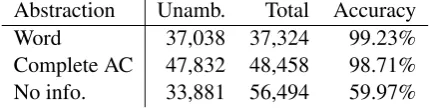
With the smaller and likely more accurately tagged TIGER corpus, we find exactly the same trends, as shown in table 3. This supports the claim across corpora that local context is often suf-ficient to disambiguate a word, if some information from the word—here, the category possibilities— is present in the nucleus.
5As pairwise ambiguity classes involve more than one
nu-cleus per corpus position, we use complete ambiguity classes.
Abstraction Unamb. Total Accuracy Word 37,038 37,324 99.23% Complete AC 47,832 48,458 98.71% No info. 33,881 56,494 59.97% Table 3: Disambiguation accuracy for TIGER
The poor accuracy for framed nuclei with no information indicates that methods which intend to match corpus annotation categories could face difficulties in obtaining a single category with-out using more information. There is still much space to explore, however, between using ambi-guity class nuclei and no information, in order to further increase the number of comparable cases without losing accuracy and in order to be more knowledge-free.
7 Summary and Outlook
Motivated by work on category acquisition, we have shown that local contexts—i.e., immediately surrounding words, or frames—can delineate cor-pus categories when the level of abstraction for the word to be disambiguated indicates some inherent properties of the word, namely the categories it can have. By abstracting away from lexical items to broader classes of words, we have been able to in-crease the recall of an error detection method with-out much drop in its precision.
Having successfully defined a representation for disambiguation, the next step is to make the rep-resentation more general, in order to include more comparable instances. As what we have done is es-sentially a form of nearest neighbor classification, one could in the future explore more sophisticated techniques to cluster contexts.
At the same time, we wish to use as little annotated knowledge as possible. Thus, an or-thogonal line of research can involve inducing classes for words which are more general than sin-gle categories, i.e., something akin to ambiguity classes (see, e.g., the discussion of ambiguity class guessers in Goldberg et al., 2008). This could make error detection completely independent of the annotation and, more importantly, lead to an improved understanding of the best knowledge-free representation for disambiguation.
one tagset in existence (see discussion in Clark, 2003), but annotation schemes make distinctions that morphosyntactic contexts cannot readily cap-ture. For example, there is an implicit notion of in-herency in the distinction between JJ and NN in the Penn Treebank (Santorini, 1990, p. 12-13). Fully outlining these inherent properties could provide insights into induction and its evaluation.
Acknowledgments
Thanks to the three anonymous reviewers for their useful comments and to Charles Jochim for helpful discussion. This material is based upon work sup-ported by the National Science Foundation under Grant No. IIS-0623837.
References
Banko, Michele and Robert C. Moore (2004). Part-of-Speech Tagging in Context. In Proceed-ings of COLING 2004. Geneva, Switzerland, pp. 556–561.
Boyd, Adriane, Markus Dickinson and Detmar Meurers (2007). Increasing the Recall of Cor-pus Annotation Error Detection. InProceedings of TLT 2007. Bergen, Norway, pp. 19–30. Brants, Sabine, Stefanie Dipper, Silvia Hansen,
Wolfgang Lezius and George Smith (2002). The TIGER Treebank. In Proceedings of TLT-02. Sozopol, Bulgaria.
Brants, Thorsten (1997). Internal and External Tagsets in Part-of-Speech Tagging. In Proceed-ings of Eurospeech. Rhodes, Greece.
Chemla, E., T. H. Mintz, S. Bernal and A. Christophe (in press). Categorizing words using ’Frequent Frames’: What cross-linguisic analyses reveal about core principles. Develop-mental Science.
Clark, Alexander (2003). Combining Distribu-tional and Morphological Information for Part of Speech Induction. InProceedings of EACL-03. Budapest, pp. 59–66.
Cutting, Doug, Julian Kupiec, Jan Pedersen and Penelope Sibun (1992). A Practical part-of-speech tagger. InProceedings of the ANLP-92. Trento, Italy, pp. 133–140.
Daelemans, Walter, Jakub Zavrel, Peter Berck and Steven Gillis (1996). MBT: A Memory-Based Part of Speech Tagger-Generator. In Proceed-ings of the Fourth Workshop on Very Large Cor-pora (VLC). Copenhagen, pp. 14–27.
Dickinson, Markus (2005). Error detection and correction in annotated corpora. Ph.D. thesis, The Ohio State University.
Dickinson, Markus (2007). Determining Ambigu-ity Classes for Part-of-Speech Tagging. In Pro-ceedings of RANLP-07. Borovets, Bulgaria. Dickinson, Markus and W. Detmar Meurers
(2003). Detecting Errors in Part-of-Speech An-notation. InProceedings of EACL-03. Budapest, pp. 107–114.
Goldberg, Yoav, Meni Adler and Michael Elhadad (2008). EM Can Find Pretty Good HMM POS-Taggers (When Given a Good Start). In Pro-ceedings of ACL-08. Columbus, OH, pp. 746– 754.
MacWhinney, Brian (2000). The CHILDES project: Tools for analyzing talk. Mahwah, NJ: Lawrence Erlbaum Associates, third edn. Manning, Christopher D. and Hinrich Sch¨utze
(1999). Foundations of Statistical Natural Lan-guage Processing. Cambridge, MA: The MIT Press.
Marcus, M., Beatrice Santorini and M. A. Marcinkiewicz (1993). Building a large anno-tated corpus of English: The Penn Treebank.
Computational Linguistics19(2), 313–330. Mintz, Toben H. (2002). Category induction
from distributional cues in an artificial language.
Memory & Cognition30, 678–686.
Mintz, Toben H. (2003). Frequent frames as a cue for grammatical categories in child directed speech. Cognition90, 91–117.
Redington, Martin, Nick Chater and Steven Finch (1998). Distributional Information: A Powerful Cue for Acquiring Syntactic Categories. Cogni-tive Science22(4), 425–469.
Santorini, Beatrice (1990). Part-Of-Speech Tag-ging Guidelines for the Penn Treebank Project (3rd Revision, 2nd printing). Tech. Rep. MS-CIS-90-47, The University of Pennsylvania, Philadelphia, PA.
Sch¨utze, Hinrich (1995). Distributional Part-of-Speech Tagging. In Proceedings of EACL-95. Dublin, Ireland, pp. 141–148.