Metric Learning for Synonym Acquisition
Nobuyuki Shimizu Information Technology Center
University of Tokyo
Masato Hagiwara
Graduate School of Information Science Nagoya University
Yasuhiro Ogawa and Katsuhiko Toyama Graduate School of Information Science
Nagoya University
{yasuhiro,toyama}@kl.i.is.nagoya-u.ac.jp
Hiroshi Nakagawa Information Technology Center
University of Tokyo
Abstract
The distance or similarity metric plays an important role in many natural language processing (NLP) tasks. Previous stud-ies have demonstrated the effectiveness of a number of metrics such as the Jaccard coefficient, especially in synonym acqui-sition. While the existing metrics per-form quite well, to further improve perfor-mance, we propose the use of a supervised machine learning algorithm that fine-tunes them. Given the known instances of sim-ilar or dissimsim-ilar words, we estimated the parameters of the Mahalanobis distance. We compared a number of metrics in our experiments, and the results show that the proposed metric has a higher mean average precision than other metrics.
1 Introduction
Accurately estimating the semantic distance be-tween words in context has applications for machine translation, information retrieval (IR), speech recognition, and text categorization (Bu-danitsky and Hirst, 2006), and it is becoming clear that a combination of corpus statistics can be used with a dictionary, thesaurus, or other knowl-edge source such as WordNet or Wikipedia, to in-crease the accuracy of semantic distance estima-tion (Mohammad and Hirst, 2006). Although com-piling such resources is labor intensive and achiev-ing wide coverage is difficult, these resources to some extent explicitly capture semantic structures
c
2008. Licensed under the Creative Commons Attribution-Noncommercial-Share Alike 3.0 Unported li-cense (http://creativecommons.org/licenses/by-nc-sa/3.0/). Some rights reserved.
of concepts and words. In contrast, corpus statis-tics achieve wide coverage, but the semantic struc-ture of a concept is only implicitly represented in the context. Assuming that two words are semanti-cally closer if they occur in similar contexts, statis-tics on the contexts of words can be gathered and compared for similarity, by using a metric such as the Jaccard coefficient.
Our proposal is to extend and fine-tune the latter approach with the training data obtained from the former. We apply metric learning to this task. Al-though still in their infancy, distance metric learn-ing methods have undergone rapid development in the field of machine learning. In a setting simi-lar to semi-supervised clustering, where known in-stances of similar or dissimilar objects are given, a metric such as the Mahalanobis distance can be learned from a few data points and tailored to fit a particular purpose. Although classification meth-ods such as logistic regression now play impor-tant roles in natural language processing, the use of metric learning has yet to be explored.
Since popular current methods for synonym ac-quisition require no statistical learning, it seems that supervised machine learning should easily outperform them. Unfortunately, there are obsta-cles to overcome. Since metric learning algorithms usually learn the parameters of a Mahalanobis dis-tance, the number of parameters is quadratic to the number of features. They learn how two features should interact to produce the final metric. While traditional metrics forgo examining of the interac-tions entirely, in applying metrics such as Jaccard coefficient, it is not uncommon nowadays to use more than 10,000 features, a number that a typical metric learner is incapable of processing. Thus we have two options: one is to find the most impor-tant features and model the interactions between
them, and the other is simply to use a large number of features. We experimentally examined the two options and found that metric learning is useful in synonym acquisition, despite it utilizing fewer fea-tures than traditional methods.
The remainder of this paper is organized as fol-lows: in section 2, we review prior work on syn-onym acquisition and metric learning. In section 3, we introduce the Mahalanobis distance metric and a learning algorithm based on this metric. In section 4 and 5, we explain the experimental set-tings and propose the use of normalization to make the Mahalanobis distances work in practice, and then in section 6, we discuss issues we encountered when applying this metric to synonym acquisition. We conclude in section 7.
2 Prior Work
As this paper is based on two different lines of re-search, we first review the work in synonym acqui-sition, and then review the work in generic metric learning. To the best of the authors’ knowledge, none of the metric learning algorithms have been applied to automatic synonym acquisition.
Synonym relation is important lexical knowl-edge for many natural language processing tasks including automatic thesaurus construction (Croach and Yang, 1992; Grefenstette, 1994) and IR (Jing and Croft, 1994). Various methods (Hin-dle, 1990; Lin, 1998) of automatically acquiring synonyms have been proposed. They are usu-ally based on the distributional hypothesis (Har-ris, 1985), which states that semantically simi-lar words share simisimi-lar contexts, and they can be roughly viewed as the combinations of two steps: context extraction and similarity calculation. The former extracts useful features from the contexts of words, such as surrounding words or dependency structure. The latter calculates how semantically similar two given words are based on similarity or distance metrics.
Many studies (Lee, 1999; Curran and Moens, 2002; Weeds et al., 2004) have investigated similarity calculation, and a variety of dis-tance/similarity measures have already been com-pared and discussed. Weeds et al.’s work is espe-cially useful because it investigated the character-istics of metrics based on a few criteria such as the relative frequency of acquired synonyms and clarified the correlation between word frequency, distributional generality, and semantic generality.
However, all of the existing research conducted only a posteriori comparison, and as Weeds et al. pointed out, there is no one best measure for all ap-plications. Therefore, the metrics must be tailored to applications, even to corpora and other settings. We next review the prior work in generic metric learning. Most previous metric learning methods learn the parameters of the Mahalanobis distance. Although the algorithms proposed in earlier work (Xing et al., 2002; Weinberger et al., 2005; Glober-son and Roweis, 2005) were shown to yield excel-lent classification performance, these algorithms all have worse than cubic computational complex-ity in the dimensionalcomplex-ity of the data. Because of the high dimensionality of our objects, we opted for information-theoretic metric learning proposed by (Davis et al., 2007). This algorithm only uses an operation quadratic in the dimensionality of the data.
Other work on learning Mahalanobis metrics in-cludes online metric learning (Shalev-Shwartz et al., 2004), locally-adaptive discriminative methods (Hastie and Tibshirani, 1996), and learning from relative comparisons (Schutz and Joahims, 2003). Non-Mahalanobis-based metric learning methods have also been proposed, though they seem to suf-fer from suboptimal performance, non-convexity, or computational complexity. Examples include neighborhood component analysis (Goldberger et al., 2004).
3 Metric Learning
3.1 Problem Formulation
To set the context for metric learning, we first de-scribe the objects whose distances from one an-other we would like to know. As noted above re-garding the distributional hypothesis, our object is the context of a target word. To represent the con-text, we use a sparse vector inRd. Each dimension of an input vector represents a feature of the con-text, and its value corresponds to the strength of the association. The vectors of two target words represent their contexts as points in multidimen-sional feature-space. A suitable metric (for exam-ple, Euclidean) defines the distance between the two points, thereby estimating the semantic dis-tance between the target words.
Given points xi, xj ∈ Rd, the (squared) Ma-halanobis distance between them is parameter-ized by a positive definite matrix A as follows
Ma-halanobis distance is a straightforward extension of the standard Euclidean distance. If we let A be the identity matrix, the Mahalanobis distance reduces to the Euclidean distance. Our objective is to obtain the positive definite matrixAthat pa-rameterizes the Mahalanobis distance, so that the distance between the vectors of two synonymous words is small, and the distance between the vec-tors of two dissimilar words is large. Stated more formally, the Mahalanobis distance between two similar points must be smaller than a given upper bound, i.e.,dA(xi, xj) ≤ u for a relatively small value ofu. Similarly, two points are dissimilar if
dA(xi, xj)≥lfor sufficiently largel.
As we discuss below, we were able to use the Euclidean distance to acquire synonyms quite well. Therefore, we would like the positive definite matrixAof the Mahalanobis distance to be close to the identity matrixI. This keeps the Mahalanobis distance similar to the Euclidean distance, which would help to prevent overfitting the data. To op-timize the matrix, we follow the information theo-retic metric learning approach described in (Davis et al., 2007). We summarize the problem formula-tion advocated by this approach in this secformula-tion and the learning algorithm in the next section.
To define the closeness between A and I, we use a simple bijection (up to a scaling function) from the set of Mahalanobis distances to the set of equal mean multivariate Gaussian distributions. Without loss of generalization, let the equal mean be µ. Then given a Mahalanobis distance pa-rameterized by A, the corresponding Gaussian is
p(x;A) = 1
Zexp(−12dA(x, µ)) where Z is the
normalizing factor. This enables us to measure the distance between two Mahalanobis distances with the Kullback-Leibler (KL) divergence of two Gaussians:
KL(p(x;I)||p(x;A)) =
Z
p(x, I) log
p(x;I)
p(x;A)
dx.
Given pairs of similar pointsSand pairs of dis-similar pointsD, the optimization problem is:
minA KL(p(x;I)||p(x;A))
subject to dA(xi, xj)≤u (i, j)∈S
dA(xi, xj)≥l (i, j)∈D
3.2 Learning Algorithm
(Davis and Dhillon, 2006) has shown that the KL divergence between two multivariate Gaus-sians can be expressed as the convex combination of a Mahalanobis distance between mean vectors
and the LogDet divergence between the covariance matrices. The LogDet divergence equals
Dld(A, A0) =tr(AA0−1)−log det(AA−01)−n
fornbynmatricesA, A0. If we assume the means of the Gaussians to be the same, we have
KL(p(x;A0||p(x, A)) = 12Dld(A, A0)
The optimization problem can be restated as
minA0 Dld(A, I)
s.t. tr(A(xi−xj)(xi−xj)⊤)≤u (i, j)∈S
tr(A(xi−xj)(xi−xj)⊤)≥l (i, j)∈D
We then incorporate slack variables into the for-mulation to guarantee the existence of a feasible solution for A. The optimization problem be-comes:
minA0 Dld(A, I) +γDld(diag(ξ), diag(ξ0))
s.t. tr(A(xi−xj)(xi−xj)⊤)≤ξc(i,j) (i, j)∈S
tr(A(xi−xj)(xi−xj)⊤)≥ξc(i,j) (i, j)∈D
wherec(i, j)is the index of the(i, j)-th constraint andξ is a vector of slack variables whose compo-nents are initialized tou for similarity constraints and l for dissimilarity constraints. The tradeoff between satisfying the constraints and minimiz-ing Dld(A, I) is controlled by the parameter γ. To solve this optimization problem, the algorithm shown in Algorithm 3.1 repeatedly projects the current solution onto a single constraint.
This completes the summary of (Davis et al., 2007).
4 Experimental Settings
In this section, we describe the experimental set-tings including the preprocessing of data and fea-tures, creation of the query word sets, and settings of the cross validation.
4.1 Features
We used a dependency structure as the context for words because it is the most widely used and one of the best performing contextual information in the past studies (Ruge, 1997; Lin, 1998). As the extraction of an accurate and comprehensive de-pendency structure is in itself a complicated task, the sophisticated parser RASP Toolkit 2 (Briscoe et al., 2006) was utilized to extract this kind of word relation.
Algorithm
3.1: INFORMATIONTHEORETICMETRICLEARNING
Input:
X(dbynmatrix), I(identity matrix)
S(set of similar pairs), D(set of dissimilar pairs) γ(slack parameter), c(constraint index function) u, l(distance thresholds)
Output:
A(Mahalanobis matrix)
A:=I λij:= 0
ξc(i,j):=ufor(i, j)∈S; otherwise,ξc(i,j):=l
repeat
Pick a constraint(i, j)∈Sor(i, j)∈D p:= (xi−xj)⊤A(xi−xj)
δ:= 1if(i, j)∈S,−1otherwise. α:= min(λij,δ2(p1 −ξc(γi,j)))
β:=δα/(1−δαξc(i,j))
ξc(i,j):=γξc(i,j)/(γ+δαξc(i,j))
λij:=λij−α
A:=A+βA(xi−xj)(xi−xj)⊤A
until convergence return(A)
in which w occurs. These raw counts were ob-tained from New York Times articles (July 1994) extracted from English Gigaword 1. The section consists of 7,593 documents and approx. 5 million words. As discussed below, we limited the vocab-ulary to the nouns in the Longman Defining Vo-cabulary (LDV) 2. The features were constructed by weighting them using pointwise mutual infor-mation:wgt(w, c) = PMI(w, c) = logPP(w(w,c)P()c).
Co-occurrence data constructed this way can yield more than 10,000 context types, rendering metric learning impractical. As the applications of feature selection reduce the performance of the baseline metrics, we tested them in two different settings: with and without feature selection. To mitigate this problem, we applied a feature selec-tion technique to reduce the feature dimensional-ity. We selected features using two approaches. The first approach is a simple frequency cutoff, ap-plied as a pre-processing to filter out words and contexts with low frequency and to reduce com-putational cost. Specifically, all words w such that PcN(w, c) < θf and contexts c such that
P
wN(w, c) < θf, withθf = 5, are removed from
the co-occurrence data.
The second approach is feature selection by
con-1
http://www.ldc.upenn.edu/Catalog/CatalogEntry.jsp? catalogId=LDC2003T05
2
http://www.cs.utexas.edu/users/kbarker/working notes/ ldoce-vocab.html
text importance (Hagiwara et al., 2008). First, the context importance score for each context type is calculated, and then the least important context types are eliminated, until a desired numbers of them remains. To measure the context importance score, we used the number of unique words the context co-occurs with: df(c) = |{w|N(w, c) >
0}|. We adopted this context selection criterion on the assumption that the contexts shared by many words should be informative, and the syn-onym acquisition performance based on normal distributional similarity calculation retains its orig-inal level of performance until up to almost 90% of context types are eliminated (Hagiwara et al., 2008). In our experiment, we selected features rather aggressively, finally using only 10% of the original contexts. These feature reduction oper-ations reduced the dimensionality to a figure as small as 1,281, while keeping the performance loss at a minimum.
4.2 Similarity and Distance Functions
We compared seven similarity/distance functions in our experiments: cosine similarity, Euclidean distance, Manhattan distance, Jaccard coeffi-cient, vector-based Jaccard coefficient (Jaccardv), Jensen-Shannon Divergence (JS) and skew diver-gence (SD99). We first define some notations. Let
C(w)be the set of context types that co-occur with word w, i.e.,C(w) ={c|N(w, c)>0}, andwibe the feature vector corresponding to word w, i.e.,
wi = [wgt(wi, c1) ... wgt(wi, cM)]⊤. The first three, the cosine, Euclidean and Manhattan dis-tance, are vector-based metrics.
cosine similarity
w1·w2
||w1|| · ||w2||
Euclidean distance
s X
c∈C(w1)∪C(w2)
(wgt(w1, c)−wgt(w2, c))2
Manhattan distance
X
c∈C(w1)∪C(w2)
|wgt(w1, c)−wgt(w2, c)|
Jaccard coefficient
P
c∈C(w1)∩C(w2)min(wgt(w1, c),wgt(w2, c))
P
c∈C(w1)∪C(w2)max(wgt(w1, c),wgt(w2, c))
vector-based Jaccard coefficient (Jaccardv)
wi·wj
||wi||+||wj|| −wi·wj.
Jensen-Shannon divergence (JS)
1
2{KL(p1||m) +KL(p2||m)}, m=p1+p2.
JS and SD99 are based on the KL divergence, so the vectors must be normalized to form a probabil-ity distribution. For notational convenience, we let
pi be the probability distribution representation of
feature vectorwi, i.e.,pi(c) = N(wi, c)/N(wi). While the KL divergence suffers from the so-called zero-frequency problem, a symmetric version of the KL divergence called the Jensen-Shannon di-vergence naturally avoids it.
skew divergence (SD99)
KL(p1||αp2+ (1−α)p1).
As proposed by (Lee, 2001), the skew diver-gence also avoids the zero-frequency problem by mixing the original distribution with the target dis-tribution. Parameterαis set to 0.99.
4.3 Query Word Set and Cross Validation
To formalize the experiments, we must prepare a set of query words for which synonyms are known in advance. We chose the Longman Defining Vocabulary (LDV) as the candidate set of query words. For each word in the LDV, we consulted three existing thesauri: Roget’s Thesaurus (Ro-get, 1995), Collins COBUILD Thesaurus (Collins, 2002), and WordNet (Fellbaum, 1998). Each LDV word was looked up as a noun to obtain the union of synonyms. After removing words marked “id-iom”, “informal” or “slang” and phrases com-prised of two or more words, this union was used as the reference set of query words. LDV words for which no noun synonyms were found in any of the reference thesauri were omitted. From the remain-ing 771 LDV words, there were 231 words that had five or more synonyms in the combined thesaurus. We selected these 231 words to be the query words and distributed them into five partitions so as to conduct five-fold cross validation. Four partitions were used in training, and the remaining partition was used in testing. For each fold, we created the training set from four partitions as follows; for each query word in the partitions, we randomly se-lected five synonymous words and added the pairs
of query words and synonymous words to S, the set of similar pairs. Similarly, five pairs of query words and dissimilar words were randomly added toD, the set of dissimilar pairs. The training set for each fold consisted ofSandD. Since a learner trained on an imbalanced dataset may not learn to discriminate enough between classes, we sam-pled dissimilar pairs to create an evenly distributed training dataset.
To make the evaluation realistic, we used a dif-ferent method to create the test set: we paired each query word with each of the 771 remaining words to form the test set. Thus, in each fold, the training set had an equal number of positive and negative pairs, while in the test set, negative pairs outnum-bered the positive pairs. While this is not a typical setting for cross validation, it renders the evalua-tion more realistic since an automatic synonym ac-quisition system in operation must be able to pick a few synonyms from a large number of dissimilar words.
The meta-parameters of the metric learning model were simply setu = 1, l = 2and γ = 1. Each training set consisted of 1,850 pairs, and the test set consisted of 34,684 pairs. Since we con-ducted five-fold cross validation, the reported per-formance in this paper is actually a summary over different folds.
4.4 Evaluation Measures
We used an evaluation program for KDD Cup 2004 (Caruana et al., 2004) called Perf to measure the effectiveness of the metrics in acquiring syn-onyms. To use the program, we used the following formula to convert each distance metric to a simi-larity metric. s(xi, xj) = 1/(1 + exp(d(xi, xj))). Below, we summarize the three measures we used: Mean Average Precision, TOP1, and Aver-age Rank of Last Synonym.
Mean Average Precision (APR)
precision is 0.0.
Average Rank of Last Synonym (RKL)
As in other evaluation measures, synonym can-didates are sorted by predicted similarity, and this metric measures how far down the sorted cases we must go to find the last true synonym. A rank of 1 indicates that the last synonym is placed in the top position. Given a query word, the highest ob-tainable rank isN if there areN synonyms in the corpus. The lower this measure is the better. Aver-age ranks near 771 indicate poor performance.
TOP1
In each query, synonym candidates are sorted by predicted similarity. If the word that ranks at the top (highest similarity to the query word) is a true synonym of the query word, Perf scores a 1 for that query, and 0 otherwise. If there are ties, Perf scores 0 unless all of the tied cases are synonyms. TOP1 score ranges from 1.0 to 0.0. To achieve 1.0, perfect TOP1 prediction, a similarity metric must place a true synonym at the top of the sorted list in every query. In the next section, we report the mean of each query’s TOP1.
5 Results
The evaluations of the metrics are listed in Table 1. The figure on the left side of→represents the performance with 1,281 features, and that on the right side with 12,812 features. Of all the met-rics in Table 1, only the Mahalanobis L2 is trained with the previously presented metric learning al-gorithm. Thus, the values for the Mahalanobis L2 are produced by the five-fold cross validation, while the rest are given by the straight application of the metrics discussed in Section 4.2 to the same dataset. Strictly speaking, this is not a fair com-parison, since we ought to compare a supervised learning with a supervised learning. However, our baseline is not the simple Euclidean distance; it is the Jaccard coefficient and cosine similarity, a handcrafted, best performing metric for synonym acquisition, with 10 times as many features.
The computational resources required to obtain the Mahalanobis L2 results were as follows: in the training phase, each fold of cross validation took about 80 iterations (less than one week) to con-verge on a Xeon 5160 3.0GHz. The time required to use the learned distance was a few hours at most. At first, we were unable to perform competi-tively with the Euclidean distance. As seen in
Ta-ble 1, the TOP1 measure of the Euclidean distance is only 1.732%. This indicates that the likelihood of finding the first item on the ranked list to be a true synonym is 1.732%. The vector-based Jac-card coefficient performs much better than the Eu-clidean distance, placing a true synonym at the top of the list 30.736% of the time.
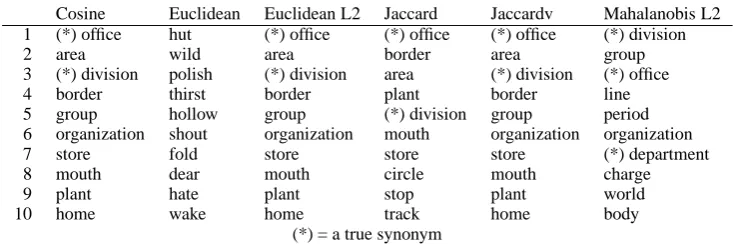
Table 2 shows the Top 10 Words for Query “branch”. The results for the Euclidean distance rank “hut” and other dissimilar words highly. This is because the norm of such vectors is small, and in a high dimensional space, the sparse vectors near the origin are relatively close to many other sparse vectors. To overcome this problem, we normal-ized the input vectors by the L2 normx′=x/||x|| This normalization enables the Euclidean distance to perform very much like the cosine similarity, since the Euclidean distance between points on a sphere acts like the angle between the vectors. Sur-prisingly, normalization by L2 did not affect other metrics all that much; while the performances of some metrics improved slightly, the L2 normaliza-tion lowered that of the Jaccardv metric.
Once we learned the normalization trick, the learned Mahalanobis distance consistently outper-formed all other metrics, including the ones with 10 times more features, in all three evaluation measures, achieving an APR of 18.66%, RKL of 545.09 and TOP1 of 45.455%.
6 Discussion
Metric APR RKL TOP1
Cosine 0.1184→0.1324 580.27→579.00 0.2987→0.3160 Euclidean 0.0229→0.0173 662.74→695.71 0.0173→0.0000 Euclidean L2 0.1182→0.1324 580.30→578.99 0.2943→0.3160 Jaccard 0.1120→0.1264 580.76→579.51 0.2684→0.2943 Jaccard L2 0.1113→0.1324 580.29→570.88 0.2640→0.2987 Jaccardv 0.1189→0.1318 580.50→580.19 0.3073→0.3030 Jaccardv L2 0.1184→0.1254 580.27→570.00 0.2987→0.3160 JS 0.0199→0.0170 681.97→700.53 0.0129→0.0000 JS L2 0.0229→0.0173 679.21→699.00 0.0303→0.0086 Manhattan 0.0181→0.0168 687.73→701.47 0.0043→0.0000 Manhattan L2 0.0185→0.0170 686.56→701.11 0.0043→0.0086 SD99 0.0324→0.1039 640.71→588.16 0.0173→0.2640 SD99 L2 0.0334→0.1117 633.32→586.78 0.0216→0.2900 Mahalanobis L2 0.1866 545.09 0.4545
Table 1: Evaluation of Various Metrics, as Number of Features Increase from 1,281 to 12,812
Cosine Euclidean Euclidean L2 Jaccard Jaccardv Mahalanobis L2 1 (*) office hut (*) office (*) office (*) office (*) division
2 area wild area border area group
3 (*) division polish (*) division area (*) division (*) office 4 border thirst border plant border line 5 group hollow group (*) division group period 6 organization shout organization mouth organization organization 7 store fold store store store (*) department 8 mouth dear mouth circle mouth charge
9 plant hate plant stop plant world
10 home wake home track home body
(*) = a true synonym
Table 2: Top 10 Words for Query “branch”
of words that “to” and “within”, take as an objects were clear from the corpus: “to” takes a person or place, “within” takes duration of time3. Other heavy features includes being the object of “write” or “about”. While not obvious, we postulate that having these words as a part of the context indi-cates that a word is an event of some type.
7 Conclusion
We applied metric learning to automatic synonym acquisition for the first time, and our experiments showed that the learned metric significantly out-performs existing similarity metrics. This outcome indicates that while we must resort to feature se-lection to apply metric learning, the performance gain from the supervised learning is enough to off-set the disadvantage and justify its usage in some applications. This leads us to think that a com-bination of the learned metric with unsupervised metrics with even more features may produces the best results. We also discussed interesting features found in the learned Mahalanobis matrix. Since
3Interestingly, we note that not all prepositions were as
heavy: “beyond” and “without” were relatively light among the diagonal elements. In the NYT corpus, the class of words they take was not as clear as, for example, “by”.
metric learning is known to boost clustering per-formance in a semi-supervised clustering setting, we believe these automatically identified features would be helpful in assigning a target word to a word class.
References
T. Briscoe, J. Carroll and R. Watson. 2006. The Sec-ond Release of the RASP System. Proc. of the
COL-ING/ACL 2006 Interactive Presentation Sessions,
77–80.
T. Briscoe, J. Carroll, J. Graham and A. Copestake, 2002. Relational evaluation schemes. Proc. of the
Beyond PARSEVAL Workshop at the Third Interna-tional Conference on Language Resources and Eval-uation, 4–8.
A. Budanitsky and G. Hirst. 2006. Evaluat-ing WordNet-based measures of semantic distance.
Computational Linguistics, 32(1):13–47.
R. Caruana, T. Jachims and L. Backstrom. 2004. KDD-Cup 2004: results and analysis ACM SIGKDD
Ex-plorations Newslatter, 6(2):95–108.
Annual International ACM SIGIR Conference on Re-search and Development in Information Retrieval,
77–88.
J. R. Curran and M. Moens. 2002. Improvements in automatic thesaurus extraction. In Workshop on Un-supervised Lexical Acquisition. Proc. of the ACL
SIGLEX, 231–238.
J. V. Davis and I. S. Dhillon. 2006. Differential En-tropic Clustering of Multivariate Gaussians. Ad-vances in Neural Information Processing Systems (NIPS).
J. V. Davis, B. Kulis, P. Jain, S. Sra and I. S. Dhillon. 2007. Information Theoretic Metric Learning. Proc.
of the International Conference on Machine Learn-ing (ICML).
A. Globerson and S. Roweis. 2005. Metric Learning by Collapsing Classes. Advances in Neural Information
Processing Systems (NIPS).
J. Goldberger, S. Roweis, G. Hinton and R. Salakhut-dinov. 2004. Neighbourhood Component Analysis.
Advances in Neural Information Processing Systems (NIPS).
G. Grefenstette. 1994. Explorations in Automatic The-suarus Discovery. Kluwer Academic Publisher.
M. Hagiwara, Y. Ogawa, and K. Toyama. 2008. Con-text Feature Selection for Distributional Similarity.
Proc. of IJCNLP-08, 553–560.
Z. Harris. 1985. Distributional Structure. Jerrold J. Katz (ed.) The Philosophy of Linguistics. Oxford University Press. 26–47.
T. Hastie and R. Tibshirani. 1996. Discriminant adap-tive nearest neighbor classification. Pattern Analysis
and Machine Intelligence, 18, 607–616.
D. Hindle. 1990. Noun classification from predicate-argument structures. Proc. of the ACL, 268–275.
J. J. Jiang and D. W. Conrath. 1997. Semantic sim-ilarity based on corpus statistics and lexical taxon-omy. Proceedings of International Conference on
Research on Computational Linguistics (ROCLING X), Taiwan.
Y. Jing and B. Croft. 1994. An Association The-saurus for Information Retrieval. Proc. of Recherche
d’Informations Assist´ee par Ordinateur (RIAO),
146–160.
D. Lin. 1998. Automatic retrieval and clustering of similar words. Proc. of COLING/ACL 1998, 786– 774.
L. Lee. 1999. Measures of distributional similarity.
Proc. of the ACL, 23–32
L. Lee. 2001. On the Effectiveness of the Skew Diver-gence for Statistical Language Analysis. Artificial
Intelligence and Statistics 2001, 65–72.
S. Mohammad and G. Hirst. 2006. Distributional mea-sures of concept-distance: A task-oriented evalua-tion. Proceedings of the Conference on Empirical
Methods in Natural Language Processing (EMNLP),
Sydney, Australia.
P. Resnik. 1995. Using information content to evaluate semantic similarity. Proceedings of the 14th
Inter-national Joint Conference on Artificial Intelligence (IJCAI-95), 448–453, Montreal, Canada.
G. Ruge. 1997. Automatic detection of thesaurus re-lations for information retrieval applications.
Foundations of Computer Science: Potential Theory -Cognition, LNCS, Volume 1337, 499–506, Springer
Verlag, Berlin, Germany.
S. Shalev-Shwartz, Y. Singer and A. Y. Ng. 2004. On-line and Batch Learning of Pseudo-Metrics. Proc. of
the International Conference on Machine Learning (ICML).
M. Schutz and T. Joachims. 2003. Learning a Dis-tance Metric from Relative Comparisons. Advances
in Neural Information Processing Systems (NIPS)..
J. Weeds, D. Weir and D. McCarthy. 2004. Character-ising Measures of Lexical Distributional Similarity.
Proc. of COLING 2004, 1015–1021.
K. Q. Weinberger, J. Blitzer and L. K. Saul. 2005. Distance Metric Learning for Large Margin Nearest Neighbor Classification. Advances in Neural
Infor-mation Processing Systems (NIPS).
E. P. Xing, A. Y. Ng, M. Jordan and S. Russell 2002. Distance metric learning with application to cluster-ing with sideinformation. Advances in Neural
Infor-mation Processing Systems (NIPS).
Y. Yang and J. O. Pedersen. 1997. A Comparative Study on Feature Selection in Text Categorization.