L
A u t o m a t i c M e s s a g e I n d e x i n g and Full T e x t R e t r i e v a l for a
C o m m u n i c a t i o n A i d
Stefan Langer
Applied Computing
University of Dundee
Dundee, Scotland
slanger@mic, dundee, ac. ukMarianne Hickey
Applied Computing
University of Dundee
Dundee, Scotland
mhickey@mic, dundee, ac. ukAbstract
T h e aim of the WordKeys project is to enhance a communication aid with tech- niques based on research in text retrieval, in order to reduce the cognitive load nor- mally associated with retrieving pre-stored messages in augmentative and alternative communication (AAC) systems. In this paper, the differences between traditional information retrieval and the requirements for text retrieval in a communication aid are highlighted. We then present the over- all design of the retrieval based communi- cation aid, and describe the morphological analysis module used for indexing and the ranking algorithm in more detail. T h e sys- tem relies on a large lexicon for the auto- matic indexing of messages and for seman- tic query expansion. The lexicon is derived from the WordNet database and addition- ally includes frequency information. Cur- rently, user trials are being carried out to determine the suitability of the approach for AAC.
1 M e s s a g e r e t r i e v a l f o r a n A A C s y s t e m
Currently, there exist different types of communica- tion aids for non-speaking people. Among the sys- tems using natural language, we distinguish two dif- ferent approaches. T h e communication strategy can be based on enhanced message composition, or the user can rely on a set of pre-stored messages, to- gether with a selection procedure. It is the latter type of communication aid t h a t will be discussed further here.
A principal deficiency of the current generation of communication aids is the low rate of communica- tion which can be achieved by users. Rates of be-
tween 2 and 25 words per minute are typical, which compares poorly to natural speech rates of 150 to 175 words per minute (Foulds, 1980); (Darragh and Wit- ten, 1992). T h e low communication rate does not en- courage either the user of an aid to create messages or a communication p a r t n e r to maintain attention (Aim et al, 1993). For message selection systems, the low communication rate is partially caused by the fact t h a t many systems rely on retrieval meth- ods t h a t put a high cognitive load on the user. In most systems, the user must remember an access route, or in some cases a code, in order to speak a message. T h e load placed on the user means t h a t he or she is only able to select from a small number of different things to say.
T h e reduction of the necessary user input to pro- duce an utterance and the minimization of the cogni- tive the load on the user in a message-based commu- nication aid can be achieved through efficient mes- sage access. A novel approach to reach this is the use of full text retrieval to access a message database. C o n t r a r y to most existing message based system, in an AAC system based on text retrieval, in order to select a message, the users do not have to remember any message numbers or a n o t h e r code. T h e y can select a conversational item from the database by entering one or several key words. Appropriate mes- sages will be those containing these words or words related to the key words (Hickey and Page, 1993);
(Hickey, 1995).
siderably to be applicable to the messages commu- nicated by AAC users, which typically contain not more than 20 words. In addition to the difference in length of the messages to be accessed, there is an- other constraint that affects communication aids to a much higher degree than standard text retrieval sys- tems - - the minimal input requirement. In standard text retrieval, queries of 5-10 words are regarded as short queries (Hearst, 1996)..This is different for a communication aid. Users of these devices typically have a very low typing rate, and it is desirable that any message from the message database can be re- trieved by only one key word, without the need for query refinement.
The state of the art and the named special re- quirement for a retrieval module in an AAC device suggest the use of enhanced full text retrieval us- ing semantic expansion of queries. A system based on a query expansion technique has the capability of finding messages that contain words that are se- mantically related to the query words in addition to the messages that contain the query words them- selves. Semantic query expansion is especially suited for communication aids, where minimal input and high recall are the key factors. Research in text re- trieval has shown that it looks promising to further investigate the use of electronic semantic lexicons both for query expansion and in order to overcome problems of word sense ambiguity (Richardson and Smeaton, 1995). Especially relating to short text, research on image caption retrieval has shown that the recall rate can be considerably higher, if suitable methods of calculating semantic distances between query words and message words are used (Smeaton and Quigley, 1996); (Guglielmo and Rowe, 1996). The measurement of semantic distance can be based on semantic relationship between words. The rela- tionship encoded in many dictionaries and thesauri is synonymy, and often some hypernyms are also included. Both kind of links are relevant for mes- sage retrieval. It has been shown that apart from • synonyms, which have been used for query expan- sions for decades, hyponymic links should be con- sidered for text retrieval purposes (Richardson and Smeaton, 1995). The usefulness of hyponymic links has also been evaluated for WordKeys (Langer and Hickey, in preparation). The usefulness of other links, such as meronymy, has yet to be confirmed.
For semantic query expansion through semanti- cally related words, a comprehensive electronic dic- tionary containing extensive semantic information is needed. Research in electronic lexicography has been very intense during the last years, and many large dictionaries are being built for different lan-
guages. Few of those dictionaries, however, are pub- licly available; and few of those available are suit- able for retrieval of unrestricted text. The semantic database WordNet (Miller et al, 1990) has already been successfully used for information retrieval pur- poses (Richardson and Smeaton, 1995); (Smeaton and Quigley, 1996), and has also been a source for the design of another lexical database for AAC sys- tems, which, like the lexicon used for WordKeys, in- cluded additional frequency information (Zickus et al, 1995). The size and coverage of WordNet led to the decision to base the indexing module and the semantic expansion in the WordKeys system on this lexical database.
2 T h e W o r d K e y s s y s t e m
WordKeys is a system based on full text retrieval of pre-stored messages. It is typically used in two different settings:
• When the user wants to prepare a communica- tion, new messages are typed in. These mes- sages are automatically indexed and integrated in the system's database.
• In communication mode, WordKeys displays the search field, where the user can type in search words, the list of predicted input words, the list of messages found and the field contain- ing the selected message.
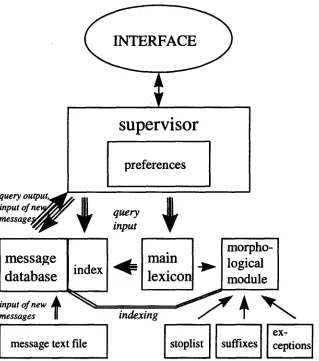
Figure 1 demonstrates the overall architecture of the WordKeys system.
WordKeys is implemented in C + + . There is strong emphasis of re-usability of the software, espe- cially the lexicon modules, for other AAC-systems. We have also taken care to provide the possibility of porting the system to languages other than English. The different lexicons are text files and correspond to a simple and clearly specified format. They can be exchanged for lexicons in other languages.
3 I n d e x i n g , m o r p h o l o g i c a l a n a l y s i s
a n d
m e s s a g e r a n k i n g3.1 Indexing
The WordKeys system offers the possibility of im- porting any text file to add it to the message database. Additionally, at any stage of a conver- sation, the user can add a message to the database or modify an existing message. When a message is added to the database, the following actions are per- formed:
supervisor
preferences
input
of
neyj~ ~"
messag
e~,~
inputqUe
ry
.
[ morpho-
message I ;,.,4or ] ~
mmn
~ I logical
database ~
~ - lexicon - J module
inputofnew~ ~
Z
~ %
messages
indexing
[ message text file
[
[ stoplist [ [ suffixes [ :eX;tions[
Figure 1: Overall organisation of the WordKeys system
• Morphological analysis: word forms are anal-
ysed to find lemmas and roots and to determine
their syntactic category;
• The resulting words are looked up in the seman-
tic lexicon to find frequent hypernyms which are
added to the list of index words;
• The message with the list of index words is
added to the database and its index.
3.2
M o r p h o l o g i c a l analysis
Morphological analysers are available in the public
domain. However, we decided to use a custom pro-
grammed morphological module, because the output
of the available analysers did not correspond to our
needs, and, at least for English, a simple analysis
is relatively easy to implement. The data used for
analysis is partially based on the WordNet morpho-
logical information. The morphological module uses
an affix list in combination with an exception list
and the information about syntactic categories from
WordNet. The analysis of a word form is carried out
in two steps:
• lemmatization;
• determination of the derivational root (only for
semantically transparent derivation affixes).
[image:3.596.137.456.99.460.2]to several possible lemmas are currently not disam- biguated. Apart from the lack of disambiguation, we achieved an error-free lemmatisation of all occurring word forms for a trial message database of about 1200 words.
After the lemmatization procedure, a derivational analysis is carried out on the lemmatized word forms. We separate the two steps in order to be able to give the link between a word form and the lemma a higher weight in message access t h a n links between morphologically complex words and their roots. T h e procedure of distinguishing between the results of in- flectional and derivational analysis is consistent with the findings reported in Hull (1996). He concludes t h a t complex stemming algorithms can be slightly more effective t h a n simple ones, and t h a t the re- moval of derivational affixes is not always desirable. This is especially true for a system such as Word- Keys, which uses semantic relationship for retrieval and performs message ranking, which can increase the impact of inaccuracies in the morphological anal- ysis. Semantic relations between a lemma and some word form on the one hand differs considerably from the semantic relations between derived words and their root.
To be able to determine semantically related words without loss of precision, information from the morphological analysis is also used to determine the morpho-syntactic categories of word forms and lem- mas. T h e category can be clearly determined in the following cases:
• a word has one single entry in the main lexicon, which means the word is already a lemma;
• a word form has an inflectional or derivational affix which only occurs with bases of one single morpho-syntactic category.
Removing ambiguities concerning syntactic cate- gories has a certain impact on the performance of the semantic expansion module. T h e less words • with inappropriate syntactic categories are included in the index, the higher precision will be achieved by the system, because less expansions will be gen- erated. For many word forms in the messages, how- ever, the category remains ambiguous. Currently, we are investigating the use stochastic taggers and local grammars for determining syntactic informa- tion in these cases.
3.3 Message ranking
When the user has t y p e d in one or several key words and decides to start the search the following tasks are carried out:
• Tokenization: the content of the input field on the interface is parsed into word forms.
• Lemmatization: word forms are analysed to be able to look them up in the lexicon.
• T h e word forms and lemmas are looked up in the message index. If they are found, the cor- responding message numbers are added to the list of retrieved messages.
• T h e lemmas are looked up in the semantic lex- icon to retrieve related words. T h e relations used for query expansion are dependent on the semantic paths defined in the settings. T h e re- lated words are re-applied for another query to the index of the message database.
T h e messages which have been found are displayed on the screen, the order corresponds to their score.
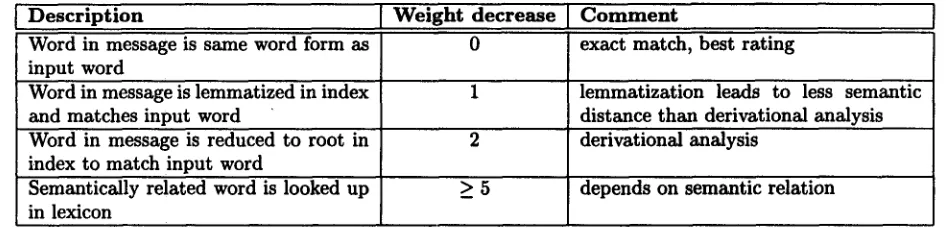
Trials with a number of different settings for the message retrieval algorithm have been carried out to improve message ranking. T h e ranking algorithm as- sures t h a t messages which are retrieved, but are not considered very relevant for a query, are put lower in the list or excluded from the display. Conforming to the results of the trials, messages retrieved from the database are ranked according to the criterion of semantic distance between key word and index word. Semantic distance is zero in the beginning of the following list and increases:
• same word form;
• different word form from the key word form (cars - - car);
• other derivation of the root of the key word (in- v e s t i g a t i o n - investigate);
• synonyms of key word (car - - automobile);
• other related words: the semantic paths and their weighting are defined in the settings file. A p a t h is the concatenation of semantic links t h a t are used to get from the input key word to the index word.
Description Weight decrease C o m m e n t
Word in message is same word form as 0 exact match, best rating input word
Word in message is lemmatized in index 1 lemmatization leads to less semantic
and matches input word distance than derivational analysis
Word in message is reduced to root in 2 derivational analysis index to match input word
Semantically related word is looked up > 5 depends on semantic relation in lexicon
Table 1: Value determination for message ranking
We will illustrate the message ranking with an ex- ample. The messages retrieved from an experimen- tal database for the item swim are (in that order):
(1) Would you like to go ]or a swim?
(2) Normally I don't like swimming, but this Sunday it was so hot that I spent the whole day on the
beach and in the water.
(3) I ' m not a very good swimmer.
(4) Shall we go for a dip ?
The first message contains the key word itself; message (2) contains another word form of the same lemma. The third message in the list contains a derivation of the key word. Finally, message (4) is an example of retrieval through semantic query expansion. It contains a synonym (dip) of the key word.
3.4 T h e lexicon for q u e r y e x p a n s i o n
One purpose of the main lexicon in WordKeys is to serve as a lexical database for the indexing module when performing morphological analysis. The main function of this lexicon, however, is to serve as a basis for the semantic query expansion. To choose the right lexicon, we had to bear in mind that Word- Keys is a retrieval system for unrestricted text. This implies that the system is able to retrieve messages containing any word of the English language apart from extremely domain specific vocabulary.
We decided to use the semantic database WordNet for the following reasons:
• it is very comprehensive;
• it contains most relevant semantic links;
• the information contained in WordNet is stored in text files, and can be easily converted to any other format.
In order to use the information in WordNet for our text retrieval algorithm, some preparation was needed.
• WordNet was converted to a format suitable for the WordKeys software. We chose a format which was easily portable: a text file containing lemmas together with their syntactic category and related words corresponding to the differ- ent senses;
• The semantic paths that the WordKeys soft- ware uses for query expansion were defined. A semantic path is a series of semantic relations which can be used to reach a lemmatised mes- sage word from a lemmatised input key word. This also involved defining weights for the links in order to rank retrieved messages. For exam- ple, messages containing synonyms of key words receive a high rating, those containing hyper- nyms are assigned a lower rating.
Additionally we included statistics over word fre- quencies in the main lexicon, in order to be able to retrieve hypernyms of words that are useful as index words - these are not necessarily the closest superor- dinated words in the WordNet hierarchy, but ofte.n words occurring several levels higher.
Consequently, in each lexicon entry the following information is stored:
Syntactic category of word, which is used for morphological analysis and semantic links.
[image:5.596.50.525.83.197.2]Links to other words in the lexicon, and speci- fication of the type of link (synonym, hyponym etc.).
4
E v a l u a t i o n
Formal evaluation of the performance of the se- mantic retrieval modules is reported in Langer and Hickey (in preparation). The purpose of the evalu- ation was to look at the benefits of semantic expan- sion in terms of retrieval success. These trials have shown, that the semantic expansion enhances re- call rate considerably without having a major effect on precision. A further improvement was achieved by including frequency information in the lexicon. The evaluation results for the frequency counting lexicon were considerably better than those for the first lexicon derived from WordNet without includ- ing frequencies. The frequency counts can be used to determine frequent hyponyms and hyperonyms of index terms, even if they are rather distant in the hyponymic hierarchy, because the method al- lows the elimination of intermediate level terms that are not interesting for query expansion. Taking into account this information resulted in a higher recall rate, without a major detoriation in precision. For a small, experimental database, 80% of the target messages were correctly retrieved (compared with about 70% with the first lexicon and 50% without query expansion).
Currently we have started the second evaluation phase. A non-speaking person who has already had experience with message based systems for sev- eral years, and who uses a relatively large pool of pre-stored messages, is evaluating WordKeys in real communication settings. The main purpose of this study is to investigate the following points:
• How high is the recall rate in real communica- tion settings?
• How useful is the semantic expansion module, i.e. how often does it play a crucial role for successful retrieval?
Apart from these more technical points, the inter- face and ease of use will also be a evaluated.
5
C o n c l u s i o n s
We have detailed the reasons which lead to the de- sign of a communication aid for non-speakers based on ideas from text retrieval with semantic expan- sion, and we demonstrated the overall design of the prototype. The main differences between standard information retrieval and text retrieval for an AAC
system were presented, namely the size and type of texts retrieved by the system and the necessity to minimize the cognitive load, which leads to the min- imal input requirement. In the detailed system de- scription, we have shown that a precise morpholog- ical analysis can be achieved - - at least for English - - with relatively low effort, ff we use data from pub- licly available resources. The morphological module is indispensable to be able to enhance the system with a query expansion algorithm, which is needed to satisfy the minimal input requirement for com- munication aids.
Several ideas for improving the text retrieval al- gorithms and WordKeys and their inclusion in other communication aids are still waiting to be realised. One idea is to use a semantic lexicon that is able to learn from the input. This would mean that success- ful semantic links will get a higher weight than other ones. New links could be added based on knowledge of the user's message selections. Interactions where initial search words do not retrieve relevant messages could be recorded.
A further aim is the integration of the retrieval module with other AAC systems. WordKeys is not designed to assist all kinds of communication. In- tegration with other AAC software should be inves- tigated, such as software designed for unique text entry (word prediction systems) and for the rapid use of quick conversational fillers.
A c k n o w l e d g e m e n t s
The current phase of the WordKeys project is funded through a European H C M / T M R fellowship for 20 months (January 1996 - September 1997). Evalua- tion equipment has been purchased with a donation from the Anonymous Charitable Trust.
R e f e r e n c e s
Aim N., Murray I.R., Arnott J. and Newell A.F. 1993. Pragmatics and affect in a communication system for non-speakers. Journal of the Ameri- can Voice I / 0 Society. Special Issue: People with disabilities, March 1993, pp. 1-15.
Darragh J. and Witten I. 1992. The Reactive Key- board. Cambridge. Cambridge University Press.
Foulds R. 1980. Communication rates for non- speech expression as a function of manual tasks and linguistic constraints. In Proceedings of the International Conference on Rehabilitation Engi- neering, Toronto, RESNA, pp. 83-87.
captions. A CM Transactions on Information Sys- tems, 14, 3 (July 1996), pp. 237-267.
Hearst M. 1996. Improving Full-Text Preci-
sion on Short Queries using Simple Constraints.
In Proceedings of the Fifth Annual Symposium on Document Analysis and Information Retrieval (SDAIR), Las Vegas, April 1996.
Hickey M. 1995. Communication enhancement in an aid for severely disabled people. PhD Thesis. Coventry University.
Hickey M. and Page C. J. 1993. Polyvox: Flexible message selection in a communication prosthesis
for non-speakers. In Proceedings of the 2nd Euro-
pean Conference on the Advancement of Rehabili- tation Technology, May 26 - 28, 1993, Stockholm, Sweden, Section 11.3, pp. 89 - 91.
Hull D. 1996. Stemming Algorithms: A Case Study
for Detailed Evaluation. Journal of the American
Society for Information Science, vol 47, Number 1 (January), pp 70-84:
Langer S. and Hickey M. in preparation. Using Se- mantic Lexicons for Intelligent Message Retrieval
in a Communication Aid. Submitted to Journal
of Natural Language Engineering, special issue on Natural Language Processing for Communication Aids.
Miller G. A. et al. 1990. Wordnet: An on-line lexical
database. International Journal of Lexicography,
3(4).
Richardson R. and Smeaton A. 1995. Using Word- Net in a Knowledge-Based Approach to Informa- tion Retrieval. Working paper CA-0395, School of Computer Applications, Trinity College Dublin.
Smeaton A. and Quigley I. 1996. Experiments on Using Semantic Distances between Words in Im-
age Caption Retrieval. In Proceedings of the 19th
International Conference on Research and Devel- opment in Information Retrieval, Zfirich, pp. 174- 180.
Zickus, W. M., K. F. McCoy, P. W. Demasco and Pennington C.A. 1995. A lexical database for
intelligent AAC systems. In Proceedings of the