Clustering Co-occurrence Graph based on Transitivity
K,,mlko T A N A K A - I s h i i Electrotechnical Laboratory
1-1-4 Umezono, Tsukuba~ Ibaragi 305 JAPAN. klmiko~etl, go. jp
H i d e y a I W A S A K I
Tokyo Univ. of Agriculture and Technology 2-24-16 Naka-cho, Koganei, Tol~'o 184 JAPA.N.
iwasaki@ipl, el. r u n t . ac. jp
A b s t r a c t
Word co-occurrences form a graph, regarding words as nodes and co-occurrence relations as branches. Thus, a co-occurrence graph can be constructed by co-occurrence relations in a cor- pus. This paper discusses a clustering m e t h o d of the co-occurrence graph, the decomposition of the graph, from a graph-theoretical view- point. Since one of the applications for the clustering results is the ambiguity resolution, each output cluster is expected to have no am- biguity and be specialized in a single topic. We observed t h a t a graph has no ambiguity if its branches representing co-occurrence relations are transitive. A n algorithm to extract such graphs are proposed and its uniqueness of the output is discussed. The effectiveness of our m e t h o d is examined by an experiment using co-occurrence graph obtained from a 30M bytes corpus.
1 I n t r o d u c t i o n
Clustering is t h e operation to group words by some criterion. Thesauri and synonym dictio- naries are some of its manual examples. Auto- matic outputs can be used not only to revise them, but also to aid ambiguity resolution, an essential problem in natural language process- ing. For instance, the m e ~ i n g of an ambiguous word can be decided by
e.xamln'i~g
the d u s t e r it belongs to. Furthermore, clusters grouped ac- cording to topics have m a n y application areas such as automatic document classification. The input in this paper is the word co-occurrence graph obta~ued from corpus. The output is itssubgraphs with the condition that each sub- graph is specialized in a topic.
Many automatic clustering methods have been already proposed. Most of them are based on the statistical similarity between two words. Our approach is different; it is graph theoreti- cal. We tried to find out the special structure in linguistic graph.
Having a huge co-occurrence graph obtained from a corpus, we first tried to decompose it to analyze its graph structure using graph theoretical tools, such as maximum strongly connected components, or biconnected compo- nents. Although both tools decompose a graph into tightly connected subgraphs, these trials resulted in vain. The question arose; what must be taken into account to decompose the co- occurrence graph. 7 The answer is the ambigu- ity. Furthermore, we reached to the conclusion that the ambiguity can be explained in terms of intransitivity. This feature is developed into an algorithm for clustering.
This paper is organized as follows. The fol- lowing chapter describes the relationship be- tween the transitivity in the graph and the ambiguity resolution. Chapter 3 shows the re- lationships between clustering and transitivity. Chapter 4 proposes and discusses an algorithm for clustering. Related work is resumed in Chapter 5. Our method is examined in Chap- ter 6 by some experiments.
2 W o r d A m b i g u i t y a n d T r a n s i t i v i t y Two words are said to co-occur when they fre- quently appear close to each other within texts. Regarding words as nodes and co-occurring re-
latious as branches, a graph can be constructed from a given corpus. We define such a graph as c o - o c c u r r e n c e g r a p h .
W h e n a portion of a corpus specializes in a topic, we can sti]l extract a co-occurrence graph from the portion. A general corpus, such as newspaper corpus, contains many corpus por- tious, each specializing in one topic. Therefore, the whole co-occurrence graph obtained from a general corpus cont~.in.q subgraphs, each spe- cializing in one topic. Our question is to extract such subgraphs of topics from a co-occurrence graph.
We denote V as the set of nodes (words), E as the set of branches (co-occurrence relations), G = < V, E ~ as an input graph and I1/"1 as the number of nodes. English words referred as examples will b e w~itten in this font.
2.1 T r A n s i t i v i t y i n C o - o c c u r r e n c e R e l a - t i o n
The most basic mathematical laws discussed about relations between elements in a set are reflective, symmetric and transitive laws. Hav- ing a, b, c E V and R as a relation, they can be described as follows:
R e f l e c t i v e aRa.
S y m m e t r i c a R b ~ b R a . T r a n s i t i v e aRb, bRc ~ a r c .
Let V be word set and R be co-occurrence re- lation. W h e n each property holds for .EL, words a, b and c can be explained as follows from the linguistic viewpoint:
Reflective W o r d a co-occurs with itself. S y m m e t r i c Co-occurrence relation does not
depend on the occurrence order.
Transitive W o r d b does not have two-sided meanings (ambiguity). For instance, doc- tor, which has both medical and academic meanings, co-occurs with nurse within a medical topic, and co-occurs with professor within an academic topic. However, nurse and professor do not co-occur, so the tran- sitivity between nurse: doctor and professor does not hold.
!
I
G @ a C
b
a c a c
'
db
%
-
i |
(5) d (6) e d
c c c
b b b
(7) a d (8) d
c @ c
O. = ~ . . = m O
[image:2.612.354.543.86.323.2]~clmr branch duplicate brm-tch
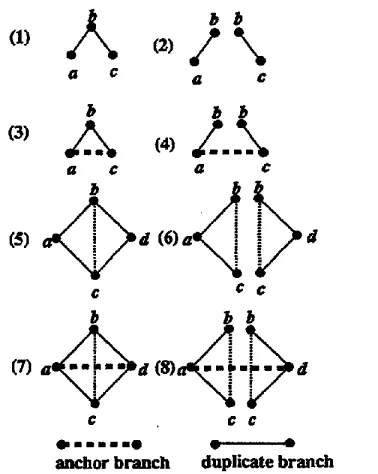
Figure 1: Graph Decomposition
Our request is to extract subgraphs each of which focuses on one topic with no ambiguity. Therefore, we perform clustering by extracting subgraphs whose branches form transitive co- occurrence relations.
3
TrAnsitivity
a n d C l u s t e r i n g
3 . 1 D e c o m p o s i t i o n a n d D u p l i c a t i o n
The simplest case is a graph of three nodes. Figure 1-(1) is a graph in which the transitivity does not hold. For example, when b is doctor, a is nurse a n d c is professor, nurse and professor do not co-occur due to the node b's two-sided meanings. Therefore, as in Figure 1-(2), we "duplicate" b so t h a t each duplicated node cor- responds only to a single me~in,~. Then the ambiguity within b is resolved and the entire graph is divided into two subgraphs, the aca- demic one and the medical one. To sum up, when the transitivity does not hold, a graph can b e decomposed b y duplicating the ambigu- ous node.
I
graph cannot be decomposed by duplication
of
I
b (Figure I-(4)). This can be explained that
2"~::'"
T
the graph does not have the ambiguity. (1) . = . ~ . . q . g ~ m ~ . u m m m * (2) m ~ t t t : ~ m ~ We extend the above into the case of four ' ' " ~ - "
i nodes(Figure 1-(5)). Here, transitivity does not •
hold in a-b-d because there is no branch be- b b
tween a-d. When b--c is duplicated, the graph ~
I
can be decomposed into
two subgraphs (Figure
(3) a
d (4)a
d
i-(6))
in which the transitivity
holds On the
contrary, Figure 1-(7) c~not be decomposed
c
cby duplicating b-c due to the branch a-d (Fig- ure 1-(8)); this shows t h a t b-c is not ambigu- ous. Note t h a t Figure 1-(7) is a complete graph of 4 nodes. We deYme d u p l i c a t e b r a n c h as a branch to be duplicated for graph decomposi- tion (such as b-c) and a n c h o r b r a n c h as a branch which i~hlbit graph decomposition by duplication (such as a-d).
In general, when a graph could not be sep- arated by duplicating its subgraph, then the subgraph is regarded not to have ambiguity. Therefore, ideal clustering is to decompose graphs into subgraphs which cannot be decom- posed further by duplication. Unfortunately, this constraint is too strict because such a graph is restricted to a complete graph. In addition, extracting complete graphs withln a given graph is NP-complete. Therefore we dis- cuss in the following how to loosen the con- straint.
3.2 T r a n s i t i v e G r a p h
There are two methods to loosen the con- straint.
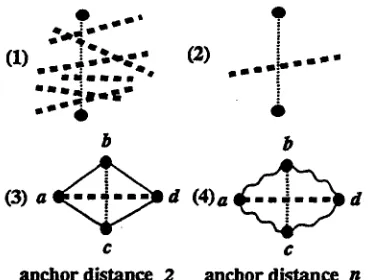
The first is to decrease the nllmber of anchor branches. In the complete graph of more t h a n 5 nodes, several anchor branches exist for each duplicate branch (Figure 2-(1)). However, only one anchor branch is sufficient to inhibit the decomposition. The less the number of anchor branch is, the looser the constraint is.
This intuitively corresponds to loosen t h e sharpness of the focus of the topic in the re- sulting cluster. For instance, two words pneu- monia and cancer do not always co-occur, but they do co-occur with words as doctor, nurse
and hospital forming the core of medical topics.
anchor distance 2 anchor distance n
Figure 2: Loose Constraint for Graph Decom- position
Pneumonia will be included into a cluster if it is connected with these three words even if it is not connected with cancer. If cancer is also connected with these three words, both cancer and pneumonia, the different subtopical words within a medical topic are included in a cluster. The second is to loosen the transitivity itself. It was defined in Section 2.1 within three nodes. We may prepare a loose transitivity as follows:
VlJ~:~21 - ' . , ~n_l~:~Vn ---> ~ l _ ~ n
We define a n c h o r d i s t a n c e as the maximum distance of the minimum distances of a--b-d and a-c--d. For example, when minimum distance of a-b-d is 4 and that of a - c - d is 6 then the anchor distance is 6. The tightest constraint is when anchor distance is 2 as in Figure 2- (3). This also blurs the topic focus of a cluster. In the example of pneumonia, the word will be included if it is connected directly with at least
one of the words among
doctor, hospital,
nurse,and cancer, and connected indirectly w i t h the
others.
For m , n <
IVI-
1, G is called ( m , n ) -t r a n s i t i v e g r a p h when
for all e E E, there ave m anchor branches e t E E of anchor distance _<n.
(m, n)-transitive graphs can be extracted as the subgraphs of the input graph. Figure 3 shows a map of (m,n)-transitive graphs. The axis of ordinates describes the number of an- chor branches (m). The axis of abscissas de-
[image:3.612.340.524.86.226.2]. °
tlght constraint = > I o e s e
loose
2 -
fight 3 -
4 -
• I V I . I -
2 4
I -1
! o
- ~ G S 1 ... G 5 2
$
i
---~SO...¢om pier e graph
number of anchor branches m
Figure 3: (m, n)-Transitive Graph
scribes the anchor distance (n). The constraint is loose when m is small and n is large. For the same input, ( m l , n ) - t r a n s i t i v e graphs are in- cluded in (m2, n)-transitive graphs when m l < m2, and (m, n l ) - t r a n s i t i v e graphs are included in (m, n2)-transitive graphs when n2 < hi.
GS2
in Figure 3 is the clusters obtained un- der the loosest constraint: m is the m a x i m u m and n is the ~ n i ~ u m . In GS2, all ambiguity of a branch and nodes at its ends are resolved. G $ O are the transitive graphs of the tightest constraint. All transitive graphs on the hori- zontal line including G $ O are complete.4 E x t r a c t i o n o f T r a n s i t i v e G r a p h s So far, we did not explain how to detect the duplicate and anchor branches, given a graph. A n algorithm for clustering can be top-down or bottom-up. The former gives clusters by de- composing the input graph by detecting dupli- cate branches.
Although we have explained our clustering m e t h o d top-down up to now, we propose our clustering m e t h o d as bottom-up. We obtain clusters by accumulating adjacent nodes so t h a t every branch has anchor branches and the resulting clusters include no duplicate branch. Thus, in the bottom-up method, we need no~ detect duplicate branches. This is convenient,
because the condition for anchor and dupli- cate branches is denoted by local relationships among nodes.
The branches in the input graph are assumed to be all symmetric. In this section, we use terms c l u s t e r s as our output and s u b g r a p h s as their candidates.
4.1 D e f i n i t i o n o f C l u s t e r s
We extract
GS1,
the (1, 2)-transitive graph. A subgraph A including a branch e in the input graph can be extracted as follows: S t e p 1. Put a triangle graph including e intoA.
S t e p 2. Take a branch e ~ in A and a node v which makes a triangle with e t (Figure 4). If the following condition is satisfied, put v into A.
There exists a node v t E G
(in-
put
graph) whose distance from e ~ is 1, and it is connected to v with a branch. Here, the branch J-~v is the anchor branch so t h a t e t is hindered to be the duplicate branch in the resulting cluster. Additionally, put every branch between v" E G and v into A.S t e p 3. Repeat Step 2 until A c~nnot be ex- tended.
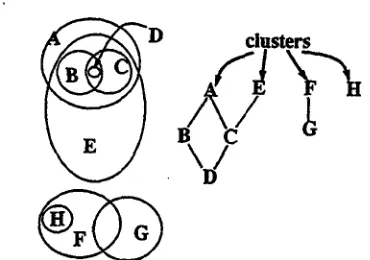
Performing the above procedure starting from every branch in the input graph, we obtain many subgraphs. Considering the inclusion relation between subgraphs, t h e y constitute a partial order (Figure 5). We define clusters as maximal subgraphs in this partial order chain. They are subgraphs not included in any other subgraphs. The uniqueness of the clusters for an input is self-evident.
4.2 A l g o r i t h m f o r C l u s t e r i n g
In the previous section, the procedure to obtain subgraphs should begin from every branch in the input. However, it is su~cient to calculate as follows.
S t e p O. i -- 0
I
I
il
i
I
I
l
I
I
!
I
I
I
a
Y
Figure 4: Extraction of (1,2)-Transitive Graph
~
D
cl/~~ste~
Figure 5: Subgrapl~ and their Partial Order
S t e p 1. Choose a branch e E G not included in G o , " ' , Gi-1. If no e is found, go to Step 5. Gi --- < 0,0 >. Put a triangle graph including e into Gi.
S t e p 2 a n d 3. Extend Gi using Step 2 and 3 of the previous section
S t e p 4. Set
i -
i q- 1 and goto Step 1.S t e p 5. Examine every pair of subgraphs (A, B), a n d i f A includes B, then drop B. The remaining subgraphs are defined as clus- ters.
A maximal subgraph c ~ o t be missed. Its starting branch is encountered without fail in the above algorithm. If it is encountered as the starting branch in Step 1, the maximal sub- graph is obtained. If it is captured into a sub- graph and becomes e ~ in Step 2, the subgraph extends to the size of maximal subgraph; if it gets larger, the subgraph contradicts being maximal as the result of the last section.
The algorithm halts since the input graph is finite, and the output is unique for an input.
5 Related Work
[Li and Abe, 1996] compared clustering meth- ods proposed so far [Hindle, 1990] [Brown et ¢1., 1 9 9 2 ] [Pereira et al., 1993] [Tokunaga et el., 1995][Li and Abe, 199@
Most of them are so-called hard ch~tering:
each word is included only in one cluster. We do not follow the trend, from the sense that our objective is the extraction of clusters of topics. It is natural that an ambiguous word should be included in different clusters.
[Pereira et ¢l., 1993] adopts sof~ clustering.
They measured co-occurrence between nouns and verbs, and clustered nouns of the same dis- tribution of verbs.
[Fukumoto and Tsujii, 1994]'s
work has common motivation with us: the am- biguity should be resolved for clustering. They clustered verbs using the gravity of multivari- ate analysis.
[Sugihara, 1995]'s approach has a common point in that it focuses on graph structure for clustering and tries to structurize the input graph, a bipartite graph of words and concepts (such as food, fruit etc.). His clustering method is so called Dlllrnage-Mendelsohn decomposi- tion in graph theory. The output naturally gives a partial order of clusters which can be compared with conventional thesauri.
Our input is not bipartite. In the begin- ning, we tried to decompose input graph into maximum strongly connected components to obtain graphs of topics from the observation that nodes in a cycles are strongly related 1. However, subgraphs about different topics is merged into the same cluster by two ambiguous words which bridge these two subgraphs(Figure 6). Next, we observed that articulation nodes are ambiguous, so we performed decomposi- tion into biconnected components. In this case when several biconnected components are con- nected in a ring, articulation nodes could not be detected (Figure 7). The observation that there are no co-occurrence relationship between
X[Tokunagaaud Tanaka, 1990] discusses on extrac- tion of cycles formed by trauslation relations fzom bilin-
gual dictionary.
[image:5.612.96.281.241.371.2]Figure 6: Problematic ~Structure in MSCC Clustering
•
mblguous wordclusters of dffferem toph:s
Figure 7: Problematic Structure in Bicon- nected Component Clustering
two biconnected graph across the articulation node was the start point of this paper.
6 E x p e r i m e n t s
6.1 P r o c e d u r e o f C l u s t e r i n g
First, we make the input graph from a 30M bytes of Wall Street Journal. Co-occurrences of n o ~ s and verbs are extracted by a morpho- logical analyzer. We defined that a word co- occurs with 5 words ahead of the word within a sentence. Co-occurrence degree is measured by m u t u a l information[Church and Hanks, 1990]. We set a certain threshold to the values to ex- t r a c t the input graph.
The number of resulting clusters depends on the input graph as follows:
1 One huge connected subgraph. 2 Several medium sized subgraphs. 3 Many small sized subgraphs.
W h e n the threshold value is too high, the out- p u t is 3. On the contrary, when it is too low, then the o u t p u t becomes 1. Both 1 and 3 are
I
I
N u m b e r of dusters of size more t h a n 7
40
i
30
I
20
I
10
1 r
t - , I ,
.Thresh°Id
~1
1 2 s 4 s s ~
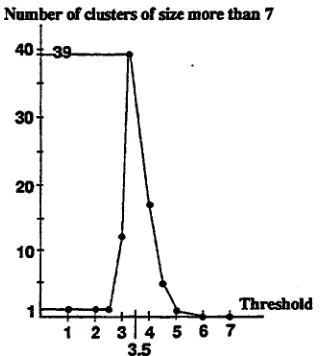
Figure 8: Threshold and the Output
not interesting, because 1 is a graph including all topics, and 3 generates graphs of too small topics to check the global trend of topics in the input. Therefore, we varied threshold from 1.0 up to 7.0 by 0.5 steps to make the input graph, applied our algorithm to each input in order to detect the best threshold.
The result is shown in Figure 8. The num- b e r of clusters whose sizes are more t h a n 7 is plotted against the threshold value. When the threshold is 3.5, such dusters were most nu- merous. In 39 dusters, there were 727 different words out of 15347 in the input graph.
6.2 Evaluation of Clusters
In Appendix, 39 clusters are shown their con- tents sorted b y size. Words judged inappro- priate in each cluster are attached ~t'- Words tmdecidable being suitable in their clusters are put "~".
All 39 clusters are attached four items as fol- lows:
• Subjectively judged topic
• Cluster size (CS): number of words in a cluster
• Error rate (ER): rate of inappropriate words (attached " t ' )
• Uncertainty rate (UR): rate of uncertain words (attached "~" and "~")
[image:6.612.98.306.72.324.2] [image:6.612.358.522.86.264.2]ER=10.3%, UP,.= 14.7%; hence, the ambiguity was removed from clusters up to 85% on aver- age. The number of the cluster whose topic was inestimable is only 1. The estimation of topic becomes clltTicult with two factors, CS and UR. W h e n CS is too small, even when UR is 0.0, the cluster itself lacks in information. When UR is high, it is natural that the topic becomes ines- timable.
6.3 E v a l u a t i o n o f W o r d s C o n t a i n e d in M o r e t h u n T w o C l u s t e r s
T h e n u m b e r of words belonging to more than two clusters amounts to 57. They are classified as follows (numbers in parenthesis are cluster n u m b e r in Appendix):
i. A word with different words).
men-lugs (10
l cell
(1, 15)I ice
(3,8) I
panel (1, 7)
treat (1, 3)
2. A word with the same me~nlng but used in different contexts (32 words).
star
(9,12,14)
brand
(3,22)
3. A word with the same meaning in t h e same context (7 words).
4. Others (One of the words is uncertain, or its cluster's context is not estimated. 6
words)
W o r d s of class 1 is the ambiguous words. Cell in Cluster I means cells of tissue, whereas that in Cluster 15 means battery. Ice in Cluster 3 m e a n s ice for cooling beverage, whereas that in Cluster 8 means ice to skate on.
According to our objectives to obtain sub- graphs of topics, words in class 2 is quite im- portant to be duplicated. For instance, star in Cluster 9 is a sport player star, that in Clus- ter 12 is a singer star and that in Cluster 14 is a movie star. If star were not duplicated, the three different topics would be merged into a single subgraph. The same situation is ob- served for children: it would merge topics of childbirth and education into a graph if it was
not duplicated. We are apt to pay attention only to the words of class 1, but that of class 2 plays an important role in clustering.
Words in class 3 is not ambiguous: they should connect two subgraphs into one (see Section7).
6.4 C l u s t e r H i e r a r c h y
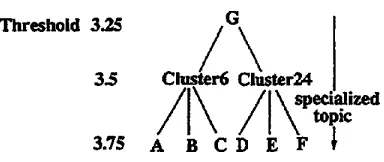
An output subgraph of higher threshold is in- cluded as that of lower threshold. With this inclusion relation, the clusters form a hierar- chy(Figure 9). A part of the hierarchy is shown below:
T h r e s h o l d 3.75
A
admission college scholarship
]3 admission applicant college
C campus children classroom college edu-
cation enroll faculty grade math parent
scholarship school
student sugarteach
teacher tuition
tutor university voucher D birth child children couple marriagemarry parent wedlock woman E birth infant weight
F
birth boy
marryT h r e s h o l d 3.5 Cluster 6,24 in Appendix. T h r e s h o l d
3.25
G
admission applicant baby birth boy
campus century child children
class-
room college couple daughter educa-
tion endowment enroll
enrollment es- tablishment faculty father giftgirl god
grade homework husband
infant ivykid
live love man marriage marry math
mother oxford parent professor
psychol-
ogist scholar scholarship school son stu-
dent
study sugar taught teach teacher teachingtoy tuition
tutor university voucher wed wedlock womanAt threshold 3.75, the origins of e d u c a - t i o n ( C l u s t e r 6) and c h i l d b i r t h ( C l u s t e r 24) clusters are already formed. Among educa- tion, there are subtopics on scholarship school and school entrance. They are merged into Cluster 6 when the threshold is lowered to 3.5. Cluster 24 is also formed from Clusters D,E,F of threshold 3.75. Then Cluster 6 and 24 are merged into Cluster G when the threshold is
Threshold 3.25 3.5 3.75
cA
A B C
Figure 9: Cluster Hierarchy
lowered again to 3.25. The clusters' hierarchi- cal relationships are shown in Figure 9.
We may see that the topic is more specialized when the threshold is high. Clusters which are merged between threshold 3.75 and 3.5 were those within a topic (A,B,C or D,E,F), but topics of different clusters are merged at 3.25 (Clusters 6 and 24). Thus, the lower the thresh- old is, the more the cluster contains ambiguity. The reason is that the two words in different topics do not co-occur.
7 D i s c u s s i o n
The best threshold differs in topics. Some ex- amples are:
E c o n o m i c topic: Although Wall Street Jour- nal articles have economic tendency, clus- ters of economic topic cannot be found in
the dusters with more than ? words of threshold 3.5. They appear in clusters at threshold 3.0 as follows:
• accountant audit bracket deduction filer income offset tax taxpayer • convert conversion debenture debt
holder out.stand prefer redeem redemp- tion repay tidewater
The threshold should be lower for this topic.
M e d i c a l t o p i c : Cluster 1 have too many words. Despite of a medical cluster, potato
appears in the cluster. At the thresh- old 3.0, Cluster 3 is completely merged with Cluster 1. The appearance of potato
shows the sign that the merge of two clif- ferent topic has already begun. Therefore, a higher threshold is preferred.
Trial topic: Several clusters exist on trial in Appendix. They should form a cluster with relatively lower threshold.
Consequently, one of the most important future work is to integrate two stages, the first stage of malc;ng input graph with the static threshold, and the second stage of clustering, into a single stage with dynamic threshold.
8 C o n c l u s i o n
We have discussed a method to duster a co- occurrence graph obtained from a corpus, from a graph-theoretical viewpoint. A graph has no ambiguity if its branches, co-occurrence rela- tions are transitive. This graph theoretical ap- proach using graph is characteristic and it dif- fers from the conventional clustering method. We proposed an algorithm to extract subgraphs whose branches are transitive co-occurrence re- lations and discussed its features. The effec- tiveness of our method was examined using the 30M corpus.
R e f e r e n c e s
[Li and Abe, 1996] H. Li and N. Abe. Clus- tering Words with the MDL Principle.
In Proceedings of the 15th International Confervnce on Computational Linguistics,
roll. pp.4-10, 1996.
[Sugihara, 1995] K. Sugihara. A Graph-The- oretical Method For Monitoring Concept Formation. Pattern Recognition, Vol.28, No.ll, pp. 1635--1643, 1995.
[Tokunaga et al., 1995]
T. Tokunaga, M. Iwayama and H. Tanaka. Automatic Thesaurus Construction based on Grammatical Relations. In Proceedings of the International Joint Conference on Artificial Intelligence '95, 1995.
[Fukmnoto and Tsujii, 1994] F. Fu.kumoto and J. Tsujii. Automatic Recognition of Verbal Polysemy. In Proceedings of the igth In- ternational Conference on Computational Linguistics , vol.2, pp.762-768, 1994. [Pereira et al., 1993] F. Pereira, N. Tishby and
[image:8.612.110.302.86.167.2]glish Words. I n Proceedings of t~e Mst ACt, pp. 183-190, 1993.
[Brown et
aL,
1992] P. Brown, V. Pietra, et al. Class-based n-gram Models of Natural Language.Computational Lingui.~ics,
18 (4), pp. 283-298, 1992.[TokLmaga and Tanaka~ 1990] Tokunaga, T. and Tauaka, H. The Automatic Extrac- tion of Conceptual Items from Bilingual Dictionaries.
PRICAI,
1990.~Rindle, 1990] D. Hindle. Noun Classification from Predicate - - Argument Structures.
In Procceed~gs of fAe ~8~h ACL,
pp.168- 175, 1990.[Church and Hanks, 1990] K. W. Church and P. Hanks. Word Association Norms, Mu- tual Information, and Lexicography. Com-
putatior~al L~guistics,
vol. 16 (1), pp. 22- 29, 1990.A p p e n d i x
The triples are (CS, Ei~ UR) (See Section 6.2). Cluster 1: medicine (105, 4.8%, 5.7~)
afflict cancer disease gene researcher cell hepatitis lung patient bacterium protein repair scientist therapy mice tissue virus fibrositis implant mouse vaccine antigen nicotine treat infect receptor switch~ blood enzyme in- ject insulin molecule pill aid heart infection transplant prostate stroke symptom transmit treatment cure de- pression diagnose kidney trial t bone chemotherapy dose marrow ulcer cause stomach doctor breast disor- der prescribe blockers clot eradicate medication sam- ple brain nerve potato~ donate plasma patch arthri- tis drug lithium placebo version t test laboratory pro- tease prevention syndrome panel schizophrenia sub- stance tumor psychotheraw sclerosis suffer die pain physician lab urine rat radiation animal cholesterol pharmacist pharmacy collagen internist hospital pre- scription medicine care referral~nonprescription Cluster 2: transportation (101, 12.6%,14.6%) air surveillance mlssilet plane fighte~ radar aircraft patriot~ransport airline jet tank boat pilot serb~ trainer airliner crash engine flight fly aviation passen- ger bus carrier bump airport hub saudi airplane de- livery surfaces machinist attendant wing airway shut- tle nonstop route delta fare hanoi~ walkout mechanic
transportation haul denver railroad courier rail freight mile truck shipment diesel pickup minivan gasoline fuel sportt buiitt midsize~ assembly heat inventory detroit vehicle model oil petroleum car auto styling'~ emission:[: brake cylinder sedan equip antilock omega
airbag luxury bag driver jaguar
dodger
accident pump motor rover wheel neont ford cherokee~ rear front dealershiptexplorer plant build shreveportCluster 3: meal (60, 8.3%, iL7% )
alcohol beer brew label liquor miller beverage taste bottle brewer brewery ale ice brand vodka coca cola wine can drink milk coke diet fruit juice dinner draft dairy tea nestle supermarket grocer toronto'~ bottler crownf flavor [ithuania~ atlantat pepper cranberry infection~, soup cheese cow hormone meat refrigerate calorie category spray t eat ocean:[: meal chicken variety treat food sauce beef restaurant
Cluster 4: agriculture (32, 3.1%, 15.6%) acre flood corn farmer grain harvest agriculture hog ,soybean wheat bushel crop depress'~ exporter feed live- stock cotton rain africa~ cattle farm meat brazil~ july rice shipment forecast~, bale frost season flake~ sugar Cluster 5: Near East Asia (32, 0.0%, 0.0%) arab qatar saud} egypt kuwait israel king peace arabia bahrain gaza emirate oil jew jordan lebanon occupy fighter jerusalem syria palestine barrel settler massacre territory kill strip cabinet liberation jericho
Cluster 6: education (31, 3.2%, 12.9%)
admission scholarship school college applicant stu- dent university education professor taught teach tu- ition classroom faculty girl t teacher enroll enrollment grade homework math parent campus psychologist.~ scholar ivy voucher children tutor sugar t endowment C]uster 7: politics (25, 24.0, 40.0%)
bidden t senate senator democrat nomination biparti- san vermont.~ chafe t dole ]nman~ maine committee subcommittee confirmation rhode~ bob t columnists judiciary.~ ranking chairmen panel chairman hearing oversight t oregon~
Cluster 8: w i n t e r sports (24, 4.2%, 12.5%) alpine race ski cup norway winter medal skate skier boa~ cross kilometer sport silver snow tommy# men t athlete skater boot ice meter speed track
Cluster 9: ball games (24, 16.7%, 16.7%o) baseball sports basketball fan football league liberty"l" team pro soccer televise coach stadium star foxy cowboyj" bowl conferenceS" franchise game hockey player tournament college
Cluster 10: computer network (18, 5.6%, 5.6%) bulletin user prodigy~ computer message internet mail pager laptop facsimile machine desk'top modem note- book dell subscription communicate subscriber Cluster 11: Asia (17, 23.5%, 23.5%)
asia singapore thailand indonesia malaysia philippines vietnam taiwan korea burma china interbanktneighbor visito~ pakistan status t human~ belling
Cluster 12: song (17, 0.0%, 0.0%)
album pop sing song music radio singer jackson artist recording disk band channel jazz star copy concert
Cluster 13: Soviet Union (17, 0.0%, 5.9%) arsenal russia soviet ukraine weapon dismantle moscow baltic ruble bloc warhead kiev parliament re- former cabinet uranium quit:~
Cluster l d : movie (17, 5.9%, 5.9%)
academy hollywood film picture studio movie poly- gram actor library video turner lansin~screen script actress star theater
C]uster 15: satellite broadcast (17, 5.9%,
zz.s%)
affiliate station broadcast fox~ network radio television clutteQ antenna satellite channel beam signal trans- mit format dish cell
'Cluster 16: software (16,0.0%, 0.0%)
apple version window mac macintosh user application software unix lotus spreadsheet developer copyright
excel feature word
Cluster 17: Eoxope (15, 0.0%, 0.0%)
austria belgium france italy netherlands sweden fin- land spain britain denmark holland switzerland norway kingdom membership
Cluster 18: p e t r o l u m (14, 14.3%, 28.6%) alberta,: energy calgary~ gas oil pipeline feet barrel basin~ refine chevron 1" exploration petroleum conden- sate
Cluster 19: art (13, 15.4%, 15.4%)
art works exhibit exhibition paint collection gallery mu- seum photograph landscape artist avenue1" flood C]oster 20: K o r e a (13, 15.4%, 23.1%)
artillery tank weapon missile korea pyongyang regime seoul iraqt patriot inspector scuds stance t
Cluster 21: B a l k s - Peninsula (12, 0.0%, 0.0%) artillery serb strike weapon muslim bomb troop peace peacekeeper croat negotiator withdraw
C.luster 22: ciga.tette (11, 0.0%, 0.0%)
addict smoker cigarette nicotine smoke camel morris tobacco ban antismoke brand
Cluster 23: multimedia. (11, 0.0%, 0.0%) audio text video disk cassette library multimedia tape music videocassette entertainment
Cluster 24: childbirth (11, 0.0%, 0.0%)
birth wedlock child marriage marry mother parent woman couple children infant
Cluster 25: c a l a m i t y (11, 9.1%, 9.1%)
crop relief disaster flood earthquake riot~ hurricane quake rebuilding victim francisco
Cluster 26: goods (10, 10.0%, 10.0%)
apparel retailer store furnishing mart merchandise warehouse outlet mass'~ chain
Cluster 27: trial (10, 20.0%, 20.0%)
appeal reinstate ruling court: upheld circuit~ arbitration judge overturn t arbitrator
Cluster 28: trash (10, 50.0%, 50.0%)
cleanup sitet superfundt dump pollute insurert waste
trash ferrist gluQ
Cluster 29: ? (10, 100.0%, 100.0%)
arkansasf rock~ thriftt guaranty'~ madison'~ supervise'~ failure'~ limitationt surroundin~ investigation'~ Cluster 30: earthquake (9, 22.2%, 22.2%) aftershock quake damage earthquake repair epicenter freewayt homeownert inspect
Chzster 31: real estate (9, 0.0%, 11.1%) apartment bedroom rent avenue manhattan tower ten- ant subsidizer landlord
Cluster 32: trial (9, 0.0%, 0.0%)
convict prison sentence jail parole conviction 'fine of- fender plead
Cluster 33: trial (9, 0.0%, 0.0%)
award damage jury plaintiff verdict defendant case ju- ror convict
Cluster 34: winter resort (9, 0.0%, 0.0%) crest resort ski skier mountain snow valley slope sky Cluster 35: trial (8, 0.0%, 0.0%)
bureau probe subpoena investigation prosecutor coun- sel inquiry suicide
Cluster 36: telephone network (8, 0.0%, 0.0%) cable wire fiber phone transmission voice fax mi- crowave
Cluster 37: bond (8, 0.0%, 75.0%)
bondholder reorganizations chapters creditor reorganizer pet'rl:ion~ proceedings 'filingt
Cluster 38: book (8, 12.5%, 12.5%)
audio'~ publisher title book bestseller bookstore refer- ence copy