Learning Thesaurus Relations from Distributional Features
Rosa Tsegaye Aga, Christian Wartena, Lucas Drumond, Lars Schmidt-Thieme
Hochschule Hannover, Universitat Hildesheim[email protected], [email protected], [email protected],[email protected]
Abstract
In distributional semantics words are represented by aggregated context features. The similarity of words can be computed by comparing their feature vectors. Thus, we can predict whether two words are synonymous or similar with respect to some other semantic relation. We will show on six different datasets of pairs of similar and non-similar words that a supervised learning algorithm on feature vectors representing pairs of words outperforms cosine similarity between vectors representing single words. We compared different methods to construct a feature vector representing a pair of words. We show that simple methods like pairwise addition or multiplication give better results than a recently proposed method that combines different types of features. The semantic relation we consider is relatedness of terms in thesauri for intellectual document classification. Thus our findings can directly be applied for the maintenance and extension of such thesauri. To the best of our knowledge this relation was not considered before in the field of distributional semantics.
Keywords:Distributional semantics, thesauri, context vectors, Supervised machine learning
1.
Introduction
In the past decades, distributional similarity (DS) has been used to solve many different tasks related to the meaning of words. The main idea of DS is, that words that appear in similar contexts are likely to have a similar meaning. When context representations are built from large amounts of texts, DS can give good results for various tasks. How-ever, DS does not directly correspond to any traditional se-mantic relation. Distributional similar words might be syn-onyms, antsyn-onyms, hypernyms etc.
In this paper we will consider a very basic and central task for computational lexical semantics: the decision whether two words are semantically related or not. A simple ap-proach is to compute a similarity between the words and learn a threshold above which the words can be considered as being related. We show that a much stronger supervised approach, in which the similarity between the words itself is learned from examples, gives much better results. To do so we need to construct feature vectors representing pairs of words. Especially, we show that a simple combination of context vectors gives better results than using vectors com-bining different types of features.
Much research on DS has been done on very small datasets; For example, the TOEFL data, presumably the most of-ten used dataset in this field, just has 80 questions. Be-cause we need large datasets, we use data sampled from large thesauri, especially Eurovoc (Office for Official Pub-lications of the European Communities, 1995) and STW (ZBW - Leibniz Information Centre for Economics, 2014). These data have two advantages: It is easy to sample large amounts of related (and non-related) words and the data are constructed independent of any specific semantic task. Since thesauri are also used for automatic indexing and for full-text retrieval, it is important to know all possible terms that refer to a certain concept. Therefore, extension of the-sauri with more labels for each concept is an important task in the maintenance of these vocabularies. Thus the results of this paper also have a direct practical application. The rest of the paper is organized as follows. In section 2., we review related work. Section 3. explains the
distribu-tional feature construction and pairwise feature generation. We discuss the experiment data, supervised method and evaluation in Section 4.. In Section 5. and 6., we discuss the result and conclusion with future work respectively.
2.
Related Work
Distributional similarity can be seen as a machine learn-ing method, since we derive semantic representations from large amounts of data. Nevertheless, supervised methods have not been very popular in this field. Zhitomirsky and Dagan (2009) use a supervised method for feature selec-tion. In (B¨ar et al., 2012) and (Wartena, 2013) ensemble models are used to combine different DS measures. The approach of Turney (2014) also is based on supervised learning using a large number of different similarity fea-tures. The difference to the afore mentiones approaches is, that Turney focusses on similarity of phrases and the simi-larities that are used as features are not simisimi-larities for the pair themselves.
The work that is most closely related to ours is the research on metric learning for DS from (Shimizu et al., 2008) and (Hagiwara, 2008). Shimizu et al. (2008) used a learned Ma-halanobis distance to rank pairs of synonyms and unrelated words. In order to make the learning computationally feasi-ble they reduced the number of context features massively by selecting the most promising features. In the approach of Hagiwara (2008) feature selection is not necessary as he constructed features to represent each pair of words. Subse-quently a Support Vector Machine (SVM) (Cristianini and Shawe-Taylor, 2000) is used to learn which pairs are pairs of synonyms and which pairs are not. We will follow a similar approach but we use different ways to construct the features.
Table 1: Pair of words datasets size XX
XX XX
XXX X Classes
Datasets
SC53 Eurovoc-2 Eurovoc-1 Eurovoc-0 STW-1 STW-0
Positive 1 752 10 000 10 000 2 175 10 000 10 000
Negative 1 752 10 000 10 000 2 335 10 000 10 000
based on DS.
3.
Methods
The task that we consider is deciding whether a pair of words is semantically related. We construct vectors of co-occurrence features to represent each word. However, in-stead of computing a similarity between two feature vectors we will construct a vector of features representing a pair of words. A linear Support Vector Machine (SVM) is trained on the features of the word pair to discriminate between re-lated and unrere-lated pair of words. The SVM model decides whether two words are semantically related by considering the feature vector representing the pair of words. We built models on two types of vectors: 1. Vectors constructed by a simple operation on context vectors, 2. Vectors constructed by aggregating different types of features using Turney’s SuperSimmethod (Turney, 2014). The two types of vector construction will be explained in section 3.2. .
We compared the results between the two models and with results obtained by using cosine similarity. For cosine simi-larity training is nothing more than finding an optimal value to split the examples.
3.1.
Feature construction
In DS the meaning of a word is represented by a vector of context features. As context features co-occurrence data with other words in a large text corpus are used.
There are a number of choices that have to be made when building the context vectors for each word. In the following we will use the choices that turned out to yield the best re-sults in a number of different tasks in recent studies by Bul-linaria and Levy (2007; 2012) and Kiela and Clark (2014). First it has to be determined what words are used as context features, i.e. for what words co-occurrence statistics have to be computed. Generally, it is found that mid frequency words are most effective. After some preliminary experi-ments we found that including all words in the frequency range from4·103to1·106in the UkWaC Corpus is a good compromise between optimal results and acceptable stor-age and computing efforts. Therefore, context words which have frequency range from4·103to1·106in the UkWaC Corpus have considered to construct the context vector for each words. Then each word is now represented by a vector of 17 400 features. In other word, there are 17 400 different words that occur at least4·103times and at most1·106 times in the corpus.
Next we have to determine the size of the window for co-occurrence. If the training corpus is large enough all studies show that smaller windows yield better results. We first remove all stop words and then use a window size of two words on the stopped text, respecting sentence boundaries. Syntactic relations are not used to determine the context of a word.
Finally, we use positive pointwise mutual information (PPMI) as a degree of co-occurrence, since it was shown to give better results than raw co-occurrence probabilities in a number of different studies. For a context wordscand a (target) wordtthe PPMI is defined as
ppmi(c, t) = max
logp(c|t)
p(c) ,0
. (1)
3.2.
Representation of word pairs
In order to decide whether two words are semantically re-lated, Shimizu (2008) proposed learning a SVM model by taking the distributional features as an input, that were con-structed by addition of the context vectors of both words. Turney (2014) proposes a method, calledSuperSim, to resent pair of words, and identify related pairs. Turney rep-resents a pair of words by aggregating four types of fea-tures, all based on frequencies in a large corpus. These are logarithm frequency values for each word of the pair, PPMI between the two words of the pairs, the similarities of two words in domain space, and the similarity of two words in function space Turney (2014).
To find the best representation for a pair of words, we com-pared the above three approaches. For the first approach, we moreover compared four different methods to combine the two co-occurrence feature vectors. These four proposed methods are:
• Addition; used before by Shimizu (2008) who ob-tained good results using this method.
• Subtraction
• Point-wise or Hadamard product (closely related to the cosine: if we normalize the length of the vectors, the cosine is the sum of the elements of their Hadamard product)
• Binary vector. The binary vector−→vbinof two vectors
− →v
1and−→v2is defined by settingv−−−→bin,i= 1if−→v1,i>0 and−→v2,i>0, otherwise−−−→vbin,i= 0.
For the addition, subtraction and point-wise, we also test the variants in which we first normalize the length of the vectors to the unit vector.
4.
Experiment
In this section, we will describe the experimental setup and the data used.
4.1.
Data description
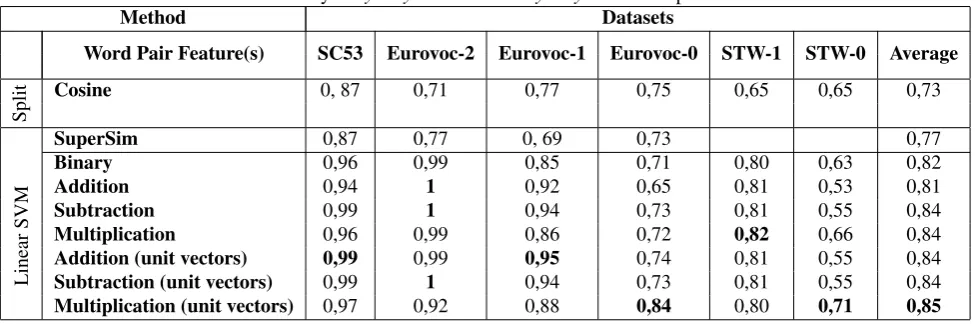
Table 2: Accuracy ofsynonymousandnon synonymousword pair classifiers
Method Datasets
Word Pair Feature(s) SC53 Eurovoc-2 Eurovoc-1 Eurovoc-0 STW-1 STW-0 Average
Split
Cosine 0, 87 0,71 0,77 0,75 0,65 0,65 0,73
SuperSim 0,87 0,77 0, 69 0,73 0,77
Linear
SVM
Binary 0,96 0,99 0,85 0,71 0,80 0,63 0,82
Addition 0,94 1 0,92 0,65 0,81 0,53 0,81
Subtraction 0,99 1 0,94 0,73 0,81 0,55 0,84
Multiplication 0,96 0,99 0,86 0,72 0,82 0,66 0,84
Addition (unit vectors) 0,99 0,99 0,95 0,74 0,81 0,55 0,84
Subtraction (unit vectors) 0,99 1 0,94 0,73 0,81 0,55 0,84
Multiplication (unit vectors) 0,97 0,92 0,88 0,84 0,80 0,71 0,85
For our experiments we use data extracted from two large thesauri and from a data set introduced in (Bullinaria and Levy, 2007). This last data set contains 530 words which have been taken from 53 semantic categories (10 words for each category). We will refer to this data set as SC53. From this collection we draw a set of 1752 pairs of words belong-ing to the same category and 1752 randomly chosen pairs of words from two different categories.
All other data sets are extracted from thesauri. Since the-sauri are organized hierarchically we can define similarity at different levels. We use both similarity at a very fine grained level, considering almost only synonyms as sim-ilar and at a broad level, considering all terms belonging to the same branch of the hierarchy as similar. However, since each thesaurus has some focus domain that is worked out very detailed and other areas that are modeled much more coarse grained, in the core of the thesaurus two terms denoting the same concept will be real synonyms, while in other areas quite different words can refer to the same concept. Keeping this in mind, we understand that an au-tomatic approach will never be able to decide whether two terms denote the same concept without errors .
We have compiled three data sets from the Eurovoc The-saurus (Office for Official Publications of the European Communities, 1995). Eurovoc is a multilingual thesaurus developed by the European Commissions Publications Of-fice as a controlled vocabulary for the intellectual indexa-tion of documents. The Eurovoc thesaurus is divided into 127 micro-thesauri. From each of these micro-thesauri we took the top-level concepts, 528 in total, as semantic cat-egories. For each category we collected all narrower con-cepts and considered their preferred and alternative labels as terms for that category. We then removed all terms that belong to more than one category or that consist of more than two words. Finally, we removed all categories for which less than 10 terms were found. Now 190 categories with a total of 2386 terms are left. The largest category con-sists of 44 terms. From this data set we have constructed two set of pairs: the first set has 10 000 pairs of words be-longing to the same category and the second set has 10 000 randomly chosen pairs from two different categories. We will refer to this set of pairs a Eurovoc-1, since the terms are equivalent by going up one level in the Eurovoc concept
hierarchy. Furthermore we built a collection of pairs by se-lecting 10 000 pairs of words from the same data set where both words are taken from the same micro-thesaurus and 10 000 pairs taken from two different micro-thesauri. We call this set 2. Both for 1 and Eurovoc-2 we only selected terms consisting of one word and we moreover required that word occurs at least once in the UKWaC.
Finally, we sampled pairs of words from the original Eu-rovoc thesaurus by taking preferred and alternative labels for the same concept as synonymous terms, and pairs that are used as labels for different concepts as non-synonym pairs. For the negative examples we want to have an equal distribution of easy and difficult pairs. Thus we took 20% pairs with words from concepts with a distance of 1 step, using any specified thesaurus relation. Further 20% were taken from concepts with a distance of 2 steps, and so on. For the last 20%, pairs of concepts with a distance of at least 5 steps were used. In all cases it was ensured that no shorter path exists. For this set, we have 2175 synonymous and 2335 non-synonymous words; This set of pairs we will refer to as Eurovoc-0.
The German experiment data are derived from German no-tations from the German thesaurus on business and eco-nomics Standard-Thesaurus Wirtschaft(STW). The STW is divided into 7 sub-thesauri. Each part consists of a hierarchy of notations and descriptors. Descriptors have preferred and eventually non-preferred labels and in some cases narrower descriptors. We took all terms (i.e. labels from descriptors) from 6 thesauri (leaving out the sub-thesaurus with general terms) that belong to only one no-tation and consist of at most 2 words. Subsequently, we removed all words belonging to a notation with less than 5 terms in our sample. This gives us 419 classes (one class for a notation) with a total of 11 599 terms. There are 5 classes with over 100 terms. The largest class has 233 terms. From this set we randomly selected a set of pairs of words, 10 000 from the same class and 10 000 from different classes. We restricted the selection of words to words occurring at least once in DeWaC, but we included multi-words. We call this set STW-1.
con-trolled the distribution of negative pairs in the same way the Eurovoc-0 data. This data set has 10 000 positive and 10 000 negative pairs and is referred to as STW-0.
The pair of words data size is shown in Table 1.
4.2.
Supervised Similarity Learning
In this section, we will see how we used the supervised method to predict the pair of words by taking the distribu-tional features as an input.
We used linear SVM from the liblinear package to learn a model and classify the word pairs represented by one fea-ture vector. Liblinear is very efficient and fast for train-ing large-scale problems (Fan et al., 2008). The hyper-parameters of the models have been tuned using grid search from LIBSVM. To find the best C parameter value, we tested the numbers in between 0 and 20 in step 0.05.
4.3.
Experiment Setup
We evaluated the models presented in Section 3.2. on dis-tinguishing pairs of related words from arbitrary pairs using ten-fold cross validation.
For all experiments, we used ten cross validation. We con-sidered 10% for the test and 90% for the train set, and gen-erated ten train and ten test datasets. For each methods the same split was used.
5.
Results
We can consider the results obtained by using cosine sim-ilarity as a baseline, since the cosine is usually considered as the best similarity measure for classification of context vectors (Bullinaria and Levy, 2007; Bullinaria and Levy, 2012; Kiela and Clark, 2014). Another possible baseline is Turney’ SuperSim method (Turney, 2014) that gave good results for phrase similarity in a number of experiments. In total we have done 48 classification experiments on both English and German pairs, and 3 more classification ex-periments on different types of features (Turny’s approach) only on English pairs. The average accuracy results from ten-fold cross-validation are given in Table 2. The results confirm the outcome of the experiment from (Hagiwara, 2008) on one data set: training an SVM on one type of features representing the pairs yields better results than us-ing cosine similarity and different types of features classi-fication. We find that a SVM learned on the pairwise fea-tures on one type for all 6 data sets gives better results than the cosine similarity and different types of features classi-fication. However, feature addition, as used by Hagiwara, seems not always to be the best choice and only gives best results when the feature vectors are normalized before ad-dition.
6.
Conclusions and Future Work
Our experiments suggest that a model learned on one type of feature for a specific task can give better results than a general similarity measure and different types of features. In our experiment, we have shown that multiplication and addition are the best methods to construct pairwise features, and learn the pairs relation on SVM. Furthermore, we see that the vector length allays should be normalized before
vectors are combined by one of the four methods to repre-sent a word pair.
For further work, we would like to extend the method to classification into more than two classes, and to investigate more specific relations between words.
7.
Bibliographical References
B¨ar, D., Biemann, C., Gurevych, I., and Zesch, T. (2012). UKP: Computing Semantic Textual Similarity by Com-bining Multiple Content Similarity Measures. In Pro-ceedings of the Sixth International Workshop on Seman-tic Evaluation (SemEval-2012), pages 435–440.
Baroni, M., Bernardini, S., Ferraresi, A., and Zanchetta, E. (2009). The WaCky Wide Web: A Collection of Very Large Linguistically Processed Web-Crawled Corpora. Language Resources and Evaluation 43 (3): 209-226, 43(3):209–226.
Bullinaria, J. A. and Levy, J. P. (2007). Extracting seman-tic representations from word co-occurrence statisseman-tics: A computational study. Behaviour Research Methods, 39(3):510–526.
Bullinaria, J. A. and Levy, J. P. (2012). Extracting Seman-tic Representations from Word Co-occurrence StatisSeman-tics: Stop-lists, Stemming and SVD. Behaviour Research Methods, 44(3):890–907.
Cristianini, N. and Shawe-Taylor, J. (2000). An Introduc-tion to Support Vector Machines and other kernel-base learning methods. Cambridge University Press.
Crouch, C. J. (1990). An approach to the automatic con-struction of global thesauri. Information Processing & Management, 5:629–640.
Curran, J. R. and Moens, M. (2002). Improvements in Au-tomatic Thesaurus Extraction. InUnsupervised Lexical Acquisition: Proceedings of the Workshop of the ACL Special Interest Group on the Lexicon (SIGLAX), pages 59–66.
Fan, R.-E., Chang, K.-W., Hsieh, C.-J., Wang, X.-R., and Lin, C.-J. (2008). Liblinear: A library for large linear classification.J. Mach. Learn. Res., 9:1871–1874, June. Hagiwara, M. (2008). A Supervised Learning Approach to Automatic Synonym Identification Based on Distri-butional Features for Computational Linguistics, June 15-20, 2008, Columbus, Ohio, USA, Student Research Workshop. InACL 2008, Proceedings of the 46th An-nual Meeting of the Association for Computational Lin-guistics, pages 1–6.
Kiela, D. and Clark, S. (2014). A Systematic Study of Se-mantic Vector Space Model Parameters. In 2nd Work-shop on Continuous Vector Space Models and their Com-positionality (CVSC).
Office for Official Publications of the European Commu-nities. (1995). Thesaurus eurovoc - volume 2: Subject-oriented version.
Shimizu, N., Hagiwara, M., Ogawa, Y., Toyama, K., and Nakagawa, H. (2008). Metric learning for synonym ac-quisition. InCOLING ’08 Proceedings of the 22nd In-ternational Conference on Computational Linguistics, pages 793–800.
Meaning: Vector Space Models of Semantics. Journal of Artificial Intelligence Research, 37:141–188.
Turney, P. (2014). Distributional semantics beyond words: Supervised learning of analogy and paraphrase. Trans-actions of the Association for Computational Linguistics, 1:353–366.
Wartena, C. and Brussee, R. (2008). Instance-Based Map-ping between Thesauri and Folksonomies. In Amit Sheth, editor,The semantic web - ISWC 2008, volume 5318 ofLecture Notes in Computer Science SL 3, Infor-mation Systems and Application, incl. Internet/Web and HCI, pages 356–370. SpringerLink [host], Berlin. Wartena, C. (2013). HsH: Estimating semantic
similar-ity of words and short phrases with frequency normal-ized distance measures. In Proceedings of the 6th In-ternational Workshop on Semantic Evaluation (SemEval 2012), Atlanta, Georgia, USA.
ZBW - Leibniz Information Centre for Economics. (2014). STW Thesaurus for Economics.