Using the TED Talks to Evaluate Spoken Post-editing of Machine Translation
Jeevanthi Liyanapathirana
Andrei Popescu-Belis
Copenhagen Business School Idiap Research InstituteDalgas Have 15 Rue Marconi 19
DK-2000 Frederiksberg, Denmark CH-1920 Martigny, Switzerland [email protected] [email protected]
Abstract
This paper presents a solution to evaluate spoken post-editing of imperfect machine translation output by a human translator. We compare two approaches to the combination of machine translation (MT) and automatic speech recognition (ASR): a heuristic algorithm and a machine learning method. To obtain a data set with spoken post-editing information, we use the French version of TED talks as the source texts submitted to MT, and the spoken English counterparts as their corrections, which are submitted to an ASR system. We ex-periment with various levels of artificial ASR noise and also with a state-of-the-art ASR system. The results show that the combination of MT with ASR improves over both individual outputs of MT and ASR in terms of BLEU scores, especially when ASR performance is low.
Keywords:machine translation, spoken post-editing, evaluation
1.
Introduction
In this paper, we consider the task of voice-based post-editing of the output of a machine translation (MT) sys-tem. In other words, a human corrects the translation pro-duced by a system simply by speaking out this correction. The paper presents a method for using an existing dataset to evaluate spoken post-editing methods without the need for costly experiments involving human post-editors. We use the French transcripts of TED talks (www.ted.com) as the source texts to be translated by MT, the original En-glish audio recordings as the spoken corrections, and the English transcripts as a reference for the automatic evalua-tion of translaevalua-tion quality.
The proposed evaluation framework is applied to two orig-inal methods for combining the outputs of an automatic speech recognition (ASR) system and of an MT system, to generate a better translation than each of the outputs consid-ered individually. The first method is heuristic-based and relies on the confidence of the ASR to select words, while the second method uses machine learning to learn selec-tion rules based on a wider set of features, including word length, position and part-of-speech, and ASR confidence. The paper is organized as follows. Section 2 presents the motivation of our system. Section 3 describes the setting of our experiments, the ASR and MT systems, and the use of TED data for spoken post-editing. Section 4 defines the two approaches to ASR/MT combination that we use to gener-ate an improved translation. Section 5 describes the experi-ments and their results. Finally, Section 6 reviews previous work that has been done in this area, in comparison to our proposal.
2.
Motivation
Voice-based post-editing is valuable whenever using a key-board is not possible or practical, e.g. with mobile devices or impaired users. Therefore, the range of applications of our proposal is quite large, and covers the dissemination uses of MT rather than the assimilation ones, as defined
by Hovy et al. (2002), because it helps producing a high-quality translation. The applications are intended for users who are proficient in both source and target languages, so that spoken post-editing is accurate, but who prefer using voice rather than a keyboard – e.g. on a mobile device such as a smartphone or a smartwatch. For instance, they could use spoken post-editing of MT to translate and disseminate to their colleagues an email originally written in a foreign language, or to re-tweet to their followers a message from a foreign contributor.
Mesa-Lao (2014) surveyed the post-editors’ views and atti-tudes before and after the introduction of speech technology as a front-end to a computer-aided translation workbench. The survey shows that people tend to respond positively to-wards ASR used in post-editing, and they seem willing to adopt it as an input method for future post-editing tasks. In another user-oriented study, Dragsted et al. (2011) inves-tigated the efficiency that can be achieved by using speech recognition software for translation tasks. With sufficient training and practice, the speech recognition’s time con-sumption appears to approach that of sight translation, and speech recognition quality appears to approach that of writ-ten translation. These studies thus indicate the need for, and the potential acceptability of, voice-based post-editing of MT output, although more studies focusing on possible uses in multilingual social networks and/or access from mo-bile devices would be welcome.
3.
Experimental Framework for Studying
Spoken Post-Editing of MT
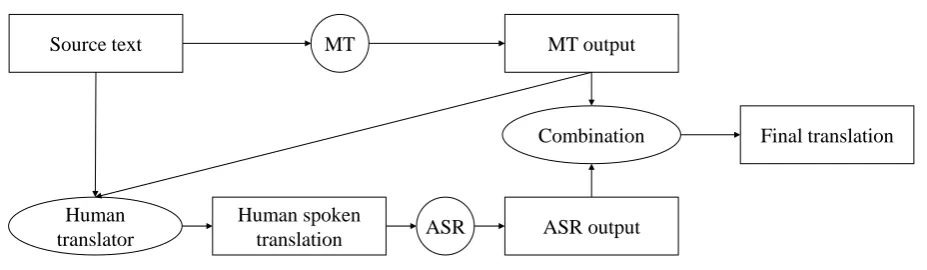
Source text MT
ASR Human
translator
MT output
ASR output
Combination Final translation
[image:2.595.74.538.69.204.2]Human spoken translation
Figure 1: Workflow of the proposed system: the human translator views the source text and the MT output and speaks a corrected translation. The hypotheses of MT and ASR are combined into a final, improved translation.
The results of the system depend on the initial MT and ASR quality. Therefore, we will experiment with several ASR quality levels. Indeed, while state-of-the-art MT perfor-mance for a given language and domain can be considered quite stable, the ASR quality typically varies significantly with the speaker, microphone, surrounding noise, and com-puting resources. Moreover, we will assume that the hu-man post-editor utters the entire corrected sentence, though in future work we will consider the possibility of uttering only a corrected fragment.
In this section, we explain how we make use of the TED data to train and test our proposal (3.1). Then, we present the third-party systems for MT and ASR used in our framework (3.2), along with a method to simulate ASR noise (3.3).
3.1.
Data: TED Talks and Transcripts
One of the main experimental challenges is the availabil-ity of sufficient data, without the need to conduct costly experiments to collect it from human post-editors through recording and manual transcription. We propose thus the following approach.
We take advantage of the TED talks, available fromwww. ted.com, which are audio-visual recordings of prepared speeches, in English, on scientific, artistic and social top-ics, for a typical duration of 18 minutes. The speeches are transcribed, verified, and translated into a variety of lan-guages by volunteers. TED talks data has been used in the IWSLT campaigns (Federico et al., 2014) and is distributed as a parallel corpus to train and test MT systems (Cettolo et al., 2012) or recommender systems (Pappas and Popescu-Belis, 2015). In our experiments, we use 20 talks (around 1200 sentences) obtained directly from the TED website.1
To emulate spoken post-editing, we consider each utterance spoken in English as a potential correction of the transla-tion into English of a foreign-language version. Here, we use the French version as our source language. A French sentence is thus translated by our MT system, and then it is
1For training, we used 15 talks, with the following index
num-bers: 69, 93, 779, 789, 785, 790, 792, 799, 805, 837, 1090, 1100, 1131, 1133, and 1143. For testing, we used five talks: 227, 531, 535, 767 and 769. The actual URL where each talk can be viewed is obtained by appending the index number to the following prefix:
http://www.ted.com/talks/.
“corrected” by the English speaker, who utters exactly the reference translation.2 In this way, the English transcript serves as a reference to MT, and allows us to score the out-put of our approach, in comparison to MT or ASR alone, using the BLEU score (Papineni et al., 2002).
As the speaker utters the exact reference sentence, if there were no ASR mistakes, the best strategy would be to con-sider the ASR output as the final translation (thus scoring 100% BLEU), simply discarding the MT output. However, ASR is far from perfect, and we therefore experimented with several levels of ASR accuracy to study the combi-nation of ASR and MT. In such cases, our experimental framework and data set provide a testbed for ASR/MT com-bination algorithms.
3.2.
MT and ASR Systems
We consider two MT systems. The Moses phrase-based statistical MT system (Koehn et al., 2007) was trained and tuned on the French/English parts of the Europarl corpus (Koehn, 2005), with an English language model generated using SRILM (Stolcke, 2002). The system’s parameters were optimized using the Minimum Error Rate Training procedure (Och, 2003). However, we found that our Moses system was outperformed by the online Google Translate service (available at http://translate.google. com). Therefore, we will use the output of Google Trans-late in all the experiments presented below.
For ASR, we used the output over the TED English audio of two systems: (1) the baseline output pro-vided by the IWSLT organizers (available at http:// workshop2013.iwslt.org/59.php) from a system with around 15% word error rate, and (2) the ASR sys-tem presented by the University of Edinburgh at the IWSLT 2014 evaluation (Bell et al., 2012).
Figure 2 shows an example sentence from a TED talk, first in French and then in English, along with the corresponding ASR and MT outputs (respectively from the UEdin ASR and Google Translate).
2
Source Sentence: Vous savez, un des plaisirs intenses du voyage et un des
d´elices de la recherche ethnographique est la possibilit´e de vivre parmi ceux
qui n’ont pas oubli´e les anciennes coutumes, qui ressentent encore leur
pass´e souffler dans le vent, qui le touchent dans les pierres polies par la pluie, le d´egustent dans les feuilles
am`eres des plantes.
Reference Translation: You know, one of the intense pleasures of travel and one
of the delights of ethnographic research is the opportunity to live amongst those
who have not forgotten the old ways, who still feel their past in the wind, touch
it in stones polished by rain, taste it in the bitter leaves of plants.
ASR: intense pleasures of travel and one of the delights of ethnographic research is the opportunity to live amongst those
have have not forgotten the old ways, to still feel their past the wind, touch and stones caused by rain, i tasted the
bitter leaves of plants.
MT: You know, one of the intense pleasures of travel and one of the delights of ethnographic research is the ability to live among them who have not
forgotten the old ways, still feel their past blowing in the wind, affecting the
[image:3.595.302.542.70.109.2]smooth stones in the rain, eaten in the leaves bitter plants.
Figure 2: A French source sentence, its reference transla-tion, the speech recognition output from the English audio, and the MT output from the French sentence.
3.3.
Simulating Variable ASR Error Rates
To study the robustness of our proposal with respect to the ASR error rate, which can vary greatly depending on the context of use, we experiment with several error rates, which were not, however, obtained from various systems (because this would be unpractical and hard to control), but rather using a simulation technique reproduced from Habibi and Popescu-Belis (2015). We introduce into the English reference transcripts three different types of simulated ASR noise: insertion, deletion, or substitution. We select random words from the text, and for each of them we perform one of the following edits: (1)inserta new word (randomly cho-sen from a dictionary) after the selected word; (2)deletethe selected word; (3)substitutethe selected word with a new word (again randomly chosen from a dictionary). These ed-its are performed on all occurrences of each selected word. The percentage of noise (i.e., word selection rate) is var-ied from 0.5% to 10%, which results in word error rates (WER) from 85% to 55%, as shown in Table 1 for a 3600-word sample. Overall, WER increases with the number of edits increases, though not linearly.
Number of edits 20 50 100 250 500 Errors in text (%) 0.4 1 2 5 10 Accuracy 85.1 81.2 79.2 69.6 54.5
Table 1: Percentage of errors in the text and accuracy scores (complement to 100% of word error rates) of degraded ASR output, over a 3600-word sample transcript, when varying the number of edits.
4.
Methods for Merging ASR and MT
We define, implement, and evaluate two methods for merg-ing the output of ASR and MT, with the goal of reducmerg-ing the number of errors (i.e. differences from the reference translation) in the final merged output. The methods rely on the word-alignment of ASR and MT outputs, followed by a word selection procedure, for which we designed a heuristic-based algorithm and one based on machine learn-ing. To perform ASR/MT alignment, a dynamic program-ming algorithm is used, from the HResults algorithm in the HTK toolkit (Young et al., 2006). Figure 3 shows an exam-ple of an alignment made between the ASR and MT output.
4.1.
Heuristic-Based Approach
Starting from the word-level alignment between ASR and MT, we define several heuristics to decide which word (ei-ther from ASR or from MT) to select for the final merged output. The challenge is to select the word which is more likely to be correct, i.e. identical to the reference transla-tion, without any particular knowledge of this reference. The heuristics loop over the pairs of aligned words, noted as
(WASR, WMT). The selection problem occurs only when
the two words are different – when they are the same, this word is always selected. A specific case to consider is when one of the words is aligned with an empty word (noted∅) in the other stream (but empty-to-empty alignments cannot occur).
The first heuristic (noted ‘CONFIDENCE’) selects the ASR word when the ASR confidence is higher than 0.8, while the second heuristic (noted ‘CONFIDENCENODUPLICATES’) adds rules to avoid selecting words that have neighboring duplicates, as follows:
• CONFIDENCE: ifWASR6=∅andConfASR(WASR)≥
0.8then selectWASR, else selectWMT.
• CONFIDENCENODUPLICATES: First, follow the same procedure as CONFIDENCE up to the end of the sentence. However, do not select in the resulting sentence a word which has neighboring duplicates, as follows. Let W(−/+)n be the n -th word before/after -the current word W. If W ∈ {W(−3), W(−2), W(−1), W(+1), W(+2), W(+3)} then do not selectW in the resulting sentence.
MT: ability#### to live amongst them# who have #### not ASR: opportunity to live amongst those ### have have not
Confidence: .8 .8 .9 .7 .5 .8 .9 .8
Figure 3: English MT and ASR outputs aligned at the word level using HTK (excerpt from sentences in Figure 2). The third line indicates the confidence score of the ASR system for each word.
who have have not”. The output of CONFIDENCENODU -PLICATESis similar, except that the second occurrence of the word “have” is removed, which improves the result.
4.2.
Machine Learning Approach
To leverage a larger set of features and find an optimal set of parameters, we apply supervised learning to perform the task of selecting one output word between the ASR and MT hypotheses, using the word-aligned representation shown in Figure 3, when these input words differ. In order to perform classification, a set of instances for training and testing were extracted, along with a set of features for each of them, inferred from the ASR and MT outputs. These features are noted using self-explanatory names as follows: ASR has characters, MT has characters, ASR is function word, MT is function word, Longer(ASR, MT), Levenshtein(ASR, MT), and Confidence(ASR). The latter two features are numeric, while the others are Boolean. Moreover, we use the lexical features ASR word and MT word but only include words with a frequency above 15; the other words are coded as ‘OTHER’.
Since the new sentence is generated by choosing from each pair either the ASR word, or the MT word, or no word at all, the three possible classes (decisions) for the learning pro-cess are labeled as, respectively, ‘ASR’, ‘MT’ and ‘NONE’. To construct the training data, we choose the class for each instance (word pair) as follows, after word-aligning the ASR and MT outputs with the reference translation.3 If the aligned ASR word is equal to the word in the reference, then we label the pair with ‘ASR’. Else, if the aligned MT word is equal to the reference, then we label the pair with ‘MT’. If neither the ASR word nor the MT word match the reference word, we label the pair with ‘NONE’. As for the heuristic-based method, we are only interested in instances where the ASR and MT words differ – if they are the same, that word is always selected.
For training a classifier, we experiment with several classi-fication algorithms implemented in the WEKA toolkit (Hall et al., 2009): C4.5 Decision Trees, Support Vector Ma-chines (SVMs), Random Forests, Decision Tables, and the Naive Bayes classifier.
5.
Results of Experiments
In this section, we first present the results of the heuristic-based approach, on actual and simulated ASR output as de-fined in Sections 3.2 and 3.3, and then perform similar ex-periments with the machine learning based approach, with the training and testing data presented in Section 3.1.
3This three-way alignment is performed as follows: first we
align separately the ASR output with the reference, and the MT output with the reference. Then these alignments are merged, us-ing the reference words as a common ground.
5.1.
Heuristic-Based Approach
We tested the heuristic-based approach with the baseline ASR output from the IWSLT workshops and MT from Google Translate. Table 2 shows the BLEU scores of the ASR and MT systems considered independently, and the scores of their combination using the CONFIDENCE heuristic. The results show that the CONFIDENCEheuristic clearly outperforms the use of MT only (p <0.001). How-ever, although CONFIDENCEhas higher scores than those of the ASR correction only, the difference is not statisti-cally significant over the five test talks.
ASR MT CONFIDENCE
Average BLEU 64.4 45.26 66.7
STD 5.24 5.38 5.76
[image:4.595.98.496.71.104.2]p-value wrt. CONF. 0.93 0.0001 —
Table 2: Average BLEU scores over five TED talks for the ASR output over the spoken correction (IWSLT baseline with a WER of about 15%), for the MT output (Google Translate), and for their combination using the CONFI -DENCEheuristic.
When varying the quality of the ASR systems, we found that the CONFIDENCEand CONFIDENCENODUPLICATES heuristics have similar scores, and outperform the ASR only when its accuracy is considerably low; however, in that case, the use of MT alone offers a better option. In other words,a prioriknowledge of the accuracies of ASR and of MT leads to simply selecting the output of one or the other, depending on their accuracy, with no need for a combination method.
[image:4.595.306.539.314.365.2]5.2.
Machine Learning Approach
Table 3 shows the obtained classification accuracy for var-ious levels of ASR noise, in terms of number of correctly classified instances, for several types of classifiers, with 10-fold cross-validation over the training set. The features used were those listed above, except for the ASR confi-dence, which is not available for simulated ASR errors. The SVM classifier outperformed the others, and is therefore be used in the other experiments presented below.
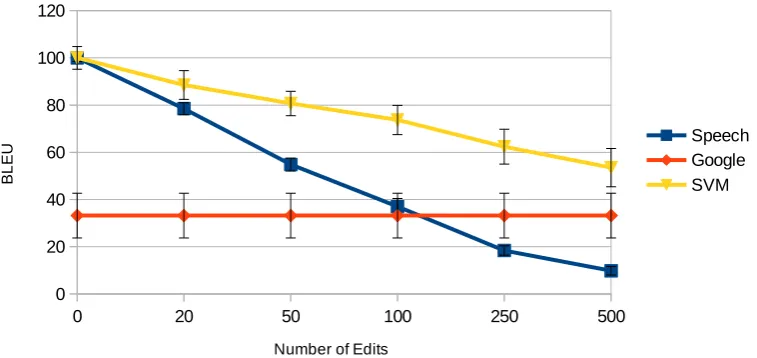
Once the classifiers were trained on the training data and the optimal feature set was identified, the classifications were performed on the test set. We calculated the BLEU scores of the newly generated sentences using varying ASR error levels, and averaged the BLEU scores over the five TED talks of the test set, also computing confidence intervals over the 5-talk sample.
Sheet2
Page 7
0 20 50 100 250 500
0 20 40 60 80 100 120
Average BLEU Score vs. Number of edits
Speech Google SVM
Number of Edits
B
L
E
[image:5.595.103.482.70.249.2]U
Figure 4: Mean BLEU score for various error levels of the ASR (in terms of number of edits, see Table 1) for three outputs: ASR only, MT only, and ASR combined with MT using the SVM classifier. The vertical error bar depicts the 95% confidence interval for each data point. Overall, the combination of ASR and MT outperforms both ASR and MT considered alone, except for the smallest ASR error levels.
Percentage of Classifier
errors in ASR J48 N.Bayes R.Forest SVM
0.4% 99.4 99.5 99.6 99.7
1% 97.5 97.6 97.9 97.9
2% 96.1 96.3 96.3 96.8
5% 93.2 93.3 93.4 93.5
[image:5.595.306.539.327.415.2]10% 91.0 91.4 91.5 91.8
Table 3: Accuracy (number of correctly classified in-stances) for several classifiers and varying levels of ASR noise.
(with 95% confidence intervals) against different quality levels of the ASR. When there is no ASR noise, the classi-fiers generates a sentence that is identical to the ASR sen-tence. As ASR noise levels increase, the BLEU score of the combination method remains higher than both the ASR out-put and the MT outout-put, and this difference increases when the ASR quality decreases considerably. The combination method thus leads to an effective solution for spoken post-editing of MT, which outperforms both the non-edited MT and the voice-dictated translation.
Table 4 displays the scores of several machine learning methods along with ASR of spoken corrections (from the UEdin system) and MT (from Google Translate) for five TED talks. An error analysis on one of the TED talks (n. 769) shows that most function words of the MT translation are unaligned with an ASR word. Therefore, we experi-ment with inserting into the output translation of the com-bined system the MT words which (1) are function words and (2) are not aligned with an ASR word. This additional post-processing step, noted “SVM + FW” in Table 4, im-proves BLEU score in TED talks n. 535, 767, and 769. To determine the optimal feature subsets, we per-formed feature selection on the training data with 10-fold cross-validation. The set with the highest in-formation gain included the following features:
Confi-Talk ID
Method 227 531 535 767 769
ASR 72.7 62.6 75.0 58.4 65.01
MT 36.4 43.7 26.8 39.9 39.76
C4.5 Dec. Trees 71.5 62.2 75.0 59.5 64.47
SVM 73.5 63.2 77.0 59.0 64.18
[image:5.595.53.288.327.417.2]SVM + FW 73.4 63.2 77.1 59.1 65.38
Table 4: BLEU scores for combination methods (along with ASR and MT alone) over five TED talks. The scores of the last line (SVM plus a heuristic favoring function words from MT) outperform both ASR and MT considered inde-pendently (first two lines).
dence(ASR), Longer(ASR, MT), ASR has characters and MT has characters. When compared to the heuristic-based method, the Confidence(ASR) feature plays an equally im-portant role for machine learning approaches. The features ASR has characters and MT has characters fill up the re-quirement of checking for non-null words in the heuristics approach. Other features such as ASR is function word and MT is function word, Levenshtein(ASR, MT) have a lesser importance in the classification process.
6.
Related Work
ex-plored integrating speech recognition and translation mod-els for automatic dictation. Similar experiments were also conducted by Rodr´ıguez et al. (2012), using SMT model probabilities to update statistical language model probabil-ities in ASR, and achieving low computational complexity and error rate in the output.
The TransTalk project proposed to use the ASR and MT models together to generate a better translation (Dymetman et al., 1994; Brousseau et al., 1995). Since the speech rec-ognizer has access to the source text as well as the spo-ken translation, the statistical translation model guides the recognition process in this work. The application of transla-tion models was conducted before, during and after speech recognition, resulting in higher speed and accuracy. Reddy et al. (2007) experimented with a dictation system, us-ing the combined SMT and ASR statistical models. The most significant performance improvement was obtained by rescoring ASR lattices from an initial recognition pass with a language model trained from the SMT output for the given document and speaker. A different approach was taken by Reddy and Rose (2010), where translation proba-bilities derived from SMT, along with named entity tags de-rived from named entity recognition, were used with acous-tic phoneacous-tic information obtained from an ASR system. Reddy and Rose (2008) addressed issues related to task-independent ASR, by including domain information from the document in the form of named entity labels.
Instead of using n-best rescoring approaches, Khadivi et al. (2006) unified MT models and ASR models using finite state automata, which they claim is more suitable for a real-time prediction engine. Also, in a different manner, Ma-tusov et al. (2005) exploited word lattices of ASR hypothe-ses as input to the translation system based on weighted finite-state transducers.
Interactive machine translation (IMT), where a human ex-pert is integrated in the process of automatic translation, has been considered by a number of previous studies. In IMT, a human expert interacts with a system by partially correcting the errors of the system’s initial output. Then, the system proposes a new solution, and the process can be repeated until the output meets the desired quality. Alabau et al. (2011) used keyboard, mouse and speech as input modalities and reported a significant performance boost in speed and quality. Vidal et al. (2006) followed a similar approach: the human translator utters part of a prefix of the final target sentence, and then either amends or validates it until the end of the sentence is reached. Using an in-teractive predictive process to correct the system generated errors was explored by Khadivi and Vakil (2012): an ASR n-best list is rescored by using translation models, thereby achieving better results. Ortiz-Mart´ınez et al. (2012) pre-sented a translator’s workbench which takes into account the cognitive processes involved in human translation. The workbench determines what type of assistance is offered to the translator, and takes input from user by means of key-board, mouse or e-pen.
Our work differs from the previously conducted work in two ways. On the one hand, we aim mainly at disseminat-ing translated information when a keyboard is not available, mainly aiming at scenarios like mobile applications. On the
other hand, in contrast to the integration methods conducted at the model level, we use surface level information from the ASR and MT outputs to generate the new translations. Our results show that a minimal amount of information is sufficient to improve the translation significantly.
7.
Conclusion and Future Work
In this paper, we explored the possibility of applying spo-ken corrections to machine translation in order to generate a better translation. Additionally, we presented a framework to re-use the TED talks (audio, transcript and translation) to evaluate this integration, in particular using ASR error simulation to test our methods in various conditions. In contrast to the previous work conducted in this area involv-ing integratinvolv-ing ASR and MT models, we reached an im-provement by using the word level information from both outputs. Our results show that using machine learning ap-proaches to generate a new translation out of the ASR and MT outputs is a successful approach. In the future, we ex-pect to find more effective features and methods that could generate more efficiently an improved translation output. The proposed methods can be applied to any setting where spoken correction of a written text is desired, for instance when correcting short messages dictated to smart per-sonal assistants, especially smartphones or smartwatches, where keyboard-based correction is not practical or feasi-ble. These methods can also be extended to improve the written translation of a spoken discourse (e.g. a lecture) us-ing interpreted speech, when available, assumus-ing that no transcripts are available.In all the experiments presented above, the translator who spoke the translation was assumed to have seen the refer-ence translation. We aim to expand our research by relax-ing this assumption. In future experiments, the translator will translate or correct each sentence without looking at the reference translation, but only at the MT output. We will thus explore how useful the spoken translation is to improve the translation performance, when its content is not influenced by the reference translation. Furthermore, the translator will correct the MT by speaking out only the fragments of the sentence which need to be corrected. This way, we will investigate the performance improvement ob-tained by providing minimal spoken translation input.
8.
Acknowledgments
The major part of this work was carried out while the first author was a visitor at the Idiap Research Institute. This work was partly supported by the Swiss National Sci-ence Foundation through the MODERN Sinergia project (www.idiap.ch/project/modern). We are grateful to ILCC/CSTR, University of Edinburgh, for the output of their IWSLT 2014 ASR system.
9.
Bibliographical References
Bell, P., Swietojanski, P., Driesen, J., Sinclair, M., McInnes, F., and Renals, S. (2012). The UEDIN ASR systems for the IWSLT 2014 evaluation. InProceedings of the In-ternational Workshop on Spoken Language Translation (IWSLT), pages 26–33, Lake Tahoe, CA.
Brousseau, J., Drouin, C., Foster, G., Isabelle, P., Kuhn, R., Normandin, Y., and Plamondon, P. (1995). French speech recognition in an automatic dictation system for translators: the TransTalk project. In Proceedings of the 4th European Conference on Speech Communication and Technology (EUROSPEECH), Madrid, Spain. Cettolo, M., Girardi, C., and Federico, M. (2012). WIT3:
Web inventory of transcribed and translated talks. In Proceedings of the 16thConference of the European As-sociation for Machine Translation (EAMT), pages 261– 268, Trento, Italy.
Dragsted, B., Mees, I., and Hansen, I. G. (2011). Speak-ing your translation: students’ first encounter with speech recognition technology. Translation & Interpret-ing, 3(1):10–43.
Dymetman, M., Brousseau, J., Foster, G. F., Isabelle, P., Normandin, Y., and Plamondon, P. (1994). Towards an automatic dictation system for translators: the TransTalk project. In Proceedings of the 3rd International Con-ference on Speech and Language Processing (ICSLP), pages 691–694, Yokohama, Japan.
Federico, M., St¨ucker, S., and Yvon, F. (2014). Proceed-ings of the International Workshop on Spoken Language Translation (IWSLT), Lake Tahoe, CA.
Habibi, M. and Popescu-Belis, A. (2015). Keyword ex-traction and clustering for document recommendation in conversations. IEEE Transactions on Audio Speech and Language Processing, 23(4):746–759.
Hall, M., Frank, E., Holmes, G., Pfahringer, B., Reute-mann, P., and Witten, I. H. (2009). The WEKA data mining software: An update. SIGKDD Explorer Newsletter, 11(1):10–18.
Hovy, E., King, M., and Popescu-Belis, A. (2002). Prin-ciples of context-based machine translation evaluation. Machine Translation, 17(1):43–75.
Khadivi, S. and Ney, H. (2008). Integration of auto-matic speech recognition and machine translation in computer-assisted translation. IEEE Transactions on Audio, Speech and Language Processing, 16(8):1551– 1564.
Khadivi, S. and Vakil, Z. (2012). Interactive-predictive speech-enabled computer-assisted translation. In Pro-ceedings of the International Workshop on Spoken Lan-guage Technology (IWSLT), pages 237–243, Hong-Kong, China.
Khadivi, S., Zolnay, A., and Ney, H. (2005). Au-tomatic text dictation in computer-assisted transla-tion. In Proceedings of the 9th European Conference on Speech Communication and Technology (INTER-SPEECH), pages 2265–2268, Lisbon, Portugal.
Khadivi, S., Zens, R., and Ney, H. (2006). Integration of speech to computer-assisted translation using finite-state automata. InProceedings of the 21st International Con-ference on Computational Linguistics and the 44th
An-nual Meeting of the Association for Computational Lin-guistics (Coling-ACL), Poster Sessions, pages 467–474, Sydney, Australia.
Koehn, P., Hoang, H., Birch, A., Callison-Burch, C., Fed-erico, M., Bertoldi, N., Cowan, B., Shen, W., Moran, C., Zens, R., Dyer, C., Bojar, O., Constantin, A., and Herbs, E. (2007). Moses: Open source toolkit for sta-tistical machine translation. InProceedings of 45th An-nual Meeting of the Association for Computational Lin-guistics (ACL), Demonstration Session, pages 177–180, Prague, Czech Republic.
Koehn, P. (2005). Europarl: A parallel corpus for statisti-cal machine translation. InProceedings of the Machine Translation Summit X, pages 79–86, Phuket, Thailand. Matsoukas, S., Bulyko, I., Xiang, B., Nguyen, K.,
Schwartz, R. M., and Makhoul, J. (2007). Integrating speech recognition and machine translation. In Proceed-ings of the IEEE International Conference on Acoustics, Speech, and Signal Processing (ICASSP), pages 1281– 1284, Honolulu, HI.
Matusov, E., Kanthak, S., and Ney, H. (2005). On the in-tegration of speech recognition and statistical machine translation. In Proceedings of the 9th European Con-ference on Speech Communication and Technology (IN-TERSPEECH), pages 3177–3180, Lisbon, Portugal. Mesa-Lao, B. (2014). Speech-enabled computer-aided
translation: A satisfaction survey with post-editor trainees. InProceedings of the EACL Workshop on Hu-mans and Computer-assisted Translation (HaCat), pages 99–103, Gothenburg, Sweden.
Och, F. J. (2003). Minimum error rate training in statistical machine translation. InProceedings of the 41st Annual Meeting of the Association for Computational Linguis-tics (ACL), pages 160–167, Sapporo, Japan.
Ortiz-Mart´ınez, D., Sanchis-Trilles, G., Casacuberta, F., Alabau, V., Vidal, E., Bened´ı, J.-M., Gonz´alez-Rubio, J., Sanchis, A., and Gonz´alez, J. (2012). The CAS-MACAT project: The next generation translator’s work-bench. InProceedings of the VII Jornadas en Tecnolog´ıa del Habla and the III Iberian SLTech Workshop (Iber-SPEECH), pages 326–334, Madrid, Spain.
Papineni, K., Roukos, S., Ward, T., and Zhu, W.-J. (2002). BLEU: A method for automatic evaluation of machine translation. InProceedings of the 40th Annual Meeting of the Association for Computational Linguistics (ACL), pages 311–318, Philadelphia, PA.
Pappas, N. and Popescu-Belis, A. (2015). Combining con-tent with user preferences for non-fiction multimedia rec-ommendation: A study on TED lectures. Multimedia Tools and Applications (MTAP), 74(4):1175–1197. Reddy, A. M. and Rose, R. C. (2008). Towards domain
independence in machine aided human translation. In Proceedings of the 9th Annual Conference of the In-ternational Speech Communication Association (INTER-SPEECH), pages 2358–2361, Brisbane, Australia. Reddy, A. M. and Rose, R. C. (2010). Integration of
18(8):2015–2027.
Reddy, A. M., Rose, R. C., and D´esilets, A. (2007). In-tegration of ASR and machine translation models in a document translation task. InProceedings of the 8th An-nual Conference of the International Speech Communi-cation Association (INTERSPEECH), pages 2457–2460, Antwerp, Belgium.
Rodr´ıguez, L., Reddy, A. M., and Rose, R. C. (2012). Effi-cient integration of translation and speech models in dic-tation based machine aided human translation. In Pro-ceedings of the International Conference on Acoustics, Speech and Signal Processing (ICASSP), pages 4949– 4952, Kyoto, Japan.
Stolcke, A. (2002). SRILM – an extensible language mod-eling toolkit. In Proceedings of the 7th International Conference on Spoken Language Processing (ICSLP), pages 901–904, Denver, CO.
Vidal, E., Casacuberta, F., Rodriguez, L., Civera, J., and Hinarejos, C. (2006). Computer-assisted translation us-ing speech recognition. IEEE Transactions on Audio, Speech, and Language Processing, 14(3):941–951. Young, S. J., Kershaw, D., Odell, J., Ollason, D., Valtchev,